How parents help their kids cheat in school

March 6, 2018

I recently heard an acquaintance complain about how tired they were at work one morning. The reason? “I was up all night working on my kid’s science project.”

The parent was adamant that their child had to “do well” on the science project. To that parent, “doing well” meant getting a good grade and receiving praise (and possibly a prize) from the judges. It wasn’t about if or how much their child learned during the process.

That got me thinking about the various ways I’ve observed parents helping their kids cheat in school. Here are a few:

Doing the work for them

When parents do their kids’ homework for them, students don’t learn.

Fixing all the mistakes

When parents fix all the mistakes so their child can hand in a perfect assignment, it doesn’t show the teacher how the student needs to improve.

Re-writing it

When parents re-write a student’s work to make it sound better, the end product does not reflect the student’s current writing ability.

Re-designing it

When parents re-work the slide deck or improve the design of a project, the end product shows what the parent can do, not the child.

Doing all the research

Parents are not helping their kids learn when they do all the background research for a project.

5 Ways parents help their kids cheat in school.jpg

Parents need to stop equating doing their children’s school work as an act of service that shows their children how much they love them. Doing a child’s school work does not send the message, “I love you!” Instead, it enables the child to avoid learning things for themselves.

When parents to school work on behalf of their children, it is a form of cheating. In fact, it is part of special kind of academic dishonesty called “contract cheating”. This is when a student has someone else do their work on their behalf. Contract cheating can happen when students buy their school work off the internet for money, or when they agree to have anyone else do their work for them, even if no money is exchanged. There is still an implicit contract in place: Someone else is doing the work on behalf of the student.

Parents can be active partners in their child’s success when they focus on learning as a process, not as an end product. That is why it is important for parents to help children learn skills like writing, designing and researching and to improve their skills over time. Learning isn’t about being perfect; it is a lifelong process that keeps going long after students leave school.

I am not saying this is easy. The temptation to “help” a child succeed can be strong. It is important for parents to understand that helping does not mean doing the student’s work for them.

______________________________________________________

Share or Tweet this: How parents help their kids cheat in school https://wp.me/pNAh3-2hd

This blog has had over 1.8 million views thanks to readers like you. If you enjoyed this post, please “like” it or share it on social media. Thanks!

Sarah Elaine Eaton is a faculty member in the Werklund School of Education, University of Calgary, Canada.

Opinions are my own and do not represent those of the Werklund School of Education or the University of Calgary.


21st century definition of plagiarism

January 23, 2018

Not long after I started getting interested in academic integrity, I began wondering how different universities defined plagiarism in their official policy documents. That led me to do an analysis of policy documents from 20 Canadian higher education institutions, and the results were published in the peer-reviewed scholarly journal, Interchange. Basically, what I found was that there was no consistent definition of plagiarism across Canadian post-secondary institutions. In other words, we don’t agree about what actually constitutes plagiarism.

This makes it confusing for students and for professors, especially considering that students might attend one school to do their undergraduate degree and another for their graduate degree, or that professors sometimes change jobs, leaving one institution for another.

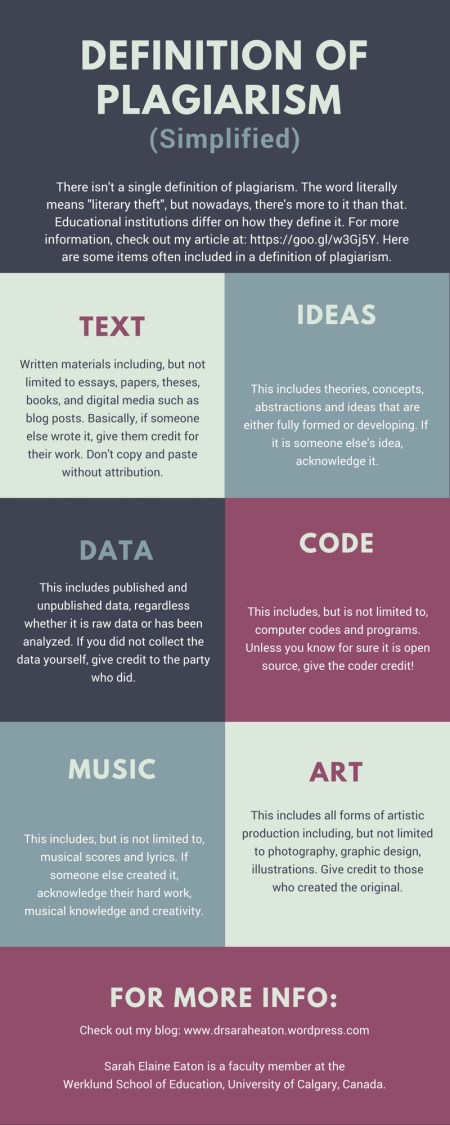
It used to be that the definition of plagiarism was simple: literary theft, but it is a lot more complicated than that in the 21st century, where digital outputs account for as much, if not more than, printed products. Students and professors have asked me, “So, how do you define plagiarism in plain and simple terms?” The answer is actually quite complex and a bit messy. But in the interest of demystifying the issue, here is a straight forward infographic that may help.

Let me say that this resource is simplified — perhaps overly so. My goal here isn’t to be reductionist and I fully acknowledge that not everyone may agree with these simplified explanations. But sometimes it can be easier to wrap your head around something simple to start and then tease out the complexities once you are more comfortable with the basic concepts.  I offer these not as the be-all-and-end-all definition, but rather as a starting point to help educators and students clarify and demystify basic concepts and also to engage in productive conversations about how to cultivate academic integrity and reduce plagiarism.

Definition of plagiarism (jpg)

Here is a free, downloadable .pdf of this infographic that you are welcome to use with your students for teaching purposes. Feel free to use it as a conversation starter to help students understand what plagiarism is and how to prevent it in their own work.

Related post:

Comparative Analysis of Institutional Policy Definitions of Plagiarism: A Pan-Canadian University Study https://wp.me/pNAh3-1LD

______________________________________________________

Share or Tweet this: 21st century definition of plagiarism https://wp.me/pNAh3-2eo

This blog has had over 1.8 million views thanks to readers like you. If you enjoyed this post, please “like” it or share it on social media. Thanks!

Sarah Elaine Eaton is a faculty member in the Werklund School of Education, University of Calgary, Canada.


New article: “Credit where credit is due”

December 19, 2017

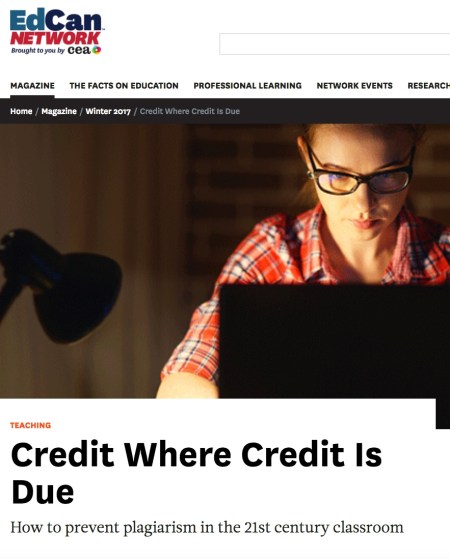
Credit where credit is due - coverIn my latest article, “Credit where credit is due: How to prevent plagiarism in the 21st century classroom” I tackle the tricky question of what it means to plagiarize in the age of copy-and-paste. I also offer K-12 teachers five practical tips on how to prevent plagiarism among school-age children.

Most of my research and writing is focusing more and more on academic integrity and plagiarism prevention in higher education contexts. But it is important for K-12 teachers to be able to talk about these topics to their students, too. That’s what inspired me to write this article.

The full article was published by the EdCan Network and it is a web exclusive in their most recent edition. You can check it out here: https://www.edcan.ca/articles/credit-where-credit-is-due/

______________________________________________________

Share or Tweet this: New article: “Credit where credit is due”

This blog has had over 1.8 million views thanks to readers like you. If you enjoyed this post, please “like” it or share it on social media. Thanks!

Sarah Elaine Eaton is a faculty member in the Werklund School of Education, University of Calgary, Canada.


Understanding academic misconduct: Special event

November 21, 2017

University of Calgary logoIn my role as Interim Associate Dean, Teaching and Learning for the Werklund School of Education at the University of Calgary, I am pleased announce we will welcome Dr. Julia Christensen Hughes to our campus for a special visit on November 24, 2017.

We have two events that are open to the public that I wanted to share with all of you:

Lunchtime Keynote: Understanding academic misconduct: Creating robust cultures of integrity

Time: 12:00 pm – 1:00 pm

Location: University of Calgary, Taylor Institute Forum

This keynote will draw from Christensen Hughes’s research with the late Don McCabe, founder of the International Center for Academic Integrity. Their work was published in 2006 the Canadian Journal of Higher Education (see http://journals.sfu.ca/cjhe/index.php/cjhe/article/view/183537 and http://journals.sfu.ca/cjhe/index.php/cjhe/article/view/183525), and they were awarded with the Sheffield Award from the Canadian Society for Studies in Higher Education (CSSHE) for their contribution.

Afternoon workshop: Strengthening a culture of integrity at the University of Calgary

Time: 3:00 pm – 4:00 pm

Location: University of Calgary, Taylor Institute Forum

This workshop will provide a deeper analysis of why academic misconduct is happening on Canadian university campuses, including from the perspectives of faculty and TAs. Working in groups, participants will discuss their experience at the University of Calgary and generate specific suggestions for what the University might do to strengthen its culture of integrity.

About Dr. Julia Christensen Hughes

jch-colour-photoDr. Julia Christensen Hughes is Dean of the College of Business and Economics (CBE) at the University of Guelph. With a career defined by advocacy, Julia has addressed the United Nations General Assembly on the need for business schools to contribute to advancing the UN’s sustainable development goals, including quality education. Previously, Julia served as President of the Society for Teaching and Learning in Higher Education, a predominantly Canadian organization committed to enhancing the quality of teaching and learning in post-secondary institutions. During this same time, she served as the Director of Teaching Support Services at the University of Guelph.
Julia Christensen Hughes’s scholarly work includes the edited book, Taking Stock: Research on Teaching and Learning in Higher Education (2010), McGill-Queen’s University Press. She has also written on ethics and integrity in the academy, with papers published in the Canadian Journal of Higher Education. Julia has received a number of awards and recognitions, including the Gold “educator” award from the Ontario Hostelry Institute (OHI); the Sheffield Award from the Canadian Society for the Study of Higher Education, for excellence in research; the University of Guelph’s John Bell Award, for distinguished educational leadership; and the “Woman of Distinction Award” from the Guelph YMCA, for outstanding contributions to education and training.

These events are open to all members of the campus community and the public.

______________________________________________________

Share or Tweet this: Understanding academic misconduct: Special event https://wp.me/pNAh3-22q

This blog has had over 1.8 million views thanks to readers like you. If you enjoyed this post, please “like” it or share it on social media. Thanks!

Sarah Elaine Eaton is a faculty member in the Werklund School of Education, University of Calgary, Canada.


Universities unite against the academic black market

October 17, 2017

The ConversationOn the TV show Suits, Mike Ross’s character charges a hefty fee to students to take the LSAT (law school admission test) for them. Ross has a stellar memory and a remarkable ability to take tests without getting crushed by stress — he is the perfect “contract cheater.” Later, Ross builds a career as a lawyer based on fake credentials, presumably from Harvard.

Mike Ross may be fictional, but his business is only too real within universities globally. “Contract cheaters” such as Ross complete academic work on a student’s behalf — for a fee. This work includes test taking and homework services. It includes essay-writing and even PhD thesis-writing services, also known as “paper mills.”

In my role as interim associate dean of teaching and learning at the University of Calgary, and as a researcher who specializes in plagiarism prevention and academic integrity, I have been writing about contract cheating since 2010. Since then, it has become rampant at high school and post-secondary levels.

This black market for academic work is vast and little understood. Universities in Canada, and around the world, are having a very hard time trying to police it.

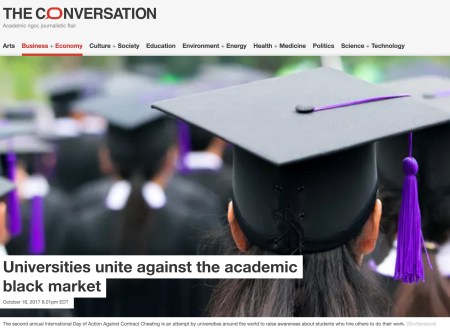
On Oct. 18, 2017, many universities have committed to the second International Day of Action Against Contract Cheating. This aims to tackle the issue head on — by raising awareness and sharing prevention strategies.

Read the whole article in The Conversation (originally published on Oct. 16, 2017).

Check out the radio interview I did on CBC: http://www.cbc.ca/listen/shows/calgary-eyeopener/segment/14438512

Related posts:

______________________________________________________

Share or Tweet this: Universities unite against the academic black market  http://wp.me/pNAh3-1YN

This blog has had over 1.8 million views thanks to readers like you. If you enjoyed this post, please “like” it or share it on social media. Thanks!

Sarah Elaine Eaton is a faculty member in the Werklund School of Education, University of Calgary, Canada.