5 Signs your child is a cyberbully

April 1, 2013

Sarah Eaton's education blogParents, educators and even children are aware that bullying is moving out of the playground and into virtual spaces. According to the American Humane Association, 15% to 20% of children bully others online.

In a previous post I talked about signs to help you figure out if your child is being cyberbullied. But what if your child is the cyberbully?

Here are 5 key indicators that your child is harassing others online:
  1. Is secretive about online activities. The cyberbully does not want to be discovered by parents, grandparents, teachers or others who may hold them accountable.
  2. Quickly switches computer screens or closes the screen when you enter the room or walk by. This is a tactic often used by people who do not want others to discover what they have been doing online. Watch for indicators that your child works to quickly minimize an online browser, close a web page or change screens within a second or two of you approaching the computer they are using. This is a sign that your child does not want you to know what they have been doing online.
  3. Uses the computer or mobile devices late at night or when he or she is unsupervised. Inappropriate online behavior is more likely to occur when the bully feels that no one is watching or supervising their actions. They feel less accountable for their online activity when left alone to misbehave.
  4. Gets extremely upset if computer privileges are revoked. While almost any child in today’s world may get upset if their technology privileges are taken away, the cyberbully may become particularly sulky, defensive or angry. The virtual space is where they feel all-powerful and free of consequences, so when that privilege is revoked, they may feel completely disempowered or oppressed.
  5. Uses multiple online accounts or accounts with a fake name. The cyberbully is likely to take the time to create multiple online accounts using public e-mail systems such as Hotmail, Google or Yahoo, since they feel these are less easily traceable. The cyberbully will often lack the courage to represent themselves online in an authentic and transparent manner.

Cyberbullies often feel like victims themselves. In my next post I’ll talk about characteristics of cyberbullies and how harassing others online may be just one sign of deeper mental or emotional illness.

____________________

Related post: How to tell if your child is being cyber-bullied http://wp.me/pNAh3-1w4

____________________

References

Amercian Humane Association. (n.d.). Cyber Bullying Prevention and Intervention.   Retrieved November 19, 2012, from http://www.americanhumane.org/children/stop-child-abuse/fact-sheets/cyber-bullying-prevention-and-intervention.html

Hinduja, S., & Patchin, J. W. (n.d.). Cyberbulling: Indentification, prevention and response. Retrieved from http://www.cyberbullying.us/Cyberbullying_Identification_Prevention_Response_Fact_Sheet.pdf

PureSight Online Child Saftey (Author). (n.d.). What should I do if my child is a cyberbully?   Retrieved November 19, 2012, from http://www.puresight.com/Cyberbullying/what-should-i-do-if-my-child-is-a-cyber-bully.html

StopBullying.gov. (n.d.). Warning signs.   Retrieved 2012, 2012, from http://www.stopbullying.gov/at-risk/warning-signs/index.html#bullying

_______________________

If you enjoyed this post, please “like” it or leave a comment. Thanks!

Share or Tweet this: 5 Signs your child is a cyberbully http://wp.me/pNAh3-1AM

Update – January 2018 – This blog has had over 1.8 million views thanks to readers like you. If you enjoyed this post, please “like” it or share it on social media. Thanks!

Sarah Elaine Eaton is a faculty member in the Werklund School of Education, University of Calgary, Canada.


10 Tips to Help Your Child Learn to Love Reading

March 22, 2013

iStock-Girl with bookHelping a child to develop his or her love of reading is a gift that will last a lifetime. Here are 10 tips to help you cultivate your child’s love of books and reading.

1. Read together – Rather than plunking your child down in a chair with the hopes that he or she will read on their own while you do other tasks, take the time to read with your child. From start to finish, show your child what it means to choose and read a book and then think about it afterwards.

2. Create special time for reading – Set aside time regularly to read. Make this one-on-one time with your child. Choose a time of day when both you and your child are alert and ready to spend quality time together. During this time, turn off and put away your mobile device. Avoid taking phone calls, responding to e-mails or sending texts during your special reading time. Give your child your full attention and focus on creating a fun and enjoyable experience.

3. Get comfy – Chose a spot that is comfortable with lots of light. Preferably, you want to read in a space that is free of loud or distracting noises, too.

4. Let your child chose the book – Chances are higher that your child will be motivated to read with you if you let him or her pick out the book you will read. If you choose the book, your child’s interest levels may be too low to fully engage him or her.

5. Take turns – You do not have to do all the reading and neither does your child. Take turns and share the reading experience.

6. Change your voice – Change the speed, pitch and tone of your voice to keep the experience exciting for your child. Create different voices for different characters to engage your child’s imagination.

7. Give encouragement – Give your child lots of praise and support as he or she learns to read. Be gentle, kind and encouraging. This helps to create a positive atmosphere where learning and discovery go hand in hand.

8. Offer incentives – For reluctant young readers, incentives can help motivate him or her. For example, one incentive might be that for every book you read together, your child can stay up for an extra 15 minutes that night… but you have to get through the whole book! Choose incentives that don’t involve food, TV or video games to help encourage a healthy lifestyle. Keep the rewards modest and then keep your promise.

9. Ask questions as you read – Ask your child to point to characters in the book or identify items that are a certain color. When your child is ready, ask about letters and words, too.

10. Keep the fun going – After you have finished your book, ask your child about his or her favorite parts of the story or favorite characters. Ask questions that help him or her remember the story. Practice new words together, too.

_______________________

If you enjoyed this post, please “like” it or leave a comment. Thanks!

Share or Tweet this: 10 Tips to Help Your Child Learn to Love Reading http://wp.me/pNAh3-1AC

Update – January 2018 – This blog has had over 1.8 million views thanks to readers like you. If you enjoyed this post, please “like” it or share it on social media. Thanks!

Sarah Elaine Eaton is a faculty member in the Werklund School of Education, University of Calgary, Canada.


What Happened to the “Public” in Public Education?

March 12, 2013

Today I received an e-mail about this event. Since it is a public event and they have asked folks to help them get the word out, I am sharing it with you:

Invitation to Participate

Public Education Focus Groups – What Happened to the “Public” in Public Education?

The Sheldon Chumir Foundation for Ethics in Leadership invites you to contribute to our research on the state of public education in Alberta.

The Foundation is conducting focus groups in Alberta cities and towns to gather information about the opinions, experiences and values of Albertans regarding public education as a public institution in the province. Discussion topics will include the purpose of public education and the type of community and democracy public education should encourage.

The Foundation is holding a focus group in Calgary on March 19, 2013 from 5:00-7:00 pm. Participants will receive a $20 honorarium and dinner will be served.

They welcome input from all Albertans, with and without connections to the public education system.

Please pass this invitation along to any friends or family you think may be interested in participating in a focus group about public education.

To attend this focus group, please RSVP to Jasmine Ing at

jing @ chumir.ca or 403-244-6666 by March 15, 2013.

When you RSVP, please include your name, phone number, and city or town.

The Sheldon Chumir Foundation for Ethics in Leadership is a non-profit organization based in Calgary which conducts activities across Canada.

———–

I am not personally involved in this event or the Foundation, but I do think it sounds like a pretty interesting conversation to be part of.

____________________________

If you enjoyed this post, please “like” it or leave a comment. Thanks!

Share or Tweet this: What Happened to the “Public” in Public Education? http://wp.me/pNAh3-1zK

Update – January 2018 – This blog has had over 1.8 million views thanks to readers like you. If you enjoyed this post, please “like” it or share it on social media. Thanks!

Sarah Elaine Eaton is a faculty member in the Werklund School of Education, University of Calgary, Canada.


How Community Conversations Create Powerful Possibilities

February 23, 2013

The other night we held a “community conversation” as part of our “Creating Space for Strength” project. Together with my two colleagues, Lee Tunstall and Vilma Dawson, the three of us were thrilled to facilitate the evening for this amazing group of Calgarians.

Representatives from Calgary’s North Central Communities

Over 40 people attended the event, including local elected representatives, Hon. Teresa Woo-Paw, MLA for Calgary Northern Hills and Calgary Alderman, Jim Stevenson.

Creating Space for Strength - Panorama shot

Citizens from a number of Calgary communities attended:

  • Harvest Hills
  • Panorama Hills
  • Coventry Hills
  • Country Hills
  • Hidden Valley
  • MacEwan Glen
  • Sandstone Valley

World Café format

We used a “world café” style of conversation. We started off by explaining that the purpose of the meeting was to find out what mattered to community residents. Then, to take the first steps towards envisioning what the community could look like in the not-too-distant future.

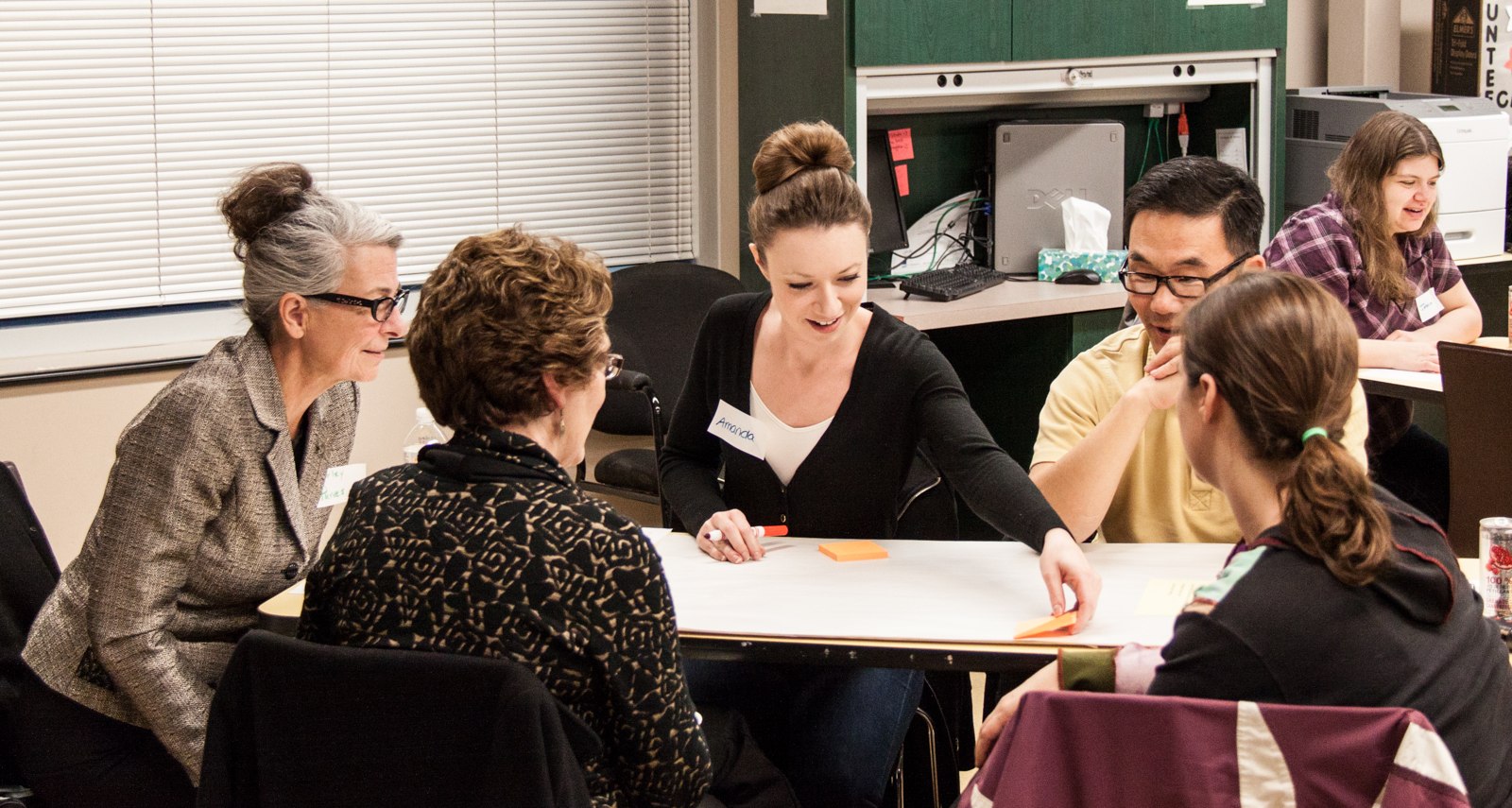
People worked in groups of 5 or 6 at small tables, using key questions to guide their conversations. We asked them to jot down their key ideas and points on sticky notes. Later, volunteers collected the sticky notes from all the tables and grouped them into common themes.

We asked four key questions, framed in asset-based community development (ABCD) way:

  • What is good and strong about our community?
  • What could be better?
  • What would you like to see the community achieve in the next 5 years?
  • How do we get there?

Creating space for Strength - community conversation 1

Community-driven

Even though a team of 3 of us consultants facilitated the evening, the whole event was planned, organized and promoted mostly by Northern Hills Community Association.

This picture shows two volunteers from the community association grouping the sticky notes from each question into themes.Creating Space for Strength (Moraig and Paul)

The community association booked the space for the event (a meeting room in a local grocery store) and arranged for food and beverages. They ordered wraps, veggie and fruit trays, cheese and crackers and sweets.

They kept in mind that the population living in their communities is culturally diverse, so they were careful to pay attention to dietary restrictions such as having beef and pork products separated from other foods, and offering completely vegetarian options. The provided a variety of water, juice and soft drinks, too. There is something that brings people together over food and so this was an important element of our evening.

The community association also took the responsibility of buying all the supplies for the evening, including hundreds of sticky notes and enough markers so that everyone could have one to use.

Results

We have yet to formally analyze the data from the event, but informally I can say that by the end of the meeting, the room was buzzing with energy. Residents stayed for a long while after the event wrapped up. They wanted to talk more about their community and how to improve it.

A number of attendees took the initiative to exchange contact information and ask how they could get involved.

Overall, it was a great night that ended on an energetic and inspired note.

As always, we want to acknowledge the organizations that are making this work possible:

Project Origins – Northern Hills Constituency

Project Funders – Government of Alberta (CFEP Grant); United Way of Calgary and Area; Aspen Family and Community Network Society; Northern Hills Community Association

Project Supporters – Northern Hills Constituency; City of Calgary; Aspen Family and Community Network Society; Northern Hills Community Association; United Way of Calgary and Area

_________________

If you enjoyed this post, please “like” it or leave a comment. Thanks!

Share or Tweet this: How Community Conversations Create Powerful Possibilities http://wp.me/pNAh3-1z7

Update – January 2018 – This blog has had over 1.8 million views thanks to readers like you. If you enjoyed this post, please “like” it or share it on social media. Thanks!

Sarah Elaine Eaton is a faculty member in the Werklund School of Education, University of Calgary, Canada.


Community Conversation – Creating Space for Strength in Calgary’s North Central Communities

February 21, 2013

Creating space for strength in Calgary - Eaton International Consulting Inc.Tonight we are gearing up for a big event for our community development project. Here are the details:

Community Consultation – Creating Space for Strength: An Asset-Based Community Development (ABCD) and Research Project for Calgary’s North Central Communities

The purpose of this community assessment is to find out what our communities’ strengths and assets are, what can be improved, and how. Identifying current resources, as well as needs, is a key step toward maximizing the potential for building an effective, locally relevant, and evidence-based community action plan.

We are interested in hearing your voice. We want to know what you think is working well in your community, what can be strengthened and how we can achieve the goals we set as a community.

This is an open, public consultation. Everyone is welcome. We’ll e using a “world cafe” format for the conversations.

We gratefully acknowledge the support of the organizations who made this project possible:

Project Origins – Northern Hills Constituency

Project Funders – Government of Alberta (CFEP Grant); United Way of Calgary and Area; Aspen Family and Community Network Society; Northern Hills Community Association

Project Supporters – Northern Hills Constituency; City of Calgary; Aspen Family and Community Network Society; Northern Hills Community Association; United Way of Calgary and Area

Here’s a link to our Eventbrite site: http://creatingspacecommunityconsultation.eventbrite.com

_________________

If you enjoyed this post, please “like” it or leave a comment. Thanks!

Share or Tweet this: Community Conversation – Creating Space for Strength in Calgary’s North Central Communities http://wp.me/pNAh3-1yX

Update – January 2018 – This blog has had over 1.8 million views thanks to readers like you. If you enjoyed this post, please “like” it or share it on social media. Thanks!

Sarah Elaine Eaton is a faculty member in the Werklund School of Education, University of Calgary, Canada.