How Community Conversations Create Powerful Possibilities

February 23, 2013

The other night we held a “community conversation” as part of our “Creating Space for Strength” project. Together with my two colleagues, Lee Tunstall and Vilma Dawson, the three of us were thrilled to facilitate the evening for this amazing group of Calgarians.

Representatives from Calgary’s North Central Communities

Over 40 people attended the event, including local elected representatives, Hon. Teresa Woo-Paw, MLA for Calgary Northern Hills and Calgary Alderman, Jim Stevenson.

Creating Space for Strength - Panorama shot

Citizens from a number of Calgary communities attended:

  • Harvest Hills
  • Panorama Hills
  • Coventry Hills
  • Country Hills
  • Hidden Valley
  • MacEwan Glen
  • Sandstone Valley

World Café format

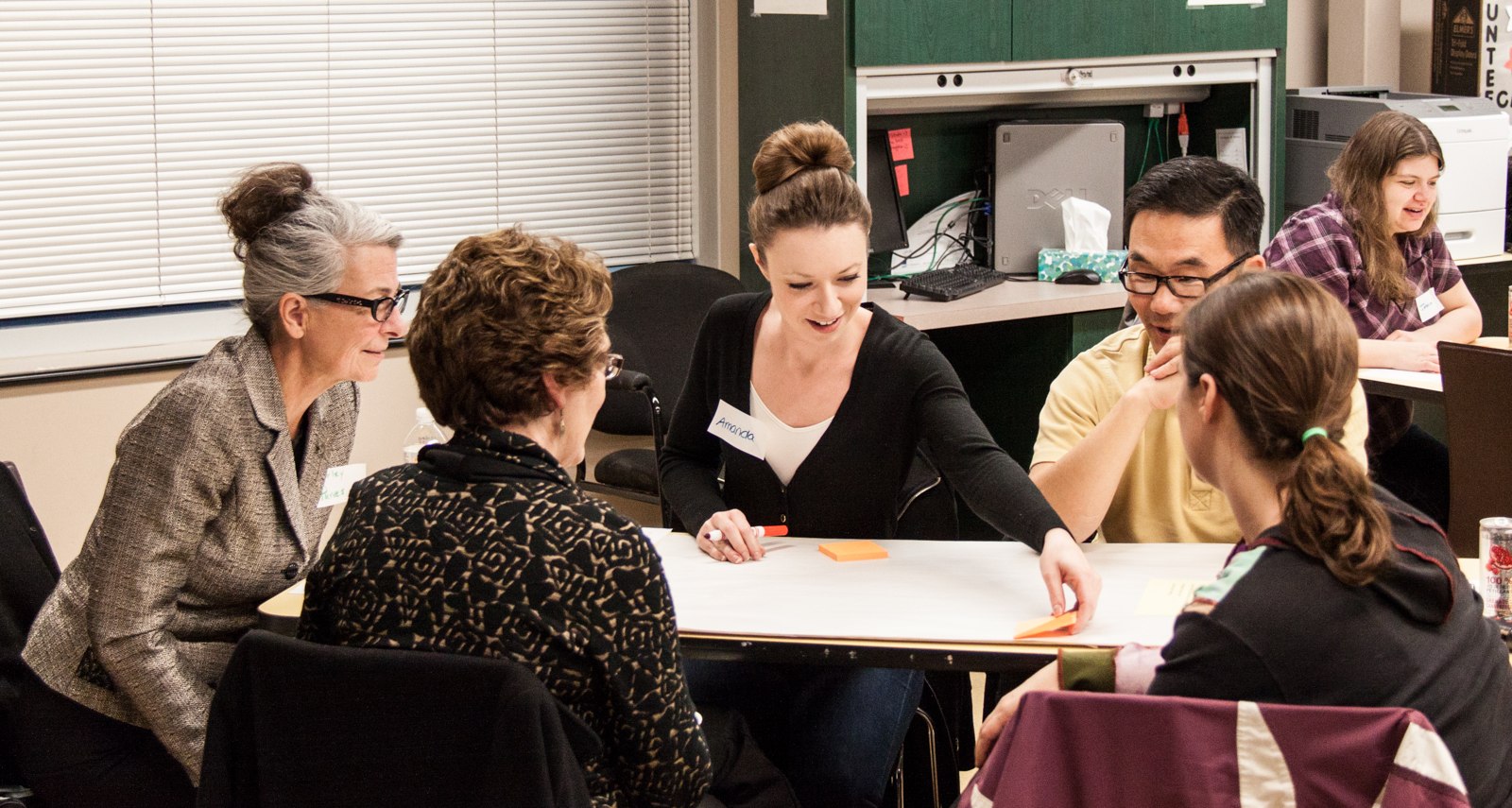
We used a “world café” style of conversation. We started off by explaining that the purpose of the meeting was to find out what mattered to community residents. Then, to take the first steps towards envisioning what the community could look like in the not-too-distant future.

People worked in groups of 5 or 6 at small tables, using key questions to guide their conversations. We asked them to jot down their key ideas and points on sticky notes. Later, volunteers collected the sticky notes from all the tables and grouped them into common themes.

We asked four key questions, framed in asset-based community development (ABCD) way:

  • What is good and strong about our community?
  • What could be better?
  • What would you like to see the community achieve in the next 5 years?
  • How do we get there?

Creating space for Strength - community conversation 1

Community-driven

Even though a team of 3 of us consultants facilitated the evening, the whole event was planned, organized and promoted mostly by Northern Hills Community Association.

This picture shows two volunteers from the community association grouping the sticky notes from each question into themes.Creating Space for Strength (Moraig and Paul)

The community association booked the space for the event (a meeting room in a local grocery store) and arranged for food and beverages. They ordered wraps, veggie and fruit trays, cheese and crackers and sweets.

They kept in mind that the population living in their communities is culturally diverse, so they were careful to pay attention to dietary restrictions such as having beef and pork products separated from other foods, and offering completely vegetarian options. The provided a variety of water, juice and soft drinks, too. There is something that brings people together over food and so this was an important element of our evening.

The community association also took the responsibility of buying all the supplies for the evening, including hundreds of sticky notes and enough markers so that everyone could have one to use.

Results

We have yet to formally analyze the data from the event, but informally I can say that by the end of the meeting, the room was buzzing with energy. Residents stayed for a long while after the event wrapped up. They wanted to talk more about their community and how to improve it.

A number of attendees took the initiative to exchange contact information and ask how they could get involved.

Overall, it was a great night that ended on an energetic and inspired note.

As always, we want to acknowledge the organizations that are making this work possible:

Project Origins – Northern Hills Constituency

Project Funders – Government of Alberta (CFEP Grant); United Way of Calgary and Area; Aspen Family and Community Network Society; Northern Hills Community Association

Project Supporters – Northern Hills Constituency; City of Calgary; Aspen Family and Community Network Society; Northern Hills Community Association; United Way of Calgary and Area

_________________

If you enjoyed this post, please “like” it or leave a comment. Thanks!

Share or Tweet this: How Community Conversations Create Powerful Possibilities http://wp.me/pNAh3-1z7

Update – January 2018 – This blog has had over 1.8 million views thanks to readers like you. If you enjoyed this post, please “like” it or share it on social media. Thanks!

Sarah Elaine Eaton is a faculty member in the Werklund School of Education, University of Calgary, Canada.


Spanish for Dentists: 6 Great (and Free!) Resources

February 13, 2013

Teeth - smile - smallI unexpectedly had to go to the dentist this week when a filling broke in half and part of it fell out. During my visit, my dentist was telling me about her plans to take her entire team to Guatemala next year to do some pro bono work in poor communities there.

She asked me if I had any resources on Spanish for dentists. I set off on a bit of a quest. Here are six wonderful, free online resources that I found to help English-speaking dentists and dental hygienists learn the basics so they can communicate with Spanish-speaking patients:

  1. English to Spanish Phrase Guide for Dentists – http://www.deltadentalins.com/dentists/guidance/english-spanish-phrase-guide.html
  2. PracticingSpanish.Com – Spanish for Dentists – http://www.practicingspanish.com/dental-exam.html
  3. Spanish for the Dental Office  – https://www.aetnadental.com/AD/ihtAD/r.WSIHW000/st.35410/t.706081.html
  4.  Spanish Words and Phrases for Dentists – http://www.artofteeth.com/files/Spanish_for_Dentists.pdf
  5. Spanish Guide of Dental Terminology – http://lrc.wfu.edu/community_interpreting/extras/editeddental.pdf
  6. English-Spanish Dictionary of Health Related Terms – http://www.cdpr.ca.gov/docs/dept/spanish/engspdict.pdf

_________________

Share or Tweet this: Spanish for Dentists: 6 Great (and Free!) Resources http://wp.me/pNAh3-1yE

Update – January 2018 – This blog has had over 1.8 million views thanks to readers like you. If you enjoyed this post, please “like” it or share it on social media. Thanks!

Sarah Elaine Eaton is a faculty member in the Werklund School of Education, University of Calgary, Canada.


Blogging workshop for ESL Teachers

January 7, 2013

iStock-woman at laptopI am super excited about an upcoming workshop I am doing. I get to combine two of my favorite passions: working with language teachers and blogging. Here’s our tentative agenda:

Introduction

  • What is a blog?
  • Why do we blog?

Getting Ready to Blog

  • Tips for creating excellent blog posts
  • Using multimedia in your blog
  • Blogging for and with students

Write on! Hands-on blogging

  • Setting up your blog
  • Writing your first blog post
  • Adding categories, tags and excerpts
  • Creating visual interest with photos

What do you think? Have I missed anything? What words of wisdom would you have for teachers who are learning how to blog for the first time? I’d love to hear your comments and thoughts.

_________________

If you enjoyed this post, please “like” it or leave a comment. Thanks!

Share or Tweet this: Blogging workshop for ESL Teachers http://wp.me/pNAh3-1yl

Update – January 2018 – This blog has had over 1.8 million views thanks to readers like you. If you enjoyed this post, please “like” it or share it on social media. Thanks!

Sarah Elaine Eaton is a faculty member in the Werklund School of Education, University of Calgary, Canada.


Easy 3-step process to evaluate a volunteer board

January 4, 2013

Business - Group - team hands

In April of 2012 I became president of our condo board, where I had served as a director for about 5 years. We had some returning board members, some new members and we had also recent changed to a new management company.

One of the issues we had with the previous condominium management company was that projects were either not completed or they took a very long time to get done. This new company seems to get tasks completed more quickly, but nevertheless, there was growing discontent that “nothing is happening” or “things are not moving fast enough”.

Using an asset-based approach to community development (ABCD), I conducted a brief appreciative assessment and presented it to the board as a report at our last meeting. They were able to see how far we had come in a few short months. One board member said that it should be sent out to all the residents as a newsletter. I am in the process of preparing that now. The technique was so simple and successful, I wanted to share it with you.

If you work with a volunteer group who is feeling, here are the steps to prepare your own ABCD evaluation of your work:

Step 1: Take an inventory of what your group has achieved

Review old meeting agendas and minutes. Review your e-mail history. Think of yourself panning for gold. Let’s face it, community work is muddy at best. Finding the little nuggets tucked into all the mud takes a bit of time and patience, but it is worth it.

As you find a significant task that has been completed add it to your list. I didn’t minor items such as light bulbs being replaced. Instead, I focused on more significant projects or tasks that we would be proud to tell our owners that we had achieved.

Step 2: Categorize your group’s achievements

For our condo board, I used these categories:

  • Policy and governance achievements
  • Major projects completed
  • Major projects initiated
  • Repairs completed
  • Additional achievements

Step 3: Organize your achievements under each category heading

I used numbered lists. The minimum I had in any category was four. The most I had was nine.

In total, we had 23 noteworthy achievements in a six-month period. Pretty impressive for a group of six volunteers, don’t you think?

When we work with condo boards, volunteer or community groups the feeling that goals are not being accomplished fast enough is more common than many of us would like to admit.

Taking an inventory of recent achievements helps you to stay accountable to those you serve. It also helps volunteers see how their contributions make a difference. Even when progress is slow, it still counts. Sometimes, it is not as slow as our perceptions might have us believe.

This type of strength-based evaluation works well with a disgruntled group who fails to recognize how far they have come in a short period of time. It is easy to focus on needs, gaps and challenges. An asset-based approaches seeks first to identify what is working well and use that as as starting point to build on. Don’t get me wrong. We still have a very long “to do” list and we have some problems that we need to solve. Sometimes, when you stop focusing obsessively on the problems and take an inventory of what is going right (as opposed to everything that is wrong), motivation levels increase, focus is renewed and people begin to enjoy their volunteer service again. That is all the more reason to take a step back and assess what we have actually done to meet the goals we set and make our community better.

This technique would work well for a team of staff, volunteers or any group who comes together to work towards a common goal.

_________________

If you enjoyed this post, please “like” it or leave a comment. Thanks!

Share or Tweet this: Easy 3-step process to evaluate a volunteer board http://wp.me/pNAh3-1ye

Update – January 2018 – This blog has had over 1.8 million views thanks to readers like you. If you enjoyed this post, please “like” it or share it on social media. Thanks!

Sarah Elaine Eaton is a faculty member in the Werklund School of Education, University of Calgary, Canada.


5 Great resources on asset-based community development (ABCD)

December 17, 2012

Creating space for strength in Calgary - Eaton International Consulting Inc.I have been working with two other consultants on a project called “Creating Space for Strength: An Asset-Based Community Development (ABCD) and Research Project Focussed on Calgary’s North Central Communities”. Our approach to the work is strength-based, using the ABCD model. We are working with some amazing people and organizations who are deeply committed to making to the lives of the people who live in their communities better.

As part of our work, we are helping them to build their understanding and capacity around the ABCD approach. Here are 5 of our favorite resources on asset-based community development:

  1. Coady Institute. (n.d.). An asset-based approach to community development: A manual for village organizers Available from http://coady.stfx.ca/tinroom/assets/file/resources/abcd/SEWA%20ABCD%20Manual.pdf
  2. Kretzmann, J. P., & McKnight, J. L. (1993). Building Communities from the Inside Out: A Path Toward Finding and Mobilizing a Community’s Assets. Skokie, IL: ACTA Publications.
  3. Kretzmann, J. P., McKnight, J. L., Dobrowolski, S., & Puntenney, D. (2005). Discovering Community Power: A Guide to Mobilizing Local Assets and Your Organization’s Capacity. from the Asset-Based Community Development Institute, School of Education and Social Policy, Northwestern University: http://www.abcdinstitute.org/docs/kelloggabcd.pdf
  4. Nelson, B., Campbell, J., & Emanuel, J. (2011). Development of a method for asset based working Available from http://www.nwph.net/phnw/writedir/da0dNW%20JSAA.pdf
  5. Miller, S. (n.d.). Asset-based community development.   Retrieved October 15, 2012, from http://www.slideshare.net/sadierynmiller/asset-based-community-development

We gratefully acknowledge the organizations who have made this project possible:

  • Project Origins – NorthernHills Constituency
  • Project Funders – Government of Alberta (CFEP Grant); United Way of Calgary and Area; Aspen Family and Community Network Society; NorthernHills Community Association
  • Project Supporters – NorthernHills Constituency; City of Calgary; Aspen Family and Community Network Society; NorthernHills Community Association; United Way of Calgary and Area

Related post: Webinar recording: Creating Space for Strength http://wp.me/pNAh3-1wI

_________________

Share or Tweet this: 5 Great resources on asset-based community development (ABCD) http://wp.me/pNAh3-1xJ

Update – January 2018 – This blog has had over 1.8 million views thanks to readers like you. If you enjoyed this post, please “like” it or share it on social media. Thanks!

Sarah Elaine Eaton is a faculty member in the Werklund School of Education, University of Calgary, Canada.