What makes a good research question?

November 6, 2012

This week I posed a question to my students: What makes a good research question?

As Masters of Education students, they are learning about what it means to be a researcher and building a foundation of knowledge. They came up with some great resources this week. If you are looking for answers to this question, check out these great resources:

Sarah Eaton blog leadershipSonia Ospina’s entry in the Encyclopedia of Leadership on Qualitative Research

This is a 13-page document, available free in .pdf format. Published in 2004, this text shares some of the fundamentals of qualitative research, particularly as it pertains to leadership. It is also very useful for students and researchers working in education and other social sciences. It contains an extensive bibliography that serves as a great point of departure for more exploration. Link for this resource: http://ualr.edu/interdisciplinary/files/2010/03/Qualitative_Research.pdf

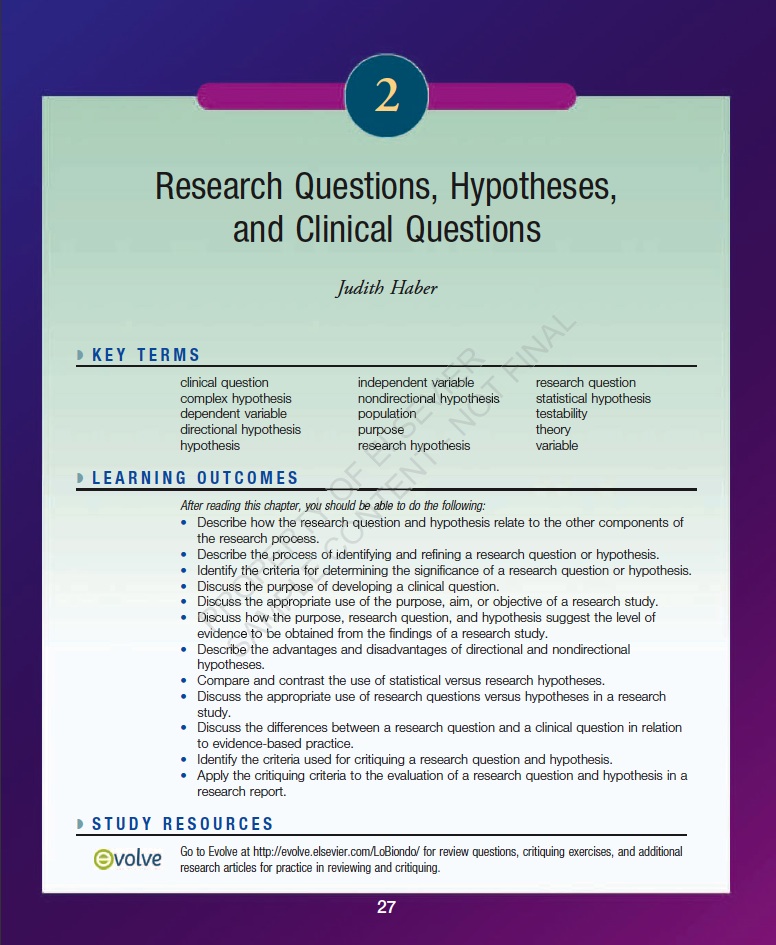
Sarah Eaton blogJudith Haber’s chapter called “Research Questions, Hypotheses and Clinical Questions”

Though marked as “Sample – Not final” with a watermark on the .pdf, this is an incredible 29-page resource that includes flow charts and tables of information. It is easy to understand and written in language that most novice researchers could understand. This one quickly became a favorite because it was colorful and concise. Even though it appears to be written for students and practitioners of health research, there are many elements that may be useful to educators and social science researchers, too. Link for this resource: http://www.us.elsevierhealth.com/media/us/samplechapters/9780323057431/Chapter%2002.pdf

Companion for Undergraduate Research

This is a website (http://www.socscidiss.bham.ac.uk/) that outlines the characteristics of a good research question. Then it talks about each characteristic in detail. It is written in clear language and is very well organized. The page also contains links to other helpful resources on research.

Figuring out how to craft a research question can be tricky. Resources like these help to demystify the process.

______________

Share or Tweet this: What makes a good research question? http://wp.me/pNAh3-1vL

Update – January 2018 – This blog has had over 1.8 million views thanks to readers like you. If you enjoyed this post, please “like” it or share it on social media. Thanks!

Sarah Elaine Eaton is a faculty member in the Werklund School of Education, University of Calgary, Canada.


Is your research biased? Answer: Yes. (Here’s why.)

October 29, 2012

Sarah Eaton blog technology researchThis semester I am teaching a course on Research Methodology in Education. One of the topics that has come up is bias.

Bias is present is bascially every research study. Even though we strive to be objective — and that is part of our work, we nevertheless start with a set of values, beliefs and philosophies that shape our opinions and world view.  It is important for reasearchers to understand the biases they bring to their work and to acknowledge them.

For example, one of my biases is that I hold is that everyone is capable of learning. Not everyone is capable of earning a Ph.D. (for any number of reasons), but everyone is capable of learning something. This is one of my values and beliefs that shapes my work. If I am an honest researcher, I must declare and acknowlege that bias when I do research. It is one thing to have and acknowledge bias. It is an entirely different matter to purposely bias our research in favor of a particular outcome or do research just to prove a point.

There are two ways to approach research:

Approach #1 – Conduct research in a manner that supports your argument

The first is to start with an argument or a position and conduct research and find literature that supports your point of view.

Though some scholars might disagree, I would submit that is an undesirable starting position. The reason is that you are likely to skew either your research or your results so they fit with your argument. Forcing results to fit to a pre-determined argument may be considered unethical. For example, pharmaceutical companies that conduct drug tests in order to prove the drug is safe and refuse to release research that may contradict that starting point are harshly criticized. Such research is not considered believable because it is skewed.

Approach #2 – Start with a research question, hypothesis or topic. Conduct your research in a manner that seeks to answer a question.

The second way to approach you research is to begin with a problem you want to solve or a question you want to answer. Then, you conduct your research in a manner that seeks to answer your research question. Once you have conducted your research, your argument emerges from your data.

The data is the information that you gather that allows you develop a cogent argument to persuade others. You can gather primary data (e.g. interviews) or secondary data (e.g. literature review).

Part of a research study almost always involves a review of previous literature written on the topic you are studying. In your literature review, it is valuable to cite opposing views. Once you have considered your question or problem from a variety of angles, then you can begin to develop an argument, based on your findings. Considering a variety of viewpoints is highly desirable as it demonstrates that you are not attempting to skew your results in favor of a pre-determined outcome.

Be aware that just because you start your research with a particular question or topic, it is unwise to assume that your starting position is the correct one. Be curious, rather than dogmatic. What themes emerge from the literature that you surveyed? What surprised you? What arguments can be made? What conclusions can be drawn?

In my own research, it has happened to me that I start with a research question, problem or hypothesis and as I surveyed the literature, my hypothesis was proven to be incorrect. Be prepared for that to happen. It does not mean you are a bad researcher. Quite the contrary, it means you have allowed your hypothesis or question to be challenged and your research is driven by the data you find.

We may come to our work with a bias. But ultimately, the research needs to speak for itself. That’s what makes it credible.

______________

Share or Tweet this: Is your research biased? Answer: Yes. (Here’s why.) http://wp.me/pNAh3-1vw

Update – January 2018 – This blog has had over 1.8 million views thanks to readers like you. If you enjoyed this post, please “like” it or share it on social media. Thanks!

Sarah Elaine Eaton is a faculty member in the Werklund School of Education, University of Calgary, Canada.


German sign language – Resources and tips

August 29, 2012

Did you know that not all countries in the world share a universal sign language? Today’s post is in honour of my friend, Meike Thomesen, who is the Assistant Principal at Bowcroft Elementary, Calgary’s only German bilingual school. Meike just came back from an intensive training program for in-service German teachers. The course was held in Germany. Part of their training involved PD to teach the German language to children by complementing the spoken language with sign language. What a super idea!

If you teach German, here are some resources to help you learn about German sign language:

DGS Korpus – A corpus of German sign language texts. This is a long-term project of the Academy of Sciences in Hamburg for documenting and researching the German Sign Language (DGS).

Basic German sign language – You Tube video with English sub-titles

German Sign Language Numbers – YouTube video

AlphaDictionary – A very cool, multilingual sign language resource site

__________________

Share or Tweet this post:  German sign language – Resources and tips http://wp.me/pNAh3-1uf

Update – January 2018 – This blog has had over 1.8 million views thanks to readers like you. If you enjoyed this post, please “like” it or share it on social media. Thanks!

Sarah Elaine Eaton is a faculty member in the Werklund School of Education, University of Calgary, Canada.


12 Tips to incorporate blogging into your classes

August 2, 2012

In a recent Master’s of Education course I taught at the University of Calgary, blogging was a required assignment for the students. The program coordinator (my boss) urged me to have the students blog as part of their course. She let me know that the students were enrolled in a graduate certificate program and that the course I was teaching was the first course of their certificate. She said that the certificate had been set up so that students would blog throughout their entire learning experience, as part of every course in their certificate.

The course I taught was on incorporating technology into educational practice. As an avid blogger myself, I was excited by the prospect of incorporating blogging into my teaching practice.

Most of the students were teachers themselves and some of them were technology leaders in their schools, but only one had her own blog.

After having incorporated “blogging for learning” into my teaching practice, here is what I learned:

1. Recommend a blogging service.

We (meaning the course coordinator and I) did not restrict what blogging service the students chose, but we recommended a few (including WordPress and Blogger). We recommended free sites and suggested that students not pay to register their own domain (at least, not to start).

 2. Show students the nuts and bolts of how to set up a blog.

I spent approximately 30 minutes in one class, showing students the “behind the scenes” of my own WordPress blog. Using an LCD projector, hooked up to a computer with an Internet connection, I took my students on a virtual tour of my own WordPress dashboard. I showed them how to choose a theme, write a post and then publish that post. They appreciated the demo and it gave them confidence to get started.

3. Give them time to set up their blog.

One student reported that it took her two hours to set up her blog. This included familiarizing herself with the dashboard, selecting a theme and figuring out how to post. Even for those who are into technology, setting up your first blog can seem overwhelming until you get the hang of it. The students needed dedicated time to figure out the practicalities of their blog.Sarah Elaine Eaton, speaker, presenter, keynote, technology, social media, Calgary, Canada, educator, education, professional development

 4. Link the blogs to the course content.

Emphasize that the topics that students post on need to relate to the cours content. Topics covered in class or questions raised during class were some suggestions. At times, I would encourage students to think about their blog by saying in class, “That is good fodder for a blog post.” This helped them to think about what a learning blog is and what topics make for good blog posts.

5. Assign a certain number of postings.

In our course, students had to publish a minimum of four posts throughout their course. Their instructions included “keeping up-to-date with postings throughout the course”. About half of the students were able to do this. The other half waited until the end of the course and then published three or four postings at once. Many students admitted to having their blogs in draft form, but did not feel ready to publish them.

6. Assign a minimum number of words for each post.

In our course, students’ blog posts had to be a minimum of 200 words. This meant that writing was part of the assignment. It was not enough to post a graphic or a video without a reflective response.

7. Encourage multimedia.

In addition to the 200 words, I encouraged students to post videos, graphics, Wordles and other multimedia to their blogs. Since our course was about incorporating technology into inquiry-based learning, this was appropriate. Some students were able to incorporate media quite easily, but others struggled with this.

8. Encourage students to include a blogroll.

Students were expected to read and comment on each other’s posts. To help them with this, we had each student post their blog address in our online class Blackboard site. I encouraged each student to include a blog roll on their own blogs, so they could easily access each other’s blogs. Not all the students figured out how to do this, but most of them were able to set up a blog roll. This helped them to keep track of each other’s blogs more easily.

9. Include commenting and interactivity as part of the assignment.

Part of the learning task included students commenting on their classmates’ blog posts at least twice. These comments counted as part of their grade for the assignment. Students were asked to post thoughtful and reflective comments that went beyond “Good post!” or “I liked this”. This proved to be problematic at the beginning, as some students had difficulty figuring out how to approve comments. Until they did, their peers’ comments did not show up on their blogs. Once the students figured out how to approve each other’s comments, this went much more smoothly.

10. Talk about blogging in class.

Not only did I highlight topics or questions that would make good blog posts, we also talked about the process of blogging in class. One student was excited to announce that someone from another country had read her blog post and “liked” it, using the “like” button in WordPress. Until then, she had no idea that anyone outside our class might read her blog posts. Knowing that another educator, whom she did not know, read and liked her post gave her great inspiration to keep writing. Her story also inspired the other students to think about how blogging can help them connect with others on a broader scale.

11. Differentiate between a personal and professional / educational blog.

Not only did I provide written instructions on the course outline, I also supported the written instructions with an in-class demo and ongoing discussions in class about blogging and how to use blogging for learning or professional teaching purposes. A couple of students had trouble figuring out how blogging for class differed from personal blogging. We talked about how a personal blog might include more family photos, recipes or other personal information, while a professional learning blog would include topics more focussed on work and our professional lives.

12. Help students find their blogging voice.

I made it clear that since the students were also professionals and teachers, that their blog was an extension of their professional selves. Some students initially found this a bit diffiult and said that they did not know what tone of voice to use in their blog. We had a conversation about language register and how a learning blog was one step down from a formal research paper and probably one step up from very informal conversations. By the end of the course, most of the students had found a happy medium.

Overall, the process of working with these adult learners (who are also teachers) in helping them learn how to blog was both challenging and rewarding. In the beginning, I had assumed (incorrectly) that since they had high levels of technology literacy and many of them teach tech as part of their professional practice, that they would find it easy to blog. In reality, it took time for them to learn the nuts and bolts of how to blog, to learn what topics made for a good blog post and to learn how to find their voice as a blogger.

In the end, they did extremely well with their blogs and I have subscribed to all of them. I am excited to see how they progress with blogging in thier next course.

_____________________

Share or Tweet this post: 12 Tips to incorporate blogging into your classes http://wp.me/pNAh3-1t8

Update – January 2018 – This blog has had over 1.8 million views thanks to readers like you. If you enjoyed this post, please “like” it or share it on social media. Thanks!

Sarah Elaine Eaton is a faculty member in the Werklund School of Education, University of Calgary, Canada.


5 free downloadable resources on effective E-learning principles

June 26, 2012

Here are some excellent downloadable resources that clearly outline basic e-learning principles in clear, easy-to-understand language:

Six principles of effective e-learning by Ruth Clark (Free 10-page .pdf from the eLearning Guild)

E-Learning: A Guidebook of Principles, Procedures and Practices by Som Naidu, Ph.D. (a free 100-page .pdf book published by the Commonwealth of Learning)

Efficiency in e-Learning: Proven Instructional Methods for Faster, Better, Online Learning by Frank Nguyen and Ruth Colvin Clark (Free 8-page downloadable .pdf from the e-Learning Guild)

E-learning Tools and Resources: Putting Principles into Practice by Wendy Chambers (A 41-page .pdf. I’ll put in plug for Wendy here. She’s a personal friend of mine and I can tell you, she really knows her stuff.)

Back to Basics: Using Adult Learning Principles to Create E-Learning Success by Steven R. Aragon (a 10-page .pdf. Note: This document opens in a separate window.)

______________

Share or Tweet this post:  5 free downloadable resources on effective E-learning principles http://wp.me/pNAh3-1rC

If you are interested in booking me (Sarah Eaton) for a presentation, keynote or workshop (either live or via webinar) contact me at sarahelaineeaton (at) gmail.com. Please visit my speaking page, too.