Exam cheating at Newfoundland high school: Lessons to be learned

February 7, 2020
photo of student inside classroom

Photo by Jeswin Thomas on Pexels.com

My day started with an interview with Bernice Hillier from the CBC Newfoundland Morning show about the recent case of exam cheating at Exploits Valley High school in Grand Falls-Windsor, NL. According to a CBC news article, there was an alleged break and enter at the school last week during the school’s mid-term exam period.

CBC news quoted the school principal, Mr. Paul Lewis, as saying:

“Early last week, the school administration became aware that unauthorized entry was recently gained to our school and individuals accessed sensitive curriculum-related school materials,” read Lewis’ letter to parents. “We understand that copies of the exams were made available and a number of students may have chosen to access this stolen material in advance of the exams.” (See the full CBC article.)

Based on my research related to academic misconduct, it is fairly rare for students to break into a school to steal exams these days. It is more likely that exam questions or answers would be posted online, as happened at Brandon University last fall. Breaking and entering is a criminal offence and in the case of the Newfoundland high school the RCMP are involved, according to the media.

As I reflect on this morning’s interview, here are some lessons to be learned from this case:

Schools need an Exam Security Protocol

The CBC article talked about an alleged break and enter. I could not help wondering how secure the exams were inside the school. Were they easily accessible once someone was within the building? Or were they secured in a locked filing cabinet within a locked office?

K-12 school districts and schools can help uphold academic integrity by developing a clear exam security protocol, such as this one at the University of Regina. It can be a plain language document that outlines what the expectations are for keeping testing materials secure throughout the life cycle of an exam.

At the very least, physical copies of printed exams need to be kept in locked filing cabinets within a locked office, with the keys stored in a separate location.

Make the Exam Security Protocol public

Then, ensure the Exam Security Protocol is publicly posted online. The University of Regina does this by posting their protocol as a downloadable .pdf. This makes the expectations for exam security clear to administrators, teachers, parents, students, and other stakeholders.

It also helps to communicate to the public that schools care about academic integrity from an organizational perspective.

Have a Communications Plan in place to address academic misconduct

Because there is an expectation for schools to uphold public trust it is important for school boards to have a communications plan in place and ready to roll out instantly when there are breaches of integrity. Having clear, positive, pro-active messaging in place and a plan to communicate that to the public is critical.

If a school board or a school never needs to implement the plan, that is all the better, but it is important to know what messages to convey, along with how and when, and to whom to convey them. Whether it is tax payer dollars or private school fees that fund education, parents and community members contribute to education. So it is important to have mechanisms in place to communicate openly and transparently about how violations of academic misconduct are handled in a positive and pro-active manner. Upholding public trust is crucial when an academic misconduct crisis occurs.

Engage the public in conversations about how schools uphold integrity

At the beginning of the radio interview this morning Bernice Hillier indicated that the school had declined to comment. Although I have research expertise on the topic of academic integrity, it is also important to get a local perspective. (Even though I grew up in Atlantic Canada, I have lived in Calgary for a long time. I am the first to admit that at times my knowledge of local news is limited.)

Not only is a local perspective important, it is imperative for school leaders to take the opportunity to communicate strong messages of integrity when there are breaches. I was disappointed to hear that neither the Exploits Valley High school, nor the Newfoundland and Labrador English School District (NLESD) would engage with the media, apart from a written statement.

Schools and school boards have an obligation to work continuously to maintain public trust. A breach of integrity is also an opportunity to engage with stakeholders. Key messages to communicate at a time of crisis like this include:

  1. Our students are our first priority. We care about our students and we are here for them.
  2. We are committed to supporting our students to learn in ethical ways.
  3. As a school community, here are the steps we are taking to uphold academic integrity…
  4. As a school community, here is what we have learned from this incident…

Incidents like this are as much an opportunity for school communities, as for students, to learn and grow. Closing ranks and declining to communicate don’t actually do much to restore public trust in the education system.

If school administrators want students to be honest and transparent about what happened, then they could choose to lead by example by being engaging in open communication themselves. This might include:

  1. Town Hall assembly for parents, students and community members.
  2. Open and transparent communications about the lessons learned by the school and school district.
  3. Public statement about the changes that will be made going forward to uphold academic integrity within the school.

There is no doubt that breaking and entering is a serious matter and a crime. This might also be an opportunity to engage educational leaders in conversations about whether a restorative justice approach might be appropriate in a case such as this.

Breaches of academic integrity present opportunities for learning and for community building. There is still time to address this situation in a positive and pro-active manner that keeps the focus on student learning and student success.

______________________________________________________

Share or Tweet this: Exam cheating at Newfoundland high school: Lessons to be learned https://wp.me/pNAh3-2q5

This blog has had over 2 million views thanks to readers like you. If you enjoyed this post, please “like” it or share it on social media. Thanks!

Sarah Elaine Eaton is a faculty member in the Werklund School of Education, and the Educational Leader in Residence, Academic Integrity, University of Calgary, Canada. Opinions are my own and do not represent those of the University of Calgary.


Academic integrity violations in Canada that made the news 2010-2019

February 3, 2020
Significant Incidents of Academic Misconduct in Canada 2010-2019

Significant Incidents of Academic Misconduct in Canada 2010-2019

At the end of the fall 2019 term, there were three instances of academic misconduct in Canadian higher education that made the news:

Brandon University, Manitoba

Students in a second-year nursing class at Brandon University faced disciplinary action after a final exam for the 2019 fall semester was deemed “compromised” (Klowak, 2020). The course in question was 71:250 Nursing Foundations II course, taught by Dr. Ali Salman. Although the total number of students implicated was not officially released,the media reported that between 46 and 48 students may have been involved. One news report printed a photo of a de-identified letter, signed by the Dean of the Faculty of Health Studies, Dr. John Moraros, indicating that the students would be offered the opportunity to re-take their final exam, with the caveat that the maximum they could earn on the rewritten exam would be 70%. Although the incident took place at the end of the fall 2019 term, details did not appear in the news until early 2020.

Simon Fraser University, British Columbia

On the west coast, the media reported that the Burnaby RCMP investigated allegations of someone impersonating a student during a final exam. Both the test writer and the student were arrested. The incident allegedly occurred on December 12, 2019, though details of the story did not appear the media for almost a week afterwards.  Details about the individuals involved or the course the final exam related to were not released.

Saskatchewan Polytechnic, Saskatchewan

Twenty-two (22) construction electricians had their journeyperson certificates suspended or cancelled as a result of an investigation into exam cheating at Saskatchewan Polytechnic in Moosejaw. Saskatchewan Apprenticeship and Trade Certification Commission (SATCC) and an unidentified third- party investigation firm found that apprentices had accessed unauthorized materials during their exams, which included Red Seal interprovincial certification exams, one of the highest credentials available to journeypeople in Canada.

News stories over the past decade

The investigation reportedly began 18 months prior, with the cheating having been found to occur between 2015 and 2018. Two individuals were implicated in the scandal. CBC reported that an instructor who was found to have been giving out exam answers to students was fired following the investigation. In addition, an SATCC staff member was also found responsible and resigned.

These reports got me asking what other cases of academic misconduct were reported by the press in the past decade. I did some digging and documented some of the most prominent cases in this report.

One of the findings that surprised me was that the media have reported at least three cases in the past decade that resulted in arrests in Canada for contract cheating through exam impersonation. In addition the 2019 case at Simon Fraser University, there was an arrest made in 2016 at Concordia University and another two years prior for a similar situation at the University of Waterloo.

The report I pulled together documents key cases covered by the media in the past decade. Here’s to doing better in the decade ahead.

Get the full report:

Eaton, S. E. (2020).  An Inquiry into Major Academic Integrity Violations in Canada: 2010-2019. Calgary, AB: University of Calgary. Retrieved from http://hdl.handle.net/1880/111483

Related posts:

______________________________________________________

Share or Tweet this: Academic integrity violations in Canada that made the news 2010-2019 https://wp.me/pNAh3-2pM

This blog has had over 2 million views thanks to readers like you. If you enjoyed this post, please “like” it or share it on social media. Thanks!

Sarah Elaine Eaton is a faculty member in the Werklund School of Education, and the Educational Leader in Residence, Academic Integrity, University of Calgary, Canada. Opinions are my own and do not represent those of the University of Calgary.


Journal of Educational Thought: Special Issue on Academic Integrity and Ethics

January 14, 2020

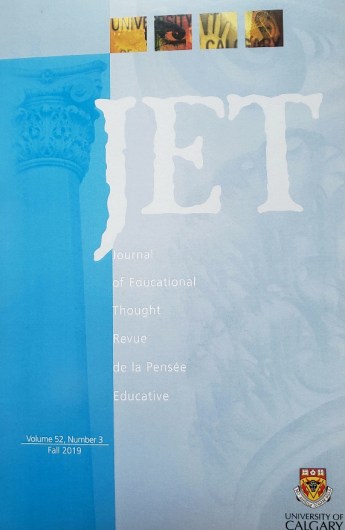
JET Cover 52(3)I am so pleased to share that the special issue of the Journal of Educational Thought dedicated to academic integrity and ethics is now out. I am excited about this work because it adds to the growing body of scholarly and research literature on these important topics, not only in Canada, but globally, too.
I was the guest Co-Editor for this special issue, together with the journal’s editor-in-chief, Ian Winchester.

Here’s an overview of what’s in the issue:

Editorials

Winchester, I. (2019). Academic integrity in the university. Journal of Educational Thought, 52(3), 187-190.

Eaton, S. E. (2019). Considerations of corruption, ethics and integrity in educational contexts: Guest editorial. Journal of Educational Thought, 52(3), 191-192.

Research articles

Lock, J., Schroeder, M., & Eaton, S. E. (2019). Designing and implementing an online academic integrity tutorial: Identifying the challenges within a post-secondary context. Journal of Educational Thought, 52(3), 193-208.

Lancaster, T., Glendinning, I., Foltýnek, T., Dlabolová, D., & Linkeschová, D. (2019). The perceptions of higher education students on contract cheating and educational corruption in South East Europe. Journal of Educational Thought, 52(3), 209-227.

Henry, R., & Gabel, C. (2019). “It’s not just a picture when lives are at stake: Ethical considerations and photovoice methods with Indigenous Peoples engaged in street lifestyles”. Journal of Educational Thought, 52(3), 229-252.

Miron, J. B. (2019). Academic integrity in a student practice environment: An elicitation study. Journal of Educational Thought, 52(3), 253-273.

All of the research articles underwent double-blind peer review.

______________________________________________________

Share or Tweet this: Journal of Educational Thought: Special Issue on Academic Integrity and Ethics

This blog has had over 2 million views thanks to readers like you. If you enjoyed this post, please “like” it or share it on social media. Thanks!

Sarah Elaine Eaton is a faculty member in the Werklund School of Education, and the Educational Leader in Residence, Academic Integrity, University of Calgary, Canada. Opinions are my own and do not represent those of the University of Calgary.


Academic Integrity: Resource for Teaching Assistants

September 16, 2019
Academic Integrity resource for teaching assistants

Academic Integrity resource for teaching assistants

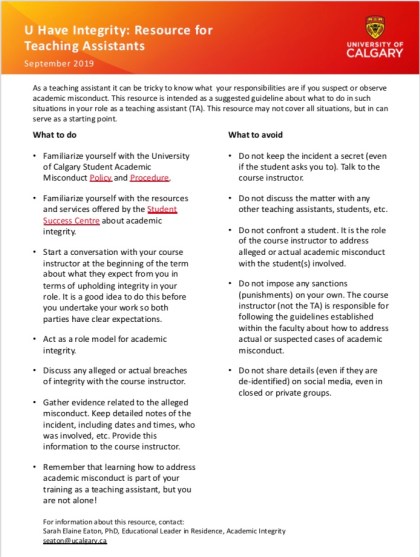
As a Teaching Assistant (TA) it can be tricky to know what your responsibilities are if you suspect or observe academic misconduct. This resource is intended to help both TAs and course instructors about the roles and responsibilities teaching assistants play in upholding academic integrity at the University of Calgary.

Teaching assistants are responsible for acting with integrity, maintaining the privacy of all parties involved and reporting any suspected or actual cases of academic misconduct to the course instructor. TAs are not responsible for confronting student(s) who may be allegedly responsible for academic misconduct and nor are they responsible for imposing sanctions (discipline). It is the responsibility of the course instructor to follow the guidelines established by their faculty for responding to allegations of academic misconduct.

Open communication between course instructors and teaching assistants is key. Establishing expectations early in the term, before issues might arise can be very helpful for teaching assistants.

It is important for teaching assistants to know they are not alone when it comes to upholding academic integrity.

This one-page tip sheet is intended as a suggested guideline to help teaching assistants figure out what to do if they encounter or suspect a breach of academic integrity. This handout is not exhaustive and it may not cover all situations. This resource was developed specifically for teaching assistants at the University of Calgary and may not apply to TAs at other institutions.

Here is a link to this free and downloadable .pdf resource: U Have Integrity: Resource for Teaching Assistants.

Here is the text of the .pdf for anyone wanting a quick read:

As a teaching assistant it can be tricky to know what your responsibilities are if you suspect or observe academic misconduct. This resource is intended as a suggested guideline about what to do in such situations in your role as a teaching assistant (TA). This resource may not cover all situations, but in can serve as a starting point. 

What to do 

  • Familiarize yourself with the University of Calgary Student Academic Misconduct Policy and Procedure. 
  • Familiarize yourself with the resources and services offered by the Student Success Centre about academic integrity. 
  • Start a conversation with your course instructor at the beginning of the term about what they expect from you in terms of upholding integrity in your role. It is a good idea to do this before you undertake your work so both parties have clear expectations. 
  • Act as a role model for academic integrity. 
  • Discuss any alleged or actual breaches of integrity with the course instructor. 
  • Gather evidence related to the alleged misconduct. Keep detailed notes of the incident, including dates and times, who was involved, etc. Provide this information to the course instructor. 
  • Remember that learning how to address academic misconduct is part of your training as a teaching assistant, but you are not alone! 

What to avoid 

  • Do not keep the incident a secret (even if the student asks you to). Talk to the course instructor. 
  • Do not discuss the matter with any other teaching assistants, students, etc. 
  • Do not confront a student. It is the role of the course instructor to address alleged or actual academic misconduct with the student(s) involved. 
  • Do not impose any sanctions (punishments) on your own. The course instructor (not the TA) is responsible for following the guidelines established within the faculty about how to address actual or suspected cases of academic misconduct. 
  • Do not share details (even if they are de-identified) on social media, even in closed or private groups.

Related posts:

______________________________________________________

Share or Tweet this: Academic Integrity: Resource for Teaching Assistants https://wp.me/pNAh3-2oQ

This blog has had over 2 million views thanks to readers like you. If you enjoyed this post, please “like” it or share it on social media. Thanks!

Sarah Elaine Eaton is a faculty member in the Werklund School of Education, and the Educational Leader in Residence, Academic Integrity, University of Calgary, Canada. Opinions are my own and do not represent those of the University of Calgary.


Multilingual essay mills – New article

August 6, 2019

Notos coverMy colleague, Roswita Dressler and I have just had a new paper published. It all started when I was at an academic integrity conference a couple of years back. I was sitting next to a colleague who works in a language other than English (LOTE). The colleague suggested that contract cheating (e.g. essay mills and other forms of outsourced academic work) was a problem of the English-speaking world, asserting that there simply wouldn’t be enough of a market in other languages.

I thought to myself, “Challenge accepted!” I recruited Roswita Dressler to help me undertake a small-scale pilot study. We both have a background in language teaching and between us, we have some level of proficiency in about four languages. We were also curious about the market for academic outsourcing for younger audiences, in elementary, middle and high school.


The questions that guided our project were:

  1. What evidence exists that online providers offer academic work in languages other than English?
  2. To what degree are K-12 students targeted by these online providers?

We framed our study specifically within the Canadian context.

Our results showed that not only do commercial contract cheating companies market to specifically to students in Canada, they target children as young as Grade six (approximately 11-12 years old). And yes, we found strong evidence that contract cheating happens in languages other than English (ten of them, in fact).

To the best of our knowledge, this is the first study on contract cheating published in Canada.

The Alberta Teachers Association is the publisher and copyright holder of this article. They have given us permission to post the article in our university’s digital repository. You can access a copy of it free of charge from here:

Eaton, S. E., & Dressler, R. (2019). Multilingual essay mills: Implications for second language teaching and learning. Notos, 14(2), 4-14. Retrieved from http://hdl.handle.net/1880/110695

______________________________________________________

Share or Tweet this: Multilingual essay mills – New article

This blog has had over 2 million views thanks to readers like you. If you enjoyed this post, please “like” it or share it on social media. Thanks!

Sarah Elaine Eaton is a faculty member in the Werklund School of Education, University of Calgary, Canada. Opinions are my own and do not represent those of the Werklund School of Education or the University of Calgary.