I worked with a GenAI LLM (Claude) to create an infographic based on this open access article that I wrote:
Eaton, S. E. (2022). New priorities for academic integrity: equity, diversity, inclusion, decolonization and Indigenization. International Journal for Educational Integrity, 1-12. https://doi.org/10.1007/s40979-022-00105-0
Here’s the result:
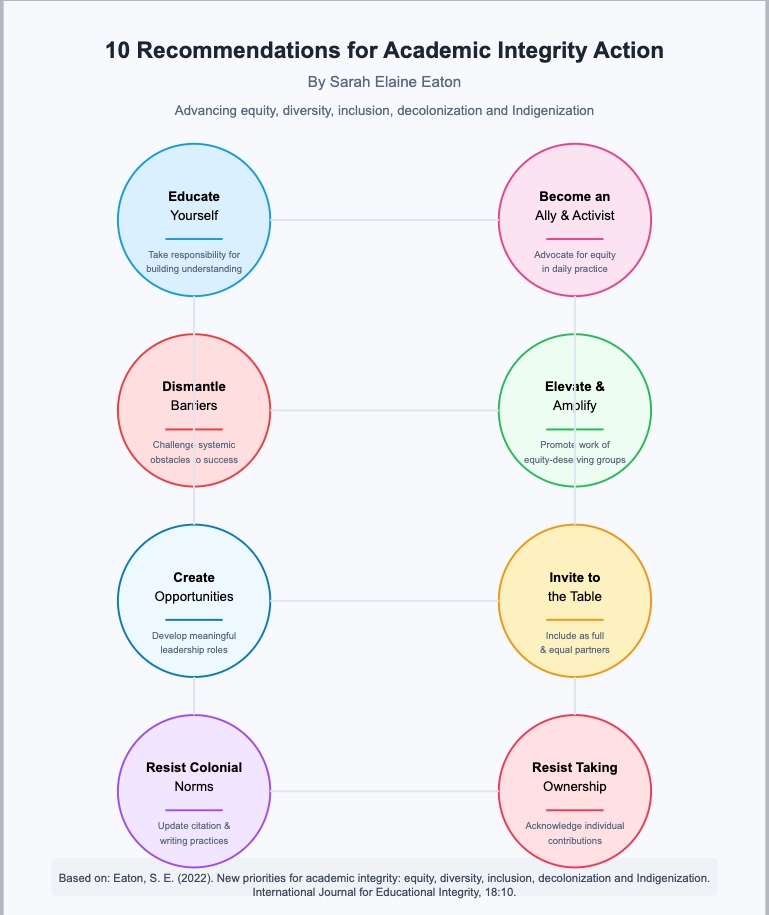
I wanted to see how #AI could be used to help with knowledge mobilization and communicating complex research ideas in simple and visually appealing ways. I am not 100% happy with this, but I am also not entirely unhappy. I am curious to see how researchers and scholars can use AI to help make our research more digestible to the general public.
At the end of the experiment, I asked Claude: Based on our interaction just now, what would you say are the benefits and drawbacks of working with AI to create infographics to share findings of research articles?
Claude’s reply:
“I can identify several key benefits and drawbacks of using AI to create infographics for research articles:
Benefits:
- Rapid Prototyping and Ideation
- Quick generation of multiple concept ideas (as shown when I suggested 4 different infographic approaches)
- Fast iteration based on feedback (like when we added your name and citation)
- Ability to quickly visualize complex concepts from text
- Structured Organization
- Systematic breakdown of complex research findings into visual elements
- Logical arrangement of information hierarchies
- Consistent application of design principles
- Customization and Flexibility
- Ability to modify designs based on specific requests
- Easy incorporation of branding elements or author attribution
- Adaptable to different formats and styles
- Technical Precision
- Exact color codes and measurements
- Consistent spacing and alignment
- Precise vector graphics that maintain quality at any size
Drawbacks:
- Format and Output Limitations
- Cannot directly generate common file formats like JPG or PowerPoint
- Unable to provide downloadable files
- Limited to specific output formats (in our case, SVG)
- Technical Barriers
- Users need to know how to convert or adapt the outputs
- May require additional tools or software to get desired final format
- Some technical knowledge needed to implement suggestions
- Creative Constraints
- Limited to certain types of visual representations
- May not capture nuanced design choices that a human designer would make
- Restricted by pre-programmed design patterns
- Implementation Challenges
- Gap between AI suggestions and practical implementation
- Need for manual conversion or recreation in other software
- Extra steps required to get to final usable format
- Quality Control Requirements
- Need for human oversight and verification
- May require professional designer input for polishing
- Could need additional refinement for professional publication
For optimal results, it seems the best approach would be to use AI as a rapid prototyping and ideation tool, then work with a professional designer or use appropriate software to create the final, polished version in the desired format. This combines the efficiency of AI for initial concept development with the precision and format flexibility of professional design tools.”
Note: The numbering issue is a function of formatting in WordPress. I’ll fix that later.
This was an interesting experiment. I’ll be interested to see how AI apps can help us better communicate our research and scholarship to members of the general public.
________________________
Share this post: 10 Recommendations for Academic Integrity Action: An AI-Assisted Experiment – https://drsaraheaton.com/2025/01/27/10-recommendations-for-academic-integrity-action-an-ai-assisted-experiment/
This blog has had over 3.7 million views thanks to readers like you. If you enjoyed this post, please ‘Like’ it using the button below or share it on social media. Thanks!
Sarah Elaine Eaton, PhD, is a Professor and Research Chair in the Werklund School of Education at the University of Calgary, Canada. Opinions are my own and do not represent those of my employer.


 Posted by Sarah Elaine Eaton, Ph.D.

 Learning, Teaching and Leadership
You must be logged in to post a comment.