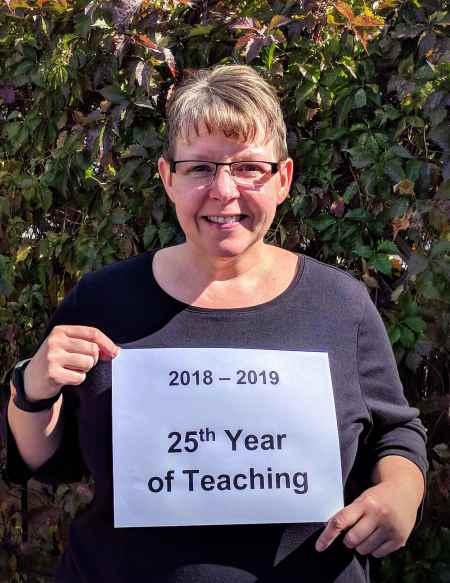
 This 2018-2019 academic year I celebrate my 25th year of teaching in higher education.
Here’s an overview of what that looks like:
- Years as a sessional instructor: 22
- Years as a full-time faculty member: 2 completed. Entering Year 3
- Number of educational institutions: 2 institutions for credit courses; 4 institutions for non-credit courses
- Number of additional organizations where I have given workshops or individual training sessions: I can’t remember or count
- Levels taught: Undergraduate, graduate, continuing education, non-credit workshops, teacher training, employee training
- Number of students taught: A few thousand, at least, but I haven’t kept track.
- Current position: Assistant Professor (tenure-track)
Like many academics, my career has zig-zagged. My first teaching experience was as a Master’s level graduate teaching assistant. I was a brand-new graduate student. I was given a class list and a textbook and told, “Here. Go teach.”
Even though my official title was “Graduate Teaching Assistant” (“TA” for short), I was also what is called the “Instructor of Record”. That means that I was officially responsible for the entire course, including developing the course outline, all instruction, tests, examinations and grading.
I’ve heard that it is no longer permitted for TAs to be the “instructor of record” and that TAs actually need to have some support and mentoring now. Back when I started, graduate TAs were largely left on their own, to do the same work as professors, at a much lower pay rate.
I remember attending a day-and-a-half training session before my first teaching assignment. It was largely focused on learning styles, which has since become a highly contested concept. Things have changed for the better since then. TAs (at our institution at least), get training and mentoring along the way. They are supervised by the Instructor of Record, which means they get to learn how to teach in a less risky, more supported environment.
The following spring and summer, I was hired to teach the same course again, but because spring and summer courses were handled by a different administrative unit at the university at that time, my title changed to “sessional instructor”, which remains the typical term for this type of appointment in Canada. This classification goes by different names depending where you are. Some synonyms include:
- part-time contingent faculty
- part-time lecturer
- contract faculty
- adjunct lecturer
- adjunct professor
- adjunct faculty
For more than two decades I worked as sessional instructor, sometimes teaching up to ten credit courses per year, supplemented by teaching continuing education courses, workshops and employee training sessions. I taught at any institution or organization that would hire me. I also took on other work in an educational context such as program evaluation and even did clerical work in educational institutions.
This year, I will celebrate my 25th year of teaching. Because of the patchwork nature of my career, no one has kept track of this experience but me. And even I have lost track of the number of organizations where I’ve taught workshops or short-term courses. I began teaching at a time before computerized HR records were kept, and everything was done on paper. Even I don’t have every contract letter or pay stub from every teaching gig I’ve ever had.
In 2016, I was hired as a full-time Assistant Professor (tenure track), for which I am truly grateful. Not long after I started in my full-time role I had lunch with one of my former professors from my Master’s program, who is now a colleague. I recall her saying, “You did it! Most people give up, but you didn’t!” She’s right. I didn’t give up. I love teaching and I believe it as much a calling as it is a career. I am enjoying my career now more than ever.
My curriculum vitae cannot accurately show that for 22 years, I travelled from one institution or organization to the next, sometimes teaching for three different places in the same day and the number of hours in any given day that I worked often exceeded what is typically regarded as “full-time hours”. It was a patchwork of part-time jobs that allowed me to pay the bills.
Twenty-two years is a long, long time to spend without job security, benefits or a pension. People who have had their full-time teaching jobs for a long time can’t relate to that kind of life. I have had colleagues who have had full-time roles for a long time share their thinly-veiled assumption that if you’re good enough, you can get a full-time job. That may be true to a certain degree, but there are other factors that can come into play. If one is not able to move to a new location in order to take on a full-time role, for example, then options become more limited.
Other colleagues have declared that “Sessionals are not faculty!”, dismissing their opinions, views or contributions to the academy. The underlying point in such an argument is that only those with full-time faculty appointments have legitimate status. Those whose status is uncertain or part-time effectively have “less than” status, which is neither credible, nor legitimate. But I have seen this situation from both sides of the table now: both as a long-term sessional and now as a tenure-track assistant professor.
As I celebrate a quarter of a century of teaching experience this year, I can say one thing for sure: Teachers matter. Whether you are part-time, full-time, and regardless of whatever your title says you are. You are a teacher at heart. You keep your students at the heart of what you do, no matter where you are or who you teach.
For anyone else out there who is currently working as Sessional / Adjunct / Contingent Faculty, let me just say: You are not alone. You work hard. You have grit and tenacity.The work you do is important. You are good enough. Actually, you are more than good enough.
I challenge you to share your own story. What does this academic year mean to you? What do you have to celebrate? What message do you want to share with others? What’s your story? I would love to hear from you!
#academiclife #highered #lifeofanacademic
______________________________________________________
Share or Tweet this: My Teaching Story: Celebrating 25 Years https://wp.me/pNAh3-2ln
This blog has had over 2 million views thanks to readers like you. If you enjoyed this post, please “like” it or share it on social media. Thanks!
Sarah Elaine Eaton is a faculty member in the Werklund School of Education, University of Calgary, Canada.
Opinions are my own and do not represent those of the Werklund School of Education or the University of Calgary.
 My colleague, Amy Burns, and I recently published this article in the Journal of Educational Thought.


 Posted by Sarah Elaine Eaton, Ph.D.
  I’m excited to share news with you about a new article that’s just been released with co-authors Michele Jacobsen, Barb Brown, Marlon Simmons and Mairi McDermott. Here’s an overview:



 Learning, Teaching and Leadership
You must be logged in to post a comment.