How to create excellent online discussion board questions

January 26, 2013

This semester I have incorporated an activity into my online courses. Students are required to facilitate the online discussion board for one or two weeks, depending on which course they are in. We use an online learning platform called Blackboard, but there are a number of different platforms available.

Here is a handy 1-page resource I created to help my  students develop and facilitate great questions that enhance learning, keep participants focussed and encourage in-depth online discussions.

View this document on Scribd

Click here to download your own copy of it: How to facilitate a Blackboard discussion

_________________

If you enjoyed this post, please “like” it or leave a comment. Thanks!

Share or Tweet this: How to create excellent online discussion board questions http://wp.me/pNAh3-1yu

Update – January 2018 – This blog has had over 1.8 million views thanks to readers like you. If you enjoyed this post, please “like” it or share it on social media. Thanks!

Sarah Elaine Eaton is a faculty member in the Werklund School of Education, University of Calgary, Canada.


How to create a research paper outline: 5 great resources

January 2, 2013

Sarah Elaine Eaton, speaker, presenter, keynote, technology, social media, Calgary, Canada, educator, education, professional developmentOnce again, I am teaching “Writing Educational Research” to Master’s of Education (M.Ed.) students at the University of Calgary this semester. I have found that some students struggle with the process of outlining their final research papers.

Outlining is an invaluable skill that helps you to conceptualize, plan and organize your writing. I learned to outline my essays when I was in school and to this day, I use outlines for research papers and even my books. I find that organizing my ideas in an outline helps me to keep my writing focussed and clear. I even outlined my Master’s and Ph.D. theses. When my Ph.D. thesis had to be modified as I was writing up my project, having an outline helped to decide what to toss, what to keep and how to re-organize the work effectively.

Here are some excellent resources that are useful to university level students, as well as high school students and adult learners who are learning to write essays:

  1. How to write an outline (SUNY) – This is an excellent web page resource produced by the State University of New York (SUNY). The method they demonstrate is the same one I learned in school. It is a classic “tiered” outline. The chart on this web page presents the information in a very clear way that is easy to understand.
  2. How to write an outline (LAVC) – Similar to the SUNY resource, this web page by the Los Angeles Valley College Library explains the difference between a topic outline and a sentence outline, using the tiered format. This web page has some great examples of what a real outline might look like.
  3. Wikihow – How to write an outline – This Wiki breaks down the process of writing an outline into simple, easy-to-follow steps. The wiki also has samples of a research outline, a literature outline and a “compare and contrast” outline.
  4. How to outline a 5-paragraph essay – This YouTube video (4:26) offers tips on how to write a shorter essay. It is great for students who have to write shorter papers or adults who are learning how to write an essay.
  5. Sample qualitative research outline by Rey Ty – This YouTube video moves a bit slowly, but it gives an excellent overview of how to write an outline for a qualitative research project.

Learning to outline is a valuable skill that will serve you in school and in the workplace. A good outline keeps you focussed, organized and on track.

Related posts:

Readings for Writing Educational Research (EDER 603.23) http://wp.me/pNAh3-1OJ

12 Phrases to Avoid in Your Academic Research Papers http://wp.me/pNAh3-1JX

Active vs. passive voice — How to tell the difference http://wp.me/pNAh3-1HX

Why APA formatting matters http://wp.me/pNAh3-1Hc

How many sources do you need in a literature review?  http://wp.me/pNAh3-1Hu

What’s the difference between a citation and a reference? http://wp.me/pNAh3-1F9

Why “as cited in” should be avoided in academic writing  http://wp.me/pNAh3-1BH

10 Great writing resources for grad students – http://wp.me/pNAh3-1Bc

_________________

If you enjoyed this post, please “like” it or leave a comment. Thanks!

Share or Tweet this: How to create a research paper outline: 5 great resources http://wp.me/pNAh3-1y6

Update – January 2018 – This blog has had over 1.8 million views thanks to readers like you. If you enjoyed this post, please “like” it or share it on social media. Thanks!

Sarah Elaine Eaton is a faculty member in the Werklund School of Education, University of Calgary, Canada.


What makes a good research question?

November 6, 2012

This week I posed a question to my students: What makes a good research question?

As Masters of Education students, they are learning about what it means to be a researcher and building a foundation of knowledge. They came up with some great resources this week. If you are looking for answers to this question, check out these great resources:

Sarah Eaton blog leadershipSonia Ospina’s entry in the Encyclopedia of Leadership on Qualitative Research

This is a 13-page document, available free in .pdf format. Published in 2004, this text shares some of the fundamentals of qualitative research, particularly as it pertains to leadership. It is also very useful for students and researchers working in education and other social sciences. It contains an extensive bibliography that serves as a great point of departure for more exploration. Link for this resource: http://ualr.edu/interdisciplinary/files/2010/03/Qualitative_Research.pdf

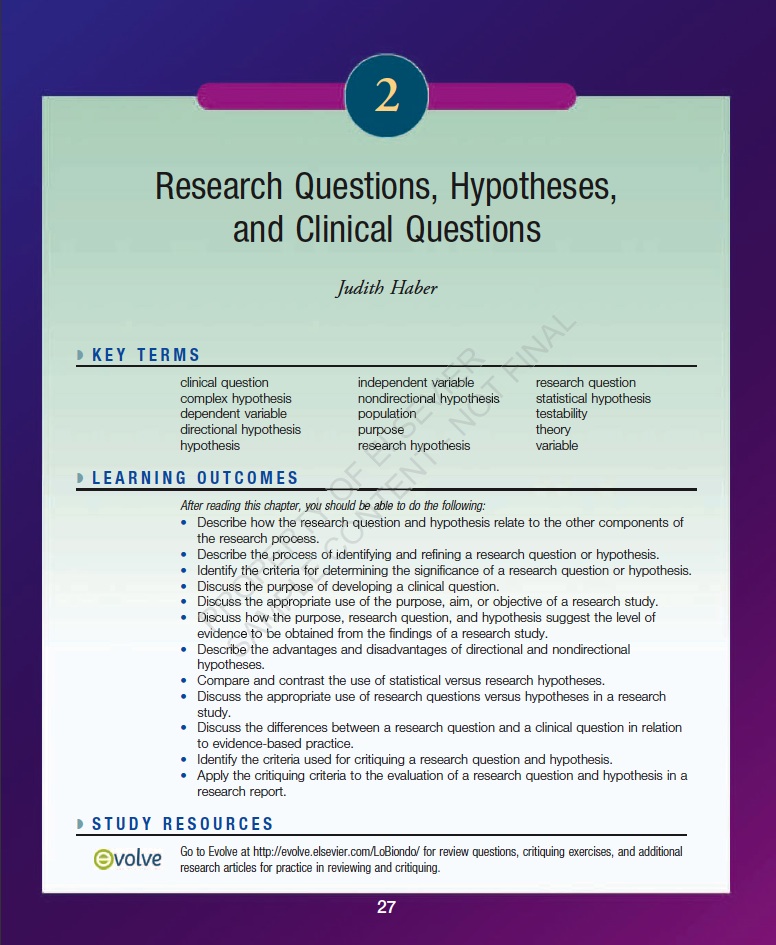
Sarah Eaton blogJudith Haber’s chapter called “Research Questions, Hypotheses and Clinical Questions”

Though marked as “Sample – Not final” with a watermark on the .pdf, this is an incredible 29-page resource that includes flow charts and tables of information. It is easy to understand and written in language that most novice researchers could understand. This one quickly became a favorite because it was colorful and concise. Even though it appears to be written for students and practitioners of health research, there are many elements that may be useful to educators and social science researchers, too. Link for this resource: http://www.us.elsevierhealth.com/media/us/samplechapters/9780323057431/Chapter%2002.pdf

Companion for Undergraduate Research

This is a website (http://www.socscidiss.bham.ac.uk/) that outlines the characteristics of a good research question. Then it talks about each characteristic in detail. It is written in clear language and is very well organized. The page also contains links to other helpful resources on research.

Figuring out how to craft a research question can be tricky. Resources like these help to demystify the process.

______________

Share or Tweet this: What makes a good research question? http://wp.me/pNAh3-1vL

Update – January 2018 – This blog has had over 1.8 million views thanks to readers like you. If you enjoyed this post, please “like” it or share it on social media. Thanks!

Sarah Elaine Eaton is a faculty member in the Werklund School of Education, University of Calgary, Canada.


Is your research biased? Answer: Yes. (Here’s why.)

October 29, 2012

Sarah Eaton blog technology researchThis semester I am teaching a course on Research Methodology in Education. One of the topics that has come up is bias.

Bias is present is bascially every research study. Even though we strive to be objective — and that is part of our work, we nevertheless start with a set of values, beliefs and philosophies that shape our opinions and world view.  It is important for reasearchers to understand the biases they bring to their work and to acknowledge them.

For example, one of my biases is that I hold is that everyone is capable of learning. Not everyone is capable of earning a Ph.D. (for any number of reasons), but everyone is capable of learning something. This is one of my values and beliefs that shapes my work. If I am an honest researcher, I must declare and acknowlege that bias when I do research. It is one thing to have and acknowledge bias. It is an entirely different matter to purposely bias our research in favor of a particular outcome or do research just to prove a point.

There are two ways to approach research:

Approach #1 – Conduct research in a manner that supports your argument

The first is to start with an argument or a position and conduct research and find literature that supports your point of view.

Though some scholars might disagree, I would submit that is an undesirable starting position. The reason is that you are likely to skew either your research or your results so they fit with your argument. Forcing results to fit to a pre-determined argument may be considered unethical. For example, pharmaceutical companies that conduct drug tests in order to prove the drug is safe and refuse to release research that may contradict that starting point are harshly criticized. Such research is not considered believable because it is skewed.

Approach #2 – Start with a research question, hypothesis or topic. Conduct your research in a manner that seeks to answer a question.

The second way to approach you research is to begin with a problem you want to solve or a question you want to answer. Then, you conduct your research in a manner that seeks to answer your research question. Once you have conducted your research, your argument emerges from your data.

The data is the information that you gather that allows you develop a cogent argument to persuade others. You can gather primary data (e.g. interviews) or secondary data (e.g. literature review).

Part of a research study almost always involves a review of previous literature written on the topic you are studying. In your literature review, it is valuable to cite opposing views. Once you have considered your question or problem from a variety of angles, then you can begin to develop an argument, based on your findings. Considering a variety of viewpoints is highly desirable as it demonstrates that you are not attempting to skew your results in favor of a pre-determined outcome.

Be aware that just because you start your research with a particular question or topic, it is unwise to assume that your starting position is the correct one. Be curious, rather than dogmatic. What themes emerge from the literature that you surveyed? What surprised you? What arguments can be made? What conclusions can be drawn?

In my own research, it has happened to me that I start with a research question, problem or hypothesis and as I surveyed the literature, my hypothesis was proven to be incorrect. Be prepared for that to happen. It does not mean you are a bad researcher. Quite the contrary, it means you have allowed your hypothesis or question to be challenged and your research is driven by the data you find.

We may come to our work with a bias. But ultimately, the research needs to speak for itself. That’s what makes it credible.

______________

Share or Tweet this: Is your research biased? Answer: Yes. (Here’s why.) http://wp.me/pNAh3-1vw

Update – January 2018 – This blog has had over 1.8 million views thanks to readers like you. If you enjoyed this post, please “like” it or share it on social media. Thanks!

Sarah Elaine Eaton is a faculty member in the Werklund School of Education, University of Calgary, Canada.


Free webinar: Learning the 21st century way: Making sense of how to use social media for learning

August 16, 2012

Over the past decade social media has changed how individuals connect online and share information and how organizations interact with stakeholders and customers. Did you know that social media is now being incorporated into learning programs from Kindergarten right on up through adult education? Does it really add any value to the learning process?

In this one-hour webinar, I’ll share exactly how I incorporated social media (and in particular, Twitter) into one of my classes. I’ll share what worked, what didn’t and what you can do in your own teaching or training practice to effectively integrate social media ‐ and why you might want to.

By the end of the webinar you will:
• Have a basic understanding of how social media can add value to your learning programs
• Gain insight into how to incorporate social media into a lesson plan
• Get ideas on how to assess activities using social media
• Get ideas on how to incorporate social media into your own learning programs

There will be time for questions at the end of the webinar.

This free webinar is sponsored by Essential Skills Ontario. Here are the details:

Date: Tuesday, August 21st, 2012

Time:

10:00 a.m. Pacific Time (Vancouver, BC)

11:00 a.m. Mountain Time (Calgary, AB)

1:00 p.m.  Eastern Time (Toronto, ON)

2:00 p.m. – Atlantic Time (Halifax, NS)

6:00 p.m. – British Summer Time (London U.K.)

7:00 p.m. – Eastern European Time (Cairo, Egypt)

It’s free for you to join in, but you must register, since there are only 100 spots available.  Click here to register.

__________________

Share or Tweet this post:  Free webinar: Learning the 21st century way: Making sense of how to use social media for learning http://wp.me/pNAh3-1tB

Update – January 2018 – This blog has had over 1.8 million views thanks to readers like you. If you enjoyed this post, please “like” it or share it on social media. Thanks!

Sarah Elaine Eaton is a faculty member in the Werklund School of Education, University of Calgary, Canada.