Share your story, share your wisdom: How to make learning memorable

June 14, 2012

There I sat in my professor’s office, sobbing. “But it is such a lousy grade,” I said. “I’ll never get another scholarship. Then, how will I pay for school? I’ll have to drop out.”

I hated statistics, but it was a mandatory course in my research program. My grade was a passing one, but just barely.

Tim, in his Northern English fashion, didn’t really have much use for tears, but he knew that I was hurting. He retorted, “Look, you’re not going to drop out of school. It will work out just fine.”

“But how?” I sniveled.

“Let me tell you about the time I got a terrible grade in one of my courses in grad school…” He went on to tell me about an experience that paralleled my own. “I made it through OK, and so will you. After you’ve crossed that stage and you have your degree in hand, no one is going to ask you what your grade in statistics was! You passed. That’s enough. Now go on, and get back to work.”

Having my teacher and mentor share a story with me about his own shortcomings did not diminish his professional excellence in my eyes; in fact, it made me respect him even more. My point to you is this: Through our personal stories, as teachers we have an opportunity to create memorable learning experiences that motivate, inspire and teach our learners.

Here are some tips on how to incorporate stories into your teaching practice:

Be vulnerable 

Stories that show your humanity and your vulnerability are likely to resonate the most deeply with others. We are not talking about melodramatically pulling all your skeletons out of the closet and putting them on parade. It is about show-ing that you, too, are human. Adult learners in particular, can be hampered by a fear of failure. By sharing our failures and vulnerabilities, we become approachable and believable.

Get personal (just a little) 

Stories that are drawn from your own experience will have the most impact. Professional speaker, Patricia Fripp calls it “mining your experience”. Find the golden nuggets of your life and polish them. Then offer them as gifts of the heart.

Unless there is a good reason to do otherwise, tell your stories using the first person. They are your stories, after all.

Speak your truth 

Your stories will be more believable if they are true. A little bit of literary license is allowed, but at least 90% of the story should be accurate and true. If there is too much embellishment, others will pick up on it. If they do, then you lose credibility as a storyteller — and as a teacher. It is OK to massage the truth, just don’t stretch it too far.

Keep it short 

Keep your stories crisp, clean and to the point. Someone once told me that a story that relates directly to your lesson should take up a maximum of 5% of your teaching time. In a 60-minute class, your story should be a maximum of 3 minutes. If it is longer, students may tune out or get impatient. I have used that guideline in my teaching practice and it seems to work well.

Focus on the learner 

Your teaching stories may be about you, but they are for your learner. Edit out unnecessary details. Ask yourself, “How will this story help my learners?”

Make a point 

In teaching, we do not tell stories to simply to entertain our students. We use the entertainment and emotional elements of a story to create memorable learning experiences. The connection between your story and the point you are trying to make may not be obvious to the listener. Use transitional phrases such as “My point to you is…” to help others contextualize the story you have just shared with them.

How can you create memorable learning experiences for your students with stories? Your life is a gold mine of experience. What nuggets of life do you have to share with your students? The wisdom contained within them is priceless.

Related posts: 

_______________________

Share or Tweet this post:  Share your story, share your wisdom: How to make learning memorable http://wp.me/pNAh3-1r2

If you are interested in booking me (Sarah Eaton) for a presentation, keynote or workshop (either live or via webinar) contact me at sarahelaineeaton (at) gmail.com. Please visit my speaking page, too.


Engaging through eLearning: Key factors to make webinars and virtual learning effective

June 6, 2012

Tomorrow I’ve been invited to do a professional development workshop for the Calgary chapter of the Canadian Society of Training and Development. The session is:

“Engaging through eLearning: Key factors to make webinars and virtual learning effective”

We are going to talk about:

  • What makes e-learning (in)effective
  • Best practices for e-learning and webinars
  • Increasing learner engagement
  • Effective e-learning assessment

If you’re in Calgary, come and join us. Here’s the link to register: http://www.cstd.ca/events/event_details.asp?id=228664

______________

Share or Tweet this post:  Engaging through eLearning: Key factors to make webinars and virtual learning effective http://wp.me/pNAh3-1qO

If you are interested in booking me (Sarah Eaton) for a presentation, keynote or workshop (either live or via webinar) contact me at sarahelaineeaton (at) gmail.com. Please visit my speaking page, too.


Learning to Talk Like Jesus: How TV shows in Sweden support the Aramaic revival in the Middle East

May 29, 2012

Sarah Elaine Eaton blog - Languages, Literacy and Leadership

Sweden is providing a new twist on learning an old language, for  young learners of Aramaic in the two villages in the Holy Land’s small Christian community, in Beit Jala, Palestine and Jish, Israel.

In the Beit Jala Mar Afram school, run by the Syrian Orthodox church, priests have taught over 320 students Aramaic over the past five years.

In Jish approximately 80 elementary school children are taking Aramaic as a voluntary option in school.

The elementary school children who take part in the Aramaic language learning program learn to speak, listen, write Aramaic script and read the language.

Dia Hadid of the Associated Press reports that:

“The dialect taught in Jish and Beit Jala is “Syriac,” which was spoken by their Christian forefathers and resembles the Galilean dialect that Jesus would have used, according to Steven Fassberg, an Aramaic expert at the Hebrew University in Jerusalem.”

The language classes have been met with criticisms from some parents and community members, some of whom are worried that having students learn Aramaic may be an attempt to convert them to Christianity or may be a threat to their Arabic identity.

According to the Associated Press, some members of the Christian community in the region still chant their liturgy in Aramaic, but few people understand the prayers.

Enter Sweden. Swedish officials estimate that anywhere from 30,000 to 80,000 Aramaic speakers reside in that country. The Aramaic community is strong there and includes an Aramaic soccer team, “Syrianska FC” in the Swedish top division from the town of Sodertalje.

Aramaic speakers in Sweden publish a newspaper called “Bahro Suryoyo”, as well as pamphlets and children’s books, including The Little Prince. But what really helps the students learn the language is Soryoyosat, a satellite television station maintained by the Swedish Aramaic community. For some members of these two villages in the holy land, watching Aramaic programming from Swedish TV station provided the first opportunity in decades for them to hear the language spoken outside church. The Associated Press reports that “Hearing it in a modern context inspired them to try revive the language among their communities.”

This is one case, where technology and television are benefitting language learners both in terms of making learning more accessible and in increasing their motivation. These kids are “kickin’ it old school”, using new technology. Aramaic may be saved, yet.

Related post:

Can TV can help you learn another language?

https://drsaraheaton.wordpress.com/2012/05/24/can-t-help-you-learn-another-language/

References

Associated Press. (2012, May 28). Pair of villages in Holy Land teaching Aramaic in effort to revive language that Jesus spoke: New focus comes with help from modern technology. NYDailyNews.com. Retrieved from http://www.nydailynews.com/news/world/pair-villages-holy-land-teaching-aramaic-effort-revive-language-jesus-spoke-article-1.1085728

Hadid, D. (2012, May 28). Aramaic: Efforts To Revive Jesus’ Language In Christian Villages Beit Jala, Jish In Holy Land, Sweden. Huffington Post. Retrieved from http://www.huffingtonpost.com/2012/05/28/aramaic-holy-land-jesus_n_1550507.html

Hadid, D. (2012, May 29). Revival of Jesus’ language attempted in two Holy Land villages. Southeast Missourian. Retrieved from http://www.semissourian.com/story/1854012.html

________________

Share or Tweet this post: Learning to Talk Like Jesus: How TV shows in Sweden support the Aramaic revival in the Middle East http://wp.me/pNAh3-1q7

Update – January 2018 – This blog has had over 1.8 million views thanks to readers like you. If you enjoyed this post, please “like” it or share it on social media. Thanks!

Sarah Elaine Eaton is a faculty member in the Werklund School of Education, University of Calgary, Canada.


Free, online resources for learning Romanian

May 13, 2012

Sarah Eaton, blog, Sarah Elaine EatonIf you’re looking to learn Romanian, here are some free, downloadable resources that may be helpful:

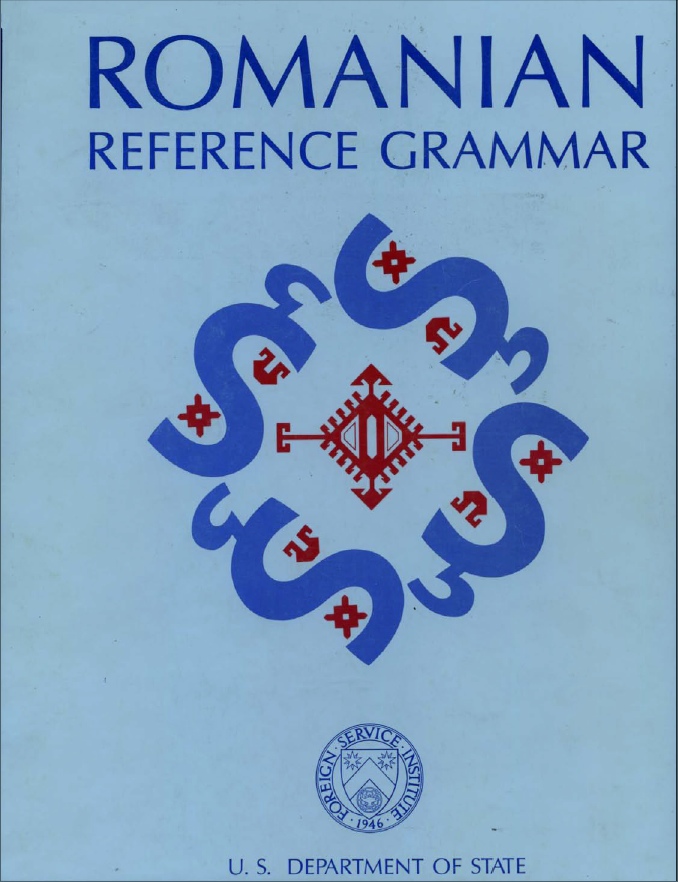
Romanian Reference Grammar (1989) – by Christina N. Hoffman, published by the U.S. Department of State Foreign Service Institute. – This guide is 109 pages and is written in English. Great resource for native English speakers wanting to learn Romanian. Available from: http://fsi-language-courses.org/Courses/Romanian/FSI%20-%20Romanian%20Reference%20Grammar%20-%20Student%20Text.pdf

Romanian Grammar – (n.d.) – Unknown author. – This is a highly detailed and technical grammar manual, spanning 183 pages. Available from: http://www.seelrc.org:8080/grammar/pdf/stand_alone_romanian.pdf

Forvo – Romanian – Online site to help with pronunciation. See: http://www.forvo.com/languages/ro/

Quizlet – A site to make your own flash cards in Romanian. See: http://quizlet.com/5937063/romanian-phrases-flash-cards/#

Note: These resources were originally shared by Paul Widergren on the FLTEACH listserv.

Do you know of other free online resources to learn Romanian? If so, please leave a comment.

__________________________

Share or Tweet this post: Free, online resources for learning Romanian http://wp.me/pNAh3-1oj

Update – January 2018 – This blog has had over 1.8 million views thanks to readers like you. If you enjoyed this post, please “like” it or share it on social media. Thanks!

Sarah Elaine Eaton is a faculty member in the Werklund School of Education, University of Calgary, Canada.


Free webinar: Learning the 21st century way: Making sense of how to use social media for learning

April 16, 2012

Over the past decade social media has changed how individuals connect online and share information and how organizations interact with stakeholders and customers. Did you know that social media is now being incorporated into learning programs from Kindergarten right on up through adult education? Does it really add any value to the learning process?

Join Literacy Nova Scotia and me for a 60-minute webinar on Wednesday, April 18. I’ll share exactly how I incorporated social media into one of my classes, what worked, what didn’t and what you can do in your own teaching or training practice to effectively integrate social media — and why you might want to.

Participant Outcomes

By the end of this program you will:

  • Have a basic understanding of how social media can add value to your learning programs
  • Gain insight into how to incorporate social media into a lesson plan
  • Get ideas on how to assess activities using social media
  • Get ideas on how to incorporate social media into your own learning programs

Webinar content

  1. Emerging technology trends in education. Where have we come from and where are we going?
  2. Case study: How I successfully incorporated Twitter into a university-level Effective Learning class.
  3. The pedagogical value of social media: What’s in it for the learners?
  4. Assessment of learning activities that use social media. What works, what doesn’t and why.
  5. Tips on how to incorporate social media into your own teaching practice.

Participant materials (provided to all registrants)

  • Twitter for Teachers – 25-page .pdf manual to help you get started with Twitter.
  • Sample Twitter activity.
  • Sample evaluation for a social media activity.

Requirement: A high-speed Internet connection with a sound card (so you can hear me).

Date and time: April 18, 2012, 12:00 noon – 1:00 p.m. Atlantic Time

Thanks to Literacy Nova Scotia’s generous sponsorship, this is event is free for participants. You need to register though, as space is limited.

___________________________

Share or Tweet this post: Free webinar: Learning the 21st century way: Making sense of how to use social media for learning http://wp.me/pNAh3-1mH

Update – January 2018 – This blog has had over 1.8 million views thanks to readers like you. If you enjoyed this post, please “like” it or share it on social media. Thanks!

Sarah Elaine Eaton is a faculty member in the Werklund School of Education, University of Calgary, Canada.