Dr. Sarah’s favorite resources of the week (Dec. 11-17, 2011)

December 18, 2011

Here are my favorite resources of the week, curated from my Twitter account.

Social Media Resources, Policy tools and How To’s

Best practices for confronting employee sexual harassment – by Judy Greenwald

15 WordPress Plugins For A Better Facebook Experience – 1stwebdesigner.com

Social Media News

Underground Industry Aims to Dupe Social Media Users – by Tom Simonite

Canada’s Tories to take questions in inaugural Twitter town hall – CTV news

What Insurers Could Do With Your ‘Social Media Score’  – by Sheryl Nance-Nash

Adult Literacy and Essential Skills

Computer Use Tip Sheet – HRSDC

Writing Tip Sheet – HRSDC

Reading Tip Sheet – HRSDC

Tips on Working with others – HRSDC

Oral communication tips – HRSDC

Children’s Literacy

Reading Companion – Great literacy resource by IBM

Robert Munsch’s Reading Website for Kids

Starfall – Excellent literacy resource for children

Top 10 Tips for Teaching Basic Reading Skills – Worksheet library

Technology and E-learning

Bringing Speech Recognition to Reading Instruction – by Marilyn Jager Adams

A lesson plan to introduce YLs to blogging – by Dina Dobrou

Apps and software for students with language-based learning disabilities – by Inov8-Ed

Popular educational Twitter feeds live and streaming – from Splaysoft

Tip of the Week – Six Great Ways to Publish Student Work – Historytech blog

Tutpup – Competitive Educational Games – by Mark Brumley

10 Instructional Design Tips for e-Learning Development  – TheNewLearner.com

The Gamification of Education: What School Can Learn from Video Games – Terrell Hick

Languages and Multilingualism

10 Myths you will be told about multilingual children – Multilingual Children’s Association

Christmas resources in 4 languages – LanguageNut

80 Apps to Learn a New Language – by Joshua Johnson

Elements Of Style Rap: Columbia Journalism Students Tackle Strunk And White Grammar Classic – Huffington Post

Education News

How the Left Side of the Brain Got Left Behind: A Hypothesis – GettingSmart.com

Online schools score better on Wall St. than in classrooms – NY Times

English Continues to Be World’s Most Influential Language, TalktoCanada Reports – SacBee

Teachers concerned about Inclusive Education Planning Tool – Alberta Teachers’ Association

Tech startups ride surge in online education – AsiaOne.com

Related posts

Dr. Sarah’s favorite resources of the week (December 4-10, 2011)

Dr. Sarah’s favorite resources of the week (November 20- 26, 2011)

Dr. Sarah’s favorite resources of the week (November 13-19, 2011)

____________________________

Share this post: Dr. Sarah’s favorite resources of the week (Dec. 11-17, 2011) http://wp.me/pNAh3-15q

Update – January 2018 – This blog has had over 1.8 million views thanks to readers like you. If you enjoyed this post, please “like” it or share it on social media. Thanks!

Sarah Elaine Eaton is a faculty member in the Werklund School of Education, University of Calgary, Canada.


Dr. Sarah’s favorite resources of the week (Dec. 4-10, 2011)

December 10, 2011

Here are my favorite resources of the week, curated from my Twitter account.

Social Media

7 Social media tips for the company Christmas party – by John Balitis and Carrie Pixler-Ryerson, for Inside Tucson Business

Social media policy essential in the workplace – by Anna Cairo

Apple’s social media policy leaked by Emily Nicholls

A social media policy pearl by Andrea Di Maio

8 Ways To Avoid Social Media Culture Clash by Debra Donston-Miller

What Boards Should Know About Social Media by Erika L. Del Giudice and Dorri C. McWhorter

Social Media Policy Essentials by Ray Silva

After Facebook rant, Manatee County suspends deputy for three days by Alison Morrow

Apple Fires Employee Over Facebook Rants by Margaret Rock

Quebec Minor Hockey League Social Media Policy – QMHL

UFC Reaps the risks and rewards of social media – by Chad Dundas, ESPN

Literacy and Essential Skills

Take time to learn together on Family Literacy Day by Community Content

Technology and teaching children to read: What does the research say? from NEIR TEC

No place in class for digital illiterates – The Guardian

Margaret Atwood says Twitter, internet boost literacy – CBC News

Tips to Make Reading Fun – in Lake Mary Health and Wellness

National Literacy Trust highlights book-free millions – by Judith Burns, BBC News

Paper or electronic? Reading to children important no matter the medium – by Roni Reino

Financial Education pays off in adult life – by Sharon Singleton

Technology and E-learning

How to convert your Powerpoint into an E-learning course – Rapid E-Learning

Google Forms for Educators – ISU Workforce Training

Top 10 iPhone Apps of 2011 – by eGichomo

Digital literacy resources – Government of South Australia

Languages and Multilingualism

How to market to foreign language speakers – by Christian Arno

“Pleasure reading” key to second language learning – Victoria University of Wellington

Effective Learning / Metacognition

Effective learning and teaching – Science for All Americans Online

5 Training “Must Knows” – by Sarah Bohnenkamp

Education News

India offers English stepping stone to east Asian students – The Guardian

Canada: a failing grade on aboriginal education – by Gerry St. Germain And Lillian Dyck, The Leader-Post

The rise of flexi-schooling – by Jeevan Vasagar

When an adult took standardized tests forced on kids – by Valerie Strauss

Related posts:

Dr. Sarah’s favorite resources of the week (Nov. 20 to 26, 2011)

Dr. Sarah’s favorite resources of the week (Nov. 13 to 19, 2011)

____________________________

Share this post: Best resources of the week (Dec. 4 to 10, 2011) http://wp.me/pNAh3-13H

Update – January 2018 – This blog has had over 1.8 million views thanks to readers like you. If you enjoyed this post, please “like” it or share it on social media. Thanks!

Sarah Elaine Eaton is a faculty member in the Werklund School of Education, University of Calgary, Canada.


Literacy and Essential Skills: Why Digital Literacy is Crucial

December 6, 2011

The Guardian recently published an article called “No place in class for digital illiterates“. The article talks about how children who lack technology literacy skills are getting left behind. Writer Gavin Dudeney talks about changing definitions of literacy that now include “digital literacy”  or the ability to use the Internet and interact with digital texts.
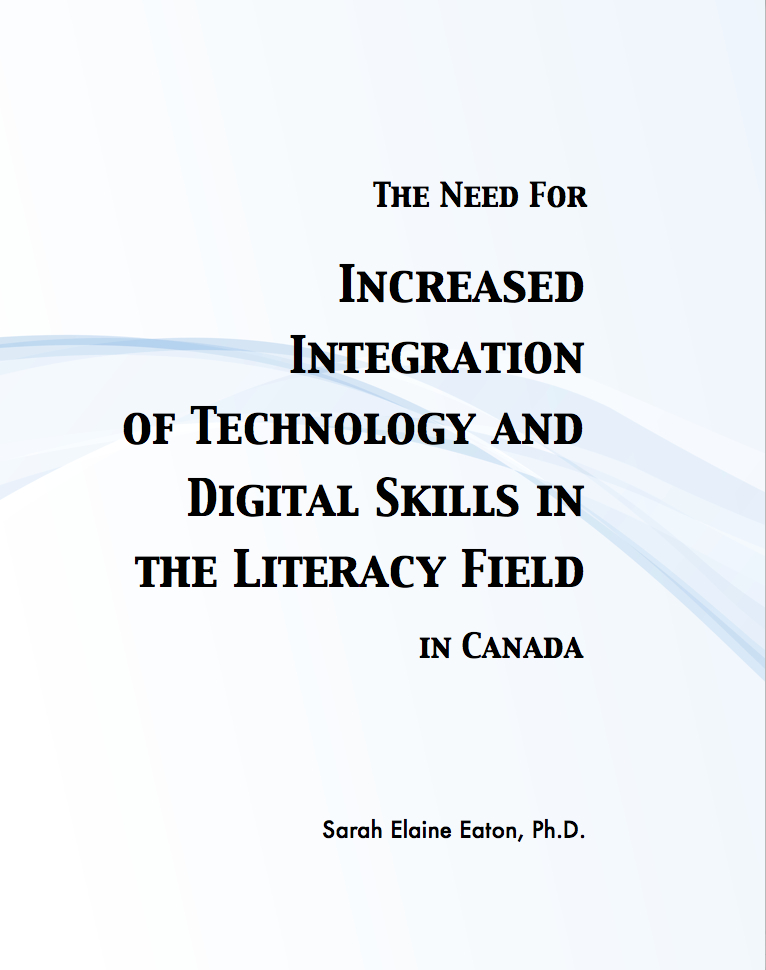
As I was writing The Need For Increased Integration of Technology and Digital Skills in the Literacy Field in Canada I found research that suggests that Canada’s 9 Literacy and Essential Skills may be just the beginning. One of the 9 Essential Skills is “Computer Use”. Some researchers are suggesting that this term is too narrow. Today, it is not enough for a person to know how to turn on a computer, manipulate a mouse or use a track pad or write a resume on a word processing program. Digital skills are an important part of computer use.

People need to know how to search for everyday information such as bus schedules, tax information and other important information that is part of every day living. Job seekers need to know how to search for and apply for jobs posted on the Internet and submit their resume through an online application system. More and more job application sites require users to create an account and register with a company or a service. If adults do not know how to do these things, they will fall behind.

Children who do not know how to use touch screens or the Internet may find themselves disadvantaged later on, as they try to catch up with digitally savvy peers. There are some groups and individuals who are opposed to the increased use of technology in schools. Waldorf Schools, a system of private schools with an excellent reputation, reportedly does not use any technology in its elementary grades.

As an educator, I worry about such approaches. Clearly, it works for them because they are a hugely successful network of schools. But I openly confess that I have never worked with a Waldorf school, myself. I’d love to be invited to one to see how they teach and engage with their learners. As a bit of a “tech junkie”, I have to acknowledge my bias in favour of using more technology, rather than less. I worried whether children who do not learn how to use touch screens or the Internet in their school years may find themselves disadvantaged later on, as they try to catch up with digitally savvy peers?

Having said that, I do think it is important to incorporate technology in a meaningful way that shows why we are using it, what purpose it serves and ultimately, how it benefits the learner. It is critical to make these links so that we show how digital skills can help children develop cognitively and socially so that when they grow up, their lives as adults have meaning as they find work that makes them feel that they are making a meaningful contribution to their world. It is a world that we can only dream about right now. As an educator, I ask, how do we best prepare our learners for success in five, ten or twenty years’ time? And what will “literacy and essential skills” look like a decade from now?

________________

Like this post? Share or Tweet it: Literacy and Essential Skills: Why Digital Literacy is Crucial http://wp.me/pNAh3-13W

Update – January 2018 – This blog has had over 1.8 million views thanks to readers like you. If you enjoyed this post, please “like” it or share it on social media. Thanks!

Sarah Elaine Eaton is a faculty member in the Werklund School of Education, University of Calgary, Canada.


Best resources of the week (Nov. 20 to 26, 2011)

December 4, 2011

Here are my favorite resources of the week, curated from my Twitter account.

Social Media

Schools would be wise to adopt Granville district’s social media policies – Newark Advocate

How to hide Twitter #hashtag chats from your followers by Dave Larson

The Rise of the Connected Non-Profit from Mashable

10 Things I Learned On My Twitter Journey To 100,000 Followers by John Paul

How 5 Top Brands Crafted Their Social Media Voices by Lauren Indvik

“Don’t do as I say, do as I do” – the role of leadership in promoting the use of social media by Don Ledingham

7 Secrets Of Highly Effective Twitter Power Users  by Lauren Dugan

10 Steps to Kick Start Your Twitter Network from Edte.ch Blog

Proposed social media policy has this school committee in a huff by Sherilynn Macale

Literacy and Essential Skills

Reading to your kid: even more important than you think – The Globe and Mail

How Canadian contemporary authors inspire youth – Imaginaction

Language Learning and Teaching

Chicago Public Schools teacher Kickstarting ESL program through song by Alyssa Vitale

Scaffolding Academic Learning for Second Language Learners by Karen Sue Bradley & Jack Alden Bradley

E-Learning

Activities for online courses: The Beginning by Nicky Hockly

How To Be a Top Learning Organization by Tiffani Murray

7 Things You Should Know about Google Apps from Educause

For some kids, a book is just an iPad that doesn’t work by Ivor Tossell

62 things you can do with Dropbox from MacWorld

Education Resources

Tools for Teaching: Authentic Assessment from the Centre for Teaching and Educational Technologies, Royal Roads University

Flipped Classroom Full Picture: An Example Lesson by Jackie Gerstein

Google Scholar Citations Now Open to All by Ryan Cordell

Education News

Dyslexia may explain my school failure, says Annabel Heseltine by Julie Henry

Ministers of Education Report to Canadians on Official Languages in Education – Canada Newswire

A School System in Maine Gives iPads to Kindergartners from Voice of America

Alberta education minister welcomes input on overhauling system via social media – Metro News

Year-round school: An idea worth exploring – The Windsor Star

Public Speaking and Presentation Skills

Stop Breaking the Basic Rules of Presenting by Ned Potter

App for Speakers: A presentation timer by Takuya Murakami

Secrets from JFK’s Speechwriter by Peter Temple

Writing

How to Write, Launch and Sell Your Informational Ebook by Alexis Grant

Related posts:

Dr. Sarah’s Favorite Resource of the Week (Nov. 13 to 19, 2011)

____________________________

Share this post: Best resources of the week (Nov. 20 to 26, 2011) http://wp.me/pNAh3-12N

Update – January 2018 – This blog has had over 1.8 million views thanks to readers like you. If you enjoyed this post, please “like” it or share it on social media. Thanks!

Sarah Elaine Eaton is a faculty member in the Werklund School of Education, University of Calgary, Canada.


The Need For Increased Integration of Technology and Digital Skills in the Literacy Field in Canada

December 2, 2011

Need for Increased Tech in Literacy by Sarah Elaine Eaton, Calgary, CanadaIt’s here! The Need For Increased Integration of Technology and Digital Skills in the Literacy Field in Canada has just been released.

Technology does not need to be adopted because it is fashionable, but because the face of learning worldwide has changed dramatically over the past several decades at all levels, from early childhood education to workforce training. When literacy professionals integrate technology in meaningful ways, they ultimately help learners prepare for long-term success.

This report highlights the changing landscape of Canadian education and training (though the findings may relate to other regions, too). It offers recommendations for literacy organizations, managers, coordinators, staff, volunteer tutors and other practitioners to incorporate technology into professional practice in an easily accessible manner that focuses on building professional competencies.

Topics covered include:

  • The changing nature of education and training.
  • The current state of literacy instruction.
  • Emerging models of technology integration in the literacy field.
  • The need for continuing professional development.
  • Recommendations.

Bibliography contains 36 references. Get your copy here: http://www.onatepress.com/titles/the-need-for-technology-in-literacy/

This publication is also available through the ERIC database: http://www.eric.ed.gov/PDFS/ED526087.pdf

______________

Like this post? Share or Tweet it: The Need For Increased Integration of Technology and Digital Skills in the Literacy Field in Canada  http://wp.me/pNAh3-12r

Update – January 2018 – This blog has had over 1.8 million views thanks to readers like you. If you enjoyed this post, please “like” it or share it on social media. Thanks!

Sarah Elaine Eaton is a faculty member in the Werklund School of Education, University of Calgary, Canada.