Webinar recording: 101 Ways to Market Your Language and Literacy Program (#1)

March 22, 2012

We had the first of 10 webinars today on how to market your language or literacy program. Here’s the recording of the first 30-minute program:

Join us next week for Class #2. It will focus on setting marketing goals, allocating resources and budgeting. Get more details here.

__________________________

Share or Tweet this post: Webinar recording: 101 Ways to Market Your Language and Literacy Program (#1) http://wp.me/pNAh3-1jF

Update – January 2018 – This blog has had over 1.8 million views thanks to readers like you. If you enjoyed this post, please “like” it or share it on social media. Thanks!

Sarah Elaine Eaton is a faculty member in the Werklund School of Education, University of Calgary, Canada.


How to Publish your Amazon Kindle e-book (It’s easier than you think!)

March 15, 2012

Are you an author or a writer? Do you have a book in you that is ready to be shared with the world?

I published my first book in 2002. Last year, everything changed. I published 4 of my own e-books as Amazon Kindle books.

In Feburary, I had the privilege of presenting the nuts and bolts of the “how to” at the National Speakers Association 2012 Winter Conference in Dallas, TX on February 4.

A few weeks later, I did the same presentation for the my home chapter of the Canadian Association of Professional Speakers. We taped the Calgary session and I have the highlights here for you. This video details the exact method for you, step-by-step.

My prediction is that teachers, students and writers of all types are soon going to be publishing and sharing their work on line in a variety of formats. Amazon e-books are just one way to do that. It is easier now to be a published writer than it has ever been in history. If you are a writer, this is your time!

___________________________

Share or Tweet this post: How to Publish your Amazon Kindle e-book (It’s easier than you think!) http://wp.me/pNAh3-1jm

Update – January 2018 – This blog has had over 1.8 million views thanks to readers like you. If you enjoyed this post, please “like” it or share it on social media. Thanks!

Sarah Elaine Eaton is a faculty member in the Werklund School of Education, University of Calgary, Canada.


101 Ways to Market Your Language Program (10 Free webinars)

March 14, 2012

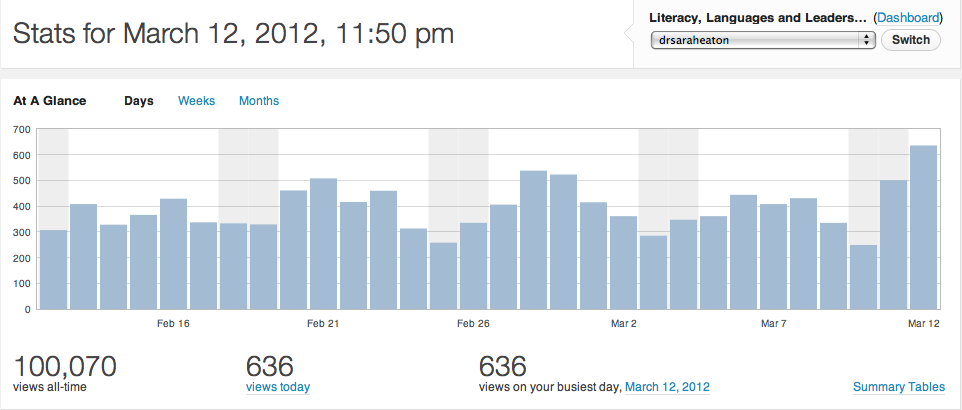
What an amazing week! My blog is just over 2 years old and this week, we topped 100,000 all-time views and 200 subscribers.

It’s definitely time to celebrate.

10 Free Webinars on How to Market and Promote Your Language or Literacy Program

Over the next 10 weeks, I’m going to host a free webinar every week. Each one will highlight different ideas from 101 Ways to Market Your Language Program. Every week you’ll get practical, low-cost ideas to help you promote any language or literacy program. Best of all, you’ll get to connect with others on line who are also interested in the same topic, ask questions and interact.

The webinars will be 30 to 60 minutes in length. Bring a pen and paper. I’m going to give you lots of ideas you can implement right away.

We’ll do the webinars for the next ten Wednesdays: March 21 to May 23, 2012

There are some time zone changes coming up around the world, so double-check these times against your local area:

Point of origin – 14:00 (2:00 p.m.) Mountain Time, March 21, 2012 – Calgary / Edmonton

16:00 (4:00 p.m.) – Eastern Time – Toronto / New York

20:00 (8:00 p.m.) – Greenwich Time – London, England

22:00 (10:00 p.m.) – Eastern European Time – Athens / Istanbul

05:00 (5:00 a.m.) – following day – Japan Standard Time – Tokyo

To join the webinar, click here: http://meet11548754.adobeconnect.com/saraheaton/ — There is no need to register. These webinars are free and open to everyone. Seating is limited though, so sign on early.

I’ll record each webinar and post it so you can view it later, too.

This is essentially a 10-week course designed to take you through the entire book from beginning to end. I’ll include some marketing “best practices” and show you how to start thinking about promoting your programs to ensure they are sustainable over the long term. I’ll share some case studies and stories, along with lots of practical “how to” information that you can use right away.

Here’s what we’ll cover

Week #1 – How to develop your marketing strategy and plan

Week #2 – Setting marketing goals, target markets, budgets

Week #3 – Focus on benefits, writing marketing materials

Week #4 – Business cards, newsletters, signs and other communications

Week #5 – What makes people care about you. How to stand out from the crowd.

Week #6 – Specialty tips for programs at large institutions

Week #7 – Relationship marketing. The power of connections.

Week #8 – It’s how you make them feel. Adding personal touches that make all the difference

Week #9 – Effective follow up with your marketing and not giving up too soon.

Week #10 – Social media for marketing

All you have to do is block off the next 10 Wednesdays in your calendar at your corresponding local time and then log in using the link above. It’s that easy. And it’s my way of showing my appreciation to you.

Thank you to everyone who has viewed the blog, left a comment or subscribed. I really love the work I do and being able to share with you, learn from you and engage with you inspires me every single day.

___________________________

Share or Tweet this post: 101 Ways to Market Your Language Program (10 Free webinars) http://wp.me/pNAh3-1j6

Update – January 2018 – This blog has had over 1.8 million views thanks to readers like you. If you enjoyed this post, please “like” it or share it on social media. Thanks!

Sarah Elaine Eaton is a faculty member in the Werklund School of Education, University of Calgary, Canada.


Dr. Sarah’s favorite resources of the week(s) (Feb. 23 to March 4, 2012)

March 5, 2012

I am behind with posting some of my favorite resources. Here are my favorite resources of the past couple of weeks, curated from my Twitter account.

Ed tech resources

Technology tools for Education Majors – Prezi

18 Free Screencasting tools to Create Video Tutorials – Web Design Blog

Seriously good resources for Screencasting – Timo Ilomäki ‘s Library

How to Build Rapport With Online Teachers – by Jennifer Williamson

Fluidsurveys – Online survey tool

7 Resources for Teaching and Learning Anatomy & Physiology – from FreeTech4Teachers

7 Strategies to Make Your Online Teaching Better – Inside Higher Ed

Literacy and languages resources

Teacher resources – Noodle Tools

The Best Apps for Learning a Foreign Language – Mobiles Please Blog

The 100 ‘Greatest Books for Kids’ – USA Today

Spark Enthusiasm – Movie and video resources for teaching Spanish

Livres audio gratuits à écouter et télécharger – Free audio books for teaching French – http://www.litteratureaudio.com/

English as a second / additional language (EAL) and related resources

Canadian Newcomer Magazine – Lots of resources and info for New Canadians

Understanding Different English Accents – Daily English Activities Blog

General education resources

40 Alternative Assessments for Learning – by Charity Preston

Differentiated Instruction – Teachers Offer Help and Resources – Teachers.net

30 Online Multimedia Resources for PBL and Flipped Classrooms – 21 Century Ed Tech

Social media resources

TweetChat – An easy way to follow Twitter chats

Related posts:

Dr. Sarah’s favorite news of the week (Feb. 6-12 2012)

Dr. Sarah’s favorite resources of the week (Jan. 30 – Feb. 5, 2012)

Dr. Sarah’s favorite resources of the week (Jan. 23-29, 2012)

Dr. Sarah’s favorite resources of the week (Jan. 16-22, 2012)

Dr. Sarah’s favorite resources of the week (Jan. 9-15, 2012)

Dr. Sarah’s favorite resources of the week (Jan. 2-8, 2012)

Dr. Sarah’s favorite resources of the week (Dec. 25, 2011 to January 1, 2012)

Dr. Sarah’s favorite resources of the week (Dec. 18-24, 2011)

Dr. Sarah’s favorite resources of the week (Dec. 11-17, 2011)

Dr. Sarah’s favorite resources of the week (Dec. 4-10, 2011)

____________________________

Share this post: Dr. Sarah’s favorite resources of the week (Feb. 27 to March 4, 2012) http://wp.me/pNAh3-1hD

Update – January 2018 – This blog has had over 1.8 million views thanks to readers like you. If you enjoyed this post, please “like” it or share it on social media. Thanks!

Sarah Elaine Eaton is a faculty member in the Werklund School of Education, University of Calgary, Canada.


10 Characteristics of Informal Learning

February 28, 2012

Before you ever go to school or take part in a Mom-and-tot program, informal learning starts the day you are born and continues on until the day you die. Here are the characteristics of informal learning:

1. Informal learning is never organized.

There are no set formulas or guidelines. Examples of informal learning include activities such as teaching your child the alphabet, or how to brush his or her teeth. There is no prescriptive program of study for this.

2. Informal learners are often highly motivated to learn.

Unlike the formal learning environment of school, informal learners are often eager and attentive. A teenager showing a friend how to find an “Easter egg” in a video game is an example of informal learning. The gamer really wants to find out how to achieve his goal, so he embarks on a journey to figure out how. His friend becomes his teacher.

3. Informal learning is often spontaneous.

Learning happens anywhere, any time. The learner is inspired to learn because of an immediate desire to know how to do something or understand a topic. Or an informal “teacher” sees an opportunity to share their knowledge or wisdom with someone else. For example, we were recently standing in line at the airport waiting to go through security. There was a family in front of us. The father, who was holding the hand of his young son, who was about seven or eight, used the posters on the wall of the security area to teach the boy to read new words. The boy sounded out the words and they talked about the content of the poster. This not only helped to pass the time during a long wait, it was a great example of spontaneous informal learning.

4. There is no formal curriculum.

There is no program of study or prescriptive methods. Whatever methods used are the one that the person teaching knows how to teach… often based on their own experience.

5. The “teacher” is someone who cares – and who has more experience than the learner.

Even the word “teacher” here is a bit of a misnomer because professional teachers all have credentials, certificates or a teaching license. In the informal learning context, those leading the learning are likely to be emotionally close to the person who is learning, such as a mother, father, grandparent or other caregiver. An adult child teaching an older parent how to use new technology is an example.

6. The world is your classroom

It is a myth that learning happens in a school or in a classroom. With informal learning, there is no classroom. Your home, the neighborhood park, the community and the world are the classroom.

7. Informal learning is difficult to quantify.

There are no exams and informal learning is difficult to quantify.

8. Often dismissed by academics and skeptics as being worthless.

Informal learning is often overlooked and not regarded as particularly valid learning. Some researchers and academics (though not all of us!) have the opinion that informal learning is less valuable than formal, prescriptive learning (due, in part, to the fact that it is difficult to quantify… and they believe that if it can not be quantified, it has no value).

Sarah Elaine Eaton education educator presenter keynote researcher Canada Alberta informal learning9. Essential to a child’s early development.

Learning your mother tongue is an excellent example of informal learning. Imagine if a child were not exposed to any language for the first 5 years. How difficult would that child’s development become? It is an experiment that, as far as I know, has never been done. It would be considered too risky and unethical. Everything a young child learns at home is informal learning, from how to brush their teeth to how to say the alphabet to good manners. Without informal learning, we would never be able to cope in a formal learning environment.

10. Essential to an adult’s lifelong learning.

Informal learning is a lifelong process. It does not end when a child enters school and the formal system “takes over”. On the contrary, children continue to learn at home. As we get older, we learn from our friends. As we enter the workforce, we learn from our co-workers. Into retirement, we still learn from friends and also from those younger than us. An adult learning to read and write from a volunteer literacy tutor is one example. A retired office worker learning from her grandson how to use an iPad is another example.

Informal learning is what keeps us vibrant, mentally active and interested in the world around us, as well as our own development. Just because informal learning can not be quantified easily does not mean that it is not worthwhile – or even essential to our development and growth as human beings.

Related posts:

Formal, Non-formal and Informal Learning (Infographic) https://wp.me/pNAh3-266

New Trends in Education: Formal, Non-formal and Informal Learning – Implications for Evaluation and Assessment

Formal, non-formal and informal learning: The case of literacy and language learning in Canada

Formal, non-formal and informal education: What Are the Differences?

Formal, Non-formal and Informal Learning: A podcast

Breathtaking Impact of Volunteers’ Contribution to Non-formal and Informal Literacy Education in Alberta

Formal, Non-formal and Informal Learning in the Sciences

_____________

Share or Tweet this post: 10 Characteristics of Informal Learning http://wp.me/pNAh3-1gJ

Update – January 2018 – This blog has had over 1.8 million views thanks to readers like you. If you enjoyed this post, please “like” it or share it on social media. Thanks!

Sarah Elaine Eaton is a faculty member in the Werklund School of Education, University of Calgary, Canada.