Tomorrow: Free webinar on using social media to market literacy and language programs

May 29, 2012

Tomorrow we wrap up our series of ten free webinars on how to market literacy programs and language schools.

Each webinar has highlighted different ideas from 101 Ways to Market Your Language Program. Tomorrow is a little different in that the ideas and strategies provided are brand new information, not published in the book. The program will be  30 to 60 minutes in length. Bring a pen and paper. I’m going to give you lots of ideas you can implement right away.

Webinar #10 of 10 – What to expect

Today’s webinar will focus on:

  • Brief overview of social media marketing for non-profit and educational programs
  • Building your social media capacity to market your programs more effectively.
  • Do’s and dont’s of social media marketing.

Webinar time

Date: Wednesday, May 30, 2012

There are some time zone changes coming up around the world, so double-check these times against your local area:

Point of origin – 14:00 (2:00 p.m.) Mountain Time, May 16, 2012 Calgary / Edmonton

16:00 (4:00 p.m.) – Eastern Time – Toronto / New York

20:00 (8:00 p.m.) – Greenwich Time – London, England

22:00 (10:00 p.m.) – Eastern European Time – Athens / Istanbul

05:00 (5:00 a.m.) – following day – Japan Standard Time – Tokyo

How to log in

There is no need to register. These webinars are free and open to everyone. Seating is limited though, so sign on early.

To join the webinar, simply click here: http://meet11548754.adobeconnect.com/saraheaton/

Will it be recorded?

You bet. I’ll record the program and post it within 24 hours or so. No charges or fees to watch these recorded programs.

Related post and recordings of past programs:

101 Ways to Market Your Language Program (10 Free webinars) http://wp.me/pNAh3-1j6

#1 Webinar recording: Marketing strategy and planning

#2 Webinar recording: Setting marketing goals and budgets

#3 Webinar recording: Writing effective marketing copy

#4 Webinar recording: Developing written marketing materials

#5 Webinar recording: Identifying what makes you unique

#6 Webinar recording: Speciality tips for programs at large institutions

#7 Webinar recording: The power of your connections

#8 Webinar recording: Relationship marketing

#9 Webinar recording: Effective marketing follow-up

___________________________

Share or Tweet this post:  Tomorrow: Free webinar on using social media to market literacy and language programs http://wp.me/pNAh3-1ql

Update – January 2018 – This blog has had over 1.8 million views thanks to readers like you. If you enjoyed this post, please “like” it or share it on social media. Thanks!

Sarah Elaine Eaton is a faculty member in the Werklund School of Education, University of Calgary, Canada.


Today’s free webinar on marketing literacy and language schools: Effective Marketing Follow-Up

May 16, 2012

We’ll have Webinar #9 on Wednesday, May 23.

Today we’re having the ninth in a series of ten free webinars on how to market and promote literacy programs and language schools.

Each webinar highlight different ideas from 101 Ways to Market Your Language Program. Every week you get practical, low-cost ideas to help you promote your program. Best of all, you’ll get to connect with others on line who are also interested in the same topic, ask questions and interact.

The webinars are  30 to 60 minutes in length. Bring a pen and paper. I’m going to give you lots of ideas you can implement right away.

Webinar #9 of 10 – What to expect

Today’s webinar will focus on:

  • Effective follow up.
  • Building patience into your marekting.
  • Not giving up too soon.

Webinar time

Date: Wednesday, May 16, 2012

There are some time zone changes coming up around the world, so double-check these times against your local area:

Point of origin – 14:00 (2:00 p.m.) Mountain Time, May 16, 2012 Calgary / Edmonton

16:00 (4:00 p.m.) – Eastern Time – Toronto / New York

20:00 (8:00 p.m.) – Greenwich Time – London, England

22:00 (10:00 p.m.) – Eastern European Time – Athens / Istanbul

05:00 (5:00 a.m.) – following day – Japan Standard Time – Tokyo

How to log in

There is no need to register. These webinars are free and open to everyone. Seating is limited though, so sign on early.

To join the webinar, simply click here: http://meet11548754.adobeconnect.com/saraheaton/

Will it be recorded?

You bet. I’ll record the program and post it within 24 hours or so. No charges or fees to watch these recorded programs.

What will future webinars cover?

Here’s what we’ll cover in our final program next week:

  • Week #10 – Social media for marketing.

All you have to do is block off Wednesdays in your calendar at your corresponding local time and then log in using the link above.

If you can’t make the webinar, and you’d like to ask a question about the topic, feel free to leave me a comment. I’ll do my best to answer questions that come in before the program during the webinar. You can watch the recording to get the answer to your question, or I’ll answer you back in the comment section.

Related post:

101 Ways to Market Your Language Program (10 Free webinars) http://wp.me/pNAh3-1j6

Recordings of past programs:

#1 Webinar recording

#2 Webinar recording

#3 Webinar recording

#4 Webinar recording

#5 Webinar recording

#6 Webinar recording

#7 Webinar recording

#8 Webinar recording

___________________________

Share or Tweet this post:  Today’s free webinar on marketing literacy and language schools: Effective Marketing Follow-Up http://wp.me/pNAh3-1ph

Update – January 2018 – This blog has had over 1.8 million views thanks to readers like you. If you enjoyed this post, please “like” it or share it on social media. Thanks!

Sarah Elaine Eaton is a faculty member in the Werklund School of Education, University of Calgary, Canada.


Letting them shine: Working with multi-organizational coalitions

April 3, 2012

A colleague and I were recently asked to facilitate a workshop for a large, multi-organizational coalition that included government, educational and non-profit stakeholders. The coalition includes over 25 organizations who have all joined forces to promote a particular aspect of education.

As facilitators, we were warned that the groups were having difficulty agreeing on a structure for their coalition network and that different stake holders came to the table with different values, philosophies and areas of expertise. Yet, they all wanted to work together. Their lack of consensus was causing concern among some members.

Traditional model of governance

The coalition had a leadership team comprised of senior members of some of the major organizations. The group had been working hard to define what the structure of their coalition would look like. Here is what they came up with:

Eaton International Consulting, Sarah Elaine Eaton, Sarah Eaton, facilitator, speaker, keynote, presenter

Characteristics of the traditional organizational structure

Org charts like this show the typical structure of a traditional organization. This chart could work for a business, a non-profit organization or a public sector organization. The characteristics that define them are fairly uniform:

  • Top-down model (Leaders are at the top)
  • Clear hierarchy
  • Orderly
  • Rigid
  • Governance-focussed
  • Straightforward and easy to understand

Why traditional models do not work for coalitions

In the traditional model there is an underlying assumption that all members who belong to the organization share the same values and that those who are lower down in the pecking order are less qualified, experienced or powerful than those at the top.

In a coalition, every member organization may have a structure like this. Or they may be a “flat organization” with very little hierarchy. In any case, in a coalition, you are bringing together collective wisdom and knowledge for a common purpose. A traditional model of governance does not work because a “pecking order” is unproductive. Members who are not at the top may feel confined and undervalued, when in fact, they have a great deal to contribute. Members at the top of the coalition may feel frustrated because they do not have all the answers and they sense disengagement from those who are lower down in the organizational structure. The result can be feelings of disempowerment, frustration, anger and ultimately, disengagement from the work that everyone has come together to do.

In addition, members may feel pressured to surrender their current organizational culture in order to become part of the new coalition. Members may feel that their identity as an organization is challenged.

The Constellation Model

We presented a different model for the member organizations to consider. This model was developed by Surman & Surman (2008). It captures the complex nature of multiple stakeholders working together based on shared interests and assets.
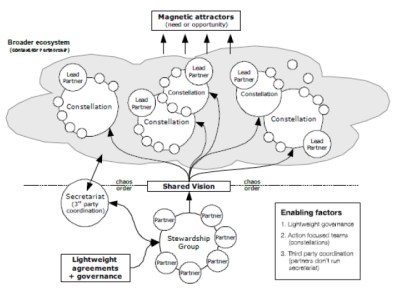
Constellation model of Social Change, Eaton International Consulting, Sarah Eaton, facilitator

At the top of the model is a “magnetic attractor”, or the purpose that caused all the groups to come together in the first place. This essentially becomes their guiding star, or in less “fluffy” language, their guiding principles. The larger group’s shared purpose is what guides them and drives their actions, defining how they will work together.

This model is light on governance. There is no separate legal entity or incorporation. Instead, action-focussed work teams called “constellations” take on the responsibility for moving certain pieces of the work forward. There is no obligation for a group to exist indefinitely. Once their work on a particular area has been completed, the constellation may be phased out, giving way to new constellations. This “phasing out” is seen as a natural progression of the work, rather than a source of anxiety. It does not mean that the foundation of the larger organization has been shaken in any way.

Instead of a traditional leadership team at the top, there is a stewardship group that serves to empower the various constellations. Their job is to set a strategic direction, monitor the coalition’s overall health. Then, it turns over the energy and power to the working groups. Each group takes the lead on a particular project or set of actions. The general terms of reference for the stewardship group are “as little process as possible”.

This model also includes a third-party secretariat whose job it is to coordinate the overall efforts of the project and troubleshoot problems. Surman and Surman point out that:

“When non-profits set up collaborative projects, they typically… (create) a secretariat within the partner who has the most capacity. This is seldom an ideal solution. Placing the coordination function within one of the partners permanently alters the power dynamic of the group. One partner takes power. The others defer responsibility and lose energy.”

In this model, the secretariat is responsible to both the stewardship team and the constellations.

Characteristics of the Constellation Model

  • Defining traits of this model are:
  • Organizationally complex
  • Lightweight governance
  • Messy
  • Exist through lightweight agreements between members
  • Fiscal and legal responsibility moves around depending on which partner is leading a constellation
  • Leadership and power are shared among members

Our process

We challenged the groups to consider the constellation model in more depth. We asked them which aspects of it resonated with them and how.

We did not tell members that their current structure was wrong or that they needed to change it. We simply presented the constellation model as a tool for further discussion.

Results

  • The group was able to engage deeply in a productive conversation about governance, leadership and structure.
  • Members gained insights into why a traditional organizational structure might not work for them.
  • Individuals who were feeling anxious and undervalued suddenly felt that they had options.
  • The group was able to acknowledge that a structure can be “messy” and still work.

Just as constellations in the sky may seem messy to the untrained eye, each functions well on its own. Sometimes stars burn out… and that is OK. In fact, it is normal and does not mean that the universe is falling apart. There is a natural ebb and flow to all work and process.

As facilitators we were astounded at the depth of conversation and levels of engagement. We brought the constellation to the table as a tool to generate dialogue. The unexpected result for us was a sense of relief, mixed in with excitement. Members felt that they had a better understanding of how many organizations could work together effectively without giving up their own identity or culture.

References:

Here are some of the resources that we drew upon in order to prepare for and deliver the workshop:

Byers, R. (2011). “Models and Elements of Collaborative Governance” from @ A Glance: A Resource of the Healthy Communities Consortium.

Cooperrider, D. L., Whitney, D., & Stavros, J. M. (2003). Appreciative inquiry handbook. Bedford Heights, OH: Lakeshore Publishers.

Koch, J. (2005). The Efficacy of Asset-Based Community Development (ABCD) in the Educational Context. (Master’s Thesis).University of Calgary, Calgary.

Kretzmann, J. P., & McKnight, J. L. (1993). Building Communities from the Inside Out: A Path Toward Finding and Mobilizing a Community’s Assets. Skokie, IL: ACTA Publications.

Kretzmann, J. P., McKnight, J. L., Dobrowolski, S., & Puntenney, D. (2005). Discovering Community Power: A Guide to Mobilizing Local Assets and Your Organization’s Capacity. from the Asset-Based Community Development Institute, School of Education and Social Policy, Northwestern University: http://www.abcdinstitute.org/docs/kelloggabcd.pdf

Storti, C. (1990). The art of crossing cultures. Yarmouth, ME: Intercultural Press, Inc.

Surman, T. (2006, March 15, 2012) Constellation Collaboration: A model for multi-organizational partnership. Retrieved from http://www.socialinnovationexchange.org/files/event/attachments/Constellation%20Model%20Description%20June%209%2706.pdf

Surman, T., & Surman, M. (2008). Listening to The Stars: The Constellation Model of Collaborative Social Change. Social Space. Retrieved from http://socialinnovation.ca/sites/default/files/Constellation%20Paper%20-%20Surman%20-%20Jun%202008%20SI%20Journal.pdf

Wheatley, M. J. (2006). Leadership and the New Science: Discovering Order in a Chaotic World (3rd. ed.). San Francisco: Berrett-Koehler Publishers, Inc.

_________________________________

Share or Tweet this post: Letting them shine: Working with multi-organizational coalitions http://wp.me/pNAh3-1kO

Update – January 2018 – This blog has had over 1.8 million views thanks to readers like you. If you enjoyed this post, please “like” it or share it on social media. Thanks!

Sarah Elaine Eaton is a faculty member in the Werklund School of Education, University of Calgary, Canada.


Is being a language teacher dangerous to your health?

March 13, 2012

Do you work in poor, run-down conditions? Or an old building that’s falling apart?

Amelia’s story

Amelia Labbe Sarah Eaton University of CalgaryWhen I started my Master’s degree in Spanish at the University of Calgary, I heard staff and professors complaining about the air quality and run down conditions in Craigie Hall, the building where the modern language departments are housed. I never really thought about it much, since I head my head buried in my books and I was learning to live in a new city and adjust to the pressures of being a young graduate student.

One of the first people to welcome me into the department was Amelia Labbé. A native of Bolivia, Amelia ran the university’s Centro de Tertulia (Spanish Centre). Officially, Amelia’s job was to provide opportunities for conversation with a native speaker. Unofficially, the Centro de Tertulia became a place where students would gather, socialize in Spanish, help one another with their homework, listen to music in Spanish and sometimes even watch telenovelas.  There was only one rule: When you crossed the threshold in to the Centro, it was Spanish only. No English. No French. Solamente español. It was her one rule and she stuck to it.

Amelia also became a mentor and unofficial advisor to many students who sought her council and words of wisdom, even though it was not part of her job. Officially, the university has designated student advisors and anyone who is not a designated advisor is not supposed to offer guidance to students. But that didn’t stop students from asking her what she thought and seeking her advice. Students trusted her. They could tell that she cared deeply about them… In fact, she cared more about the students than she did about regulations or rules. Over the course of her career, she touched the lives of thousands of students who studied Spanish at the University of Calgary, including mine.

Last fall, Amelia fell ill. She blamed it on the building where she worked, which was known to have asbestos in it. On November 8, 2011, Amelia passed away from pulmonary fibrosis. Along with many of my friends and colleagues, I attended the celebration of her life on November 19.

Faculty and staff complaints about poor air quality are blown off

Since then, twenty years of complaints about the state of the building and questions about its air quality have erupted into a full-scale war. I have gone from being a Master’s student to working in the Language Research Centre, where I now have the privilege of being a Research Associate and an Adjunct Assistant Professor, after finishing my Ph.D.

An informal investigation was held a few years ago when it was determined that an extraordinarily high percentage of the faculty and staff had been diagnosed with cancer. Many of them pointed to their physical working conditions as a factor in their illness. Tests were done. Faculty and staff were told that everything was fine. Sadly, the incidence of cancer diagnosis among language faculty continued. Others were diagnosed with asthma and unknown allergies. No one could prove any correlation between the physical environment and the incidence of illness.

Following Amelia’s passing, some faculty members and staff insisted that a full investigation be conducted. Today, the CBC published, “Teacher’s lung disease death prompts U of C building worries: But officials say Craigie Hall air quality not compromised by asbestos“. The story documents reactions to Amelia’s health issues and subsequent passing, and speculations that her physical work environment were the root cause of her death. Amelia’s husband and my colleague and mentor, Dr. Rachel Schmidt, publicly offered commentary to reports.The university released a statement declaring that “air quality and environment are within the acceptable guidelines“.

Language programs: Between a rock and a hard place

In my Ph.D. research I found that it is not uncommon for language programs at large institutions to be marginalized both politically and in terms of their physical placement on a campus.

Here’s an excerpt from my Ph.D. thesis:

Language programs, because they are not necessarily seen as academic in nature, do not always have a prominent place on campus. While it would be logical for ESL programs to be physically positioned in places that are easily accessible by foreign students who struggle with the language, “many … programs are housed in temporary bungalows, in basements, or on the periphery of our campuses” (Stoller, 1997, p. 40).

This assertion is echoed more recently by Quay Connection (2000, p. 14) whose research shows that “Many providers say their facilities are too run down, too small, impermanent, unattractive.” This speaks to the question of the legitimacy of such programs, which is discussed later on. For now it is enough to note that the physical placement of such programs on a campus is one indicator of how they are viewed by administration (Stoller, 1997). Program managers must often advocate for improved space and facilities for their programs. (Eaton, 2009, pp. 66-67).

My thesis dealt specifically with ESL programs. In the case of one of the programs I studied, it had just recently been relocated to the main floor of the building. Previous to that, it was located on the 14th floor of the building. The very odd thing about that particular building was that the 14th floor was accessible only by taking the elevator to the 13th floor and then taking the stairs up one more floor. So, non-native speakers of English were required to navigate a complex procedure in order to get to the program offices. Even native speakers had trouble figuring out how to get to their offices.

Even though the Department of French, Italian and Spanish has been renovated now, the Department of Germanic, Slavic and East Asian languages is still in need of renovations. Both language departments remain in an unattractive and outdated building with an elevator that is often broken down. The building is known to have asbestos.

A jumping off point

It seems that there is some evidence that shows that language programs are located in physical spaces that are far from ideal. In the work I have done with language programs at high schools, colleges and universities, this seems to be a common complaint… but with little to no research to identify whether or not this is indeed a problem in the field of language teaching. My guess is that large scale studies about the physical marginalization of language programs at institutions have never been done. (If you know of any such studies, please leave a comment!)

Language programs should not be relegated to old, run down buildings or pushed into basements. Language program administration and management includes advocating for programs and courses. As faculty and staff, it is our responsibility to advocate for one another, too. Some recommendations to consider:

  1. Have conversations with colleagues about the physical conditions in which you work. Are they adequate? Does your physical space promote health and well-being?
  2. Advocate for an improved location on your campus. Particularly in the case of ESL programs, students need to be able to find your offices.
  3. Engage in conversations and dialogue with faculty committees and administrators.
  4. If you suspect health issues that are due to your physical environment, keep detailed records and write it all down. Without documentation, it is more difficult to make a case for further investigation.
  5. Draw on support from your faculty association or union, if you have one. These bodies exist to protect workers’ rights, including their health.
  6. Take care of yourself. If  you are suffering ill effects and you believe that your work environment may be a contributing factor, do what you need to do to keep yourself healthy. I have colleagues in Craigie Hall who work as much as possible from home, one now works in another building and another brought in her own air filtration machine for her office. None of these is a perfect solution, but they may help. If nothing else, they give the employees a sense of empowerment, which is essential when you’re fighting cancer, or another life-threatening illness.

I’ve now watched a friend and colleague die and an alarming number of other friends have been diagnosed with cancer or asthma. No one knows for sure what the cause is. They’re all pretty convinced that the building where they work is a factor.

How’s the physical space where your language program is located?

References:

Eaton, S.E. (2009). Marketing of Revenue-generating ESL Programs at the University of Calgary: A qualitative study. Thesis. University of Calgary, Canada.

Quay-Connection. (2000). Marketing ACE in Victoria. Annadale (Australia): Adult, Community and Further Education Board, Melbourne (Australia).

Stoller, F. L. (1997). The catalyst for change and innovation. In M. A. Christison & F. L. Stoller (Eds.), A handbook for language program administrators (pp. 33-48). Burlingame, CA: Alta Book Center Publishers.

Update on this story: On March 21, I was quoted in the Calgary Herald’s article, “Craigie Hall Asbestos Level Normal: Review“. The article was written after the university released a report stating that everything was fine with the air quality in the building. Still though… it is puzzling why so many staff complain of health concerns?

____________

Share or Tweet this post: Is being a language teacher dangerous to your health? http://wp.me/pNAh3-1iJ

Update – January 2018 – This blog has had over 1.8 million views thanks to readers like you. If you enjoyed this post, please “like” it or share it on social media. Thanks!

Sarah Elaine Eaton is a faculty member in the Werklund School of Education, University of Calgary, Canada.


Social Media Literacy for Business Owners: What You Don’t Know Can Hurt You

January 4, 2012

Sarah Eaton - Author published by Social Media TodayMy latest article, published by Social Media Today, is “Social Media Literacy for Business Owners: What You Don’t Know Can Hurt You” tells the story of a local business owner whose lack of engagement with social media hurt his relationship with his customers and his business. The article offers 5 tips for business owners to boost their understanding of what social media is and why it can help their  business.

Though the article is written about a business, the same principles apply to non-profit and social sector organizations.

________________

Share or Tweet this post: Social Media Literacy for Business Owners: What You Don’t Know Can Hurt Yohttp://wp.me/pNAh3-18P

Update – January 2018 – This blog has had over 1.8 million views thanks to readers like you. If you enjoyed this post, please “like” it or share it on social media. Thanks!

Sarah Elaine Eaton is a faculty member in the Werklund School of Education, University of Calgary, Canada.
