A Comprehensive Academic Integrity (CAI) Framework: An Overview

April 14, 2023

This post is a reprint of a self-archived document available here: https://prism.ucalgary.ca/handle/1880/116060

Background

As I write this, the Handbook of Academic Integrity (2nd ed.) is well underway. All the chapters have been submitted and are at various stages of review, revision, and production. Page proofs should start going out to contributing authors this month. This has been a massive project: 150+ authors, 109 chapters, 9 section editors, and me herding all the cool cats who have made it happen.

After all the chapters had been submitted, I realized that we had something new and fresh with this edition. We have pushed the boundaries beyond persistently historical ideas about academic integrity only as a matter of student conduct. So, I wrote an introduction for the handbook that synthesizes some its through lines. The common threads of this updated edition are summed up in this Comprehensive Academic Integrity (CAI) framework.

I wrote this intro in two epic writing sessions, fuelled by gallons of coffee, Vegemite on toast, and a pizza that a friend had delivered to my house because he felt sorry for me eating Vegemite on toasted bread crusts. (I am not kidding.) Anyway, first, I drafted the chapter in full. Then I asked a couple of other section editors and contributors to the handbook to provide me with an open peer review of the draft. In the chapter I acknowledge them by name and I re-iterate my gratitude to them here. Thanks are due to Guy Curtis, Brenda M. Stoesz, Rahul Kumar, Beatriz Moya, and Bibek Dahal for their feedback that helped me to improve the chapter. In the second writing session, I incorporated just about all of their suggestions and completely re-vamped the visual image to the one you see below. The CAI Framework is a high-level synthesis of all the chapters in the handbook and as such, every single author who has contributed to the handbook (as well as those they have cited in their respective chapters) all deserve credit.

According to the publisher’s rules around self-archiving and pre-prints, I am not allowed to share the entire chapter with you ahead of publication. But I can share a summary of it, so I’m doing that here. I’ve also self-archived a copy of this overview (minus the background commentary about Vegemite and pizza) in our university’s digital repository. On the off-chance you want to cite the “official” version of the summary, I have included instructions below. You’ll have to wait for the Handbook to be published to read the full chapter, but in the meantime, I hope this overview is useful.

How to cite this overview

Eaton, S.E. (2023). A Comprehensive Academic Integrity (CAI) Framework: An Overview. Calgary, Canada: University of Calgary. https://prism.ucalgary.ca/handle/1880/116060

Overview

For years scholars and other experts have called for a more holistic approach to academic integrity (e.g., Bertram Gallant, 2008; Boud & Bearman, 2022; Bretag et al, 2014; Carrol & Duggan, 2005; Löfström et al., 2015; Morris & Carrol, 2016; Turner & Beemsterboer, 2003). The CAI framework synthesizes ideas that have been repeated for decades in various iterations.

The central argument behind a wholistic framework is that academic integrity must encompass, but extend beyond, notions of student conduct, and should be considered a foundation of all aspects of education. In this framework, I do not propose a new definition of academic integrity in part, because several useful definitions already exist (see Bretag, 2016; ICAI, 2021; Tauginienė et al., 2018). Instead, this framework can be used with existing definitions.

The Comprehensive Academic Integrity (CAI) framework includes eight (8) essential elements that includes, and extends beyond traditional notions of academic integrity merely as a student responsibility:

  • everyday ethics
  • institutional ethics
  • ethical leadership
  • professional and collegial ethics
  • instructional ethics
  • student academic conduct
  • research integrity and ethics
  • publication ethics

Figure 1. Comprehensive Academic Integrity (CAI) Framework
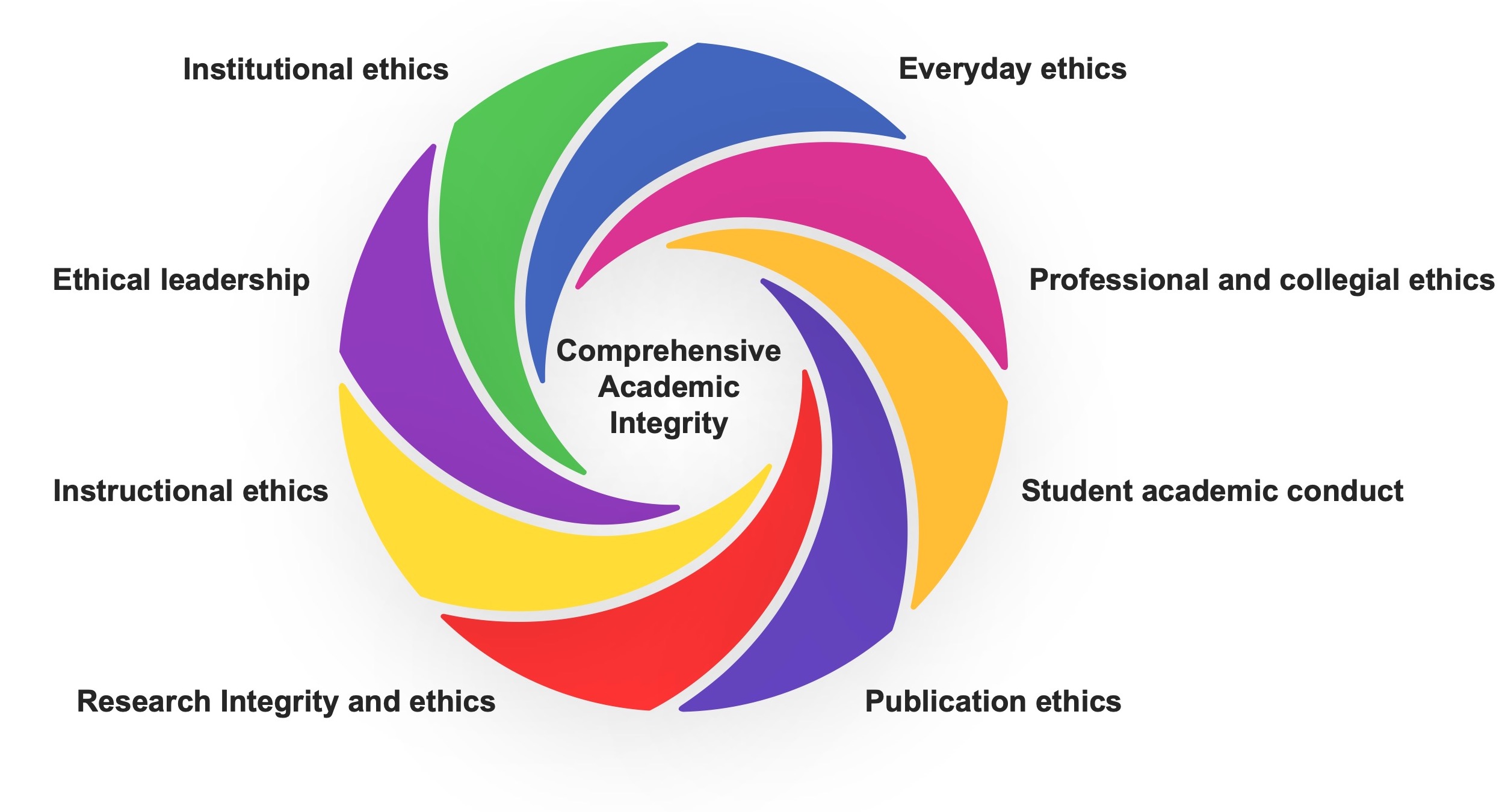
A circle with eight colourful swirls (one each in green, blue, pink, dark yellow, darker purple, red, bright yellow, medium purple, and green). There is black text associated with each swirl. This image is a graphic representation of the Comprehensive Academic Integrity (CAI) framework.

Keywords

academic integrity, student conduct, student affairs, research ethics, research integrity, publication ethics, instructional ethics, pedagogy, everyday ethics, experiential learning, definition, ethical decision-making, morals, values, virtues, leadership, equity, diversity, inclusion, accessibility, justice, decolonization, Indigenization

Postscript

Appreciation to Kieran Forde at the University of British Columbia for his most awesome interpretation of the graphic as a “colourful swirly donut”. Who doesn’t love donuts?! Thanks, Kieran!

References

Bertram Gallant, T. (2008). Academic integrity in the twenty-first century: A teaching and learning imperative. Wiley.

Boud, D., & Bearman, M. (2022). The assessment challenge of social and collaborative learning in higher education. Educational philosophy and theory, 1-10. https://doi.org/10.1080/00131857.2022.2114346   

Bretag, T. (2016). Educational integrity in Australia. In T. A. Bretag (Ed.), Handbook of Academic Integrity (pp. 1-13). Springer Singapore. https://doi.org/10.1007/978-981-287-079-7_2-1 

Bretag, T., Mahmud, S., Wallace, M., Walker, R., McGowan, U., East, J., Green, M., Partridge, L., & James, C. (2014). ‘Teach us how to do it properly!’ An Australian academic integrity student survey. Studies in higher education, 39(7), 1150-1169. https://doi.org/10.1080/03075079.2013.777406

Carroll, J., & Duggan, F. (2005, December 2-5). Institutional change to deter student plagiarism:  What seems essential to a holistic approach? 2nd Asia-Pacific Educational Integrity Conference, University of Newcastle, Callaghan, Australia.

Eaton, S. E. (forthcoming). Comprehensive academic integrity (CAI): An ethical framework for educational contexts. In S. E. Eaton (Ed.), Handbook of Academic Integrity (2nd ed.). Springer. 

International Center for Academic Integrity (ICAI). (2021). The fundamental values of academic integrity (3rd ed.). https://academicintegrity.org/resources/fundamental-values

Löfström, E., Trotman, T., Furnari, M., & Shephard, K. (2015). Who teaches academic integrity and how do they teach it? Higher Education, 69(3), 435-448. https://doi.org/10.1007/s10734-014-9784-3

Morris, E. J., & Carroll, J. (2016). Developing a sustainable holistic institutional approach: Dealing with realities “on the ground” when implementing an academic integrity policy. In T. Bretag (Ed.), Handbook of Academic Integrity (pp. 449-462). Springer Singapore. https://doi.org/10.1007/978-981-287-098-8_23

Tauginienė, L, Gaižauskaitė, I, Glendinning, I, Kravjar, J, Ojsteršek, M, Ribeiro, L, Odiņeca, T, Marino, F, Cosentino, M, Sivasubramaniam, S, Foltýnek, T. Glossary for Academic Integrity. ENAI Report 3G [online]: revised version, October 2018. https://www.academicintegrity.eu/wp/wp-content/uploads/2023/02/EN-Glossary_revised_final_24.02.23.pdf

Turner, S. P., & Beemsterboer, P. L. (2003). Enhancing academic integrity: Formulating effective honor codes. Journal of Dental Education, 67(10), 1122-1129. https://doi.org/10.1002/j.0022-0337.2003.67.10.tb03705.x

_________________________________

Share this post: A Comprehensive Academic Integrity (CAI) Framework: An Overview – https://drsaraheaton.wordpress.com/2023/04/14/a-comprehensive-academic-integrity-cai-framework-an-overview/

This blog has had over 3 million views thanks to readers like you. If you enjoyed this post, please “like” it or share it on
social media. Thanks!

Sarah Elaine Eaton, PhD, is a faculty member in the Werklund School of Education, and the Educational Leader in Residence, Academic Integrity, University of Calgary, Canada. Opinions are my own and do not represent those of the University of Calgary.


Understanding Academic Integrity from a Teaching and Learning Perspective: Engaging with the 4M Framework

August 27, 2020

This post situates academic integrity within the scholarship of teaching and learning (SoTL) discourse. The 4M framework frames integrity through a four interrelated organizational lenses: (a) micro (individual); (b) meso (departmental); (c) macro (institutional); and (d) mega (community).

Keywords: academic integrity, scholarship of teaching and learning (SoTL), pedagogy, 4M framework, systems theory.

Introduction

Using a framework to understand complex issues, such as those relating to academic integrity, can be helpful while avoiding being overly reductionist. For a long time scholars and educators haven calling for more pro-active and pedagogical approaches to academic integrity (Eaton et al., 2017; Howard, 2002; Morris, 2016). One scholar has even called academic integrity a “teaching and learning imperative” (Bertram Gallant, 2008). In addition, the position that academic integrity is solely a student responsibility is now considered outdated, as advocates call for multi-stakeholder approaches that engage various members of the learning community including students, educators, and administrators, in different but interconnected ways (Eaton et al., 2017; Morris, 2016).

To help us understand how all these different stakeholders play a role, a systems approach to academic integrity can be helpful (Bertram Gallant, 2016; Bertram Gallant & Kalichman, 2011; Drinan & Bertram Gallant, 2008).

Systems thinking is not new; it has been around for more than half a century, if not longer (Bronfenbrenner, 1976; 1981; von Bertalanffy, 1968).

The 4M Framework

Systems theory helped to inform the conceptualization of the 4M Framework, which was developed within the Scholarship of Teaching and Learning (SoTL) community to help educators understand teaching and learning inquiry (Friberg 2016; Kalu et al., 2018; Kenny et al., 2016; Poole & Simmons, 2013; Simmons, 2016; Williams et al., 2013). The framework consists of four nested levels: micro, meso, macro, and mega.

The 4M Framework: Micro, Meso, Macro, and Mega Levels

The 4M Framework: Micro, Meso, Macro, and Mega Levels

The Micro Level: Individual

Individual students and educators are at the heart of the 4M framework. Each person’s conceptual understanding of academic integrity, as well as practical skills such as paraphrasing, citing, and referencing, develop at an individual level. But this learning does not happen in isolation. It is impacted by other individuals within the system, as well as the system itself.

Individual educators also operate at the micro level when they are preparing course content, lessons and activities. Research has shown over and over again that students are more likely to care about academic integrity when educators show that it matter to them, too (Bertram Gallant, 2018; McCabe et al., 2012; Eaton et al., 2017). It is at this level that educators can have a direct and lasting impact on teaching students how to engage in ethical decision making and also how to build practical skills such as paraphrasing, citing and referencing.

The Meso Level: Departmental

At this level, academic departments and support units, such as the library or the student affairs office, provide resources and learning opportunities that allow academic integrity to be operationalized. At this level support for academic integrity can be hands-on and pro-active in the form of workshops, tutorials, and practical resources.

The Macro Level: Learning Organization

The learning organization (e.g., college or school) is responsible for setting the institutional direction and culture for academic integrity. This includes having clearly articulated policies and procedures that can be applied fairly and equitably across the institution. Leaders at this level can also act as champions who set the tone for the entire school (McCabe et al, 2012).

The Mega Level: Community

This level includes stakeholders who are connected with the school, but who may not be involved on a day-to-day basis. This includes government bodies, alumni, parents and others who can be engaged to as partners in promoting academic integrity and ethical conduct in a variety of ways.

It is important to engage with colleagues from other institutions to form networks of professional practice (Kenny et al., 2016). This helps us to expand our understanding, push our boundaries and learn with and from one another. When we engage with colleagues outside of our institutions, we are engaging at the mega level. This is essential for those working in academic integrity contexts, where there might be only a handful of individuals directly engaged with this work on a day-to-day basis. Ongoing engagement with a network of like-minded professionals is key to continuing our professional learning in a sustained and sustainable way.

Conclusions

The 4M lens helps us to understand who the various stakeholders are and how they can play a role in upholding and enacting academic integrity in our learning communities. Creating a culture of integrity cannot happen if only certain individuals are engaged (McCabe et al., 2012). Instead, creating a culture of integrity requires intentional and sustained effort across a variety of different stakeholder groups within the institution.

Discussion Questions

  • Who are some of the stakeholders actively engaged in promoting academic integrity at your school?
  • How are you engaging stakeholders at every level of your school to uphold and enact academic integrity?
  • How are you creating a culture of integrity at your school?

References

Bertram Gallant, T. (2008). Academic integrity in the twenty-first century: A teaching and learning imperative. Hoboken, NJ: Wiley.

Bertram Gallant, T. (2016). Systems approach to going forward: Introduction. In T. Bretag (Ed.), Handbook of Academic Integrity (pp. 975-977). Singapore: Springer Singapore.

Bertram Gallant, T., & Kalichman, M. (2011). Academic ethics: A systems approach to understanding misconduct and empowering change in the academy. In T. Bertram Gallant (Ed.), Creating the ethical academy: A systems approach to understanding misconduct and empowering change in higher education (pp. 27-44). New York: Routledge.

Boyer, E. L. (1990). Scholarship reconsidered: Priorities of the professoriate. New York: The Carnegie Foundation for the Advancement of Teaching.

Bronfenbrenner, U. (1976). The Experimental Ecology of Education. Paper presented at the American Educational Research Association (AERA), San Francisco, CA

Bronfenbrenner, U. (1981). The ecology of human development: Experiments by nature and design. Cambridge: Cambridge: Harvard University Press.

Drinan, P. M., & Bertram Gallant, T. (2008). Plagiarism and academic integrity systems. Journal of Library Administration, 47(3-4), 125-140. doi:10.1080/01930820802186472

Eaton, S. E., Guglielmin, M., & Otoo, B. (2017). Plagiarism: Moving from punitive to pro-active approaches. In A. P. Preciado Babb, L. Yeworiew, & S. Sabbaghan (Eds.), Selected Proceedings of the IDEAS Conference 2017: Leading Educational Change Conference (pp. 28-36). Calgary, Canada: Werklund School of Education, University of Calgary. https://prism.ucalgary.ca/handle/1880/52096

Friberg, J. C. (2016). Might the 4M Framework Support SoTL Advocacy? (July 11). Retrieved from https://illinoisstateuniversitysotl.wordpress.com/2016/07/11/might-the-4m-framework-support-sotl-advocacy/

Howard, R. M. (2002). Don’t Police Plagiarism: Just TEACH! The Education Digest, 67(5), 46-49.

Kenny, N., Watson, G. P. L., & Desmarais, S. (2016). Building sustained action: Supporting an institutional practice of SoTL at the University of Guelph. New Directions for Teaching and Learning, 2016(146), 87-94. doi:10.1002/tl.20191

Kalu, F., Dyjur, P., Berenson, C., Grant, K. A., Jeffs, C., Kenny, N., & Mueller, R. (2018). Seven voices, seven developers, seven one things that guide our practice. To Improve the Academy, 37(1), 111-127. doi:10.1002/tia2.20066

McCabe, D. L., Butterfield, K. D., & Treviño, L. K. (2012). Cheating in college: Why students do it and what educators can do about it. Baltimore, MD: Johns Hopkins University Press.

Morris, E. J. (2016). Academic Integrity: A Teaching and Learning Approach. In T. Bretag (Ed.), Handbook of Academic Integrity (pp. 1037-1053). Singapore: Springer Singapore.

Poole, G., & Simmons, N. (2013). Contributions of the scholarship of teaching and learning to quality enhancement in Canada. In R. Land & G. Gordon (Eds.), Enhancing quality in higher education international perspectives (pp. 278-298). London: London: Routledge.

Simmons, N. (2016). Synthesizing SoTL institutional initiatives toward national impact. New Directions for Teaching and Learning, 2016(146), 95-102. doi:10.1002/tl.20192

von Bertalanffy, L. (1968). General system theory: Foundations, development, applications. New York: George Braziller.

Williams, A. L., Verwoord, R., Beery, T. A., Dalton, H., McKinnon, J., Strickland, K., . . . Poole, G. (2013). The Power of social networks: A model for weaving the scholarship of teaching and learning into institutional culture. Teaching & Learning Inquiry: The ISSOTL Journal, 1(2), 49-62. doi:10.2979/teachlearninqu.1.2.4

_____________________

To cite this post in your own work, refer to the original report archived online:

Eaton, S. E. (2020). Understanding Academic Integrity from a Teaching and Learning Perspective: Engaging with the 4M Framework. Calgary: University of Calgary. http://hdl.handle.net/1880/112435

For a deeper dive into this topic, read more in:

Eaton, S. E. (2021). Plagiarism in higher education: Tackling tough topics in academic integrity. Santa Barbara, CA: Libraries Unlimited.

_________________________________

Share or Tweet this: Understanding Academic Integrity from a Teaching and Learning Perspective: Engaging with the 4M Framework https://drsaraheaton.wordpress.com/2020/08/27/understanding-academic-integrity-from-a-teaching-and-learning-perspective/

This blog has had over 2 million views thanks to readers like you. If you enjoyed this post, please “like” it or share it on social media. Thanks!

Sarah Elaine Eaton, PhD, is a faculty member in the Werklund School of Education, and the Educational Leader in Residence, Academic Integrity, University of Calgary, Canada. Opinions are my own and do not represent those of the University of Calgary.


Language Teaching and Technology – EDER 669.73 Summer 2014

June 17, 2014

I am so excited to be teaching “Language Learning and Technology” this summer in the Master’s of Education program in the Werklund School of Education at the University of Calgary. The course combines theory and practice, looking at a variety of topics around technology and language pedagogy.

One of the elements I am most excited about is that some of the course content will be decided up on and driven by the students themselves. They get to choose what articles they read, as well as facilitate and shape the online dialogue we engage in. I’ve organized some broad general topics that we’ll follow, but the students will have the opportunity to co-create the course with me throughout the summer semester. We’ll customize much of what we do to their interests and let them drive their own learning process.

Here is a copy of the course outline:

View this document on Scribd

This course combines two of my favorite topics: language learning and technology. I’m so excited to engage with the students during this learning journey.

____________________________________________________

If you enjoyed this post, please “like” it or share it on social media. Thanks!

Share or Tweet this: Language Teaching and Technology – EDER 669.73 Summer 2014 http://wp.me/pNAh3-1Ii

This blog has had over 1.8 million views thanks to readers like you. If you enjoyed this post, please “like” it or share it on social media. Thanks!

Sarah Elaine Eaton is a faculty member in the Werklund School of Education, University of Calgary, Canada.


Inquiry and ICT: Inquiry in Curriculum

July 4, 2012

University of Calgary logoI’m tickled pink to be teaching an intensive Master’s of Education course this summer at the University of Calgary. Here’s an excerpt from the course outline that describes the cool content we get to do:

Course description

This examines fundamental questions related to Information Communication Technology (ICT) and education in the 21st century. Through this course, students will examine:

  • the ways in which inquiry and digital technologies open new possibilities for representation, creation, expression and engagement;
  • the ways in which fundamental conceptions of learning, pedagogy and design reflexively influence one another;
  • the links between these conceptions and current issues in technology integration in schools;
  • the necessity of teachers of 21st century learners to be designers of learning;
  • issues of instructional design for the meaningful integration of technology in K-12 settings, including the use of Web 2.0 environments;
  • and a model of instructional design that fosters individual and collaborative searches for meaning in ambiguous, multi-dimensional environments.

Via inquiry and technology, students will explore visions of an education that not only informs learners but also equips them with knowledge, attitudes, and thinking and learning skills for nimble adaptability and responsible participation in a complex world.

Yesterday was our first day and I can’t wait to get back at it today.

______________

Share or Tweet this post:  Inquiry and ICT: Inquiry in Curriculum http://wp.me/pNAh3-1rL

Update – January 2018 – This blog has had over 1.8 million views thanks to readers like you. If you enjoyed this post, please “like” it or share it on social media. Thanks!

Sarah Elaine Eaton is a faculty member in the Werklund School of Education, University of Calgary, Canada.


What makes a teacher effective? 5 great resources

April 27, 2012

We talk a lot about what it means to be an effective learner. The flip side of that is what it takes to be an effective teacher.

Here are five outstanding resources on teacher effectiveness:

Increasing Teacher Effectiveness (2nd ed.) by Lorin W Anderson – published by UNESCO

Accelerating College and Career Readiness in States: Teacher Effectiveness – from Achieve

Best Practices for Teacher Effectiveness – from the National Council on Teacher Quality

Promoting Teacher Effectiveness in Adult Education – from the U.S. Department of Education

Instructor Competencies for Adult Education (Draft) – from the American Institute for Research

What do you think makes a teacher effective?

__________________________

Share or Tweet this post: What makes a teacher effective? 5 great resources http://wp.me/pNAh3-1nz

Update – January 2018 – This blog has had over 1.8 million views thanks to readers like you. If you enjoyed this post, please “like” it or share it on social media. Thanks!

Sarah Elaine Eaton is a faculty member in the Werklund School of Education, University of Calgary, Canada.