Promotion to Professor: Reflecting on a Three-Decade Journey

June 25, 2024

It has been a while since I have blogged. Life has been non-stop this year, but I wanted to take a moment to share some good news. I have been promoted to the rank of Professor, effective July 1, 2024. A few months back, I was also named as the Werklund Research Professor, which is a prestigious research chair in the Werklund School of Education.
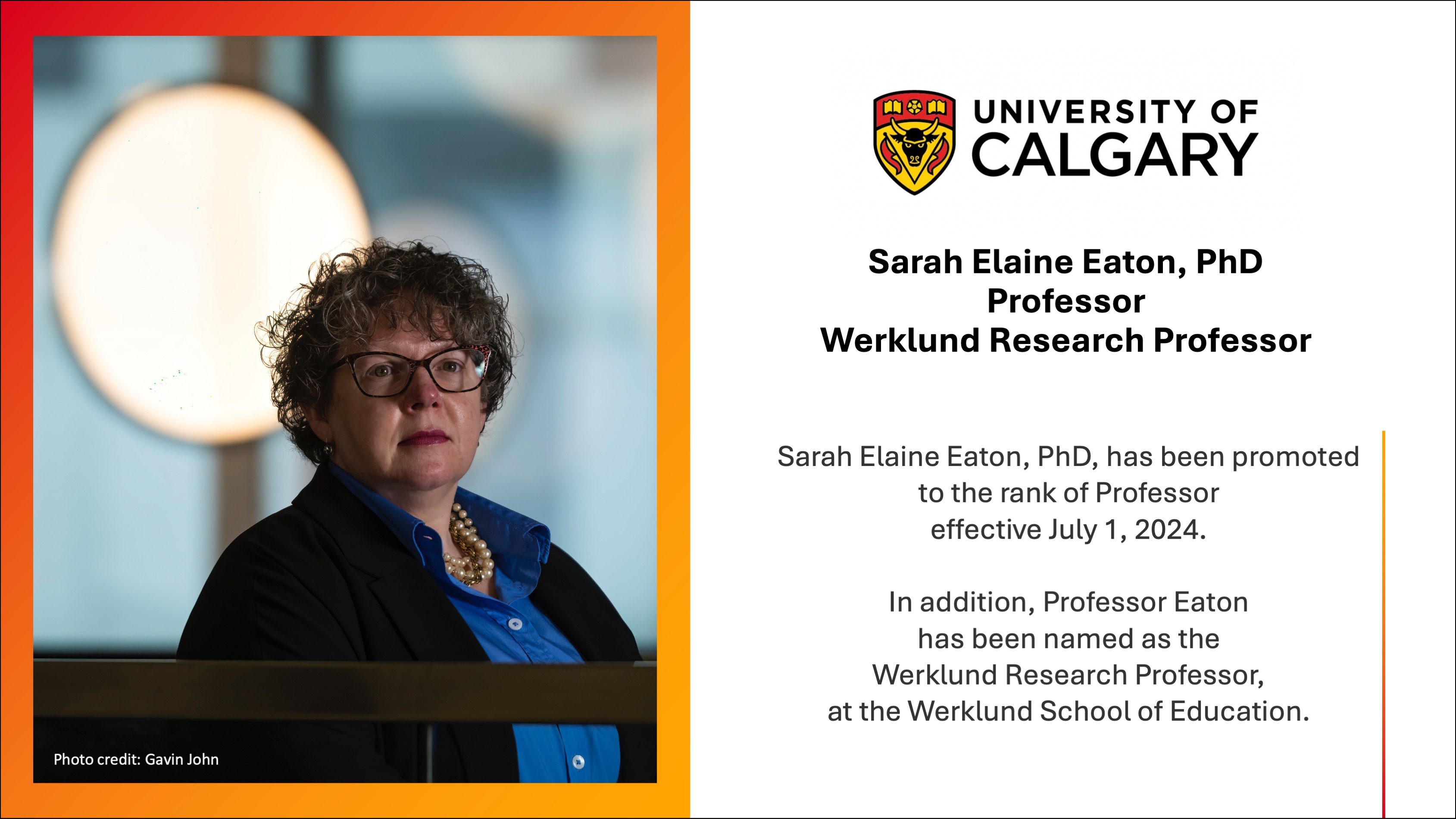
AltText: An announcement postcard. On the left is a photo of a woman with curly hair wearing glasses, a blue shirt, a black jacket and a pearl necklace. The are is an abstract background and the photo is framed in red and orange. On the right is the University of Calgary logo and black text that reads: Sarah Elaine Eaton, PhD, Professor, Werklund Research Professor. Sarah Elaine Eaton, PhD, has been promoted to the rank of Professor effective July 1, 2024.

In addition, Professor Eaton has been named as the Werklund Research Professor, at the Werklund School of Education.

I have long had a passion for integrity and ethics. I am grateful to have an opportunity to focus on ethics in my scholarship, advocacy, and leadership. The Werklund Research Professorship is a prestigious research chair, internally funded through the philanthropic generosity of Dr. David Werklund, the named patron of the Werklund School of Education. To the best of my knowledge, this is the first time anywhere in the world that a research chair role has focused on academic and research integrity. I am honoured to take up this work to advance scholarship related to ethics and integrity in higher education.

I was a first-generation student. Neither of my parents finished high school. When I was a child, my mother drilled into me that there was nothing more important than getting an education, working hard, and being independent. I have written about this, and part of my early life here. I started working when I was 15 and my first job was in a grocery store. When I first applied to university after graduating from secondary school, I had no idea how to go about filling out the application. Like many first-in-family students, I did not even know what questions to ask. I received modest scholarships throughout my studies, but I also worked, often at multiple part-time jobs, to pay the bills (including tuition), buy books, and put food on the table. I wasn’t something that I felt was a hardship, it was just something I did.

The promotion to full professor comes after 30 years of teaching at the University of Calgary. From 1994 to 2016, I taught on contract as a sessional instructor. After 22 years of precarious employment, I secured a tenure-track role in 2016. In 2020, I was promoted to associate professor with tenure. When considered in the context of the entirety of career, advancements are neither quick, nor easy. For more than two decades, I worked on semester-to-semester contracts, never knowing for sure if I would be employed in the following term until the contract actually came through. I established and successfully ran a consulting company that I maintained for twenty years, serving clients in industry, non-profit, and government. I enjoyed that work (mostly), but there were many aspects of running a business that I was horrible at.

There are plenty of things I am not good at, but I have always excelled at writing, reading, and synthesizing large amounts of information. I love working with students and I am well suited to online teaching and graduate supervision. I have not always had the luxury of being able to do work that I am good at and I recognize that it is a privilege to have a job where I can use my talents. For me, being a professor more than a job, though. It has been a lifelong dream. The reality of higher education is much harsher, more exhausting, and outright merciless than I ever imagined, and yet, I still want to be here.

One reason for this, is that there is much work to be done to preserve and sustain ethics and integrity in science, scholarly publication, teaching, learning, and educational administration. Generative artificial intelligence (Gen AI) has brought new twists on perennial challenges. Systemic barriers to academic success persist and there is plenty of research to show that corrupt and unfair systems can contribute to academic and research misconduct. Although I am interested in helping individuals uphold academic integrity, it is a fool’s errand to ignore the systemic inequities, barriers, and discrimination that are embedded into educational systems that perpetuate harm.

As I reflect back and plan forward, my goal now is to focus on doing what I can to leave the higher education system better than I found it. I plan to do this by raising awareness about systemic ethical issues and advocating for change to benefit students and staff, particularly those from equity-deserving groups. I look forward to continuing and expanding international collaborations (especially with colleagues at CRADLE Deakin University, where I hold the role of Honorary Associate Professor) and mentoring and supervising doctoral students, along with teaching and serving in leadership roles in the coming years.

____________________________

Share this post: Promotion to Professor: Reflecting on a Three-Decade Journey https://drsaraheaton.wordpress.com/2024/06/25/promotion-to-professor-reflecting-on-a-three-decade-journey/

This blog has had over 3.6 million views thanks to readers like you. If you enjoyed this post, please “like” it or share it on social media. Thanks!

Sarah Elaine Eaton, PhD, is a faculty member in the Werklund School of Education at the University of Calgary, Canada. Opinions are my own and do not represent those of my employer.

Sarah Elaine Eaton, PhD, Editor-in-Chief, International Journal for Educational Integrity


How to Connect with Me on Social Media

December 19, 2022

With the social media landscape changing quickly, I wanted to share some ways to stay connected with me on a variety of platforms:

LinkedIn: https://www.linkedin.com/in/drsaraheaton/

Mastodon: https://scholar.social/@drsaraheaton

Instagram: https://www.instagram.com/sarahelaineeaton/

Research Gate: https://www.researchgate.net/profile/Sarah-Eaton-7

Twitter: https://twitter.com/DrSarahEaton

Other places you can find me:

My University of Calgary faculty profile: https://profiles.ucalgary.ca/sarah-elaine-eaton

_________________________________

Share or Tweet this: How to Connect with Me on Social Media – https://drsaraheaton.wordpress.com/2022/12/19/how-to-connect-with-me-on-social-media/

This blog has had over 3 million views thanks to readers like you. If you enjoyed this post, please “like” it or share it on social media. Thanks! Sarah Elaine Eaton, PhD, is a faculty member in the Werklund School of Education, and the Educational Leader in Residence, Academic Integrity, University of Calgary, Canada. Opinions are my own and do not represent those of the University of Calgary.


Coming soon… “Ethics and Integrity in Teacher Education” (Eaton & Khan, eds.)

August 2, 2022
An image with written information about the forthcoming book, "Ethics and Integrity in Teacher Education" edited by Sarah Elaine Eaton and Zeenath Reza Khan

Coming soon… “Ethics and Integrity in Teacher Education” (Eaton & Khan, eds.)

 One of the best things about being on Research and Scholarship Leave (RSL, also known as “sabbatical”) is having time to write and do research. I’m super excited to share that my friend and colleague, Dr. Zeenath Reza Khan, and I have just submitted a manuscript for our edited volume, Ethics and Integrity in Teacher Education.

This book was two years in the making. Zeenath and I are both educators in higher education, but like so many others who work in academic integrity, we often hear that students arrive at post-secondary institutions ill-prepared for what awaits them, including expectations about how to uphold and enact academic integrity. We hear cries of frustration that academic integrity education must start much earlier – and we agree. However, for that to happen, teacher trainees must receive direct and explicit training about how to teach concepts and skills related to academic integrity. If this is not embedded within their pre-service teacher education, the teachers themselves are ill equipped to provide students with this important ethical foundation in K-12 education.

We sought out some of the most highly qualified experts in the world on ethics and integrity for this volume. The result is a specialized team of elite scholars from Canada, the US, the UK, Australia, Mexico, Sweden, and the UAE who have contributed chapters on various topics related to how to teach academic integrity and ethics in teacher training programs and in K-12 education.

Here is a “sneak peek” about what to expect…

  • Table of Contents
  • Acknowledgements
  • Preface
  • Chapter 01: Ethics in Teacher Training: An Overview – Sarah Elaine Eaton (Canada) and Zeenath Reza Khan (UAE)
  • Chapter 02: Embedding principles related to academic integrity in teacher education in Australia – Ann Rogerson (Australia), Claire Rogerson (Australia), and Tiffani Apps (Australia)
  • Chapter 03: Using Codes of Professional Ethics and Conduct in Teacher Education: Pitfalls and Best Practice – Daniella Forster (Australia) and Bruce Maxwell (Canada)
  • Chapter 04: Preparing Preservice Teachers to Teach Academic Integrity and Ethics – Sonja Bjelobaba (Sweden) and Marita Cronqvist (Sweden)
  • Chapter 05: Ethics education in teacher education: a comparative study of teacher education programs embedding ethics education into teacher education curriculum – Afnan Boutid (UAE) and Stephanie Martin (UAE)
  • Chapter 06:  Starting from a Place of Academic Integrity: Building Trust with Online Students – Astrid Kendrick (Canada)
  • Chapter 07: The Role of Compassion in Academic Integrity Management Processes –  Luis I. Guerrero-Martínez (Mexico), Pablo Ayala-Enríquez (Mexico), and Jean Guerrero-Dib (Mexico)
  • Chapter 08: Formalising Preservice Teacher Training to Work with Parents to Promote Academic Integrity in K-12 Education – Brenda M. Stoesz (Canada)
  • Chapter 09:  Proposing a preservice teacher-training module to manage parental involvement in K-12 assessments – Zeenath Reza Khan (UAE) and Veena Mulani (UAE)
  • Chapter 10: Incorporating Ethics into Everyday Classroom in Science Education – Shivadas D. Sivasubramaniam (UK)
  • Chapter 11:  Educational Integrity in Schools: A Framework for Young Learners – Irene Glendinning (UK)

This book will be part of the Ethics and Integrity in Educational Contexts book series, published by Springer.

We do not yet have an exact date of when the book will be published, but we expect it might be in late 2022 or early 2023. We’ll provide updates on this blog and on social media about the progress of the book.

_______________________________

Share or Tweet this: Coming soon… “Ethics and Integrity in Teacher Education” (Eaton & Khan, eds.) https://drsaraheaton.wordpress.com/2022/08/02/coming-soon-ethics-and-integrity-in-teacher-education-eaton-khan-eds/

This blog has had over 3 million views thanks to readers like you. If you enjoyed this post, please “like” it or share it on social media. Thanks!

Sarah Elaine Eaton, PhD, is a faculty member in the Werklund School of Education, and the Educational Leader in Residence, Academic Integrity, University of Calgary, Canada. Opinions are my own and do not represent those of the University of Calgary.


New article: “Career development, academic integrity and counterfeit credentials: Understanding the connections”

July 26, 2021

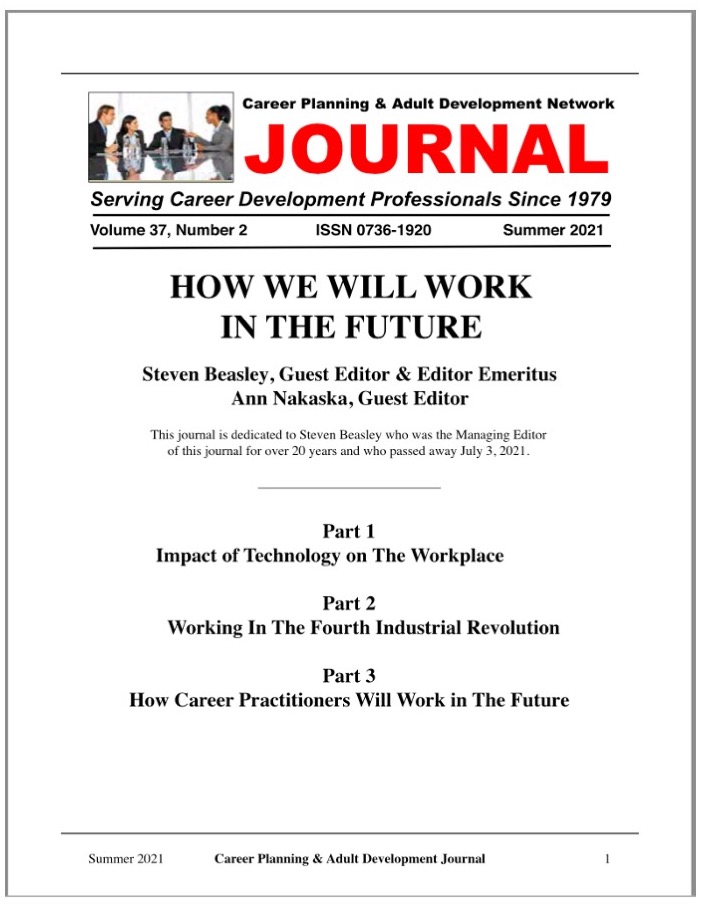
Last year, my friend and colleague, Ann Nakaska, invited me to contribute an article to a special issue of the Career Planning & Adult Development Journal for which she was serving as guest editor.

CPAD Journal

The theme of this special issue is: “How we will work in the future”. This is a robust issue, spanning 291 pages, and is divided into 3 parts:

  • Part 1: The impact of technology on the workplace
  • Part 2: Working in the fourth industrial revolution
  • Part 3: How career practitioners will work in the future

My contribution to this robust publication is in included in Part 2. My piece is, “Career development, academic integrity and counterfeit credentials: Understanding the connections” (pp. 98 – 106).

Ann’s invitation challenged me to write for a different audience: career development professionals. This piece is for a professional practitioner audience, though it may also be of interest to others interested in the topic of fake degrees and fraudulent or faulty credentials.

Abstract

The purpose of this article is to highlight ethical aspects of career development through the lens of academic integrity. I begin with an overview of academic integrity and the fundamental values that underpin it. Then I discuss fake and faulty academic credentials, including degrees, diplomas, transcripts, and related documents. I explore the impact of fake credentials on society, highlighting a few significant examples that have been featured by mainstream media. Finally, I examine the role that career development professionals play in promoting academic integrity and professional ethics to their clients. I conclude with concrete recommendations for career development professionals to inform themselves and their clients, and in doing so, to become partners in integrity and advocates of ethical education.

The issue has just been released and Ann shared with all of the contributors that just before the issue was published, her co-guest editor, Steven Beasley, who had served as managing editor of the journal for 20 years passed away. My deepest condolences to Steven and all who knew him.

The entire issue can be accessed free of charge here: https://files.ctctusercontent.com/56f4bf3f301/4ffe3e3a-9252-46b4-b19c-c9913e1fec19.pdf?rdr=true

 #AcademicIntegrity #FakeDegrees

Related posts

_____

Share or Tweet this: New article: “Career development, academic integrity and counterfeit credentials: Understanding the connections” https://drsaraheaton.wordpress.com/2021/07/26/new-article-career-development-academic-integrity-and-counterfeit-credentials-understanding-the-connections/

This blog has had over 3 million views thanks to readers like you. If you enjoyed this post, please “like” it or share it on social media. Thanks!

Sarah Elaine Eaton, PhD, is a faculty member in the Werklund School of Education, and the Educational Leader in Residence, Academic Integrity, University of Calgary, Canada. Opinions are my own and do not represent those of the University of Calgary or anyone else.


Academic Integrity (AI) Tutorials in Canadian Post-Secondary Institutions: A National Overview

March 11, 2019

I’ve been working on a national research project with my colleagues, Jenny Miron and Laura McBrearity, at Humber College to look at what programming and supports Canadian post-secondary institutions provide to students to help them learn about academic integrity. We reviewed the websites of public higher education institutions across the country to better understand how academic integrity information is shared with students and faculty across campuses. We recently presented our findings at the conference of the International Center for Academic Integrity in New Orleans. Here’s a quick overview of our session:

Miron, J. B., Eaton, S. E., & McBrearity, L. (2019). Academic Integrity (AI) Tutorials in Canadian Post-Secondary Institutions: A National Overview. Paper presented at the International Center for Academic Integrity, New Orleans, LA.

The team at Humber College created this excellent visual infographic highlighting our methods (search strategies), lessons learned and key findings:

JPG (small) - Miron, Eaton & McBrearity - 2019 Final Infographic copy

We have not published the full findings yet, though we plan to do so soon. Because there is so little research available about what kind of support (e.g. education, tutorials, modules) offer on academic integrity to Canadian post-secondary students, we wanted to make these preliminary results available now.

You can download a high quality version of this infographic here:

Miron, J. B., Eaton, S. E., & McBrearity, L. (2019). Searching Public Websites within Canadian Higher Education: Academic Integrity Tutorials [Infographic]. Retrieved from http://hdl.handle.net/1880/109916

______________________________________________________

Share or Tweet this: Academic Integrity (AI) Tutorials in Canadian Post-Secondary Institutions: A National Overview

This blog has had over 2 million views thanks to readers like you. If you enjoyed this post, please “like” it or share it on social media. Thanks!

Sarah Elaine Eaton is a faculty member in the Werklund School of Education, University of Calgary, Canada. Opinions are my own and do not represent those of the Werklund School of Education or the University of Calgary.