Dr. Sarah’s favorite resources of the week (Dec. 4-10, 2011)

December 10, 2011

Here are my favorite resources of the week, curated from my Twitter account.

Social Media

7 Social media tips for the company Christmas party – by John Balitis and Carrie Pixler-Ryerson, for Inside Tucson Business

Social media policy essential in the workplace – by Anna Cairo

Apple’s social media policy leaked by Emily Nicholls

A social media policy pearl by Andrea Di Maio

8 Ways To Avoid Social Media Culture Clash by Debra Donston-Miller

What Boards Should Know About Social Media by Erika L. Del Giudice and Dorri C. McWhorter

Social Media Policy Essentials by Ray Silva

After Facebook rant, Manatee County suspends deputy for three days by Alison Morrow

Apple Fires Employee Over Facebook Rants by Margaret Rock

Quebec Minor Hockey League Social Media Policy – QMHL

UFC Reaps the risks and rewards of social media – by Chad Dundas, ESPN

Literacy and Essential Skills

Take time to learn together on Family Literacy Day by Community Content

Technology and teaching children to read: What does the research say? from NEIR TEC

No place in class for digital illiterates – The Guardian

Margaret Atwood says Twitter, internet boost literacy – CBC News

Tips to Make Reading Fun – in Lake Mary Health and Wellness

National Literacy Trust highlights book-free millions – by Judith Burns, BBC News

Paper or electronic? Reading to children important no matter the medium – by Roni Reino

Financial Education pays off in adult life – by Sharon Singleton

Technology and E-learning

How to convert your Powerpoint into an E-learning course – Rapid E-Learning

Google Forms for Educators – ISU Workforce Training

Top 10 iPhone Apps of 2011 – by eGichomo

Digital literacy resources – Government of South Australia

Languages and Multilingualism

How to market to foreign language speakers – by Christian Arno

“Pleasure reading” key to second language learning – Victoria University of Wellington

Effective Learning / Metacognition

Effective learning and teaching – Science for All Americans Online

5 Training “Must Knows” – by Sarah Bohnenkamp

Education News

India offers English stepping stone to east Asian students – The Guardian

Canada: a failing grade on aboriginal education – by Gerry St. Germain And Lillian Dyck, The Leader-Post

The rise of flexi-schooling – by Jeevan Vasagar

When an adult took standardized tests forced on kids – by Valerie Strauss

Related posts:

Dr. Sarah’s favorite resources of the week (Nov. 20 to 26, 2011)

Dr. Sarah’s favorite resources of the week (Nov. 13 to 19, 2011)

____________________________

Share this post: Best resources of the week (Dec. 4 to 10, 2011) http://wp.me/pNAh3-13H

Update – January 2018 – This blog has had over 1.8 million views thanks to readers like you. If you enjoyed this post, please “like” it or share it on social media. Thanks!

Sarah Elaine Eaton is a faculty member in the Werklund School of Education, University of Calgary, Canada.


Best resources of the week (Nov. 20 to 26, 2011)

December 4, 2011

Here are my favorite resources of the week, curated from my Twitter account.

Social Media

Schools would be wise to adopt Granville district’s social media policies – Newark Advocate

How to hide Twitter #hashtag chats from your followers by Dave Larson

The Rise of the Connected Non-Profit from Mashable

10 Things I Learned On My Twitter Journey To 100,000 Followers by John Paul

How 5 Top Brands Crafted Their Social Media Voices by Lauren Indvik

“Don’t do as I say, do as I do” – the role of leadership in promoting the use of social media by Don Ledingham

7 Secrets Of Highly Effective Twitter Power Users  by Lauren Dugan

10 Steps to Kick Start Your Twitter Network from Edte.ch Blog

Proposed social media policy has this school committee in a huff by Sherilynn Macale

Literacy and Essential Skills

Reading to your kid: even more important than you think – The Globe and Mail

How Canadian contemporary authors inspire youth – Imaginaction

Language Learning and Teaching

Chicago Public Schools teacher Kickstarting ESL program through song by Alyssa Vitale

Scaffolding Academic Learning for Second Language Learners by Karen Sue Bradley & Jack Alden Bradley

E-Learning

Activities for online courses: The Beginning by Nicky Hockly

How To Be a Top Learning Organization by Tiffani Murray

7 Things You Should Know about Google Apps from Educause

For some kids, a book is just an iPad that doesn’t work by Ivor Tossell

62 things you can do with Dropbox from MacWorld

Education Resources

Tools for Teaching: Authentic Assessment from the Centre for Teaching and Educational Technologies, Royal Roads University

Flipped Classroom Full Picture: An Example Lesson by Jackie Gerstein

Google Scholar Citations Now Open to All by Ryan Cordell

Education News

Dyslexia may explain my school failure, says Annabel Heseltine by Julie Henry

Ministers of Education Report to Canadians on Official Languages in Education – Canada Newswire

A School System in Maine Gives iPads to Kindergartners from Voice of America

Alberta education minister welcomes input on overhauling system via social media – Metro News

Year-round school: An idea worth exploring – The Windsor Star

Public Speaking and Presentation Skills

Stop Breaking the Basic Rules of Presenting by Ned Potter

App for Speakers: A presentation timer by Takuya Murakami

Secrets from JFK’s Speechwriter by Peter Temple

Writing

How to Write, Launch and Sell Your Informational Ebook by Alexis Grant

Related posts:

Dr. Sarah’s Favorite Resource of the Week (Nov. 13 to 19, 2011)

____________________________

Share this post: Best resources of the week (Nov. 20 to 26, 2011) http://wp.me/pNAh3-12N

Update – January 2018 – This blog has had over 1.8 million views thanks to readers like you. If you enjoyed this post, please “like” it or share it on social media. Thanks!

Sarah Elaine Eaton is a faculty member in the Werklund School of Education, University of Calgary, Canada.


University’s Proposed Social Media Policy Results in Student Protests

October 27, 2011

The Chronicle of Higher Education recently released an article about an article about how a university’s proposed social media policy backfired on them. Reporter Alexandra Rice reports in “University’s Proposed Social-Media Policy Draws Cries of Censorship” that students at Sam Houston State University didn’t take kindly to the administration having access — and editing privileges — to their social media accounts.

The university released a new social media portal called Social Universe was deemed to be a one-stop portal for social media users at the university. The original policy draft indicated that any department or organization  that joined with a university e-mail account would be required to surrender their account passwords to the university, thus giving the university the right to oversee and edit activity on all accounts.

Essentially, this meant that any student, staff, faculty, department or student club with a Facebook, Twitter or any number of other online accounts that was registered with a university e-mail address could be monitored, edited, censored or even deleted by the university.

The students cried censorship. They staged a demonstration against the policy that included a “free speech wall”. That resulted in campus police citing students for creating a public disturbance… a situation which rolled itself into a second “free speech wall” later on.

In my humble opinion, if this university truly wanted to craft an effective social media policy, it would involve its users. By this I don’t just mean having reps from the student union sit on a committee, but I mean a large-scale public conversations over a period of time with all social media users at the institution.

Writing social media policies is tricky business. As this university found out, social media belongs to its users, not any one service or organization.

Policy makers are used to having all the authority when it comes to developing procedures, processes, and behaviour guidelines. Social media, social networking, flash mobs convened via Twitter and text and other forms of social interaction using technology have changed all that.

Power to the people has a whole new meaning in the era of social media. Policy-makers need to involve people, not tell them what to do. The old ways aren’t working any more, so find new ones that will.

Related article: Anatomy of a social media policy

___________

Share this post: University’s Proposed Social Media Policy Results in Student Protests https://wp.me/pNAh3-YT

Update – January 2018 – This blog has had over 1.8 million views thanks to readers like you. If you enjoyed this post, please “like” it or share it on social media. Thanks!

Sarah Elaine Eaton is a faculty member in the Werklund School of Education, University of Calgary, Canada.


12 Things I Did to Build a Following of 2000 Engaged Twitter Followers

October 20, 2011

There’s a myth about Twitter followers. You don’t need more followers. You want more engaged followers.

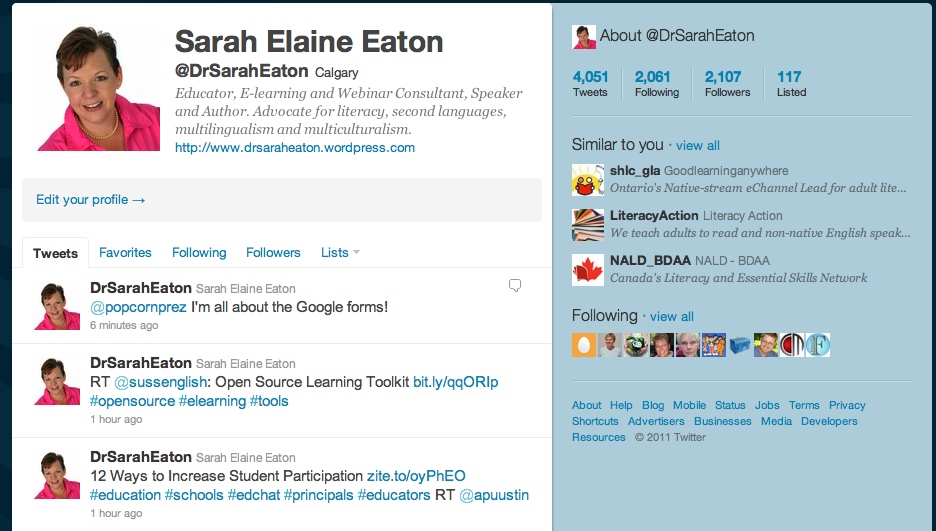
I’ve been on Twitter since 2009. I spent probably 9 months figuring out what it was all about and how to use it. Then, I started looking at other people’s followings and wondering how they did it. That’s when I learned that some people literally buy followers, by paying into a service. Everyone who pays into the service follows each other. That inflates your following. But to me, those kinds of followers don’t mean anything. And I didn’t want them.

I wanted engaged followers: people who would have online conversations with me, retweet my Tweets, read my posts, make comments, offer suggestions. I wanted to interact with my followers.

I began making a conscious effort to increase my engagement levels and reciprocity.

Here’s how I did that:

  1. I used a service that allowed me to schedule my Tweets and included a dashboard so I could monitor conversations. I use Hootsuite, but there are other ones out there, too.
  2. Be consistent. I Tweet every day. Even if I’m in meetings all day, I still Tweet.
  3. Selective and strategic sharing. I make a point to share resources that I think others will enjoy and find useful.
  4. Regular retweeting. I repost interesting Tweets and give others credit for them.
  5. Original posts. I share my own material on a regular basis — but not too often.
  6. Watch your ratios. It can’t be a constant stream of output. You need to balance your output and asks with responses, acknowledgements and retrweets. Don’t expect others to share your stuff if you don’t share and acknowledge theirs.
  7. Have conversations. I engage with others in conversations about what is important to them.
  8. Block and report spammers. I nip these folks in the bud. I have no problem reporting spammers and neither should you.
  9. Follow back selectively. I don’t follow everyone who follows me. I follow people and organizations who seem to have legitimate profiles on topics I’m interested in.
  10. Vary the Tweet topics – within a selected range. I Tweet about a lot of stuff, mostly to do with education, training, literacy and social media.
  11. Acknowledge and appreciate your Tweeps. They don’t have to follow you, retweet your stuff or give you a shoutout, you know. Showing appreciation helps build good digital relationships.
  12. Random acts of kindness. Promote a good cause. Mention a friend’s business. Give someone you don’t know a public compliment or shoutout.

As a result of these strategies, here’s what has happened:

  1. I’ve connected with people in real life. We go for coffee. We share ideas and laugh.
  2. I get retweeted every day… sometimes up to 20 or 30 times per day. This leads me to new people. If I think they’re interesting. I follow them. Sometimes, they follow me back.
  3. I’ve been offered work. Tweeps have contacted me to ask me to present at conferences and take on projects. Never was I more surprised than when I was offered a contract to build an evaluation system for an educational organization via a connection that originated on Twitter.
  4. I’ve learned tons. I check out new resources and share them freely. In the process, I stay on top of what is happening in my field. I’m current and up to date. Must of it is thanks so Twitter and social media.
  5. My understanding of social media has deepened considerably. Social media changes quickly, but for those who are new to it or still working to really understand what it is and how it can work for them, it is important to know that there are some fundamentals. One of those is that building an engaged following is much more important than just building a following.

If you liked this post, you’d probably like my Tweets, too. Let’s connect on Twitter.

__________________________________________

Share this post: 12 Things I Did to Build a Following of 2000 Engaged Twitter Followerhttp://wp.me/pNAh3-XW

Update – January 2018 – This blog has had over 1.8 million views thanks to readers like you. If you enjoyed this post, please “like” it or share it on social media. Thanks!

Sarah Elaine Eaton is a faculty member in the Werklund School of Education, University of Calgary, Canada.


7 Top Twitter Resources for Trainers and Educators

October 3, 2011

Here are some of my favorite Twitter resources that are particularly helpful for educators, tutors and others in the training profession:

Twittonary.com – Twitter Dictionary that provides explanations about Twitter-related word.

Twitter Handbook for Teachers – An 18-page, free downloadable handbook for teachers who are new to Twitter.

9 Twitter Styles: Which One Is Yours? – A lighthearted look at different styles of Tweeting.

10 Steps to Kick Start Your Twitter Network – Practical tips to grow your network in a meaningful way.

How to hide Twitter #hashtag chats from your followers – I really enjoyed this one. While I Tweet regularly about topics relating to my work, I also occasionally indulge in a little #DrWho chat, but honestly, most of my professional colleagues don’t share my love of the man who travels through space and time in the TARDIS. This is a great way not to bombard them with my little indulgence.

How Twitter will revolutionise academic research and teaching – An insightful article about how Twitter is changing how we view research and teaching.

Why Teachers Should Join Twitter… What I Have Learned as a Newbie – Insights from a new teacher Tweeter. This is a great resource for educators who still aren’t sure what Twitter is for and why it can be useful to them.

_______________

Share this post: 7 Top Twitter Resources for Trainers and Educators http://wp.me/pNAh3-VE

Update – January 2018 – This blog has had over 1.8 million views thanks to readers like you. If you enjoyed this post, please “like” it or share it on social media. Thanks!

Sarah Elaine Eaton is a faculty member in the Werklund School of Education, University of Calgary, Canada.