Tomorrow’s free webinar on marketing literacy and language schools – Setting marketing goals, target markets, budgets

March 27, 2012

Join us tomorrow for the second in a series of ten free webinars on how to market and promote your literacy program or language school.

These webinars highlight different ideas from 101 Ways to Market Your Language Program. Every week you get practical, low-cost ideas to help you promote your program. Best of all, you’ll get to connect with others on line who are also interested in the same topic, ask questions and interact.

The webinars are  30 to 60 minutes in length. Bring a pen and paper. I’m going to give you lots of ideas you can implement right away.

Webinar #2 of 10 – What to expect

Tomorrow’s webinar will focus on:

  • How to set marketing goals
  • How to identify a target market
  • The difference between “end users” and “target market”
  • How to budget for marketing and promotion

There are some time zone changes coming up around the world, so double-check these times against your local area:

Wednesday, March 28, 2012

Point of origin – 14:00 (2:00 p.m.) Mountain Time, March 21, 2012 – Calgary / Edmonton

16:00 (4:00 p.m.) – Eastern Time – Toronto / New York

20:00 (8:00 p.m.) – Greenwich Time – London, England

22:00 (10:00 p.m.) – Eastern European Time – Athens / Istanbul

05:00 (5:00 a.m.) – following day – Japan Standard Time – Tokyo

To join the webinar, click here: http://meet11548754.adobeconnect.com/saraheaton/ — There is no need to register. These webinars are free and open to everyone. Seating is limited though, so sign on early.

I’ll record the and post it so you can view it later, too.

Here’s what we’ll cover in upcoming webinars:

Week #3 – Focus on benefits, writing marketing materials

Week #4 – Business cards, newsletters, signs and other communications

Week #5 – What makes people care about you. How to stand out from the crowd.

Week #6 – Specialty tips for programs at large institutions

Week #7 – Relationship marketing. The power of connections.

Week #8 – It’s how you make them feel. Adding personal touches that make all the difference

Week #9 – Effective follow up with your marketing and not giving up too soon.

Week #10 – Social media for marketing

All you have to do is block off Wednesdays in your calendar at your corresponding local time and then log in using the link above.

If you can’t make the webinar, and you’d like to ask a question about the topic, feel free to leave me a comment. I’ll do my best to answer questions that come in before the program during the webinar. You can watch the recording to get the answer to your question, or I’ll answer you back in the comment section.

Related posts:

Webinar recording: 101 Ways to Market Your Language and Literacy Program (#1) http://wp.me/pNAh3-1jF

101 Ways to Market Your Language Program (10 Free webinars) http://wp.me/pNAh3-1j6

___________________________

Share or Tweet this post:  Tomorrow’s free webinar on marketing literacy and language schools – Setting marketing goals, target markets, budgets http://wp.me/pNAh3-1k6

Update – January 2018 – This blog has had over 1.8 million views thanks to readers like you. If you enjoyed this post, please “like” it or share it on social media. Thanks!

Sarah Elaine Eaton is a faculty member in the Werklund School of Education, University of Calgary, Canada.


Webinar recording: 101 Ways to Market Your Language and Literacy Program (#1)

March 22, 2012

We had the first of 10 webinars today on how to market your language or literacy program. Here’s the recording of the first 30-minute program:

Join us next week for Class #2. It will focus on setting marketing goals, allocating resources and budgeting. Get more details here.

__________________________

Share or Tweet this post: Webinar recording: 101 Ways to Market Your Language and Literacy Program (#1) http://wp.me/pNAh3-1jF

Update – January 2018 – This blog has had over 1.8 million views thanks to readers like you. If you enjoyed this post, please “like” it or share it on social media. Thanks!

Sarah Elaine Eaton is a faculty member in the Werklund School of Education, University of Calgary, Canada.


101 Ways to Market Your Language Program (10 Free webinars)

March 14, 2012

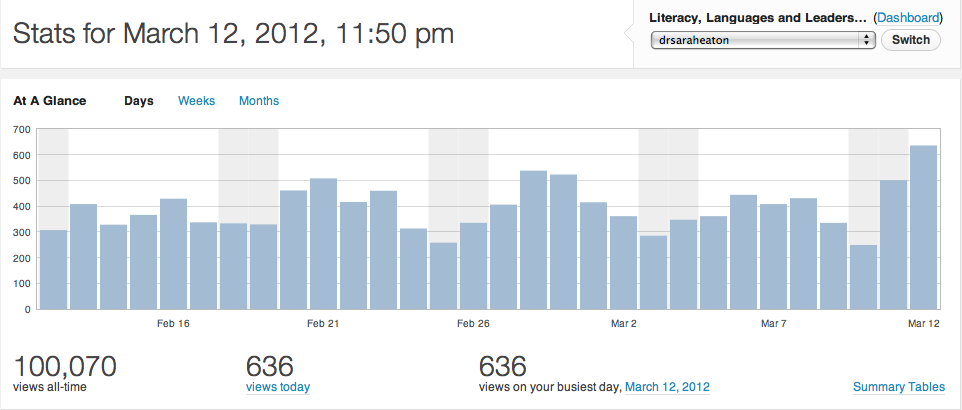
What an amazing week! My blog is just over 2 years old and this week, we topped 100,000 all-time views and 200 subscribers.

It’s definitely time to celebrate.

10 Free Webinars on How to Market and Promote Your Language or Literacy Program

Over the next 10 weeks, I’m going to host a free webinar every week. Each one will highlight different ideas from 101 Ways to Market Your Language Program. Every week you’ll get practical, low-cost ideas to help you promote any language or literacy program. Best of all, you’ll get to connect with others on line who are also interested in the same topic, ask questions and interact.

The webinars will be 30 to 60 minutes in length. Bring a pen and paper. I’m going to give you lots of ideas you can implement right away.

We’ll do the webinars for the next ten Wednesdays: March 21 to May 23, 2012

There are some time zone changes coming up around the world, so double-check these times against your local area:

Point of origin – 14:00 (2:00 p.m.) Mountain Time, March 21, 2012 – Calgary / Edmonton

16:00 (4:00 p.m.) – Eastern Time – Toronto / New York

20:00 (8:00 p.m.) – Greenwich Time – London, England

22:00 (10:00 p.m.) – Eastern European Time – Athens / Istanbul

05:00 (5:00 a.m.) – following day – Japan Standard Time – Tokyo

To join the webinar, click here: http://meet11548754.adobeconnect.com/saraheaton/ — There is no need to register. These webinars are free and open to everyone. Seating is limited though, so sign on early.

I’ll record each webinar and post it so you can view it later, too.

This is essentially a 10-week course designed to take you through the entire book from beginning to end. I’ll include some marketing “best practices” and show you how to start thinking about promoting your programs to ensure they are sustainable over the long term. I’ll share some case studies and stories, along with lots of practical “how to” information that you can use right away.

Here’s what we’ll cover

Week #1 – How to develop your marketing strategy and plan

Week #2 – Setting marketing goals, target markets, budgets

Week #3 – Focus on benefits, writing marketing materials

Week #4 – Business cards, newsletters, signs and other communications

Week #5 – What makes people care about you. How to stand out from the crowd.

Week #6 – Specialty tips for programs at large institutions

Week #7 – Relationship marketing. The power of connections.

Week #8 – It’s how you make them feel. Adding personal touches that make all the difference

Week #9 – Effective follow up with your marketing and not giving up too soon.

Week #10 – Social media for marketing

All you have to do is block off the next 10 Wednesdays in your calendar at your corresponding local time and then log in using the link above. It’s that easy. And it’s my way of showing my appreciation to you.

Thank you to everyone who has viewed the blog, left a comment or subscribed. I really love the work I do and being able to share with you, learn from you and engage with you inspires me every single day.

___________________________

Share or Tweet this post: 101 Ways to Market Your Language Program (10 Free webinars) http://wp.me/pNAh3-1j6

Update – January 2018 – This blog has had over 1.8 million views thanks to readers like you. If you enjoyed this post, please “like” it or share it on social media. Thanks!

Sarah Elaine Eaton is a faculty member in the Werklund School of Education, University of Calgary, Canada.


9 Tips for Successfully Incorporating Virtual Presentations into Your Conference

February 16, 2012

Today I had the coolest experience. My colleagues at Idaho State University (ISU) Workforce Training were having an educational technology conference today in Pocatello. I teach for them online, but today’s conference was live — except for one presenter, me.

Here’s how we did it:

1. Brief your presenter on what to expect

Jeff Hough and the team at ISU gave me a thorough briefing about the conference a few weeks prior to the event. We negotiated the terms of the presentation and they gave me details on what to expect.

2. Tech-savvy conference organizers

These folks specialize in offering professional development webinars for educators. I’ve done dozens of webinars and used the same platform (in this case, Adobe Connect) that the conference organizers had on hand. They knew how to set up their system and had used their webinar platform hundreds of times before. They are adept at all kinds of technology and had significant experience successfully producing webinar presentations.

Sarah Elaine Eaton, virtual, presenter, webinar, education, professional development3. Experienced and energetic virtual presenter

Modesty aside, it is safe to say that I know how to give a virtual presentation. I have colleagues who flatline in a webinar environment because they “need the crowd to give them their energy”. At today’s conference, I never saw my audience. Well, not until after when one of my ISU colleagues, Paul Dickey, tweeted this photo (which I saw after the presentation).

Some of the worst virtual workshops or keynotes I have seen have been given by people who have no experience or webinar training. (In case you’re interested, here’s how you can get trained).

4. Previously presented material

Ensure the presentation has been tested. The conference organizers asked me to repeat a Twitter for Teachers workshop that I had taught for them previously. They had already seen the program delivered via webinar and liked it. The program had already proven to be a success.

Conference organizers want their attendees to have a stellar experience. Many things can go wrong with a virtual presentation. Make sure the presenter’s content is not one of them.

5. Do a connectivity test

Before the conference, we tested all the technology we were going to use – audio, video, slides and a real-time screen share. Hotels and conference centres are notorious for having poor wireless connections. The more people who tap into them, the slower they get. Virtual presentations chew up a lot of bandwidth. Even if your system works perfectly at the office, having a new venue changes the game. Every single piece of tech needs to get tested… and tested again.

As we prepared for today, we had some issues with the audio. We made some adjustments that helped significantly when the room was filled with a live audience.

6. Expect the unexpected

At one point during today’s session, we lost audio. Because we were all experienced working in a virtual environment and were aware of our audio problems during the connectivity test, it came as no surprise when the audio cut out. We were quickly able to work things through and I picked up where I had been cut off. Both the conference organizers and the presenter need to be able to keep their cool when “tech happens” in front of a room full of people.

Every person involved in today’s virtual program understood what aspects of the production we could control, such as our individual mics and computer settings and which we could not control, such as the venue’s wireless connection cutting out. Knowing what you can and can not control puts you in a better position to problem solve on the fly.

7. Include real-time interactivity

In my case, Jeff acted as a host for the session, introducing me and then fielding questions from the audience. At the beginning of the session, I said, “OK, let’s do a show of hands in the room. How many people use Twitter right now?”

Jeff acted as my eyes and ears and reported back to me, “There are crickets in the room, Sarah,” meaning that there was silence. He then added, “There are maybe four hands up.”

“O.K.,” I said. “That is less than 10% of the room. Let’s see if we can’t increase that by the end of the presentation…”

We stayed in constant contact throughout the session, talking back and forth, naturally and with a conversational tone.

8. Show, don’t tell

There is a certain amount of “telling” in an instructional program, but try to limit it as much as possible.

My presentation included a combination of static slides and a real-time screen share. I was showing folks how to use Twitter, so I demonstrated it live. Because Jeff also has a Twitter account, we were able to Tweet back and forth in real time and the participants could see it on screen.

The highlight for me as a presenter came when one participant signed for Twitter during the presentation and Tweeted “@DrSarahEaton“, as I had shown them how to do moments earlier.

I noticed it on my feed and said, “Hey, who’s that? Is that someone who’s in the conference room right now?”

Jeff asked the brand-new-baby-Tweeter to raise his or her hand. She did.

This was the single best moment for me as a virtual presenter. It was completely unrehearsed and unexpected. We had no idea anyone was going to sign up for Twitter right then and there and start putting the content into action at that very moment.

It caught the attention of every single person in the room and suddenly, it all made sense. What I had been saying about educators being able to connect in real time from all over the world, was no longer something I said, it was something we were able to actually show them. It was the coolest thing.

After that, a few other people joined in and sent Tweets, too.

Jimeny Cricket may have talked, but these crickets Tweeted! It was brilliant.

9. Give participants a valuable handout

Participants did not get a copy of my presentation slides. (Bor-ing!) Instead, every participant received a copy of the Twitter for Teachers manual that I did to accompany the course. It is a 25-page, step-by-step how to guide that steps them through the exact processes I showed during the presentation, in exactly the same order. Well, except for the spontaneous moments that made the session come alive.

The technical aspects of a virtual presentation increase your risk of failure significantly. Just about anything can go wrong. Even with all the preparation in the world, the potential for unexpected screw ups can still happen. Lots of preparation helps to mitigate that risk. Having an experienced team who have worked together before also helps tremendously.

You know when a virtual presentation has been truly successful because the webinar technology becomes “invisible”. When participants are so into the experience that they almost forget their presenter is hundreds, if not thousands of miles away and their sense of distance has melted away, you know you’ve just incorporated a great virtual presentation into your conference.

A personal thanks from me to all the folks at ISU Workforce Training. As any experienced virtual presenter knows, those work on the production team are the real stars of the show.

_____________

Share or Tweet this post: 9 Tips for Successfully Incorporating Virtual Presentations into Your Conference http://wp.me/pNAh3-1fm

Update – January 2018 – This blog has had over 1.8 million views thanks to readers like you. If you enjoyed this post, please “like” it or share it on social media. Thanks!

Sarah Elaine Eaton is a faculty member in the Werklund School of Education, University of Calgary, Canada.


Webinar: How to Develop a Social Media Policy

February 14, 2012

Sarah Eaton social media technology speaker presenter webinarThis week’s webinar with Chinook Learning is “How to Develop a Social Media Policy“. Its designed for organizational leaders and managers who have to cope with guiding employees’ use of social media in the workplace.

Social media has changed how people interact with each other on line. Marketers talk about social media strategies, but that is different from an organizational policy that is designed to guide and govern users’ behaviour in social media settings. This course is based on this article “Anatomy of a Social Media Policy” that I wrote last fall, published by Social Media Today.

Participant outcomes

By the end of this webinar you will:

  • Understand the differences between a social media strategy and a social media policy.
  • Understand the basics of social media governance.
  • Know the critical elements of a social media policy.
  • Understand the importance of dialogue when it comes to striking a balance between users’ rights and responsibilities.
  • Gain a deeper understanding of what a social media policy is and how to go about developing a relatively simple, straightforward policy for your organization.

Content

  1. Social media policy – Definition and overview; Differences between a social media strategy and a policy.
  2. Social media governance – What social media governance means for organizations, employers and employees.
  3. Anatomy of a social media policy – Learn the critical elements of a well-constructed social media policy and how the various elements work together to create a fully functioning and effective policy. Learn what they key parts are so you can build your own simple, straightforward policy.
  4. Balancing users’ rights with their responsibility to their employer. Why it is important to dialogue with users in your organization and tips for doing this effectively.

____________________________

Share this post: Webinar: How to Develop a Social Media Policy http://wp.me/pNAh3-1eU

Update – January 2018 – This blog has had over 1.8 million views thanks to readers like you. If you enjoyed this post, please “like” it or share it on social media. Thanks!

Sarah Elaine Eaton is a faculty member in the Werklund School of Education, University of Calgary, Canada.