Participatory Methodology in Education

August 28, 2018

U of C logo - 2015I am excited to be teaching this doctoral level methodology course this fall.

Course Overview:

A survey of educational research methodologies broadly defined as ‘participatory’ – i.e., intended to support the involvement of as many interested and affected agents and agencies as possible and oriented toward meaningful, impactful, and sustainable action.

Course Description:

The aim of this course is to support your understanding of assumptions underpinning a range of theoretical traditions and their relationships to participatory research methodologies. You will examine and locate various theories according to their source and tradition, and will examine these theories against the backdrop of the intellectual traditions from which they originate. In examining each of these theories and their associated methodologies, you will begin to clarify your epistemological, ontological, and axiological stances in relation to participatory research methodologies. This is a reflexive process that will require you to begin to develop an understanding of your role as a researcher and your relationships to your research context and its participants.

This course supports your coming to make sense of the nuanced relationship between the researcher and his or her research context by way of working through the early intricacies of placing the self within the research inquiry. It helps you to understand and challenge the assumptions you bring to research through such questions as: What is the nature of reality? How does a worldview influence a perspective on the nature of knowledge? Where and how does knowledge come to be located and positioned? What knowledge counts as a legitimate way of knowing? What are the variant ways in which we come to know? How do we come to know and understand through different interpretive frameworks?  What are the ways in which knowledge is signified?  How might previous experiences and values influence choices of a research inquiry, a methodology, and associated methods? In looking across these research traditions and methodologies, the intent is for you to delve into their pragmatics and problematics, as well as to develop an understanding of the relationship between methodologies and methods.  To this end, we will examine closely the notion of commensurability in research designs. Throughout this course we will how we come to know what constitutes a research problem, how do we make sense/identify/mark/frame a particular lived experience as being researchable, what is the purpose of your research, what is the importance of the research and what are the ways in which a specific subject matter becomes the focus of inquiry. In particular, the course helps you get situated ethically and conceptually.

 Learning Objectives:

To consider the epistemological, ontological and axiological assumptions within the primary research paradigms and educational research methodologies.

  • To examine the conceptual influences behind participatory methodologies, and distinguish key movements and emphases in participatory methodologies.
  • To articulate an understanding of conceptual and theoretical underpinnings of educational research including the interwoven nature of research questions, research methodology and methods.
  • To partake in a reflexive inquiry concerning your values, perspectives, beliefs, experiences and understandings about research.

Approved Fall 2018 EDER 701.09 L01- Participatory Methodology in Education – Eaton

______________________________________________________

Share or Tweet this:  Participatory Methodology in Education https://wp.me/pNAh3-2l0

This blog has had over 2 million views thanks to readers like you. If you enjoyed this post, please “like” it or share it on social media. Thanks!

Sarah Elaine Eaton is a faculty member in the Werklund School of Education, University of Calgary, Canada.

Opinions are my own and do not represent those of the Werklund School of Education or the University of Calgary.


2019 Special Issue: Ethics and Integrity in Educational Contexts – Journal of Educational Thought

August 17, 2018

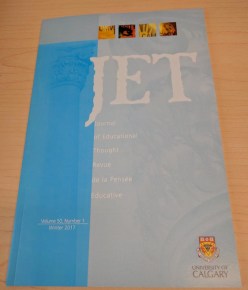
JET 50(1)Issues around ethics and integrity have become increasingly important in higher educational contexts in a variety of ways including research, teaching and leadership. With increasing expectations of research outputs; interest from students to conduct research involving human subjects; and ethical dilemmas of educational leaders in an age of commodified higher education, issues relating to ethics and integrity permeate every aspect of life in the academy.

We intend for this special issue to encourage dialogic interaction among scholars, elevating the discourse around ethics and integrity across disciplines.

Themes

We invite contributions that speak to the topic of ethics and integrity in higher education in a broad sense. Topics include, but are not limited to:

  • Research ethics
  • Ethical leadership in educational contexts
  • Academic integrity
  • Publication ethics
  • Ethical treatment of Indigenous populations (including ethical considerations for research with Indigenous populations)
  • Ethics and integrity in research partnerships and collaborations
  • Ethics and integrity in higher education
  • Ethics and integrity in K-12 education
  • Medical ethics and related topics (e.g. biomedical ethics)

Types of contributions

Scholarly contributions may include, but are not limited to:

  • Empirical research
  • Critical perspectives
  • Evidence-informed position papers
  • Scholarly essays

All submissions should be substantiated with relevant and current research evidence.

Submissions are welcome in English or French.

October 1, 2018 due date – Expressions of Interest (EOIs)

  • Maximum 500 words, briefly outlining the topic, including a maximum of 5 references of related relevant works (no self-citations).
  • Author(s) bio.
  • APA 6th edition format.

EOIs will be screened for suitability and quality. Invitations to authors to submit full manuscripts will be based on the quality of the EOIs. We anticipate inviting approximately six full manuscripts. We encourage interested parties to contact us with a query e-mail before submitting an EOI.

About the JET: Now in its 51st year of publication, the Journal of Educational Thought is a university-run journal that promotes speculative, critical, and historical research concerning the theory and practice of education in a variety of areas including administration, comparative education, curriculum, educational communication, evaluation, instructional methodology, intercultural education, philosophy, psychology, and sociology. The Journal is international in scope and qualitative in nature. It serves a broad international readership: specialists in the areas mentioned, scholars, and the public in general.

We invite submissions in English or French.

Send your Expression of Interest or queries to:

Dr. Sarah Elaine Eaton, University of Calgary – seaton (at) ucalgary.ca

or

Dr. Ian Winchester, University of Calgary – winchest (at) uncalgary.ca

______________________________________________________

Share or Tweet this: 2019 Special Issue: Ethics and Integrity in Educational Contexts – Journal of Educational Thought https://wp.me/pNAh3-2kQ

This blog has had over 2 million views thanks to readers like you. If you enjoyed this post, please “like” it or share it on social media. Thanks!

Sarah Elaine Eaton is a faculty member in the Werklund School of Education, University of Calgary, Canada.

Opinions are my own and do not represent those of the Werklund School of Education or the University of Calgary.


New article: Strengthening the research agenda of educational integrity in Canada

July 25, 2018

There’s been lots of research done about plagiarism, cheating and other topics related to academic integrity, but how much of it has actually been done in — or about — Canada? That’s the question my co-author, Rachael Ileh Edino, and I asked when we set out on a journey to review the published research literature about these topics, casting a specific lens on the Canadian context.

The results have been published by the International Journal for Educational Integrity.

Article screen shot.jpeg

Abstract

We present findings of a literature review on the topic of educational integrity in the Canadian context. Our search revealed 56 sources, published between 1992 and 2017. A historical overview showed a rise in the number of scholarly publications in recent years, but with an overall limited number of research contributions. We identified three major themes in the literature: (a) empirical research; (b) prevention and professional development; and (c) other (scholarly essay). Our analysis showed little evidence of sustained research programs in Canada over time or national funding to support integrity-related inquiry. We also found that graduate students who completed their theses on topics related to educational integrity often have not published further work in the field later in their careers. We provide five concrete recommendations to elevate and accelerate the research agenda on educational integrity in Canada on a national level. We conclude with a call to action for increased research to better understand the particular characteristics of educational integrity in Canada.

Check out the entire article: Strengthening the research agenda of educational integrity in Canada: a review of the research literature and call to action.

______________________________________________________

Share or Tweet this: New article: Strengthening the research agenda of educational integrity in Canada https://wp.me/pNAh3-2kC

This blog has had over 2 million views thanks to readers like you. If you enjoyed this post, please “like” it or share it on social media. Thanks!

Sarah Elaine Eaton is a faculty member in the Werklund School of Education, University of Calgary, Canada.

Opinions are my own and do not represent those of the Werklund School of Education or the University of Calgary.


Using video posts to promote engagement in online graduate learning

July 16, 2018

The first time I engaged with a group via e-learning was in 2005. I have been teaching graduate courses online since 2011. We often follow a standard learning design of having students read material and then write an online discussion post summarizing and/or reflecting on their readings. They repeat this format in just about every course they take. Students have anecdotally reported that they find this process tiresome, static and not very productive in terms of learning.

As a course instructor, I also find it somewhat unproductive. Don’t get me wrong. I firmly believe that written tasks have their place. At the same time, I also believe that we can provide students with challenging and engaging ways of learning that go beyond the traditional text post on a discussion board.

With that in mind, I have been playing around with using video to make online learning more engaging for my students. Since the course I am teaching right now is as Master’s level course called Language Learning and Technology, we are learning about how to incorporate technology into learning meaningful ways. I figured that if continue to engage through traditional text-posts, we are not really learning how to incorporate technology in new ways! So, I  have challenged the students to do video posts about their course readings, instead of their usual weekly write ups. Students are creating and sharing videos of 3 minutes or less that classmates and I can read and respond to. Students post their videos within our learning management system (D2L) that is associated with the course.

To lead by example, I have also been posting weekly videos welcoming students to each week of the course. In this week’s video post, I offer my own reflections on a recent article that I read, showing them how they can do their own reflections on a reading in their video posts.

Reflections on what I have learned from an instructional perspective

I realized after I posted my video that I could have conducted a more in-depth reflection in my post. This was good learning for me, because I had a lot more thoughts swirling around in my head about the reading I did, but I didn’t express them all in the video. In a written post, I would have taken the time to write, edit, revise and then maybe edit and revise some more. In the video post, I shared my reflections, but didn’t fuss over whether it was perfect. I will be mindful of this when I engage in my assessment of students’ learning using this format.

You can see that I start off with the date, and mentioning the weather for today in Calgary, where I live. I wanted to show students that I was not recycling material and that what I was creating for them was new and fresh.

I think showing that the material is new not only enhances learning and promotes principles of academic integrity, it shows we are not being lazy as instructors. I think that traditional text posts can be problematic in terms of academic integrity because students may be tempted, from time to time, to have someone else write posts on their behalf. This is a form of contract cheating (where a third party completes work on behalf of a student). Curtis and Clare (2017) reported that about 3.5% of students admitted to contract cheating. Even though that percentage is small, it is still important for instructors to offer students ways of demonstrating learning in ways that go beyond traditional writing tasks. It is important for instructors to changes the circumstances that might make it easier or more tempting for students to have someone else complete work on their behalf.

I mention this only because I research and write about topics related to academic integrity, so it’s always on my mind. By and large, I think our students are committed to their learning and act with integrity as professionals and as learners.

My intention with these activities is to offer students an opportunity to engage in ways other than text that is authentic and interesting. The process of reflecting on readings is different when we engage verbally than in writing. We are still using text-based elements of the course such as replies to weekly posts, but so far, video seems to providing a fun-yet-rigorous way for students to showcase their learning.

References:

Curtis, G. J., & Clare, J. (2017). How prevalent is contract cheating and to what extent are students repeat offenders? Journal of Academic Ethics, 15(2), 115-124. doi:10.1007/s10805-017-9278-x

Kumar Basak, S., Wotto, M., & Bélanger, P. (2018). E-learning, M-learning and D-learning: Conceptual definition and comparative analysis. E-Learning and Digital Media, 15(4), 191-216. doi:10.1177/204275301878518

______________________________________________________

Share or Tweet this: Using video posts to promote engagement in online graduate learning

This blog has had over 2 million views thanks to readers like you. If you enjoyed this post, please “like” it or share it on social media. Thanks!

Sarah Elaine Eaton is a faculty member in the Werklund School of Education, University of Calgary, Canada.

Opinions are my own and do not represent those of the Werklund School of Education or the University of Calgary.


Living Reading List for Language Learning and Technology

July 3, 2018

U of C logo - 2015I am trying something a little different with my course readings for the Master of Education summer course I am teaching, Language Learning and Technology, a living reading list.

We are required to list the course readings in our syllabus. This helps keep everyone organized and allows students to be fully prepared for their course. The problem is that many of our students are eager change agents who often bring in additional resources that everyone finds useful. So in addition to including a basic set of readings in the course outline, I will update this post throughout the course as a living list of readings, with contributions of gems we find along the way to promote co-creation of knowledge with and along side these very capable graduate students.

Official course materials (as posted in the syllabus)

This page contains a list of all your course readings. One of the readings is no longer freely available on the Internet, but I have posted it below as a .pdf, under Fair Dealing, as approved by the University of Calgary Copyright office.

Required text

Publication Manual of the American Psychological Association. (2010). (Sixth ed.). Washington, D.C: American Psychological Association.

Week 3 Readings

Benson, S. K. & Ward, C. L. (2013). Teaching with technology: Using TPACK to understand teaching expertise in online higher education. Journal of Educational Computing Research, 48 (2), 153-172. doi:10.2190/EC.48.2.c

Harris, J. B., & Hofer, M. J. (2011). Technological pedagogical content knowledge (TPACK) in action: A descriptive study of secondary teachers’; curriculum-based, technology-related instructional planning. Journal of Research on Technology in Education, 43(3), 211-229. Retrieved from http://files.eric.ed.gov/fulltext/EJ918905.pdf

Mishra, P., & Koehler, M. (2009). Too cool for school? No way! Using the TPACK framework: You can have your hot tools and teach with them, too. Learning & Leading with Technology, 36(7), 14-18. Retrieved from http://files.eric.ed.gov/fulltext/EJ839143.pdf

Mishra, P., Koehler, M. J., & Kereluik, K. (2009). Looking back to the future of educational technology. TechTrends, 53(5), 48-53.

Romrell, D., Kidder, L., & Wood, E. (2014). The SAMR Model as a Framework for Evaluating mLearning. Online Learning: Official Journal Of The Online Learning Consortium, 18(2). Retrieved from https://olj.onlinelearningconsortium.org/index.php/olj/article/view/435

van Olphen, M. (2008). World language teacher education and educational technology: A look into CK, PCK, and TPACK. Annual meeting of the American Educational Research Association (AERA).

Week 4 Readings

Gaebel, M. (2013). MOOCs: Massive open online courses. European University Association Occasional Papers, 2-17. Retrieved from http://www.eua.be/news/13-02-25/Massive_Open_Online_Courses_MOOCs_EUA_to_look_at_development_of_MOOCs_and_trends_in_innovative_learning.aspx

Ham, J.J., & Schnabel, M.A. (2011). Web 2.0 virtual design studio: social networking as facilitator of design education. Architectural Science Review(54)2, 108-116. Doi: 10.1080/00038628.2011.582369.

Marshall, S. (2014.)  Exploring the ethical implications of MOOCs. Distance Education(35)2, 250-262. doi: 10.1080/01587919.2014.917706.

U.S. Department of State Bureau of Educational and Cultural Affairs. (n.d.). MOOC for English-Teaching Professionals. Retrieved from http://www.americanenglish.state.gov/mooc-english-teaching-professionals

Week 5 Readings

Cornillie, F., Thorne, S. L., & Desmet, P. (eds.) (2012). Digital games for language learning: Challenges and opportunities. ReCALL Journal, 24(3).doi:10.1017/S0958344012000134

deHaan, J., Kuwada, K., & Ree, W. M. (2010). The effect of interactivity with a music video game on second language vocabulary recall. Language, Learning & Technology, 14(2), 74+. Retrieved from http://www.lltjournal.org/item/2689

Mifsud, C. L., Vella, R., & Camilleri, L. (2013). Attitudes towards and effects of the use of video games in classroom learning with specific reference to literacy attainment. Research In Education, 90(90), 32+.

Reinders, H. & Wattana, S. (2014).  Can I say something? The effects of digital game play on willingness to communicate.  Language Learning and Technology, 18(2). Retrieved from http://www.lltjournal.org/item/2858

Additional Resources

This part of the list contains the additional resources that the students and I collaboratively added throughout the course:

Alharbi, H., & Jacobsen, M. (2017). Tracking the Design and Development of a Six Module miniMOOC for Quality Graduate Supervision Paper presented at the AECT Annual Conference. Retrieved from https://members.aect.org/pdf/Proceedings/proceedings17/2017/17_04.pdf

Akyol, Z., & Garrison, D. R. (2011). Understanding cognitive presence in an online and blended community of inquiry: Assessing outcomes and processes for deep approaches to learning. British Journal of Educational Technology, 42(2), 233-250.

Anderson, T., Rourke, L., Garrison, D. R., & Archer, W. (2001). Assessing teacher presence in a computer conferencing context. Journal of Asynchronous Learning Networks, 5(2), 1-17.

Barber, M., Donnelly K., & Rizvi S. (2013). An avalanche is coming. Higher education and the revolution ahead. Retrieved from Institute for Public Policy website: http://www.ippr.org/publications/an-avalanche-is-coming-higher-education-andthe-revolution-ahead

Bralić, A., & Divjak, B. (2018). Integrating MOOCs in traditionally taught courses: Achieving learning outcomes with blended learning. International Journal of Educational Technology in Higher Education, 15(1), 1-16.

Cagiltay, N. E., Ozcelik, E., & Ozcelik, N. S. (2015). The effect of competition on learning in games. Computers & Education, 87(1), 35-41.

Dörnyei, Z. (2001). Motivational Strategies in the Language Classroom. Cambridge: Cambridge University Press

Common Sense Education. (2016, July, 12). How to apply the SAMR model with Ruben Puentedura. .  Retrieved from https://www.youtube.com/watch?v=ZQTx2UQQvbU

Common Sense Media. (2018). Digital Citizenship. Retrieved July 18, 2018, from https://www.commonsense.org/education/digital-citizenship

Duenas, M. (2004). The whats, whys, hows and whos of content-based instruction in second/foreign language education. International Journal of English Studies, 4(1), 73-96.

Eaton, S. E. (2011). The Need For Increased Integration of Technology and Digital Skills in the Literacy Field in Canada  Retrieved from https://files.eric.ed.gov/fulltext/ED526087.pdf

Eaton, S. E. (2012). Why some teachers will never love technology (and that’s O.K.).  Retrieved from https://drsaraheaton.wordpress.com/2012/04/24/why-some-teachers-will-never-love-technology-and-thats-o-k/

Gaebel, M. (2013). MOOCs: Massive open online courses. European University Association Occasional Papers, 2-17. Retrieved from http://www.eua.be/news/13-02-25/Massive_Open_Online_Courses_MOOCs_EUA_to_look_at_development_of_MOOCs_and_trends_in_innovative_learning.aspx

Garrison, D. R., Anderson, T., & Archer, W. (2000). Critical inquiry in a text-based environment: Computer conferencing in higher education. The Internet and Higher Education, 2(2-3), 87-105.

Garrison, D. R., Anderson, T., & Archer, W. (2001). Critical thinking, cognitive presence, and computer conferencing in distance education. American Journal of Distance Education, 15(1). doi:10.1080/08923640109527071

Garrison, D. R., & Akyol, Z. (2013). Toward the development of a metacognition construct for communities of inquiry. The Internet and Higher Education, 17, 84-89.

Golonka, E.M., Bowles, A. R., Frank, V.M., Richardson, D.L., & Freynik, S. (2014). Technologies for Foreign Language Learning: A Review of Technology Types and Their Effectiveness. Computer Assisted Language Learning, 27(1), 70-105.

Hai-Jew, S. (2010). An instructional design approach to updating an online course curriculum. Educause Review Online. Retrieved from http://www.educause.edu/ero/article/instructional-design-approach-updating-online-course-curriculum

Hoban, G. & Neilson, W. (2014).  Creating a narrated stop-motion animation to explain science: The affordances of “Slowmation” for generating discussion.  Teaching and Teacher Education42(1), 68-78. DOI:  https://doi.org/10.1016/j.tate.2014.04.007

Hughes, A. (2003). Testing for language teachers (2nd ed.). Cambridge: Cambridge University Press.

Hutchison, A., Beschorner, B., & Schmidt-Crawford, D. (2012). Exploring the use of the iPad for literacy learning. The Reading Teacher, 66(1), 15.

Jacobs, G., & Farrell, T. (2003). Understanding and implementing the CLT (Communicative Language Teaching) paradigm. RELC Journal, 34(1), 5-30.

Keat, Jane B., Strickland, Martha J., & Marinak, Barbara A. (2009). Child Voice: How Immigrant Children Enlightened Their Teachers with a Camera. Early Childhood Education Journal, 37(1).

Korda, R J, Clements, M S, & Dixon, J. (2011). Socioeconomic inequalities in the diffusion of health technology: Uptake of coronary procedures as an exampleSocial Science & Medicine 72(2). 222-22. Doi: https://doi.org/10.1016/j.socscimed.2010.11.002

Kumar Basak, S., Wotto, M., & Bélanger, P. (2018). E-learning, M-learning and D-learning: Conceptual definition and comparative analysis. E-Learning and Digital Media, 15(4), 191-216. doi:10.1177/2042753018785180

Liu, E. Z. (2011). Avoiding internet addiction when integrating digital games into Teaching. Social Behavior and Personality: An International Journal, 39(10), 1325-1335. doi:10.2224/sbp.2011.39.10.1325

Martin, A. R. (2015). Is MOOC madness here to stay? an institutional legitimacy study of employers (Order No. 3714173).

Mifsud, C. L., Vella, R., & Camilleri, L. (2013). Attitudes towards and effects of the use of video games in classroom learning with specific reference to literacy attainment. Research In Education, 90(90), 32+. Retrieved from  http://journals.sagepub.com.ezproxy.lib.ucalgary.ca/doi/abs/10.7227/RIE.90.1.3

Museelwhite, C., Martson, H. R. and Freeman, S. (2016). From needy and dependent to  independent homo ludens: Exploring digital gaming and older people. Games and Aging.   11 (1), 3-6. DOI: 10.1177/1555412015605220

Pariser, E. (2011). The filter bubble: How the new personalized web is changing what we read and how we think. New York: Penguin Books.

Prensky, M. (2001). Digital natives, digital immigrants (part 1). On the Horizon, 9(5), 1-6. doi:https://doi.org/10.1108/10748120110424816

Rogers, E. (1997). Diffusion of human factors design: Resistances and how to overcome them. Proceedings of the human factors and ergonomics society…annual meeting, 1(1). Retrieved from http://journals.sagepub.com.ezproxy.lib.ucalgary.ca/doi/pdf/10.1177/107118139704100101

Stoller, F. (2008). Content-based instruction (N. V. Deusen-Scholl & N. H. Hornberger, Eds.). In Encyclopedia of language and education (Vol. 4, Second and foreign language education, pp. 59-70). New York: Springer.

Turow, J. (2013). The daily you: How the new advertising industry is defining your identity and your worth. New Haven: Yale University Press.

Wu, I. X. Y. ; Kee, J. C. Y. ; Threapleton, D. E. ; Ma, R. C. W. ; Lam, V. C. K. ; Lee, E. K. P., Wong, S. Y. S. & Chung, V. C. H.(2018). Effectiveness of smartphone technologies on glycaemic control in patients with type 2 diabetes: systematic review with meta-analysis of  17 trials. Obesity Reviews. 19(6), p.825-838.


______________________________________________________

Share or Tweet this: Living Reading List for Language Learning and Technology https://wp.me/pNAh3-2jW

This blog has had over 2 million views thanks to readers like you. If you enjoyed this post, please “like” it or share it on social media. Thanks!

Sarah Elaine Eaton is a faculty member in the Werklund School of Education, University of Calgary, Canada.

Opinions are my own and do not represent those of the Werklund School of Education or the University of Calgary.