Ethical Reasons to Avoid Using AI Apps for Student Assessment

September 10, 2024

It’s the start of a new school year here in North America. We are into the second week of classes and already I am hearing from administrators in both K-12 and higher education institutions who are frustrated with educators who have turned to ChatGPT and other publicly-available Gen AI apps to help them assess student learning.

Although customized AI apps designed specifically to assist with the assessment of student learning already exist, many educators do not yet have access to such tools. Instead, I am hearing about educators turning to large language models (LLMs) like ChatGPT to help them provide formative or summative assessment of students’ work. There are some good reasons not to avoid using ChatGPT or other LLMs to assess student learning.

I expect that not everyone will agree with these points, please take them with the spirit in which they are intended, which to provide guidance on ethical ways to teach, learn, and assess students’ work.

8 Tips on Why Educators Should Avoid Using AI Apps to Help with Assessment of Student Learning

Intellectual Property

In Canada at least, a student’s work is their intellectual property. Unless you have permission to use it outside of class, then avoid doing so. The bottom line here is that student’s intellectual work is not yours to share to a large-language model (LLM) or any other third party application, with out their knowledge and consent.

Privacy

A student’s personal data, including their name, ID number and other details should never be uploaded to an external app without consent. One reason for this blog post is to respond to stories I am hearing about educators uploading entire student essays or assignments, including the cover page with all the identifying information, to a third-party GenAI app.

Data security

Content uploaded to an AI tool may be added to its database and used to train the tool. Uploading student assignments to GenAI apps for feedback poses several data security risks. These include potential breaches of data storage systems, privacy violations through sharing sensitive student information, and intellectual property concerns. Inadequate access controls or encryption could allow unauthorized access to student work. 

AI model vulnerabilities might enable data extraction, while unintended leakage could occur through the AI app’s responses. If the educator’s account is compromised, it could expose all of the uploaded assignments. The app’s policies may permit third-party data sharing, and long-term data persistence in backups or training sets could extend the risk timeline. Also, there may be legal and regulatory issues around sharing student data, especially for minors, without proper consent.

Bias

AI apps are known to be biased. Feedback generated by an AI app can be biased, unfair, and even racist. To learn more check out this article published in Nature. AI models can perpetuate existing biases present in their training data, which may not represent diverse student populations adequately. Apps might favour certain writing styles (e.g., standard American English), cultural references, or modes of expression, disadvantaging students from different backgrounds. 

Furthermore, the AI’s feedback could be inconsistent across similar submissions or fail to account for individual student progress and needs. Additionally, the app may not fully grasp nuanced or creative approaches, leading to standardized feedback that discourages unique thinking.

Lack of context

An AI app does not know your student like you do. Although GenAI tools can offer quick assessments and feedback, they often lack the nuanced understanding of a student’s unique context, learning style, and emotional or physical well-being. Overreliance on AI-generated feedback might lead to generic responses, diminishing the personal connection and meaningful interaction that educators provide, which are vital for effective learning.

Impersonal

AI apps can provide generic feedback, but as an educator, you can personalize feedback to help the student grow. AI apps can provide generic feedback but may not help to scaffold a student’s learning. Personalized feedback is crucial, as it fosters individual student growth, enhances understanding, and encourages engagement with the material. Tailoring feedback to specific strengths and weaknesses helps students recognize their progress and areas needing improvement. In turn, this helps to build their confidence and motivation. 

Academic Integrity

Educators model ethical behaviour, this includes transparent and fair assessment. If you are using tech tools to assess student learning, it is important to be transparent about it. In this post, I write more about how and why deceptive and covert assessment tactics are unacceptable.

Your Employee Responsibilities

If your job description includes assessing student work , you may be violating your employment contract if you offload assessment to an AI app.

Concluding Thoughts

Unless your employer has explicitly given you permission to use AI apps for assessing student work then, at least for now, consider providing feedback and assessment in the ways expected by your employer. If we do not want students to use AI apps to take shortcuts, then it is up to us as educators to model the behavior we expect from students.

I understand that educators have excessive and exhausting workloads. I appreciate that we have more items on our To Do Lists than is reasonable. I totally get it that we may look for shortcuts and ways to reduce our workload. The reality is that although Gen AI may have the capability to help with certain tasks, not all employers have endorsed their use in same way.

Not all institutions or schools have artificial intelligence policies or guideline, so when in doubt, ask your supervisor if you are not sure about the expectations. Again, there is a parallel here with student conduct. If we expect students to avoid using AI apps unless we make it explicit that it is OK, then the same goes for educators. Avoid using unauthorized tech tools for assessment without the boss knowing about it.

I am not suggesting that Gen AI apps don’t have the capability to assist with AI, but I am suggesting that many educational institutions have not yet approved the use of such apps for use in the workplace. Trust me, when there are Gen AI apps to help with the heaviest aspects of our workload as educators, I’ll be at the front of the line to use them. In the meantime, there’s a balance to be struck between what AI can do and what one’s employer may permit us to use AI for. It’s important to know the difference — and to protect your livelihood.

Related post:

The Use of AI-Detection Tools in the Assessment of Student Work https://drsaraheaton.wordpress.com/2023/05/06/the-use-of-ai-detection-tools-in-the-assessment-of-student-work/

____________________________

Share this post:
Ethical Reasons to Avoid Using AI Apps for Student Assessment – https://drsaraheaton.com/2024/09/10/ethical-reasons-to-avoid-using-ai-apps-for-student-assessment/

This blog has had over 3.6 million views thanks to readers like you. If you enjoyed this post, please “like” it or share it on social media. Thanks!

Sarah Elaine Eaton, PhD, is a faculty member in the Werklund School of Education at the University of Calgary, Canada. Opinions are my own and do not represent those of my employer.

Sarah Elaine Eaton, PhD, Editor-in-Chief, International Journal for Educational Integrity


Academic integrity and artificial intelligence in higher education (HE) contexts: A rapid scoping review

September 4, 2024

In this post, I’d like to give a shoutout to Beatriz Moya, who led a rapid review on academic integrity and artificial intelligence.

A screenshot of a title page of an academic article. There is purple and black text on a white background.
Title page of “Academic Integrity and artificial intelligence in higher education (HE) contexts: A rapid scoping review”.

Here is the reference:

Moya, B. A., Eaton, S. E., Pethrick, H., Hayden, A. K., Brennan, R., Wiens, J., & McDermott, B. (2024). Academic integrity and artificial intelligence in higher education (HE) contexts: A rapid scoping review. Canadian Perspectives on Academic Integrity, 7(3). https://doi.org/10.55016/ojs/cpai.v7i3

Abstract

Artificial intelligence (AI) developments challenge higher education institutions’ teaching, learning, assessment, and research practices. To contribute evidence-based recommendations for upholding academic integrity, we conducted a rapid scoping review focusing on what is known about academic integrity and AI in higher education before the emergence of ChatGPT. We followed the Updated Reviewer Manual for Scoping Reviews from the Joanna Briggs Institute (JBI) and the Preferred Reporting Items for Systematic reviews Meta-Analysis for Scoping Reviews (PRISMA-ScR) reporting standards. Five databases were searched, and the eligibility criteria included higher education stakeholders of any age and gender engaged with AI in the context of academic integrity from 2007 through November 2022 and available in English. The search retrieved 2,223 records, of which 14 publications with mixed methods, qualitative, quantitative, randomized controlled trials, and text and opinion studies met the inclusion criteria. The results showed bounded and unbounded ethical implications of AI. Perspectives included: AI for cheating; AI as legitimate support; an equity, diversity, and inclusion lens into AI; and emerging recommendations to tackle AI implications in higher education. The evidence from the sources provides guidance that can inform educational stakeholders in decision-making processes for AI integration, in the analysis of misconduct cases involving AI, and in the exploration of AI as legitimate assistance. Likewise, this rapid scoping review signals possibilities for future research, which we explore in our discussion.

Keywords

academic integrity, artificial intelligence, academic misconduct, higher education, rapid scoping review, large language models (LLM)

This is a fully open access article. You can download a copy of the full article here: https://doi.org/10.55016/ojs/cpai.v7i3

Related posts:

Exploring the Contemporary Intersections of Artificial Intelligence and Academic Integrity https://drsaraheaton.wordpress.com/2022/05/17/exploring-the-contemporary-intersections-of-artificial-intelligence-and-academic-integrity/

New project: Artificial Intelligence and Academic Integrity: The Ethics of Teaching and Learning with Algorithmic Writing Technologieshttps://drsaraheaton.wordpress.com/2022/04/19/new-project-artificial-intelligence-and-academic-integrity-the-ethics-of-teaching-and-learning-with-algorithmic-writing-technologies/

The Use of AI-Detection Tools in the Assessment of Student Workhttps://drsaraheaton.wordpress.com/2023/05/06/the-use-of-ai-detection-tools-in-the-assessment-of-student-work/

____________________________

Share this post: Academic integrity and artificial intelligence in higher education (HE) contexts: A rapid scoping review – https://drsaraheaton.com/2024/09/04/academic-integrity-and-artificial-intelligence-in-higher-education-he-contexts-a-rapid-scoping-review/

This blog has had over 3.6 million views thanks to readers like you. If you enjoyed this post, please “like” it or share it on social media. Thanks!

Sarah Elaine Eaton, PhD, is a faculty member in the Werklund School of Education at the University of Calgary, Canada. Opinions are my own and do not represent those of my employer.

Sarah Elaine Eaton, PhD, Editor-in-Chief, International Journal for Educational Integrity


Promotion to Professor: Reflecting on a Three-Decade Journey

June 25, 2024

It has been a while since I have blogged. Life has been non-stop this year, but I wanted to take a moment to share some good news. I have been promoted to the rank of Professor, effective July 1, 2024. A few months back, I was also named as the Werklund Research Professor, which is a prestigious research chair in the Werklund School of Education.

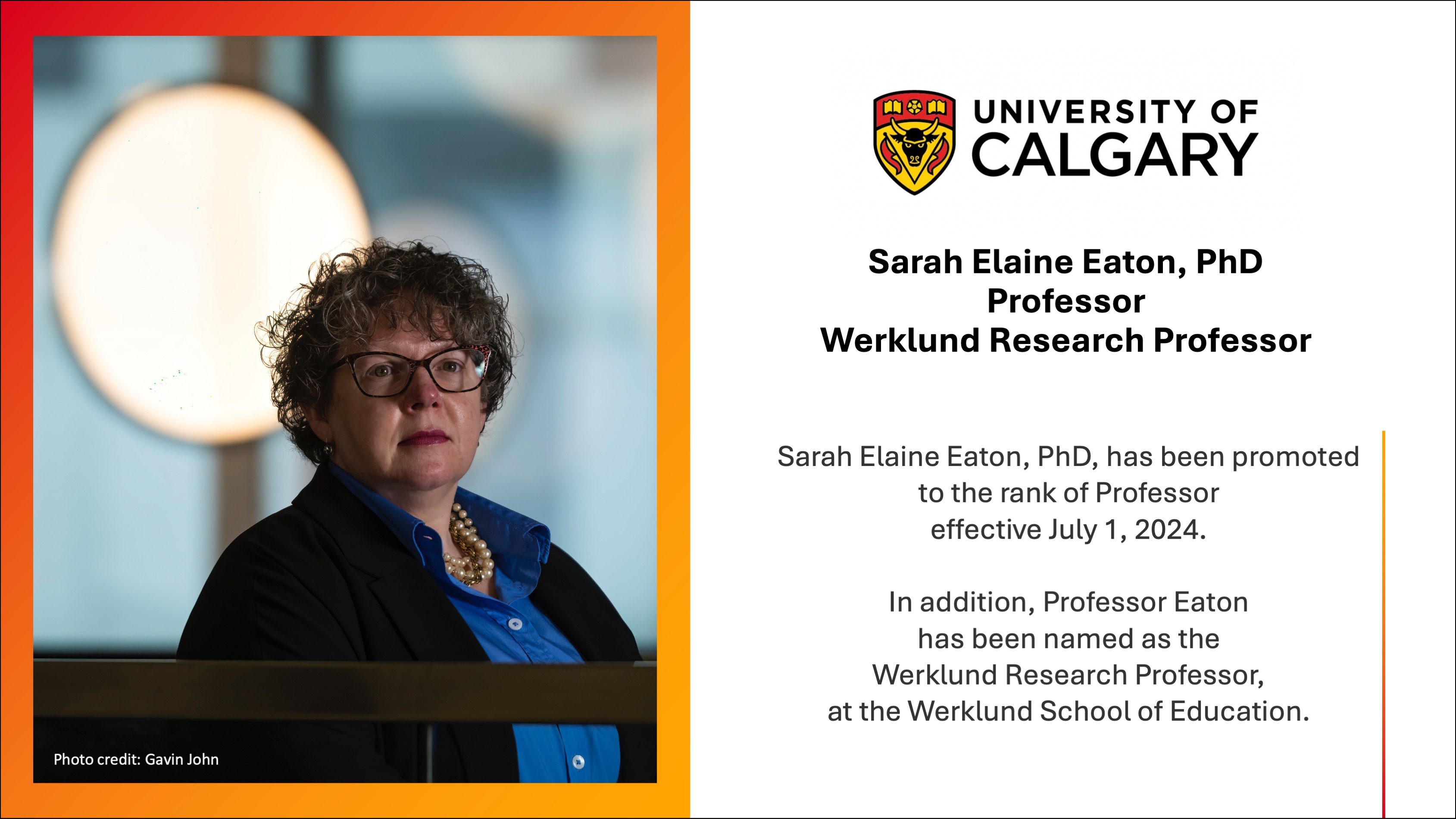
AltText: An announcement postcard. On the left is a photo of a woman with curly hair wearing glasses, a blue shirt, a black jacket and a pearl necklace. The are is an abstract background and the photo is framed in red and orange. On the right is the University of Calgary logo and black text that reads: Sarah Elaine Eaton, PhD, Professor, Werklund Research Professor. Sarah Elaine Eaton, PhD, has been promoted to the rank of Professor effective July 1, 2024.

In addition, Professor Eaton has been named as the Werklund Research Professor, at the Werklund School of Education.

I have long had a passion for integrity and ethics. I am grateful to have an opportunity to focus on ethics in my scholarship, advocacy, and leadership. The Werklund Research Professorship is a prestigious research chair, internally funded through the philanthropic generosity of Dr. David Werklund, the named patron of the Werklund School of Education. To the best of my knowledge, this is the first time anywhere in the world that a research chair role has focused on academic and research integrity. I am honoured to take up this work to advance scholarship related to ethics and integrity in higher education.

I was a first-generation student. Neither of my parents finished high school. When I was a child, my mother drilled into me that there was nothing more important than getting an education, working hard, and being independent. I have written about this, and part of my early life here. I started working when I was 15 and my first job was in a grocery store. When I first applied to university after graduating from secondary school, I had no idea how to go about filling out the application. Like many first-in-family students, I did not even know what questions to ask. I received modest scholarships throughout my studies, but I also worked, often at multiple part-time jobs, to pay the bills (including tuition), buy books, and put food on the table. I wasn’t something that I felt was a hardship, it was just something I did.

The promotion to full professor comes after 30 years of teaching at the University of Calgary. From 1994 to 2016, I taught on contract as a sessional instructor. After 22 years of precarious employment, I secured a tenure-track role in 2016. In 2020, I was promoted to associate professor with tenure. When considered in the context of the entirety of career, advancements are neither quick, nor easy. For more than two decades, I worked on semester-to-semester contracts, never knowing for sure if I would be employed in the following term until the contract actually came through. I established and successfully ran a consulting company that I maintained for twenty years, serving clients in industry, non-profit, and government. I enjoyed that work (mostly), but there were many aspects of running a business that I was horrible at.

There are plenty of things I am not good at, but I have always excelled at writing, reading, and synthesizing large amounts of information. I love working with students and I am well suited to online teaching and graduate supervision. I have not always had the luxury of being able to do work that I am good at and I recognize that it is a privilege to have a job where I can use my talents. For me, being a professor more than a job, though. It has been a lifelong dream. The reality of higher education is much harsher, more exhausting, and outright merciless than I ever imagined, and yet, I still want to be here.

One reason for this, is that there is much work to be done to preserve and sustain ethics and integrity in science, scholarly publication, teaching, learning, and educational administration. Generative artificial intelligence (Gen AI) has brought new twists on perennial challenges. Systemic barriers to academic success persist and there is plenty of research to show that corrupt and unfair systems can contribute to academic and research misconduct. Although I am interested in helping individuals uphold academic integrity, it is a fool’s errand to ignore the systemic inequities, barriers, and discrimination that are embedded into educational systems that perpetuate harm.

As I reflect back and plan forward, my goal now is to focus on doing what I can to leave the higher education system better than I found it. I plan to do this by raising awareness about systemic ethical issues and advocating for change to benefit students and staff, particularly those from equity-deserving groups. I look forward to continuing and expanding international collaborations (especially with colleagues at CRADLE Deakin University, where I hold the role of Honorary Associate Professor) and mentoring and supervising doctoral students, along with teaching and serving in leadership roles in the coming years.

____________________________

Share this post: Promotion to Professor: Reflecting on a Three-Decade Journey https://drsaraheaton.wordpress.com/2024/06/25/promotion-to-professor-reflecting-on-a-three-decade-journey/

This blog has had over 3.6 million views thanks to readers like you. If you enjoyed this post, please “like” it or share it on social media. Thanks!

Sarah Elaine Eaton, PhD, is a faculty member in the Werklund School of Education at the University of Calgary, Canada. Opinions are my own and do not represent those of my employer.

Sarah Elaine Eaton, PhD, Editor-in-Chief, International Journal for Educational Integrity


A Scholar’s Thoughts About Social Media and Blogging

March 2, 2024

Over the years I have received well-meaning, but ultimately inaccurate — or even harmful — advice from superiors or colleagues at work and friends about how to “do” social media and blogging. I have been reflecting on this topic a lot lately. Here are some things I have been told (which are totally bogus) and my responses to them.

“Facebook should be for personal stuff. Keep work posts to LinkedIn or Twitter/X.”

This is bullshit. Your social media accounts are for whatever you want them to be for. I have had people unfriend or unfollow me on Facebook because they only want to see photos of my personal life. I share some posts about personal things occasionally, but not often… and that’s my choice.

I share stuff on social media channels, in part, to connect with people who have similar interests to me. If those things don’t interest you, I respect that, but don’t preach to me about how to use my own social media accounts.

“Blogging about work-related topics isn’t a hobby. You need non-work-related hobbies.”

Photo by Pixabay on Pexels.com

I remember a senior administrator telling me this. They were criticizing me when I said that I like to blog as a hobby. They opined that hobbies should not have anything to do with work. Your hobbies — what you do outside of work to relax, blow off steam, or decompress — is your own business. If it happens to relate to work, that is also your own business.

I like blogging about things I am interested in. I happen to be interested in topics that relate to my job — ethics, integrity, higher education, etc. No one pays me to blog, so it is not technically work. It’s my blog and I’ll write about whatever I damn well please.

For the record, I have some hobbies that do not relate to my profession, but I may not post about them online. I don’t post photos of every meal I cook, even though cooking is one of my hobbies. What I share on social channels does not represent the entirety of my life.

Well-Meaning but Misplaced Advice About Online Activity

I have found wonderful online communities and individuals whom I would not have connected with any other way, if it were not for social media. In some cases, there are individuals whom I have never met in person, but yet I feel an affinity for, because we share similar interests and have meaningful conversations and interactions about things that are mutually important to us. Over the years, I have found that when I have met someone in real life for the first time that I have had a connection with online about a topic of mutual interest, the real-life encounter is easy, authentic, and often fun.

Conversely, there are people in my social media circles whom I originally met in person that I am not all that close to, or haven’t seen in years or decades. Some of these individuals seem to think it is OK to offer unsolicited advice about how to use my own social media accounts when the reality is that they don’t genuinely care much about me. If they did, they would know that I would find it more supportive if they just appreciated me for who I am, rather than who they want me to be.

Concluding Comments

I am really lucky that I enjoy my work — a lot. I have a great job that happens to align brilliantly with my strengths, expertise, and interests. I recognize this is a privilege and even a luxury. Not everyone has such luxury. Someone said to me recently, “When your interests, passion, and expertise line up with your job, you have hit the proverbial jackpot.”

That comment caused me to reflect on these criticisms in a new way. Before the neoliberalization of higher education, being a scholar was as much a lifestyle as it was a job. Being a scholar is part of my identity. It is part of who I am and I recognize that this a tremendous privilege. There are many things wrong with higher education and the system, as a whole, does not afford most of us the luxury of being scholars. There are many things that I am not good at, and some of them I am downright lousy at. But when it comes to things I am passionate about (e.g., academic integrity), I’m full on — all the time. And you know what? That. Is. Perfectly. OK.

For what it is worth, it has taken me years, no… decades, to get to a place where I can just say that.

Photo by Stanley Morales on Pexels.com

So, I’m just going to own it. I have worked hard — exceptionally hard — for the life that I have, which is that of a scholar. It is not perfect, by any stretch. I dreamed of being a professor from the time I was little. I may not sit around sipping brandy while sitting in a leather chair in a library with shelves lined from floor to ceiling with books. That reality does not exist — at least not for me. My version of being a scholar includes having a messy desk, half-read books strewn all over my untidy house, and active engagement with my online communities, my social media, and my blog.

I am in a stage of my career now, as a tenured associate professor, that I can say things that I felt too vulnerable to say as a precariously-employed or untenured academic. This blog post is for anyone out there who has been chastised or criticized by administrators, colleagues, or anyone else who has made you feel “less than” for being yourself in online spaces and communities. If you want to blog or post about topics that matter to you, I’m right there with you. If those topics relate to your work, that’s cool with me – and this should also be OK to others. If your employer does not oblige you or expect these things from you and you are engaging in these activities because they feel meaningful and important to you, then all the power to you. You may be giving of yourself, your expertise, and your wisdom in ways that extend beyond the requirements of your job – and that can actually be a pretty special and generous thing to do.

What I ask of my colleagues and superiors is that you accept me for who I am. The same goes for colleagues and others who also may be similar to me, colleagues who engage in online and social media activities about stuff that is important to them – especially when it might relate to advocacy, activism, and improving the lives of other people (in my case, students). Reserve your judgements about who a person should be and appreciate them for who they actually are. In my opinion, that is a more genuine form of acceptance, support, and even friendship. In the meantime, I am just going to sit here on a Saturday morning and keep blogging about stuff that matters to me…

Related posts

Finding your Flair: Clothing Choice in School and Work

Radical Acceptance: A Framing for Advocacy and Equity, Diversity, Inclusion, Accessibility and Integrity Work

____________________________

Share this post: A Scholar’s Thoughts About Social Media and Blogging – https://drsaraheaton.wordpress.com/2024/03/02/a-scholars-thoughts-about-social-media-and-blogging/

This blog has had over 3.6 million views thanks to readers like you. If you enjoyed this post, please “like” it or share it on social media. Thanks!

Sarah Elaine Eaton, PhD, is a faculty member in the Werklund School of Education at the University of Calgary, Canada. Opinions are my own and do not represent those of my employer.

Sarah Elaine Eaton, PhD, Editor-in-Chief, International Journal for Educational Integrity


Self-Plagiarism: Publishing Works Based on a Thesis or Dissertation

January 28, 2024

A question I am often asked is: Is it considered self-plagiarism to publish an article or some other output from one’s thesis?

I will start with a disclaimer: The contents of this post may not represent the views of my employer, an editor, or a publisher. There is no singular or universally accepted definition of self-plagiarism (or even plagiarism, for that matter). This post is based on my expertise as a scholar of plagiarism and academic misconduct. I have written about self-plagiarism in this peer-reviewed article and I dedicate an entire chapter to the topic my book, Plagiarism in Higher Education: Tackling Tough Topics in Academic Integrity.

In this post, I use the word ‘thesis’ to include any kind of student final summative written work including dissertations or other forms of final projects. A thesis can refer to undergraduate (often honours) work or graduate work, which is also called post-graduate work in some countries. In this post, I am talking specifically about student academic work that is supervised by a professor and receives approval and validation through formal evaluation such as a written appraisal of the work, an examination, and/or an oral defence.

In this post I am talking more about a thesis with a traditional format (e.g., five or six chapters) than about a manuscript-based thesis (also called ‘thesis by publication’ or ‘PhD by publication’). The queries I get about self-plagiarism are almost always about theses that follow a historically dominant structure with chapters, which is the kind of thesis that remains prevalent in the humanities and social sciences.

With these details covered, let’s get to the good stuff. Firstly, it is both expected and encouraged that students will publish from their thesis. After the oral defence or final thesis evaluation, a student’s work can be further refined and developed in order for it to be ready for publication. In many cases, student work may require substantive revisions (or even a complete overhaul) before it is suitable for publication in a journal or a book. It is foolhardy to assume that just because a student thesis has passed that it is automatically suitable for publication elsewhere. In some cases, there is still a lot of work to be done.

Here are the few things to think about after the thesis has been approved by the university authorities:

Archiving the Thesis in a Digital Repository

Our friendly institutional librarians at the University of Calgary have clarified for me on a previous occasion that theses are considered ‘unpublished’. Adding a thesis to a digital repository means it is archived, but not published. Learning that distinction was helpful for me.

Request an embargo on the release of the thesis into the public domain

Students can ask for an embargo on the release of the thesis until the results are published (e.g., journal article, book chapter or any other format). There seems to be a distressing but growing predatory practice around graduate student theses (or the data therein) being misappropriated, repackaged, and published under someone else’s name. I have heard of two such instances recently and, anecdotally, it seems this practice is growing internationally, though I have no data to substantiate this assertion.

This recommendation stems not from protecting oneself from self-plagiarism, but rather from predatory bad actors who have the intention of harvesting your work before you yourself have published it.

An embargo on a thesis should be requested for a reasonable and finite period of time, with the goal of making the research publicly accessible at some point within a couple of years of graduation, unless there is a compelling reason to extend the embargo longer than that.

Advice About How to Avoid Allegations of Self-plagiarism 

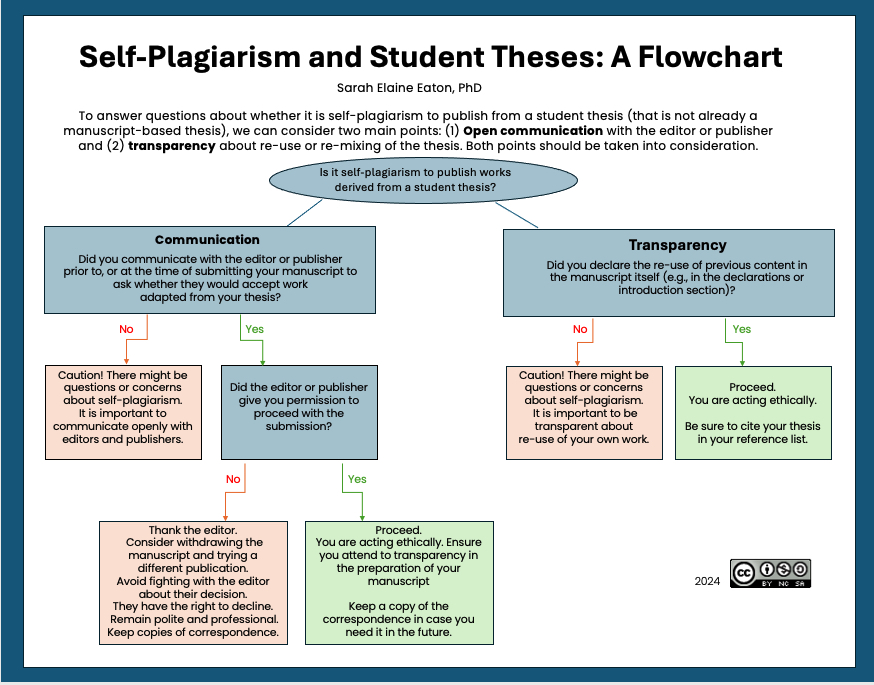
To avoid questions about academic or research misconduct, and specifically self-plagiarism, that can emerge when a student publish works derived from their thesis, there are two points to consider: communication and transparency. Both points should be taken into consideration.

An infographic. There is blue border surrounding a white background. Text is written in black. There is one oval and 8 rectangles, connected by lines. Each shape contains text. The content of this infographic is explained in the blog post.

Communication: Correspond with the Editor Prior to Submission

I recommend that students/graduates correspond with the journal editors prior to, or at the time of manuscript submission, in writing, to ensure full transparency. State clearly that the manuscript is drawn from the thesis and parts of it may be replicated exactly (e.g., methods section). Other parts of the manuscript may be derived (and/or significantly revised) from the thesis and if that is the case, offer some details, but avoid going overboard. Ask directly if such a submission would be considered by the journal / publisher. There is no harm is being clear and transparent with journal editors in this regard.

If the journal editor says no, then consider withdrawing the manuscript and trying a different publication. It is important to recognize that editors have the authority to make such judgements, so don’t be rude or try to convince the editor that their decision is wrong. Maintain a polite and professional tone at all times. Thank them for considering your request and move on.

If the editor says yes, then you are ready to proceed. Ensure you are attending to the matter of transparency during the preparation of your manuscript.

If you communicate with an editor orally (e.g., a face-to-face conversation or a video call), follow up in writing to document the conversation. Ask for confirmation that you have understood the agreement correctly. 

I recommend keeping a record of your written correspondence in case you ever need it again in the future.

Transparency: Declare the re-use of previous content in the manuscript itself

As you prepare your manuscript for submission, ensure you are being transparent about the re-use of content derived from your thesis. This can be done in a couple of ways:

Explicit transparency statement: Add a declaration to the article/chapter/knowledge output stating that it is derived from your thesis. This way, you are declaring there may be some duplication helps to mitigate concerns about self-plagiarizing. You do not need be excessive with your statement. You can keep it short and simple. Here is some sample text that you are welcome to use, re-use, or adapt (as in, I am openly giving anyone permission to use or adapt this statement):

“This work is derived from my doctoral dissertation. Portions of the text resemble or may replicate the original text from my unpublished PhD thesis and have been reproduced as such with the permission of the editors”.

Note that if you use this statement verbatim, it may (ironically) be picked up by text-matching software used by publishers (i.e., flagged for possible plagiarism). I won’t take responsibility for that, so use some judgement in how you prepare your transparency statement.

Attribution: Self-citation is a contested issue in academic publication and it is prudent to avoid over-citing oneself. There are some circumstances in which self-citation is appropriate and this is one of them. When you are deriving work from your thesis, it is appropriate to cite your thesis in the list of references of your publication.

Be careful and attentive when it comes to attribution in publications derived from your thesis. You still need to cite any original works that your thesis drew from. I once saw a manuscript derived from a student thesis and the only work listed in the references was the student thesis! This is disrespectful to the authors of any original works the student thesis was drawn from, so be sure to give credit where it is due. Ensure you give attribution to the authors whose work informed your thesis and any subsequent publications.

This does not mean that you need to replicate the entire bibliography from your thesis in subsequent publications, unless, of course, you are specifically citing every single source in the publication. Instead, be meticulous and mindful to ensure that the specific sources that inform subsequent publications are cited appropriately. Details matter, and if you are going to publish from your thesis, it is worth it to focus on producing the highest quality publication possible.

Finally, assuming that you have a good relationship with your supervisor, I recommend that you keep them informed. In some cases, co-publication with the supervisor may be appropriate, but not in all cases. Co-publishing with one’s supervisor is a topic for another blog post, so I won’t delve deep into those complexities here. Suffice to say that staying in touch with your supervisor about the publication of your work may be beneficial to you, depending on the circumstances.

The bottom line is that concerns about self-plagiarism might be solved with open communication and transparency.

Bibliography and Further Reading

  • Eaton, S. E., & Crossman, K. (2018). Self-plagiarism research literature in the social sciences: A scoping review. Interchange: A Quarterly Review of Education, 49(3), 285-311. https://rdcu.be/YR5u 
  • Roig, M. (2005). Re-using text from one’s own previously published papers: An exploratory study of potential self-plagiarism. Psychological Reports, 2005(97), 43-49. https://doi.org/10.2466/pr0.97.1.43-49
  • Roig, M. (2008). The debate on self-plagiarism: Inquisitional science or high standards of scholarship? Journal of Cognitive & Behavioral Psychotherapies, 8(2), 245-258.
  • Roig, M. (2010). Plagiarism and self-plagiarism: What every author should know. Biochemia Medica, 20(3), 295-300. https://www.biochemia-medica.com/en/journal/20/3/10.11613/BM.2010.037
  • Roig, M. (2024). On Recycling Our Own Work in the Digital Age. In S. E. Eaton (Ed.), Second Handbook of Academic Integrity (pp. 361-380). Springer Nature Switzerland. https://doi.org/10.1007/978-3-031-54144-5_15

Related posts

How to Get Your Academic Article Published in a High Quality Journal  https://drsaraheaton.wordpress.com/2024/01/02/how-to-get-your-academic-article-published-in-a-high-quality-journal/

What is the difference between a thesis, a dissertation and a capstone project? https://drsaraheaton.wordpress.com/2018/02/06/what-is-the-difference-between-a-dissertation-a-thesis-and-a-capstone-project/

What’s the difference between a citation and a reference?  https://drsaraheaton.wordpress.com/2013/10/18/whats-the-difference-between-a-citation-and-a-reference/ 

What’s the difference between a manuscript and an article?https://drsaraheaton.wordpress.com/2017/05/08/whats-the-difference-between-a-manuscript-and-an-article

____________________________

Share this post: Self-Plagiarism: Publishing Works Based on a Thesis or Dissertation – https://drsaraheaton.wordpress.com/2024/01/28/self-plagiarism-publishing-works-based-on-a-thesis-or-dissertation/

This blog has had over 3.7 million views thanks to readers like you. If you enjoyed this post, please “like” it or share it on social media. Thanks!

Sarah Elaine Eaton, PhD, is a faculty member in the Werklund School of Education at the University of Calgary, Canada. Opinions are my own and do not represent those of my employer.

Sarah Elaine Eaton, PhD, Editor-in-Chief, International Journal for Educational Integrity