Global Trends in 21st Century Education: Thinking about Technology, Teaching and Learning in the New Millennium – Speaking in Quesnel, BC

October 23, 2012

Last Friday, I was in Quesnel, British Columbia to present at the professional development day for K-12 teachers in School District 28. I was honored to be their keynote speaker, as well as do two workshops afterwards. Here is what I presented:

Keynote address – Global Trends in 21st Century Education: Thinking about Technology, Teaching and Learning in the New Millennium

This talk is based on research I have been doing since 2010 on emerging trends in education across most developed nations and what we might expect over the next 15 to 20 years. I am not a futurist by training, but there are elements of looking down the road and being able to say, “This is where we are today, and it is not impossible that this is where we are heading.”

Workshop #1 – Appreciating Innovation and Incorporating Wisdom Across the Educational Spectrum

This workshop had an educational leadership focus. We looked at how teachers with different approaches to technology can learn to work together for the benefit of students. It was a strength-based approach to working together in the digital age.

Workshop #2 – Learning the Twenty-First Century Way: Making Sense of How to Use Social Media for Classroom Learning and Student Engagement

In this workshop, I shared how I incorporated Twitter into one of my university level classes. Then we had some hands-on time in the lab and teachers got set up with their first Twitter account.

I really enjoyed my time in Quesnel, a small city of 10,000 people where the pulp mill is a major employer and residents are concerned about the land slippage into the Fraser River that is affecting homes and roadways.

I always find that I learn a lot from taxi drivers when I go somewhere to speak and Quesnel was no exception. The cab driver who picked me up at 7:15 a.m. to take me over to the high school told me that his fares so far that morning had included a round-trip drug run and that poverty was a major issue in the community.

Stories like that were countered by the one told to me by Mike Adams, the principal at Correlieu Secondary School, where our PD day was held. He told me that the young man who got the sound system set up for the day had essentially been abandoned by his parents as a teenager. Instead of turning to drugs, he was surrounded by friends, teachers and administrators who wanted to help. As a result, he was on the football team, in the band and part of the school musical. He turned his life around thanks to the strong sense of community and support he found.

Thank you gift from Quesnel, BC - keynote speaker, Sarah Elaine EatonThanks to Lisa Kishkan, who organized the whole PD day for the teachers, including the other workshops that included sessions on intrinsic vs extrinsic motivation; the art of Pysanky (Ukrainian Easter Eggs); and the aboriginal medicine wheel. I really enjoyed my time in Quesnel and as always, I think I learned as much as I shared.

I am excited to try the “birch syrup” that the teachers gave to me as a thank you gift at the end of the day. And I love coffee and I’ll enjoy the new coffee mug that will always remind me of the trip. Thank you to the educators of Quesnel for the great work you do.

______________

Share or Tweet this: Global Trends in 21st Century Education: Thinking about Technology, Teaching and Learning in the New Millennium – Speaking in Quesnel, BC http://wp.me/pNAh3-1vj

Update – January 2018 – This blog has had over 1.8 million views thanks to readers like you. If you enjoyed this post, please “like” it or share it on social media. Thanks!

Sarah Elaine Eaton is a faculty member in the Werklund School of Education, University of Calgary, Canada.


5 Tips to make writing easier

October 4, 2012

This past spring I taught a course on Writing Educational Research to a group of Master’s students, most of whom taught English as an Additional Language as their job. I was surprised how many of them loathed writing. One student said that she was reluctant to teach writing in her EAL courses because it felt like forcing a traumatic experience on them.

Over the course of the six-weeks we learned together, we came up with some strategies that they could use for themselves, and also use with their students. Here they are:

1. Write every day. Saying, “I’m going to write my essay on the weekend,” can turn the weekend into a time of torture instead of a time to relax and recharge your batteries. Instead, commit to writing 30 minutes per day. This helps build the writing habit.

2. Choose a time of the day when you feel fresh and creative.  For me, that time is often first thing in the morning. By mid-afternoon I am crashing and after supper my brain seems capable of basic life support only. In the morning is when I feel both creative and clear-headed.

3. Work with a writing partner. Choose someone you get along with and like to work with. Arrange a time to work together to review each other’s writing, make suggestions and do some peer editing. The point of working together is to try to help each other, not to nit pick. Set some ground rules and focus on the positive.

4. Let go. Some students said they hated writing because they couldn’t tolerate being criticized or being asked to revise their writing. They became very emotionally attached to their writing right away. What if the purpose of writing was to share it? And share it in the best form possible? If we start with that idea, then we might become less emotionally tethered to the writing… You can still be proud of your work without having a  Gollum-like attachment to it.

5. Edit and revise. It is said that Mozart never revised his music. He sat down, wrote it and was done. Unfortunately, most of us are not Mozart. I recently submitted the second revision of an article I submitted to a peer-reviewed academic journal. It was “accepted with minor revisions” when I first submitted it. That was almost six months ago. I made the changes the reviewers requested and re-submitted it. Then recently, the editor came back to me with a few more minor changes. He was right in asking me to change a few more things. I had forgotten to add in some citations, which are important in journal articles. I made the changes and sent the manuscript back again. I had been so close to the work, I could no longer see the errors. Working with editors, reviewers and instructors is really a chance to make your writing better.

Writing seems to be very easy for some people and very painful for others. These strategies may help a few reluctant writers and ease their stress so writing does not seem so daunting.

_______________

Share or Tweet this: 5 Tips to make writing easier http://wp.me/pNAh3-1uY

Update – January 2018 – This blog has had over 1.8 million views thanks to readers like you. If you enjoyed this post, please “like” it or share it on social media. Thanks!

Sarah Elaine Eaton is a faculty member in the Werklund School of Education, University of Calgary, Canada.


Why do we make our students write essays?

September 13, 2012

Recently a friend sent me a link to a website called UnemployedProfessors.com. I have written about services like this in an earlier blog post. This site is a regular paper mill, with a twist.

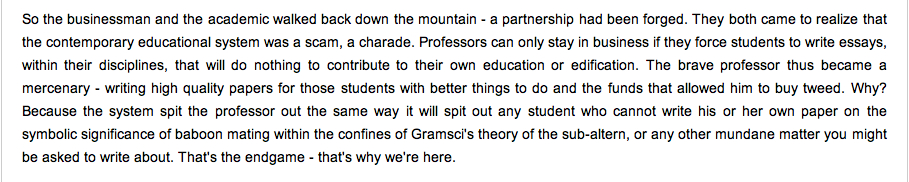
They mock the entire educational system. Here’s a screen shot from their “About Us” page:

In case you can’t read that, the juicy bits say that education is…

“a scam, a charade. Professors can only stay in business if they force students to write essays, within their disciplines, that will do nothing to contribute to their own education or edification… the system spit the professor out the same way it will spit out any student who cannot write his or her own paper on the symbolic significance of baboon mating within the confines of Gramsci’s theory of the sub-altern, or any other mundane matter you might be asked to write about. That’s the endgame – that’s why we’re here.”

That got me thinking, why do we have students write essays? Is it really because that’s how the system “spit us out” and now we are doing the same to our students? Well, for some instructors, there may be an element of truth there. Some academics and teachers think that things should be done the way they have always been done because that it the tradition.

But really, that’s not good enough.

To me, we don’t ask students to write papers because that’s part of the “scam” of the system, or because our students have to go through what we went through in order to be initiated into the hallowed halls of the university.

We ask students to write papers so they can learn how to write. The topic and content areas are secondary. Knowing how to write cogently and construct a written report that has elements like an introduction, a body and a conclusion is a useful skill to know. It is also useful to know how to construct sentences, form an argument and persuade a reader.

Why? Because when you leave school and get a real job, you may have to write something. A report. A letter. A policy. Whatever. You may need to convince someone that you actually know what you are talking about. You may need to show someone (your boss, for example?) you can string together ideas with some semblance of logic and coherency.

I did a post a while back on the International Adult Literacy Skills Survey that showed that 2% of Canadian-born university graduates scored at the lowest levels of prose literacy. In other words, 2% of folks who are born in this country and who make it through University can barely identify or decode words and numbers. Most seven-year olds can do that. (Check out this post on what the literacy levels of IALSS are.)

If we are focussing on having students write on a particular subject, we are missing the mark. (Pardon the pun). Not only is it more about learning to write well than it is about expounding on any given subject, it is also about learning to take pride in your own work and creation. It is about going through the entire process of creating a piece of research writing from beginning to end.

It’s also not about a grade. If the focus is just on getting a good grade and not on learning, heck, why wouldn’t students use these services?

What would happen if we said to our students, “OK, folks, your grade is based on learning, not just on production, or on completing an inane assignment. Show me what you’ve learned, how you’ve learned and it and why you think it has any relevance at all to the real world.”

How would that change what we do as teachers?

How would it change our students’ view of their assignments?

We don’t make our students write papers so they can learn about “the symbolic significance of baboon mating within the confines of Gramsci’s theory of the sub-altern”. We have students write papers so they can learn the art and craft of writing and more importantly, to “learn about learning” and to learn about themselves as students and human beings. Hopefully they grow and expand their own minds in the process.

If students’ minds aren’t expanding, we are not doing our job.

Related posts:

_______________

Share or Tweet this: Why do we make our students write essays? http://wp.me/pNAh3-1ul

If you are interested in booking me (Sarah Eaton) for a presentation, keynote or workshop (either live or via webinar) contact me at sarahelaineeaton (at) gmail.com. Please visit my speaking page, too.


German sign language – Resources and tips

August 29, 2012

Did you know that not all countries in the world share a universal sign language? Today’s post is in honour of my friend, Meike Thomesen, who is the Assistant Principal at Bowcroft Elementary, Calgary’s only German bilingual school. Meike just came back from an intensive training program for in-service German teachers. The course was held in Germany. Part of their training involved PD to teach the German language to children by complementing the spoken language with sign language. What a super idea!

If you teach German, here are some resources to help you learn about German sign language:

DGS Korpus – A corpus of German sign language texts. This is a long-term project of the Academy of Sciences in Hamburg for documenting and researching the German Sign Language (DGS).

Basic German sign language – You Tube video with English sub-titles

German Sign Language Numbers – YouTube video

AlphaDictionary – A very cool, multilingual sign language resource site

__________________

Share or Tweet this post:  German sign language – Resources and tips http://wp.me/pNAh3-1uf

Update – January 2018 – This blog has had over 1.8 million views thanks to readers like you. If you enjoyed this post, please “like” it or share it on social media. Thanks!

Sarah Elaine Eaton is a faculty member in the Werklund School of Education, University of Calgary, Canada.


Sample “Family Internet Policy” to keep you and your kids safe

August 27, 2012

Sarah Eaton - blog - group of childrenWith a new school year just around the corner, are you worried about your kids’ Internet use? The Calgary Police Service offers this free sample “Internet Security Policy” for everyone in the family.

You click, download it, and talk about it with your family. Everyone agrees to the policy and signs it. Then you post a copy of the policy on all the computers in the house.

Printing the policy out on removable labels is another option.

Start the school year off right, by having a conversation with your kids about what you expect from when they are using the Internet. Help your children become great digital citizens.

According the Calgary Board of Education, parents can do a lot to help their children learn “surf smarts”. Here’s a handy resource on what you can do to teach your kids about Internet safety.

Remember that this policy isn’t just for kids; it’s for the whole family. Parents need to lead by example when it comes to using the Internet responsibly.

__________________

Share or Tweet this post:  Sample of a “Family Internet Policy” to keep you and your kids safe http://wp.me/pNAh3-1u4

Update – January 2018 – This blog has had over 1.8 million views thanks to readers like you. If you enjoyed this post, please “like” it or share it on social media. Thanks!

Sarah Elaine Eaton is a faculty member in the Werklund School of Education, University of Calgary, Canada.