What Should We Be Assessing in a World with AI? Insights from Higher Education Educators

November 25, 2025

The arrival of generative AI tools such as ChatGPT has disrupted how we think about assessment in higher education. As educators, we’re facing a critical question: What should we actually be assessing when students have access to these powerful tools?

Our recent study explored how 28 Canadian higher education educators are navigating this challenge. Through in-depth interviews, we discovered that educators are positioning themselves as “stewards of learning with integrity” – carefully drawing boundaries between acceptable and unacceptable uses of chatbots in student assessments.

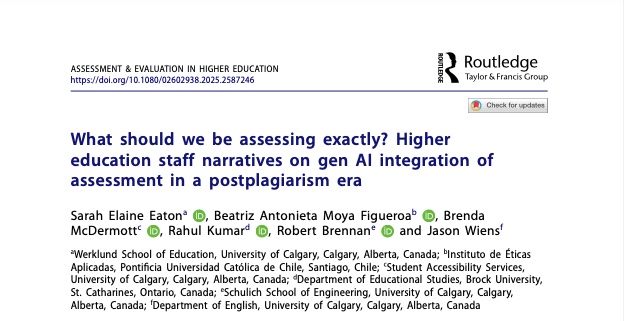
Screenshot of an academic journal article header from Assessment & Evaluation in Higher Education, published by Routledge. The article title reads: “What should we be assessing exactly? Higher education staff narratives on gen AI integration of assessment in a postplagiarism era.” Authors listed are Sarah Elaine Eaton, Beatriz Antonieta Moya Figueroa, Brenda McDermott, Rahul Kumar, Robert Brennan, and Jason Wiens, with institutional affiliations including University of Calgary, Pontificia Universidad Católica de Chile, Brock University, and others. The DOI link is visible at the top: https://doi.org/10.1080/02602938.2025.2587246.

Where Educators Found Common Ground

Across disciplines, participants agreed that prompting skills and critical thinking are appropriate to assess with chatbot integration. Prompting requires students to demonstrate foundational knowledge, clear communication skills, and ethical principles like transparency and respect. Critical thinking assessments can leverage chatbots’ current limitations – their unreliable arguments, weak fact-checking, and inability to explain reasoning – positioning students as evaluators of AI-generated content.

The Nuanced Territory of Writing Assessment

Writing skills proved far more controversial. Educators accepted chatbot use for brainstorming (generating initial ideas) and editing (grammar checking after independent writing), but only under specific conditions: students must voice their own ideas, complete the core writing independently, and critically evaluate any AI suggestions.

Notably absent from discussions was the composition phase – the actual process of developing and organizing original arguments. This silence suggests educators view composition as distinctly human cognitive work that should remain student-generated, even as peripheral tasks might accommodate technological assistance.

Broader Concerns

Participants raised important challenges beyond specific skill assessments: language standardization that erases student voice, potential for overreliance on AI, blurred authorship boundaries, and untraceable forms of academic misconduct. Many emphasized that students training to become professional communicators shouldn’t rely on AI for core writing tasks.

Moving Forward

Our findings suggest that ethical AI integration in assessment requires more than policies, it demands ongoing conversations about what makes learning authentic in technology-mediated environments. Educators need support in identifying which ‘cognitive offloads’ are appropriate, understanding how AI works, and building students’ evaluative judgment skills.

The key insight? Assessment in the AI era isn’t about banning technology, but about distinguishing between tasks where AI can enhance learning and those where independent human cognition remains essential. As one participant reflected: we must continue asking ourselves, “What should we be assessing exactly?”

The postplagiarism era requires us to protect academic standards while preparing students for technology-rich professional environments – a delicate balance that demands ongoing dialogue, flexibility, and our commitment to learning and student success.

Read the full article: https://doi.org/10.1080/02602938.2025.2587246

______________

Share this post: What Should We Be Assessing in a World with AI? Insights from Higher Education Educators – https://drsaraheaton.com/2025/11/25/what-should-we-be-assessing-in-a-world-with-ai-insights-from-higher-education-educators/

Sarah Elaine Eaton, PhD, is a Professor and Research Chair in the Werklund School of Education at the University of Calgary, Canada. Opinions are my own and do not represent those of my employer.

Beyond Student Compliance: Building a Culture of Shared Academic Integrity

November 17, 2025

The recent court case in British Columbia, Canada, involving a student suing instructors for alleged plagiarism at University Canada West raises an uncomfortable but important question: Should academic integrity policies apply only to students?

In this case, the court dismissed the lawsuit, noting that the university’s academic integrity policy explicitly applied to students, but not faculty. Although the legal reasoning is sound, the ethical implications are profound. 

Integrity Is a Shared Responsibility

Academic integrity is not a student-only obligation. As Julia Christensen Hughes and I pointed out in our 2022 chapter on why academic integrity is about more than student cheating, faculty members are role models and gatekeepers of scholarly standards. When instructors are exempt from integrity policies, institutions risk creating a double standard that erodes trust and credibility.

Why does this matter?

  1. Role Modeling: Faculty are the standard-bearers of scholarly conduct. When instructors fail to uphold integrity, it undermines the credibility of the entire educational process. This is an idea repeated over and over again in the Second Handbook of Academic Integrity and one that emerged in the Comprehensive Academic Integrity Framework: academic integrity includes, and extends beyond student conduct.
  2. Trust and Fairness: Students trust that their learning environment is built on fairness. A double standard, where plagiarism policies apply only to students, erodes that trust. As I have written about elsewhere, trust has been a central theme of academic integrity for decades and is a foundation for education and it applies not only to students, but to faculty and administrators as well.
  3. Institutional Reputation: Universities thrive on public confidence in their academic rigour. Ignoring faculty misconduct risks reputational damage far beyond the classroom.

What should change?

Institutions need comprehensive integrity policies that apply to everyone—students, faculty, and administrators. These policies should include clear definitions, reporting mechanisms, and consequences for violations. Academic integrity is a shared responsibility, and everyone in the learning community is accountable.

Recommendations for Higher Education Institutions

  1. Expand and Unify Policy Scope: Ensure academic integrity policies explicitly apply to faculty, staff, and administrators, not just students. 
  2. Develop Reporting Mechanisms: Create confidential, transparent processes for reporting and investigating faculty misconduct.
  3. Mandatory Training: Require regular integrity training for faculty, emphasizing ethical scholarship and teaching practices, as well as research ethics.
  4. Institutional Culture: Promote integrity as a shared value through leadership messaging, recognition programs, and open dialogue. 
  5. Accountability Framework: Include consequences for faculty breaches in contracts and performance evaluations. 

Call to Action

Academic integrity is a foundation of higher education. If we expect students to be honest in their work, then faculty must be held to the same (if not higher) standards. Universities and colleges should act now to close the policy gap, embed integrity in institutional culture, and hold everyone accountable. If we want students to take integrity seriously, faculty must lead by example. Anything less is hypocrisy.

References

Eaton, S. E. (2024). Comprehensive Academic Integrity (CAI): An Ethical Framework for Educational Contexts. In S. E. Eaton (Ed.), Second Handbook of Academic Integrity (pp. 1–14). Springer Nature Switzerland. https://doi.org/10.1007/978-3-031-54144-5_194 

Eaton, S. E. (2025). Think Piece: Trust as a foundation for ethics and integrity in educational contexts. Critical Studies in Teaching and Learning (CriSTaL), 13(SI2), 4–7. https://doi.org/10.14426/cristal.v13iSI2.3057

Christensen Hughes, J., & Eaton, S. E. (2022). Academic misconduct in Canadian higher education: Beyond student cheating. In S. E. Eaton & J. Christensen Hughes (Eds.), Academic integrity in Canada: An enduring and essential challenge (pp. 81–102). Springer. https://doi.org/10.1007/978-3-030-83255-1

Labbé, S. (2025, November 13). B.C. student sues his teachers over plagiarism, judge strikes case. Business Intellgence for BC. https://www.biv.com/news/human-resources-education/bc-student-sues-his-teachers-over-plagiarism-judge-strikes-case-11485013

______________

Share this post: Beyond Student Compliance: Building a Culture of Shared Academic Integrity – https://drsaraheaton.com/2025/11/17/beyond-student-compliance-building-a-culture-of-shared-academic-integrity/

Sarah Elaine Eaton, PhD, is a Professor and Research Chair in the Werklund School of Education at the University of Calgary, Canada. Opinions are my own and do not represent those of my employer.


Embedding Social Justice, Equity, Inclusion, Diversity, and Accessibility in Academic Integrity

August 25, 2025

As a new academic year begins here in the northern hemisphere, I’m worried. I am worried that equity-deserving students, including racialized and linguistic-minority students, disabled and neurodivergent students, and others from equity-deserving groups will fall through the cracks again this year.

Conversations about academic integrity often centre around detection and discipline. 

How many students will be accused of — and investigated for — academic cheating this year when what they actually needed was learning support? Or language support? Or just a clearer understanding of what academic integrity is and how to uphold it?

It doesn’t have to be this way.

Academic integrity is also about creating a learning environment grounded in fairness and opportunity for every student. Social justice, equity, inclusion, diversity, and accessibility shape how students experience integrity in real ways:

  • Equity reminds us that students enter the classroom with different levels of preparation and support.
  • Inclusion ensures every student can participate in learning and assessment.
  • Accessibility removes barriers that make it harder for some students to meet expectations.
Infographic entitled 'Embedding Social Justice, Equity, Inclusion, Diversity, and Accessibility in Academic Integrity.' It features four bullet points: Equity acknowledges varied student preparation and support; Inclusion promotes participation in learning and assessment; Accessibility removes barriers to meeting expectations; and a Social Justice lens reveals patterns in integrity breaches. An illustration of a balanced scale appears below the text. The poster is credited to Sarah Elaine Eaton, PhD, August 2025.

A social justice lens helps us see patterns in who is reported or penalized for breaches of integrity and why.

  • Here are some actions educators can take in the first month of classes to support student success:
  • Review course materials to ensure instructions and policies about integrity are written in plain, accessible language.
  • Dedicate class time to talking with students about what integrity looks like in your course and why it matters.
  • Share examples of proper citation and collaboration that are relevant to your discipline.
  • Make time for questions about assessments so students understand what is expected and where to find help.
  • Connect students early to campus supports such as writing centres, student services, and accessibility services.

This is just a start.

My point is this: Do not assume that students should just know what academic integrity means. Take the time to explain your expectations and policies. In order for students to follow the rules, they need to know what the rules are.

Academic integrity is not only about avoiding plagiarism or cheating. It is also about fostering trust and fairness so that all students have a fair chance to learn and succeed. The choices we make in the first few weeks of the term set the tone for the entire year.

What steps are you taking at the start of this new school year to build a more inclusive and equitable approach to academic integrity?

________________________

Share this post: Embedding Social Justice, Equity, Inclusion, Diversity, and Accessibility in Academic Integrity – https://drsaraheaton.com/2025/08/25/embedding-social-justice-equity-inclusion-diversity-and-accessibility-in-academic-integrity/

Sarah Elaine Eaton, PhD, is a Professor and Research Chair in the Werklund School of Education at the University of Calgary, Canada. Opinions are my own and do not represent those of my employer.


Celebrating 5 Years of Integrity Hour in Canadian Higher Education

March 31, 2025

Five years ago we started Integrity Hour, an online community of Practice by and for Canadian higher education #AcademicIntegrity enthusiasts, professionals, educators, researchers, and students. 

Today we had our five-year celebration, which also served as a closure of sorts. After serving as a co-steward of the community almost since the beginning, Dr. Beatriz Moya has started the next chapter of her career. 

We are working with some of our long-standing partners to reconceptualize what the next iteration of Integrity Hour will look like. For now, we will take a little pause as we regroup.

At our anniversary celebration meeting today, Brooklin Schneider encouraged us to share this guide widely, so we are posting it here, as an open access resource: “Integrity Hour: A Guide to  Developing and Facilitating an Online Community of Practice for Academic Integrity”.

Our collective outputs have been collaboratively conceptualized and co-developed. Here are a couple of other resources we have worked on over the years:

Reflections on the first year of Integrity Hour: An online community of practice for academic integrity

Academic Integrity Leadership and Community Building in Canadian Higher Education

In my remarks today I shared that being part of this weekly community of practice has influenced and informed my thinking, advocacy, and practice in way I could never have imagined. 

My gratitude to everyone who has been part of our community, sharing wisdom, knowledge, and resources. What an incredible half a decade it has been!

________________________

Share this post: Celebrating 5 Years of Integrity Hour in Canadian Higher Education – https://drsaraheaton.com/2025/03/31/celebrating-5-years-of-integrity-hour-in-canadian-higher-education/

This blog has had over 3.7 million views thanks to readers like you. If you enjoyed this post, please ‘Like’ it using the button below or share it on social media. Thanks!

Sarah Elaine Eaton, PhD, is a Professor and Research Chair in the Werklund School of Education at the University of Calgary, Canada. Opinions are my own and do not represent those of my employer. 


Time Management Tips and Goal-Setting for Graduate Students

January 6, 2025

This post is for my grad students, but may be of interest to others, too.

For as long as I can remember, I’ve started each year by setting goals for the year and sometimes even for multiple years. Call it a quest for independence, a desire for self-determination, or a way to keep myself from getting down in the dumps as the shininess of a new year wears off and the drudgery of February descends.

SMART Goals

Some years ago I learned about SMART (specific, measurable, achievable, relevant, and time-bound) goals. That has been a helpful framework for me, but I have also struggled to keep my thinking flexible when setting goals. Having a framework and being flexible with that framework, rather than adhering to it strictly, is ongoing goal.

Write Down the Goals

I write down my goals and I also keep To Do Lists. This helps me to keep track of what goals I set and their due dates. Now, due dates get shifted sometimes, but I am more likely to meet my goals and complete the tasks that help me achieve them if I give myself a deadline.

Some of my Favourite Tools

An alumnus from our school of education introduced me to Magic To Do Goblin Tools a while back. It’s an AI app that helps break down a big task into smaller tasks.

I also use Google sheets to create To Do lists. I used to use a word processor for this, but over time I have migrated to spreadsheets because I like being able to sort the columns by different categories such as due dates, tasks completed, and so on. One reason I use Google sheets is that I like being able to access it from any device, anywhere in the world.

Back during the pandemic, Phill Dawson and I were working on our respective books. He was writing Defending Assessment in a Digital World and I was writing Plagiarism in Higher Education: Tackling Tough Topics in Academic Integrity. He posted on Twitter that he was using WriteTrack ( to help him complete the book. I checked it out and immediately signed up. This has been one of the single most helpful tools to help me complete large writing projects that have a target word count. I recommend it to students who are writing a thesis or anyone tackling a big writing project.

Microgoals

For me, one of the things that I have found helpful, is to break down big goals into smaller ones. I break the smaller ones in to even smaller ones. I keep going until I have micro goals, which for me are small things I can do in half an hour or less.

My preference is to have big chunks of time (at least three or four hours of uninterrupted time) to work on projects. Most days I do not have that luxury, which is frustrating, but also outside of my control. Instead, I try to do micro tasks throughout the day that require less focus, so that when the opportunity comes to have an hour or more to work on a task, I am less preoccupied with other chores or deliverables that need to get done. Five minutes to fill out and submit a form for a graduate student’s progress. Ten minutes to load the dishwasher. Fifteen minutes to answer some e-mails.

Some days I do not have time to read an entire article or an entire chapter of a book, so my microgoal is to simply open the .pdf, scan the title and read the abstract. I might add the article to my EndNote library. That’s another micro task. Even if I cannot complete an entire task, I try to make some progress, however small it may seem.

Some microtasks are things that I don’t particularly enjoy doing, but they are responsibilities and I just need to get them done. Other micro tasks are things I really wish I could spend more time on. Either way, doing something rather than nothing means we are making progress.

Monitor Your Progress and Celebrate Small Wins

The point is to find tools that work for us to declare and then monitor our progress. Making some progress is better than making no progress at all. Things sometimes (often?) take longer than we anticipate, but the goal might still be worth working towards. Monitoring progress and celebrating the small steps is an important part of the process. We do what we can, and we can feel proud of that.

Expect the Unexpected

One of the things I struggle with is being interrupted. If I am focused on a task and I am interrupted, sometimes it can feel like the whole day is ruined. One of my daily challenges is dealing with abrupt or unexpected changes that can take me away from something I am working on. My reality is that most days are full of interruptions. It’s one of the reasons I often get up early to work on important projects. I often say that by the time 09:00 a.m. rolls around, I can’t get any more work done for the day. I say it in jest, but there’s a kernel of truth in there.

I have learned to expect the unexpected and assume that my day will include interruptions that I have no control over. For me this means bracing myself for incidents, e-mails, or the cat throwing up a hair ball that will demand my attention and throw me off balance. It’s not that learning to expect the unexpected means that I am suddenly able to regain my balance, but rather that I accept that I may be in a sustained state of internal imbalance due to factors outside my control. I practice breathing and just carrying on… however off kilter I may feel.

Anticipate the Need for Extra Time

One of the reasons I like to think I’m good at time management is because I often allow extra time for tasks. I block travel time in my calendar to get to work, for example. I tend to allow more time than I might need on an average day, so that if traffic is heavy or if there’s an accident on the road, I have built some buffer into my schedule. On days when I arrive to work a little bit early, I can spend a bit of extra time getting ready for my meetings or chatting with people I run into along the way.

For me, anticipating I may need more time than a task might require, helps me cope when unexpected things happen. It also helps me to limit the number of tasks I expect of myself in a day. Because I tend to over-schedule and over-plan, limiting the number of tasks in a day can actually be helpful for me.

Release the Day

Set daily goals that you can realistically achieve. If you do not achieve them by the end of the day, then release them… At the end of the day, say to yourself, “Today is over and I have done my best. Tomorrow is a new day.” Set concrete and small goals for the next day and when you wake up, review your list. Look at it throughout the day. Do what you can. Then, at the end of that day, accept that the day is over, you have done your best, release what you did not accomplish and if possible, move those goals to the next day.

I have too many things on my lists for me to accomplish them all. When I was younger, I would get very upset with myself for not achieving everything on my To Do List. One of the most powerful techniques I learned was to ‘release the day’. At the end of every day, I review what tasks I accomplished. (Sometimes I even book in relaxation as a goal and that one is always a challenge for me.)

At the end of the day, say to yourself, “Today is over and I have done my best. Tomorrow is a new day.” in my mind, I close the day and release myself from any guilt, sadness, or anger that I have not made as much progress on my To Do List. There are a limited number of hours in each day and I do what I can. 

I forgive myself for whatever didn’t get done and give myself permission to start tomorrow as a new day. Each day is its own little time capsule. Success happens from doing many small tasks over time to achieve a big goal.

Limit the Worrying

This can be easier said than done. For me at least, worry is like an evil monster that can block me from making any progress at all. Worrying can be normal, but worrying too much can prohibit us from making progress on small things we can do today. By anticipating the unexpected, anticipating the need for extra time, and releasing the day, I tend to worry less.

Little Steps Towards Big Goals

I often tell graduate students that I work with that we complete our academic programs as a result of doing many little tasks every day that help propel us towards their overall goal. Of course, there are big program milestones: completion of individual courses, followed by completion of all the required courses, writing the thesis proposal, the candidacy exam, the final oral defence, and then graduation. These big milestones are way points along the journey. Each and every step along the path matters though. No matter how small, even one step helps get us closer to our goals.

Ask for (and Accept) Help

Asking for help can be a challenge. I am not always great at asking for help, but whether I like it or not, there are a lot of things I am either not good at or just cannot do for one reason or another. As a supervisor, there are certain things I can help my students with, but there are other things that I can’t do. For example, if a student is experiencing high levels of anxiety, demand avoidance or task initiation paralysis, I can listen and be supportive, and I may recommend that the students seek additional support from a qualified therapist or counsellor. I am aware that my role as an academic supervisor has some constraints and I am not qualified to serve as a proxy therapist for a student who needs more support than I can give. In these cases, I see my role is one of helping students recognize that they may need extra support and provide referrals to the Student Wellness centre, were further diagnostics or support can be provided.

I might share that when I was a graduate student, I myself got help from counsellors along my journey who helped me manage my anxiety, sleep better, and helped me achieve my goals. Sometimes that disclosure helps and sometimes it doesn’t. If a student is resistant to seeking help, I recognize that ultimately, they own that resistance, not me. Everyone’s journey is personal.

Concluding remarks

A new year brings an opportunity for a re-set. We can acknowledge and celebrate what we achieved in the previous year as we look ahead to new challenges, new experiences, highs, lows, and everything in between. It’s not that the journey is always fun, because it’s not. The journey itself is difficult, with many twists and turns, with unexpected obstacles along the way. The point is to keep working towards our goals, little by little, while still taking time to rest and rejuvenate, so we have the energy to keep going.

Related posts (ones that might of special interest to students)

________________________

Share this post: Time Management Tips and Goal-Setting for Graduate Students – https://drsaraheaton.com/2025/01/06/time-management-tips-and-goal-setting-for-graduate-students/

This blog has had over 3.7 million views thanks to readers like you. If you enjoyed this post, please ‘Like’ it using the button below or share it on social media. Thanks!

Sarah Elaine Eaton, PhD, is a Professor and Research Chair in the Werklund School of Education at the University of Calgary, Canada. Opinions are my own and do not represent those of my employer.