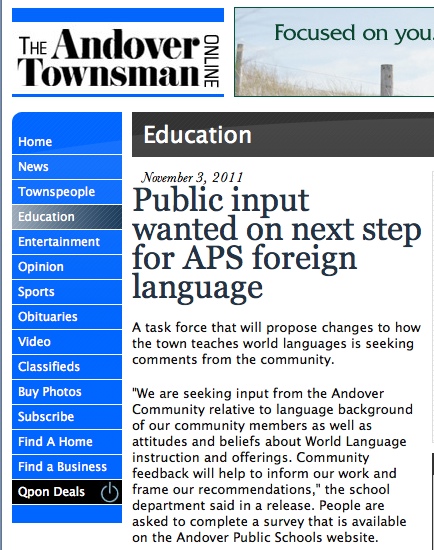
U.S. School district asks for public input on world language program

November 6, 2011

Andover public schools seek public inputThe Andover Public School board in Massachusetts, U.S.A. has established a World Language Task Force, reports the Andover Townsman. The purpose of the task force is to seek input from the community on what languages they would like to see taught in their schools and why. The task force is comprised of teachers, parents, community members, and administrators. The purpose of the task force is to:

Study the K-12 programming model and trends in world language teaching and learning.

Develop goals and strategies for a K-12 World Language program for inclusion in the Andover Public Schools Strategic Plan.

Produce recommendations relative to which one language will be taught on the elementary school level, which two languages will be taught on the middle school level, and which languages will be taught at Andover High School.

The task force is soliciting input from the public through a public online survey developed by the school board. The survey asks respondents to rank the importance of such factors as cultural competence, writing and testing skills in a first language and preparing students for global society. It also asks for input on what languages the board should offer, including popular languages such as Spanish and Chinese, as well as less popular languages such as Hmong, Khmer and Creolo Haitian.

I believe that this is a commendable initiative for a variety of reasons:

  1. Generating dialogue between school boards and the community promotes a culture of open communication. It gives a voice to parents, grandparents and even students about that is important to them. It gives a voice to the community.
  2. In addition to giving a voice to the community, it also seeks to uncover what is important to the community, digging deeper into the values, beliefs and opinions of those who live in the local area. Then, it would assume, the task force would consider these values as part of its criteria when it comes to making its decisions.
  3. It downplays the traditional authoritarian nature of school boards. Instead of propagating the ideas that “school boards know best”, it levels the playing field (at least in terms of the optics) and sends the message that “We’re here to serve you, not dictate to you.” This is a strategy that the Calgary Board of Education would have done well to employ when it arbitrarily decided to cut French programs without engaging the community in any dialogue about it.
  4. It generates community involvement and interest in language programs at the local schools. At a time when cutbacks to language programs, particularly in the United States, are mercilessly targeting world language programs, initiatives such as this will draw importance to language programs. After people have contributed to the discussion and have had some say into the decision-making process they are emotionally and psychologically invested in the outcome and are more likely to support foreign and world language programs in general.

One comment posted on the Andover news article pointed out that the survey is an imperfect tool, since respondents can answer as many times as they like, potentially skewing the results. This is relatively easy to overcome, depending on which survey tool is used. Nevertheless, the concept is brilliant. Opening up discussions about education and in particular, language learning, to the public and ultimately involving the community in the decision making process is innovative, respectful of the community and downright brilliant.

________________

Share this post: U.S. School district asks for public input on world language program http://wp.me/pNAh3-ZV

Update – January 2018 – This blog has had over 1.8 million views thanks to readers like you. If you enjoyed this post, please “like” it or share it on social media. Thanks!

Sarah Elaine Eaton is a faculty member in the Werklund School of Education, University of Calgary, Canada.


Vain, insane or free rein? Confessions of a self-published writer (Part 1 of 2)

November 3, 2011

Nine years ago I did something scandalous, something that caused many of my colleagues to balk and wrinkle their noses in disdain. I self-published a book.

I have worked in academia since 1994, where the pinnacle of respect comes from articles published in the most highly acclaimed peer-reviewed journals. Self-publishing anything, let alone a “how to” guide doesn’t really result in respect. In fact, it results in quiet whispers of, “Who does she think she is, publishing her own work? We’re scholars, not peddlers. It’s just so… vain!”

I remember one particularly stinging comment of a professor who said, “Anyone who self-publishes their own work clearly has more ego than intellect.” At least he had the courage to say it to my face… and I’ve never forgotten it.

I’ve always struggled with two seemingly disparate aspects of my character. One aspect is deeply curious, driven deep into research to the point of forgetting to eat, methodical and persistent, obsessed with learning, surrounded by books, and slightly susceptible to worshipping great teachers as heroes who have inspired me to be a voracious learner. That’s the scholar side.

The other side demonstrates all the classic personality traits of an entrepreneur: impulsive, headstrong, stubborn, relentless about progress and pushing the boundaries of new ways of doing things (often before I’ve considered all the risks), with a wildly creative spirit that flourishes in an environment where there are high levels of autonomy and self-determination.

When someone tells me that I can’t do something, my usual (though often unvoiced) reaction is, “Oh yeah? Watch me.”

Then I proceed to do it, come hell or high water.

I’ve run a marathon, gone “polar bearing” in Halifax harbour on New Year’s Day, done a Master’s degree in a language I didn’t really speak very well, then did a Ph.D. in a completely different field and started an educational consulting business. I’ve done these things despite the fact that at least one person told me I couldn’t do it… would never succeed. Or was it because someone told me I couldn’t do it? I’ve never really figured out which it was.

In 2002, I added “self-publishing” to that list. Very few people were self-publishing then. It was considered heinously poor form. The truth is, I couldn’t find a publisher for my book. I looked and looked. For months. No one was interested. “It won’t sell,” they said.

I didn’t want to let that stop me, so I hired an editor and a graphic designer to help me do it. Self-publishing taught me a great deal about the process of publishing a book. I still worked with an editor, a designer and a printer. My editor was relentless. Any ego I had before starting to work with her was undeniably and unapologetically crushed in the process. She reduced me to a pile of humble tired bones, pushing fingers forward on a keyboard. It was excellence or nothing. (She taught me that it’s free “rein” and not free “reign”, as I’d previously thought.) God, she was good.

I pushed myself to produce the very highest quality that I could and to learn not only about content, but also form, style and little details of the publishing process, right down to what kind of paper we would use and why.

The first edition of 101 Ways to Market Your Language Program ranked among DeMille’s Technical Books Top 10 Best sellers, reaching #1 on that Top 10 list on August 25, 2003. Now, being a best seller among technical books on a small list isn’t like being a #1 best seller on the New York Times or anything, but in its own way, it was a highlight of my career.

It was, however, a bittersweet victory. While I worked like a demon on the project, I often felt sheepish and ashamed in front of some my academic colleagues who found the whole prospect of self-publishing downright disdainful.

If you believe Wikipedia, then you might be as surprised as I was to learn that works by authors such as  e.e. cummings, Deepak Chopra, Benjamin Franklin, Rudyard Kipling, D. H. Lawrence, Edgar Allan Poe, Ezra Pound, Carl Sandburg, George Bernard Shaw, Upton Sinclair, Gertrude Stein, Henry David Thoreau, Walt Whitman and Mark Twain were self-published. Though we need to be clear that there are thousands of people whose self-published work will never be elevated to such high regard. The fact remains that some pretty darn amazing writers went ahead and published their own work when no one else would.

Here we are in 2011, when there are 156 million public blogs in existence (as reported by  “BlogPulse”. The Nielsen Company. February 16, 2011). Today, people self-publish every day, in every corner of the world. Earlier this year, the New York Times published an article about the rise of self-published books. Publisher’s Weekly reported that in 2009, 764,448 new books were either self-published or micro-published.

Suddenly, I don’t feel so alone any more.

I still struggle, on an almost daily basis with being an “academic entrepreneur”. Most of the time, I feel like I don’t fit properly into either world, and with fierce determination, I push aside the feelings in order to push forward with the work. For me, doing the work — and doing it well — has always been more important than how I feel about the work, because I rarely feel good about the work I do. No matter how good it may be, I always want to be better. It keeps me up at night… most nights, in fact.

I don’t know if e.e. cummings really did self-publish, but I do love his quote, “It takes courage to grow up and become who you really are.” It takes courage to put yourself out there, to use your voice and do something a bit rash and a bit wild. People may sneer. (But then again… those same people would likely find something to sneer about anyway.)

Digital technology has democratized creativity and empowered anyone with a voice to use it. What have you done lately that is wildly creative (and even a little rebellious)? I’d love to hear your stories about how you’ve taken a creative risk and what you learned from it.

(Check out Part 2 of this post, where I talk about how I used what I’ve learned over the past nine years to help someone else launch into the world of becoming a published author.)

___________________

Share this post: Confessions of a self-published writer (Part 1 of 2) http://wp.me/pNAh3-ZE

Update – January 2018 – This blog has had over 1.8 million views thanks to readers like you. If you enjoyed this post, please “like” it or share it on social media. Thanks!

Sarah Elaine Eaton is a faculty member in the Werklund School of Education, University of Calgary, Canada.


How to market your language or literacy program: Build trust over time

October 30, 2011

If you send prospective students a brochure or answer an e-mail, they are not very likely to register in your program. Here’s why…

Marketers tell us that we need to see an advertisement or hear a message at least seven times before we are likely to buy a product. Sales professionals say that it can take anywhere between five and 27 “touches” or contact with a prospective buyer before they are convinced to make a purchase from you.

What does that mean for language programs and literacy organizations? It means that we can not simply send out a brochure to a student and reasonable expect that suddenly he or she will want to register in our program.

The “drip theory” recommends regular, repeated contact – at least six or seven times – with a prospect to ensure that your name sticks in her mind. This does not mean sending out six or seven copies of the same brochure! There is a difference between “dripping” and “bombarding” or worse yet, “stalking”.

Each “touch” needs to be different — and still relevant. For example, connecting via e-mail, followed by sending a brochure, followed a week later by an invitation to register, followed by a couple of monthly newsletters.

The timing of each contact is also important. Bombarding someone in seven different ways in a very short period of time is more likely to turn them off than to convince them that they want to join your program. There is no one perfect formula for how often you should connect with your prospects… Once a week or a few times a week seems to be an accepted norm in the educational and non-profit sectors. There seems to be a lower tolerance for repeated contact in a short period of time with prospects in the social sectors than there is in the business sectors.

In my PhD research, I found that it can take anywhere from two to five years to get a new language program off the ground. That is the “sales cycle” for English as an Additional Language (ESL / EFL / EAL / ESOL) programs. It can also take up to two years to convert a prospective student into a current student.

In Guerrilla Marketing for NonProfits, authors Jay Conrad Levinson, Frank Adkins and Chris Forbes talk about how non-profit organizations often give up too soon. They expect to see results NOW. If they do not get an immediate response (which is highly unlikely) they give up. In fact, they say that most non-profits give up on new programs just before they hit the point of success.

If you get an e-mail address for the prospect and you can send monthly updates about what is going on in your program, you will be using yet another medium to show your prospects that you have not forgotten about them.

Ideally, you want to combine different types of contact: social media, mail, e-mail, phone calls and personal contact. This is not always easy in an international marketplace, but do try for repeated contact in a variety of ways.

If you don’t get any response after several tries, then you can change the prospect from active to inactive in your database. In any case, you are more likely to get more registrants by using the drip effect than by sending an initial brochure and nothing else.

Here are seven ways to help you market your language or literacy program consistently

1) List all of the methods you use to connect with your prospective learners (phone, e-mail, drop-in, brochures, etc.).

2) Set up a spreadsheet with each method of contact across the top.

3) Every time a prospect contacts you, ask for his or her contact information.

4) Note the date that you made contact under the appropriate column.

5) Make an effort to stay in touch with the prospective learner, at least once a week, using a different method each time.

6) If a prospective student shows a preference for a particular type of communication, use that one more often. For example, if a prospective student does not respond to e-mails, but calls or Skypes, then make a note of it. At least once, take the initiative to connect with the prospect in the way that they prefer. It’s about them, after all.

7) Track how many prospective students actually end up enrolling in your program and how long it takes. You may be surprised to find that it take  longer than you think it will, or longer than you would like it to. This does not mean that should try to accelerate that cycle. That can often backfire and turn prospects off. It is useful, however, to show you how long prospective learners may take to make a decision.

It’s not about trying to force them to make a decision faster. It is about cultivating trust and building a relationship with them so that when they are ready to make a decision, they choose your program because they feel that they know you and that you care about them. When the time comes for them to make their decision, trust will often be the factor that sways people one way or another. If you haven’t built the trust with them over time, they may never register. That takes time. In the long run, it is worth it.

___________________

This post is adapted from “Idea #17: Be a Drip ” in 101 Ways to Market Your Language Program

________________

Share or Tweet this post: How to market your language or literacy program: Build trust over time http://wp.me/pNAh3-wx

Update – January 2018 – This blog has had over 1.8 million views thanks to readers like you. If you enjoyed this post, please “like” it or share it on social media. Thanks!

Sarah Elaine Eaton is a faculty member in the Werklund School of Education, University of Calgary, Canada.


How to Use Webinars for Literacy: PD, Programming and Promotion

October 28, 2011

A huge thank you to our participants and speakers today who participated in the online discussion on how to use webinars for professional development, programming and promotion in the literacy field.

Our speakers

Allison Mullin is the manager of communications and marketing at the Ontario Literacy Coalition (OLC), after previously working in the communications departments of Mount Sinai Hospital in Toronto and the City of Calgary. As part of it’s strategy to provide professional development opportunities for those working in the literacy field in Ontario, the OLC has been hosting a webinar series for the past year on a wide variety of topics.

 Courtney Hare is a Financial Literacy Facilitator for the non-profit organization in Calgary called Momentum. She is a certified Training Practitioner and holds an MA in Education from the University of Calgary where she got her start moderating and facilitating E-learning and online presentations. She is now looking for ways to further engage learners who may have barriers to accessing face-to-face workshops or learners who prefer to engage online. She is in the process of establishing the first E-learning module for a Momentum’s program called “StartSmart.”

Laura Godfrey is the Manager of Learning Links Resource Centre in Calgary, where she manages the development and operations of the centre. A graduate of the Southern Alberta Institute of Tecnology’s Library and Information Technology program, LearningLinks is the fifth library she has had a hand in setting up and running.

Each of the speakers is at a different point along the “continuum of development” for webinars. Allison heads up a successful webinar series that regularly has sessions filled over capacity. Courtney is beginning to prepare webinars for her organization. Laura is just starting to ask questions about webinars for literacy.

Laura provided a number of questions to guide today’s discussion:

  1. We’re a non-profit. How do we cover the costs of doing a webinar?
  2. Do we have to buy special software?
  3. How do we pick a topic to cover in a webinar?
  4. How long does it need to be?
  5. Can we record it and how can we make it available to others later?
  6. How tech savvy do you need to be in order to do this?
  7. Do you need to hire a speaker or can anyone do the speakers job?
  8. Who else is doing webinars in the literacy and adult education field?
  9. Why should we do this?
  10. Are there chances to collaborate with other groups?

Check out the webinar recording

In addition to our pre-arranged speakers, kudos also go to Dr. Jenny Horsman and Dr. Peggy Albers, both of whom shared insights from their own experiences about doing webinars in the literacy field.

Resources that were shared by participants today

Global Conversations in Literacy Research – A webinar series presented by Dr. Peggy Albers and hosted at Georgia State University

Camtasia – a video-capture software

RGK Foundation – Learning grants (USA only)

MacArthur Foundation Granting agency (USA only)

Techsoup – Technology resources for non-profits

Ontario Literacy Coalition Spotlight on Learning – OLC’s archived webinars

Learning and Violence – This site contains resources and archived webinars

Center for Interactive Learning and Collaboration (CILC) – Clearing house of e-learning, video conferencing and webinars for K-12, educator PD and community education

Stock Exchange – Free stock photography site (requires registration)

Nancy Duarte – Best practices and resources for slide presentations

Twitter handles of some of today’s participants

@englishwob

@ontarioliteracy

@LLRCLibrary

@LandVdotnet

I enjoyed the resources and information that everyone shared today. It was an open group who was willing to give ideas and share what they knew.

For me, this was one of the most technically challenging webinars I’ve done in a while. For some reason, I couldn’t hear participants while my own mic was turned on, which meant that I ended up “talking over” people without even knowing that they were trying to speak. My apologies for the rudeness! I can assure it that it was not at all intentional.

I am so grateful to everyone for their participation today. YOU made it worthwhile!

___________

Share this post: How to Use Webinars for Literacy: PD, Programming and Promotion http://wp.me/pNAh3-Z6

Update – January 2018 – This blog has had over 1.8 million views thanks to readers like you. If you enjoyed this post, please “like” it or share it on social media. Thanks!

Sarah Elaine Eaton is a faculty member in the Werklund School of Education, University of Calgary, Canada.


University’s Proposed Social Media Policy Results in Student Protests

October 27, 2011

The Chronicle of Higher Education recently released an article about an article about how a university’s proposed social media policy backfired on them. Reporter Alexandra Rice reports in “University’s Proposed Social-Media Policy Draws Cries of Censorship” that students at Sam Houston State University didn’t take kindly to the administration having access — and editing privileges — to their social media accounts.

The university released a new social media portal called Social Universe was deemed to be a one-stop portal for social media users at the university. The original policy draft indicated that any department or organization  that joined with a university e-mail account would be required to surrender their account passwords to the university, thus giving the university the right to oversee and edit activity on all accounts.

Essentially, this meant that any student, staff, faculty, department or student club with a Facebook, Twitter or any number of other online accounts that was registered with a university e-mail address could be monitored, edited, censored or even deleted by the university.

The students cried censorship. They staged a demonstration against the policy that included a “free speech wall”. That resulted in campus police citing students for creating a public disturbance… a situation which rolled itself into a second “free speech wall” later on.

In my humble opinion, if this university truly wanted to craft an effective social media policy, it would involve its users. By this I don’t just mean having reps from the student union sit on a committee, but I mean a large-scale public conversations over a period of time with all social media users at the institution.

Writing social media policies is tricky business. As this university found out, social media belongs to its users, not any one service or organization.

Policy makers are used to having all the authority when it comes to developing procedures, processes, and behaviour guidelines. Social media, social networking, flash mobs convened via Twitter and text and other forms of social interaction using technology have changed all that.

Power to the people has a whole new meaning in the era of social media. Policy-makers need to involve people, not tell them what to do. The old ways aren’t working any more, so find new ones that will.

Related article: Anatomy of a social media policy

___________

Share this post: University’s Proposed Social Media Policy Results in Student Protests https://wp.me/pNAh3-YT

Update – January 2018 – This blog has had over 1.8 million views thanks to readers like you. If you enjoyed this post, please “like” it or share it on social media. Thanks!

Sarah Elaine Eaton is a faculty member in the Werklund School of Education, University of Calgary, Canada.