A year of inspired insights #4: How teaching Spanish to a deaf multilingual student opened my eyes

February 2, 2012

It was two days before the semester began. I was sitting in my office preparing for class when the phone rang. I looked at the call display and saw that it was the department head calling me.

“Hello?” I answered.

“Hi, Sarah. I just wanted to give you the head’s up that you have a student with a disability in your class this semester.”

We get at least one student with either a physical or learning disability every semester, so this was nothing new. As instructors we were used to working with the disability resource centre on campus to help accommodate students with “learning needs”, as they were called.

“OK…?” I queried, wondering why this situation warranted a phone call.

The department head hesitated and said, “She’s deaf.”

I had taught a blind student once, but never a deaf student. I was a bit baffled. There are four primary skills in language learning: reading, writing, speaking and listening. I wondered how I was going to handle the latter two with this student.

The department head continued, “She would like to come to see you today if that is OK?”

“Sure,” I said. “Thanks for letting me know.” I went back to my course preparation, wondering how in the world I was going to teach a deaf student Spanish.

Little did I know at the time that Zaina would be the first of two deaf students I would encounter in my career and that experience later lead to project work in the area of Deaf  Literacy.

But at the time, I was apprehensive and unsure of what to do.

First contact

An hour later, Zaina showed up at the door, accompanied by her cousin, Hiba. She beamed a smile and waved hello. I smiled, waived back and motioned for them both to come into the office and sit down.

My first surprise was that Zaina was multilingual. Her native language was Arabic and she was also fluent in English, French and American Sign Language (ASL). Spanish would be her fifth language, she said, but it would be her first time taking a language course as part of her post-secondary education. She was very focused on doing well in school and so, had asked Hiba to enroll in the course with her.

Hiba, who was also multilingual and fluent in ASL was as interested in learning Spanish as she was in helping her cousin succeed.

Zaina, explained that she had been born deaf and had a cochlear implant, which allowed her to hear to some extent. She said if she did not understand something that Hiba could translate it from English in to ASL for her.

I said that since it was a second language class, that most of the class was to be taught in Spanish, though I began to understand that I would need to change things up a bit for this situation.

Learning from my student

I confessed that I had never taught a deaf student before and that I would rely on her to tell me what she needed.

She asked for 3 things. “First,” she said. “We’d like to sit at the front of the room so I have a clear view of you and can watch you as you are teaching. Would that be OK?”

A student asking to sit at the front of the class? Heck, yeah! That would be easy.

“Second,” she said. “It will help if I can see you while you are talking.” She said that she found it difficult when teachers would write on the board and speak at the same time.

I replied, “Well, that’s just bad teaching, regardless of whether your students are deaf or not.” She nodded in agreement.

“Lastly, it will help if I can ask you about things I do not understand. Would that be OK?”

Again, this seemed like a no-brainer to me. Zaina explained though, that she had previously had teachers who got impatient if she asked for clarification during the class. I replied that it would be helpful, in fact, if she did ask questions as we went along.

Within a few moments I figured out that Zaina was very much in charge of her own learning. She demonstrated self-awareness, discipline, high levels of interest and engagement and self-regulation. She knew what she needed and was not shy about asking for it.

Adapted learning (and teaching)

As a result of Zaina’s being in my class, here are actions I took:

More “prepared” visual aids. Previous to that point, I had incorporated visual notes and explanations spontaneously into the class. With Zaina there, I prepared more PowerPoints so that the visuals could stand alone as an explanation. It turned out that other students loved them, too.

I stopped moving around the classroom. I used to circulate around the classroom during  a lesson, talking as I went. Sometimes, I even taught for a few minutes from the back of the room. With Zaina in my class, I made sure to remain in her range of vision at all times.

I paid more attention to what I was saying. As a trained speaker and Toastmaster, I learned to become aware of the “um”s and “ah”s in my speech. With a deaf student I focussed on using precise, concise language.

I asked her what made sense for her. I knew that I was venturing into uncharted territory. I asked her to help me, help her. The end result was a collaborative approach to learning that proved successful.

I opened myself up to trying new things. I knew I had some teaching techniques that worked well, regardless of the group. At the same time, I was not so stuck on what had worked in the past that I was not willing to risk trying something new as we went along.

Inspired insight

Working with Zaina made me realize that no matter how hard I tried and how much I prepared, I would never know exactly how to teach every single student 100% of the time. There are some teachers who are deeply convinced that their techniques are superior to others’ techniques. They will say with seductive (if not a little dogmatic) charisma that their methods are really amazing.

In the early years of my teaching career, I listened to a few teachers like that. I even tried to be like a couple of them. They were so convinced of their methods that it was nearly impossible not to be seduced by their unwavering belief in themselves.

Working with Zaina, and other students I have had since then, showed me that it is impossible for a teacher have all the answers. In fact, thinking that you do have all the answers means that you necessarily are not willing to consider other ways of doing things. Being a leader or a teacher or a role model does not mean figuring out the one right way to do things and then convincing others that your way is right. For me, at least, it means a constant and unrelenting search to learn more techniques and strategies and adopting the practice of “resilient adaptability” in my professional practice. That means being resilient enough to deal with unexpected challenges and adaptable enough to figure out new solutions as you go along.

How about you? How have people you have worked with prompted you to try things differently, open yourself up to new ways of doing things and improve your own professional practice? What worked? What didn’t?

Related posts:

A year of inspired insights #3: Servant leadership in the scullery

A year of inspired insights #2: Conversations change everything

A year of inspired insights #1: There’s a silver lining in every ambulance

My 2012 resolution project: A year of inspired insights

_____________

Share or Tweet this post: A year of inspired insights #4: How teaching Spanish to a deaf multilingual student opened my eyes http://wp.me/pNAh3-1do

Update – January 2018 – This blog has had over 1.8 million views thanks to readers like you. If you enjoyed this post, please “like” it or share it on social media. Thanks!

Sarah Elaine Eaton is a faculty member in the Werklund School of Education, University of Calgary, Canada.


The wisdom of your story: Storytelling resources for teachers

January 27, 2012

Storytelling is a practice that dates back centuries. Sometime in the last 20th century however, its use in the classroom began to diminish, but researcher, Melanie C. Green, reminds us that “stories are a powerful structure for organizing and transmitting information, and for creating meaning in our lives and environments”.

How-to articles and resources

Storyteller.nethttp://www.storyteller.net/– This site has a sub-page called “Articles” with dozens of links and resources

Storytelling: How to tell a tale – by LibrarySpot.com – http://www.libraryspot.com/features/storytellingfeature.htm – This article goes over the essentials, and learning the art of storytelling. It also has links to a variety of other resources.

Storytelling Lessons, lesson plans and activities

Storytelling – Oral Traditions (lesson plan for grades 4-6) – by Teachers’ Domain – http://www.teachersdomain.org/resource/echo07.lan.stories.lporaltrad/

Storytelling – ProTeacher.com – This site is a collection of links to other resources, including lesson plans and activities – http://www.proteacher.com/070163.shtml

Professional organizations

National Storytelling Network (U.S.A. ) http://www.storynet.org/

Research articles

Storytelling in Teaching – by Melanie C. Green, published in APS Observer – http://www.psychologicalscience.org/observer/getArticle.cfm?id=1562

_________

Share or Tweet this post: Storytelling resources for teachers http://wp.me/pNAh3-1bo

Update – January 2018 – This blog has had over 1.8 million views thanks to readers like you. If you enjoyed this post, please “like” it or share it on social media. Thanks!

Sarah Elaine Eaton is a faculty member in the Werklund School of Education, University of Calgary, Canada.


Would you care for an earthworm with your coffee?: Turning language blunders into powerful teaching stories

January 25, 2012

Let’s face it: Language lessons sometimes involve material that is dry or boring. The reality is, it can be hard to remember facts or information. The rules of grammar? Bo-ring! At least, that is what the average person might think. Adult education guru, Stephen Lieb, tells us that adult learners need content that is relevant and useful in their every day live. What can seem less relevant to every day life of working to paying the bills, raising the kids and trying to have some kind of life. Most people just do not see a connection.

Scenario #1: Teaching with examples

Examples provide a method to make the learning concrete and relevant.

Seasoned teachers will have an arsenal of examples of their own students’ grammar and language mistakes. Examples can also be found on Internet sites such as ESL Prof.

“When I was six, I went to primate school.”

Clearly the speaker intended to say “primary” instead of “primate”. This is a classic example of mixing up words with similar sounds that have completely different meanings.

If you were using this example with EAL adult learners, you might make the connection between  language errors and the real world by linking it to employment. You might say that the implication for an adult EAL learner might be that if he or she were to say this in a job interview, it might cost them the job. Though it is not ethical (or logical) some recruitment officers may make decisions about a prospective employee’s intelligence or competence based on their language skills.

That example would provide a real-world context for why it is important to learn vocabulary very well. You have developed a cogent and logical argument to support your point using an example.

Scenario #2: Teaching through stories

Imagine dipping into your own past, experience and heritage to create a story that illustrates the same point. When teaching native Spanish speakers English, I would tell them about my own struggles with language learning.

Setting the stage and the context

“I was so proud to have a native Spanish speaker visit my home,” I would tell them. “We had agreed to do a language exchange and help each other with our conversation skills.”

Providing key detail

“I prepared coffee and baked home-made oatmeal cookies, my mother’s recipe.”

Deliver the punch line

“I asked my new friend, “¿Desea guisano con su café?

The quick thinkers erupt in laughter. Others will puzzle over the meaning until it clicks that what I meant, instead of “guisano”, was “galleta”.

As a learner of Spanish as a second language, I spent years confusing those two words. The result was that instead of offering my guest a cookie (galleta), I had offered them an earthworm (guisano).

To a native speaker, the result is either a turned stomach or comedic effect, or a bit of both.

The moral of the story

I would follow the story by saying this to the students: “My point to you is that it is easy to confuse words in a new language. In fact, it is normal. But be aware that these kinds of mistakes can result in people laughing at you or, possibly even taking you as an imbecile. In my case, I was lucky. My friend, who was both quick witted and gracious simply said, ‘Por favor, una galleta. No me gustan los guisanos‘.” (Translation: “A cookie, please. I don’t really care for earthworms.”)

From a linguistic point of view, the two scenarios are similar. The language learner mistakenly uses one word for another. The two words sound similar to the ear of a non-native speaker. But to a native speaker, the difference in meaning between the two words is worlds apart. It would never even occur to them to mix those words up.

Examples provide logical reasons, whereas stories create memorable moments that connect with human experience and emotion.

I admit that this type of story worked only because I was working with Spanish speakers learning  English. It would not work with a linguistically diverse group.

The point here is to ask yourself, what stories or experiences do you have that can help you make a point and make a connection with your learners at the same time? We all have stories. What are  some of yours?

Related posts:

Share your story, share your wisdom: How to make learning memorable

Storytelling resources for teachers

_____________________

Share or Tweet this post: Would you care for an earthworm with your coffee?: Turning language blunders into powerful teaching stories http://wp.me/pNAh3-1bM

Update – January 2018 – This blog has had over 1.8 million views thanks to readers like you. If you enjoyed this post, please “like” it or share it on social media. Thanks!

Sarah Elaine Eaton is a faculty member in the Werklund School of Education, University of Calgary, Canada.


Nelson Mandela’s first language being cut from South African schools

January 24, 2012

Nelson Mandela is a man with a deep commitment to defending human rights. He also speaks English as a Second Language. His first language is Xhosa.

A recent article from the Times Alive in South Africa reports that language classes for both Xhosa and Zulu are being cut in South African state schools. The main language of instruction in South African schools is English. Prega Govender reports that until this school year, students were required to take classes in two additional languages, but this year, that requirement has been changed. Now students are only required to take one additional language.

Most schools in the area are opting for Afrikaans as the additional language of choice for students in that region. The article reports that in one case, the Xhosa language teacher has been re-deployed to teach Afrikaans this year. The decision seems to be driven by numbers:

“Last year, 68455 matrics countrywide wrote Afrikaans as their first additional language, whereas only 10943 wrote Zulu and a mere 1547 wrote Xhosa.”

Regular readers of this blog will know that I am strongly opposed to the removal of language programs from a curriculum.  There are a number of reasons for this:

Benefits of learning additional languages for cognitive ability

Research shows that the benefits of learning additional languages extend beyond language and cultural skills. Learning additional languages also has a positive effect on a person’s general cognitive ability (Kimbrough Oller, D and Eilers R.E., 2002). Specific research has also found that students who study other languages also score better on math tests (Bournot-Trites, M. and K. Reeder, 2001; de Courcy, M. and M. Burston, 2000; Turnbull, M., S. Lapkin and D. Hart, 2001 and Turnbull, M., D. Hart and S. Lapkin, 2003). The benefits of learning additional languages are clear and have been documented time and time again through research. We know that the more languages a young person is exposed to, the more capacity he or she will have to develop lifelong multilingual skills.

When languages are removed from a curriculum, it sends a message that the language is unimportant

It could be argued that students in South Africa will still enjoy these cognitive and linguistic benefits, since they will be studying Afrikaans as an additional language. That may be true, but making the decision to remove Xhosa and Zulu from the curriculum sends a strong message that these languages do not matter in formal education in that region.

While I do not profess to understand the complexity of minority languages or the politics of South Africa, I have studied the concepts of formal and informal education extensively.

Young students who speak Xhosa and Zulu as first languages at home have now lost the opportunity to learn their native language in an organized, formal environment, as a shared experience with peers. Though they may continue to learn the language in the informal context of the home, we know that informal learning is considered the least legitimate and is less respected than formal learning.

By removing these languages from the curriculum, those who have the responsibility and authority to set policies and make decisions send a strong message that these languages lack sufficient legitimacy to be included in the standard curriculum of formal education in the region.

Language abilities are linked to leadership skills

In previous research I have discussed how some significant world leaders, such as Ghandi, leveraged multiple languages to extend their leadership reach. Nelson Mandela’s first language is Xhosa. While not a perfect human being, he has arguably been one of the world’s most influential leaders over the past several decades. What message does it send to teachers, parents, students and indeed, everyone living in the region, that this leader’s first language, which was formerly offered as part of the standard state school curriculum, has now been cut for students in the younger grades?

While the article reports that students may still take the language in later grades, cutting it from the curriculum for children in grades one to three sends a strong message that it is not as important as math, science or even Afrikaans. Those subjects are considered part of the critical foundation of the young learner’s formal education experience. But Zulu and Xhosa… these are superfluous options that can be added later.

I worry when languages are cut from curricula. I worry when students and parents get the message that language learning is not important. I worry even more when they get the message that their first language is not important, as is the case for Xhosa and Zulu for many young people in South Africa. Formally recognizing the importance and significance of learning first languages in a plurilingual society such as South Africa is critical.

As educators worldwide we must do everything in our power to prepare the young people of today to lead the world tomorrow. Learning additional languages will help them do that.

References

Bournot-Trites, M. and K. Reeder. (2001). “Interdependence Revisited: Mathematics Achievement in an Intensified French Immersion Program.”

de Courcy, M. and M. Burston. (2000). “Learning Mathematics Through French in Australia.”

Eaton, S. E. (2010). Leading though Language Learning and Teaching: The Case of Gandhi. Retrieved from ERIC: http://www.eric.ed.gov/PDFS/ED508664.pdf

Eaton, S. E. (2010). Formal, non-formal and informal education: The case of literacy, essential skills and language learning in Canada. Calgary.

Kimbrough Oller, D and Eilers R.E. (2002). “Balancing Interpretations Regarding Effects of Bilingualism: Empirical Outcomes and Theoretical Possibilities.”

Turnbull, M., S. Lapkin and D. Hart. (2001). “Grade Three Immersion Students’ Performance in Literacy and Mathematics: Province-wide Results from Ontario (1998–99).”

Turnbull, M., D. Hart and S. Lapkin. (2003). “Grade 6 French Immersion Students’ Performance on Large-scale Reading, Writing, and Mathematics Tests: Building Explanations.”

Related posts

Formal, Non-formal and Informal Learning: What Are the Differences?

Formal, non-formal and informal learning: The case of literacy and language learning in Canada

____________________________

Share this post: Nelson Mandela’s first language being cut from South African schools http://wp.me/pNAh3-1cA

Update – January 2018 – This blog has had over 1.8 million views thanks to readers like you. If you enjoyed this post, please “like” it or share it on social media. Thanks!

Sarah Elaine Eaton is a faculty member in the Werklund School of Education, University of Calgary, Canada.


Webinar: Harry Potter in Translation: Make language learning magical

January 18, 2012

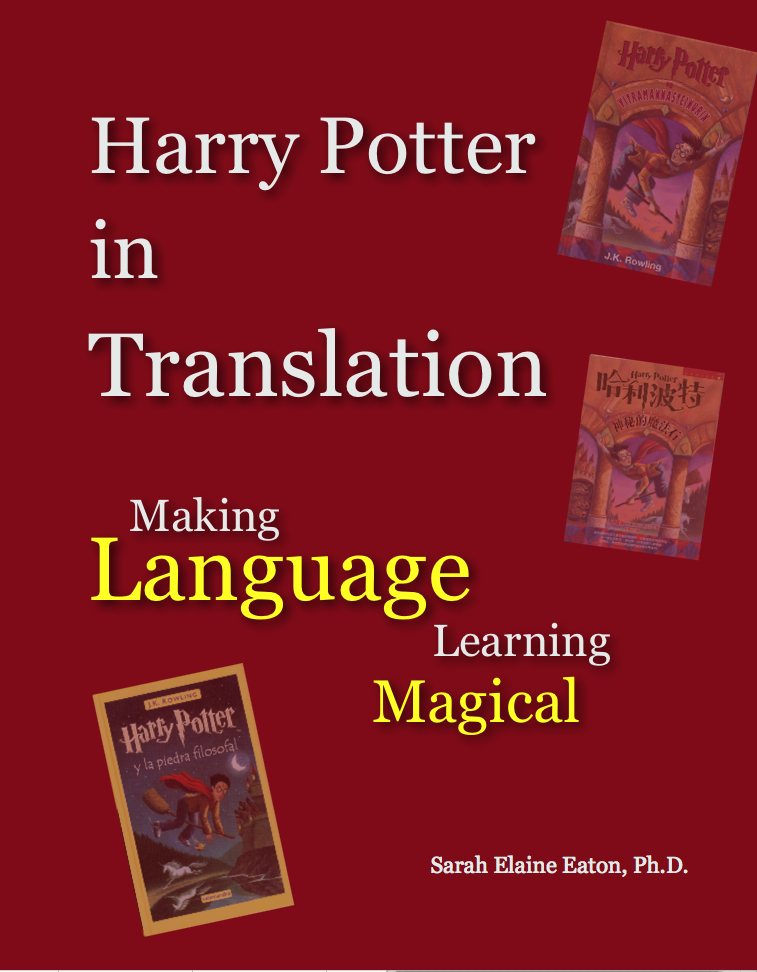
Harry Potter in Translation by Sarah Elaine EatonDid you know that the Harry Potter books have been translated into more than 70 languages? A project through the Language Research Centre brought together dozens of native speakers who recorded a portion of the first Harry Potter book. These recordings are available free of charge for language teachers and students everywhere.

In this professional development webinar for educators, presented by ISU Workforce Training, you get an introduction to the Harry Potter in translation project at the University of Calgary’s Language Research Centre. You also get ideas on how to use this free service in your own language classes.

This program includes 5 lesson plans for teachers to help them use Harry Potter as a teaching tool for second languages.

Make your language class magical by using Harry Potter in translation!

Webinar date: January 19, 2011

Webinar time: 4:00 p.m. MST

Register here.

_______________

Share or Tweet this post: Webinar: Harry Potter in Translation: Make language learning magical http://wp.me/pNAh3-1bZ

Update – January 2018 – This blog has had over 1.8 million views thanks to readers like you. If you enjoyed this post, please “like” it or share it on social media. Thanks!

Sarah Elaine Eaton is a faculty member in the Werklund School of Education, University of Calgary, Canada.