Invitation to Participate: Research Study on Artificial Intelligence and Academic Integrity: 

April 19, 2023

The Ethics of Teaching and Learning with Algorithmic Writing Technologies 
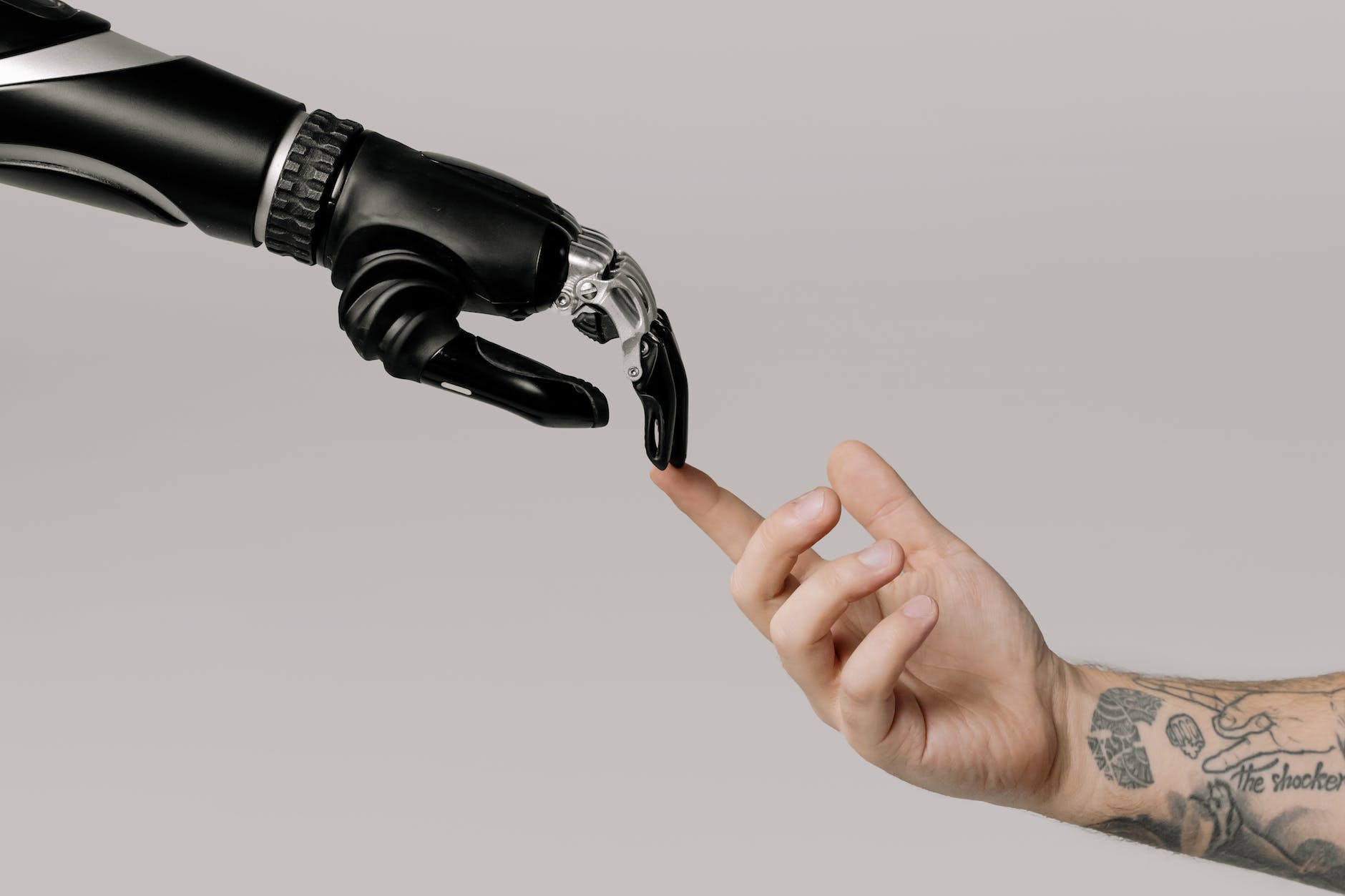
On the right there is a black robotic hand and forearm. On the left there is a human hand and forearm. The forearm is tatooed. One finger from each hand is touching the other.
Photo by cottonbro studio on Pexels.com

Academic misconduct has taken various forms in present-day educational systems. One method that is on the rise is the use of artificially generated software compositions. The capabilities and sophistication of these new technologies are improving steadily. We are conducting a study to gauge the sophistication of the current artificial intelligence (AI) software-generated text. To that end, we are recruiting participants to evaluate the level of writing level of small compositions (260 words in length at most).

Your participation in this study would be to evaluate two small pieces of text presented in a survey and optionally make comments on your observation. We appreciate your consideration in this matter. This research provides an opportunity for the participants to contribute to the state of AI software used for various educational purposes. Participation in this study is voluntary, and you are free to terminate the survey and withdraw at any time and for any reason without censor. There are no known physical, psychological, or social risks associated with participation in the study.

All demographic data collected will be kept strictly confidential. Only the researchers listed in this letter will have access to the raw data. The data (in electronic format) will be retained indefinitely. Participation in the study will be asked for some basic demographic information and then presented with a 260- word length composition. After reading, the participants will be asked to evaluate the level, assign a mark to the composition, and note any pertinent observations. The second piece of composition, also of the same length, will be followed by the same set of questions. The total anticipated time for completing the survey is about 9-12 minutes, but it can vary based on reading speed and consideration afforded to the assigned grade.

If you have any questions or concerns about your participation in this study, you can contact the Principal Investigator, Dr. Sarah Elaine Eaton, seaton (at) ucalgary.ca

This study is funded by a University of Calgary Teaching and Learning Grant. This study has been approved by the Conjoint Faculties Research Ethics Board at the University of Calgary: REB22-0137.

To take the survey, click here.

_________________________________

Share this post: Invitation to Participate: Research Study on Artificial Intelligence and Academic Integrity: The Ethics of Teaching and Learning with Algorithmic Writing Technologies – https://wp.me/pNAh3-2U3

This blog has had over 3 million views thanks to readers like you. If you enjoyed this post, please “like” it or share it on social media. Thanks! Sarah Elaine Eaton, PhD, is a faculty member in the Werklund School of Education, and the Educational Leader in Residence, Academic Integrity, University of Calgary, Canada. Opinions are my own and do not represent those of the University of Calgary.


6 Tenets of Postplagiarism: Writing in the Age of Artificial Intelligence

February 25, 2023
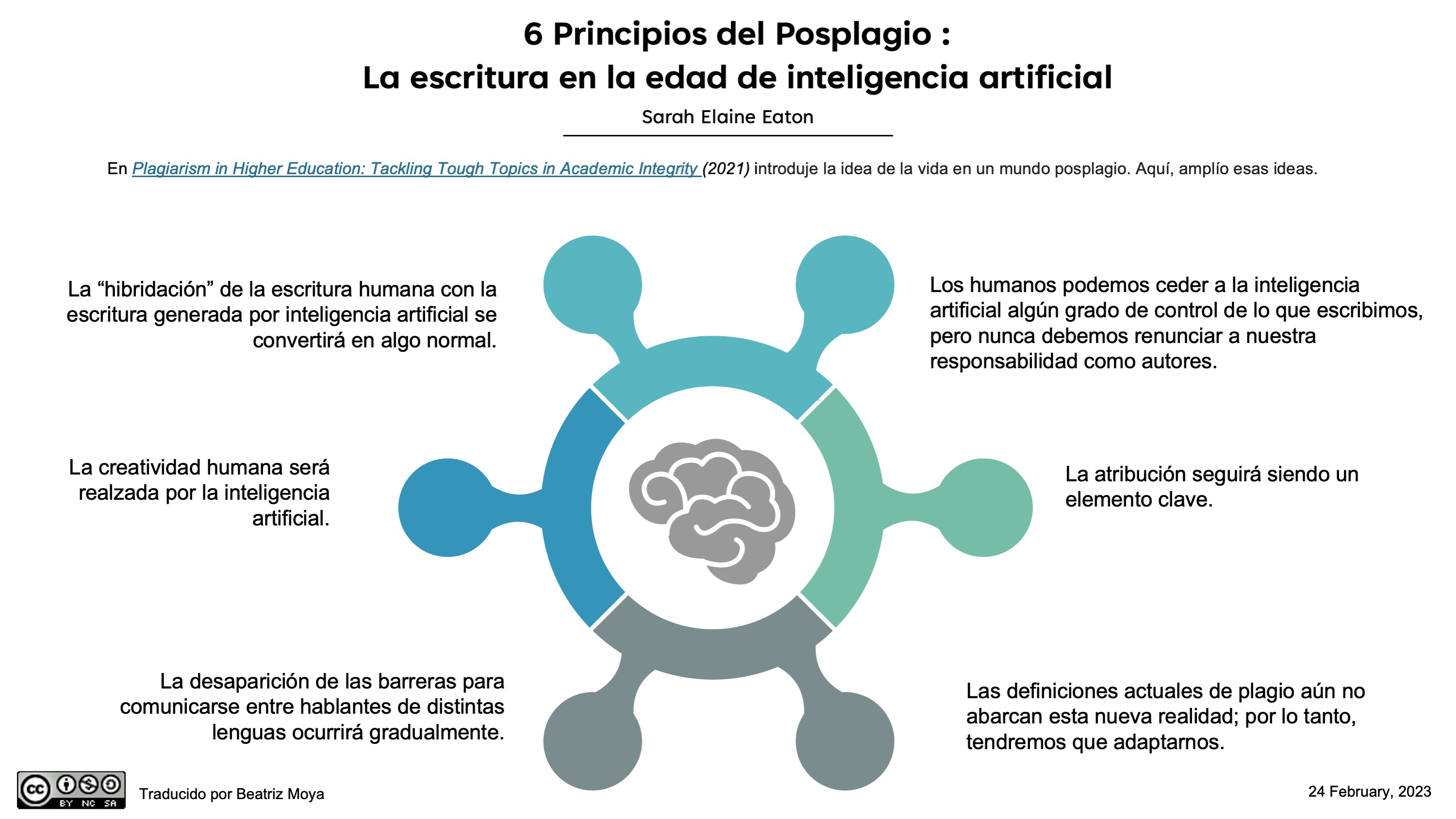
An infographic showing the 6 tenets of the post-plagiarism age. There is a circle with six points extending from it. There is an icon of a brain at the centre. These ideas were developed from the book, Plagiarism in Higher Education: Tackling Tough Topics in Academic Integrity (2021) by S. E. Eaton.

In the final chapter of Plagiarism in Higher Education: Tackling Tough Topics in Academic Integrity (2021) I contemplate the future of plagiarism and academic integrity. I introduced the idea of life in a postplagiarism world; thinking about the impact of artificial intelligence on writing. Here, I expand on those ideas. These 6 tenets characterize the post-plagiarism age:

Hybrid Human-AI Writing Will Become Normal

Hybrid writing, co-created by human and artificial intelligence together is becoming prevalent. Soon it will be the norm. Trying to determine where the human ends and where the artificial intelligence begins is pointless and futile.

Human Creativity is Enhanced

Human creativity is enhanced, not threatened by artificial intelligence. Humans can be inspired and inspire others. Humans may even be inspired by artificial intelligence, but our ability to imagine, inspire, and create remains boundless and inexhaustible.

Language Barriers Disappear

One’s first language will begin to matter less and less as tools become available for humans to understand each other in countless languages.

Humans can Relinquish Control, but not Responsibility

Humans can retain control over what they write, but they can also relinquish control to artificial intelligence tools if they choose. Although humans can relinquish control, they do not relinquish responsibility for what is written. Humans can – and must – remain accountable for fact-checking, verification procedures, and truth-telling. Humans are also responsible for how AI-tools are developed.

Attribution Remains Important

It always has been, and always will be, appropriate and desirable to appreciate, admire, and respect our teachers, mentors, and guides. Humans learn in community with one another, even when they are learning alone. Citing, referencing, and attribution remain important skills.

Historical Definitions of Plagiarism No Longer Apply

Historical definitions of plagiarism will not be rewritten because of artificial intelligence; they will be transcended. Policy definitions can – and must – adapt.

Translations of the Six Tenets of Postplagiarism

Since I first shared the Six Tenets of Postplagiarism, the infographic has been translated into French and Spanish. I am very grateful to the translators, who put in time and effort to go through the points in detail. Here are the translated versions:

Les 6 Principes du Postplagiat (French)

This translation was done by Dr. Elaine Beaulieu at the University of Ottawa, Canada.

Colleagues at the Université du Québec à Montréal (Canada), also wrote a web article in French. It is available here: https://collimateur.uqam.ca/collimateur/6-principes-de-lapres-plagiat-a-lere-de-lia/

6 Principios del Posplagio (Spanish)

The Spanish translation was done by Beatriz Moya, PhD candidate at the University of Calgary.

More Resources on PostPlagiarism

Check out my video on this topic on YouTube: https://youtu.be/NxFMMw1QZX0

Check out my article in University World News on this topic: “Artificial intelligence and academic integrity, post-plagiarism”

_________________________________

Share this:  6 Tenets of Postplagiarism: Writing in the Age of Artificial Intelligence https://drsaraheaton.wordpress.com/2023/02/25/6-tenets-of-postplagiarism-writing-in-the-age-of-artificial-intelligence/

This blog has had over 3 million views thanks to readers like you. If you enjoyed this post, please “like” it or share it on social media. Thanks!

Sarah Elaine Eaton, PhD, is a faculty member in the Werklund School of Education, and the Educational Leader in Residence, Academic Integrity, University of Calgary, Canada. Opinions are my own and do not represent those of the University of Calgary.


Sarah’s Thoughts: Artificial Intelligence and Academic Integrity

December 9, 2022

The release of ChatGPT has everyone abuzz about artificial intelligence. I’ve been getting lots of questions about our research project Artificial Intelligence and Academic Integrity: The Ethics of Teaching and Learning with Algorithmic Writing Technologies. We are ready to start data collection in January so I do not yet have results to share. Our team has two preliminary papers under review, but I won’t say much about them until they are published.

In the meantime, I wanted to share some high level thoughts on the topic since many of you have been asking. Even though I am on Research and Scholarship Leave (RSL, a.k.a. sabbatical) this year, I’ve got another big project on the go that is taking up a lot of my time and focus right now, in addition to the research project above. I am serving as the Editor-in-Chief of the the Handbook of Academic Integrity (2nd ed.) The first edition of the Handbook was edited by Tracey Bretag who passed away in 2020.

The second edition is well underway and I’ve been working with an amazing team of Section Editors (giving a wave of gratitude to the team: Brenda M. Stoesz, Silvia Rossi, Joseph F. Brown, Guy Curtis, Irene Glendinning, Ceceilia Parnther, Loreta Tauginienė, Zeenath Reza Khan, and Wendy Sutherland-Smith). We have more than 100 chapters in the second edition, including some from the first edition as well as lots of new chapters. (Giving a wave of gratitude to all the contributors! Thank you for your amazing contributions!) It is a massive project and it has been a major focus of my sabbatical.

Suffice to say, I have not had a spare moment to put fingers to keyboard to write in depth about this topic on social media, but I wanted to share a few high level ideas here. I will have to unpack them in a future blog post or maybe an editorial, but for now, let me just say that I think the moral panic over the use of artificial intelligence is not the answer. But so you know where I stand on the issue, here are some thoughts:

I am happy to chat more, but let me just say that if you are afraid of an explosion of cheating in your classes because of ChatGPT or any other new technological advance, you are not alone, but honestly, technology isn’t the problem.

Stay tuned for more…

Related posts:

Artificial Intelligence and Academic Integrity: The Ethics of Teaching and Learning with Algorithmic Writing Technologies 

University of Calgary Graduate Assistant (Research) (GAR) – Job posting “Artificial Intelligence and Academic Integrity: The Ethics of Teaching and Learning with Algorithmic Writing” https://drsaraheaton.wordpress.com/2022/11/30/university-of-calgary-research-assistant-job-posting-artificial-intelligence-and-academic-integrity-the-ethics-of-teaching-and-learning-with-algorithmic-writing/

_________________________________

Share or Tweet this: Sarah’s Thoughts: Artificial Intelligence and Academic Integrity https://drsaraheaton.wordpress.com/2022/12/09/sarahs-thoughts-artificial-intelligence-and-academic-integrity/

This blog has had over 3 million views thanks to readers like you. If you enjoyed this post, please “like” it or share it on social media. Thanks! Sarah Elaine Eaton, PhD, is a faculty member in the Werklund School of Education, and the Educational Leader in Residence, Academic Integrity, University of Calgary, Canada. Opinions are my own and do not represent those of the University of Calgary.


Now Published: Contract Cheating in Higher Education

August 11, 2022
Eaton, Curtis, Clare, Stoesz, Seeland & Rundle cover

Now published: Contract Cheating in Higher Education: Global Perspectives on Theory, Practice, and Policy (Eaton, Curtis, Stoesz, Clare, Rundle, & Seeland, 2022). This volume, published by Palgrave MacMillan, includes twenty chapters from contributors across Australia, North America, and Europe:

  1. Introduction: Contract cheating and introduction to the problem. – Curtis, G. J., Clare, J., Rundle, K., Eaton, S. E., Stoesz, B. M., & Seeland, J.
  2. What can we learn from measuring crime when looking to quantify the prevalence and incidence of contract cheating? – Clare, J., & Rundle, K.
  3. Limitations of contract cheating research. –  Krásničan, V., Foltýnek, T., & Dlabolová, D. H.
  4. Essay mills and contract cheating from a legal point of view. – Draper, M.
  5. Leveraging college copyright ownership against file-sharing and contract cheating websites. – Seeland, J., Eaton, S. E., & Stoesz, B. M.
  6. The encouragement of file sharing behaviours through technology and social media: Impacts on student cheating behaviours and academic piracy. – Rogerson, A. M.
  7. Higher education assessment design. – Sutherland-Smith, W., & Dawson, P.
  8. Critical thinking as an antidote to contract cheating. – Stoesz, B. M., Eaton, S. E., & Seeland, J.
  9. Contract cheating and the Dark Triad traits. – Baran, L., & Jonason, P. K.
  10. Contract cheating: The influence of attitudes and emotions. – Curtis, G. J., & Tindall, I. K.
  11. Applying situational crime prevention techniques to contract cheating. – Clare, J.
  12. Presentation, Properties and Provenance: the three Ps of identifying evidence of contract-cheating in student assignments. – Crockett, R.
  13. “(Im)possible to prove”: Formalising academic judgement evidence in contract cheating cases using bibliographic forensics. – Ellis, C., Rogerson, A. M., House, D., & Murdoch, K.
  14. Aligning academic quality and standards with academic integrity – Glendinning, I.
  15. Addressing contract cheating through staff-student partnerships. – Lancaster, T.
  16. The extortionate cost of contract cheating. – Veeran-Colton, T., Sefcik, L., & Yorke, J.
  17. The rise of contract cheating in graduate education. –  Parnther, C.
  18. Listening to ghosts: A qualitative study of narratives from contract cheating writers from the 1930s onwards. – Eaton, S. E., Stoesz, B. M., & Seeland, J.
  19. Assessment brokering and collaboration: Ghostwriter and student academic literacies. – Thacker, E. J.
  20. Conclusion – Eaton, S. E., Stoesz, B. M., Seeland, J. Curtis, G. J., Clare, J., & Rundle, K. 

Updates:

October 4, 2022 – The final proofs have been submitted to the publisher. The book now moves into production and should be available very soon!

October 28, 2022 – The book has now been published!

_______________________________

Share or Tweet this: New Book Coming Soon: Contract Cheating in Higher Education – https://drsaraheaton.wordpress.com/2022/08/11/new-book-coming-soon-contract-cheating-in-higher-education/

This blog has had over 3 million views thanks to readers like you. If you enjoyed this post, please “like” it or share it on social media. Thanks!

Sarah Elaine Eaton, PhD, is a faculty member in the Werklund School of Education, and the Educational Leader in Residence, Academic Integrity, University of Calgary, Canada. Opinions are my own and do not represent those of the University of Calgary.


Exploring the Contemporary Intersections of Artificial Intelligence and Academic Integrity

May 17, 2022
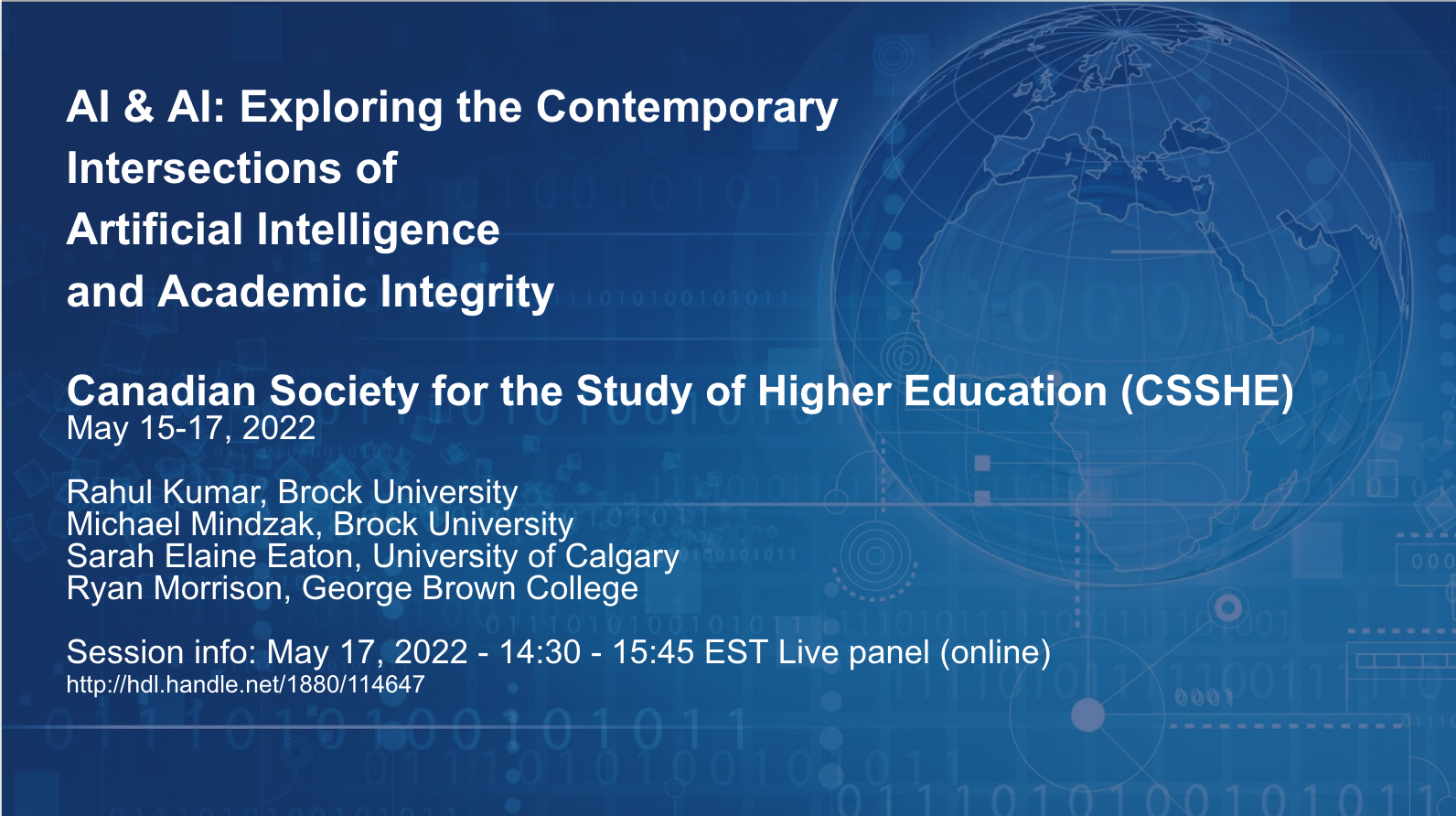
Title slide from CSSHE 2022 panel discussion: AI & AI: Exploring the contemporary intersections of artificial intelligence and academic integrity (Kumar, Mindzak, Eaton & Morrison)

For more than a year there have been small teams of us across Canada studying the impact of artificial intelligence on academic integrity. Today I am pleased to be part of a panel discussion on this topic at the annual conference of the Canadian Society for the Study of Higher Education (CSSHE), which is part of Congress 2022.

Our panel is led by Rahul Kumar (Brock University, Canada), together with Michael Mindzak (Brock University, Canada) and Ryan Morrison (George Brown College, Canada)

Here is the information about our panel:

Session G3: Panel: AI & AI: Exploring the Contemporary Intersections of Artificial Intelligence and Academic Integrity (Live, remote) 

Panel Chair: Rahul Kumar 

  • Rahul Kumar (Brock University): Ethical application with practical examples
  • Michael Mindzak (Brock University): Implications on labour 
  • Ryan Morrison (George Brown College): Large language models: An overview for educators 
  • Sarah Elaine Eaton (University of Calgary): Academic integrity and assessment 

We have developed a combined slide deck for our panel discussion today. You can download the entire slide deck from the link noted in the citation below:

Kumar, R., Mindzak, M., Morrison, R., & Eaton, S. E. (2022, May 17). AI & AI: Exploring the contemporary intersections of artificial intelligence and academic integrity [online]. Paper presented at the Canadian Society for the Study of Higher Education (CSSHE). http://hdl.handle.net/1880/114647

Related posts:

New project: Artificial Intelligence and Academic Integrity: The Ethics of Teaching and Learning with Algorithmic Writing Technologies – https://drsaraheaton.wordpress.com/2022/04/19/new-project-artificial-intelligence-and-academic-integrity-the-ethics-of-teaching-and-learning-with-algorithmic-writing-technologies/

Keywords: artificial intelligence, large language models, GPT-3, academic integrity, academic misconduct, plagiarism, higher education, teaching, learning, assessment

_________________________________

Share or Tweet this: Exploring the Contemporary Intersections of Artificial Intelligence and Academic Integrity https://drsaraheaton.wordpress.com/2022/05/17/exploring-the-contemporary-intersections-of-artificial-intelligence-and-academic-integrity/

This blog has had over 3 million views thanks to readers like you. If you enjoyed this post, please “like” it or share it on social media. Thanks!

Sarah Elaine Eaton, PhD, is a faculty member in the Werklund School of Education, and the Educational Leader in Residence, Academic Integrity, University of Calgary, Canada. Opinions are my own and do not represent those of the University of Calgary.