101 Ways to Market Your Language Program (10 Free webinars)

March 14, 2012

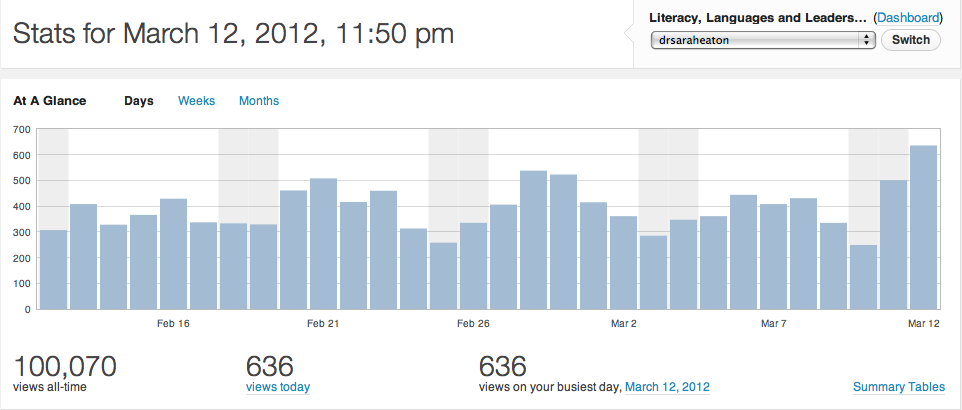
What an amazing week! My blog is just over 2 years old and this week, we topped 100,000 all-time views and 200 subscribers.

It’s definitely time to celebrate.

10 Free Webinars on How to Market and Promote Your Language or Literacy Program

Over the next 10 weeks, I’m going to host a free webinar every week. Each one will highlight different ideas from 101 Ways to Market Your Language Program. Every week you’ll get practical, low-cost ideas to help you promote any language or literacy program. Best of all, you’ll get to connect with others on line who are also interested in the same topic, ask questions and interact.

The webinars will be 30 to 60 minutes in length. Bring a pen and paper. I’m going to give you lots of ideas you can implement right away.

We’ll do the webinars for the next ten Wednesdays: March 21 to May 23, 2012

There are some time zone changes coming up around the world, so double-check these times against your local area:

Point of origin – 14:00 (2:00 p.m.) Mountain Time, March 21, 2012 – Calgary / Edmonton

16:00 (4:00 p.m.) – Eastern Time – Toronto / New York

20:00 (8:00 p.m.) – Greenwich Time – London, England

22:00 (10:00 p.m.) – Eastern European Time – Athens / Istanbul

05:00 (5:00 a.m.) – following day – Japan Standard Time – Tokyo

To join the webinar, click here: http://meet11548754.adobeconnect.com/saraheaton/ — There is no need to register. These webinars are free and open to everyone. Seating is limited though, so sign on early.

I’ll record each webinar and post it so you can view it later, too.

This is essentially a 10-week course designed to take you through the entire book from beginning to end. I’ll include some marketing “best practices” and show you how to start thinking about promoting your programs to ensure they are sustainable over the long term. I’ll share some case studies and stories, along with lots of practical “how to” information that you can use right away.

Here’s what we’ll cover

Week #1 – How to develop your marketing strategy and plan

Week #2 – Setting marketing goals, target markets, budgets

Week #3 – Focus on benefits, writing marketing materials

Week #4 – Business cards, newsletters, signs and other communications

Week #5 – What makes people care about you. How to stand out from the crowd.

Week #6 – Specialty tips for programs at large institutions

Week #7 – Relationship marketing. The power of connections.

Week #8 – It’s how you make them feel. Adding personal touches that make all the difference

Week #9 – Effective follow up with your marketing and not giving up too soon.

Week #10 – Social media for marketing

All you have to do is block off the next 10 Wednesdays in your calendar at your corresponding local time and then log in using the link above. It’s that easy. And it’s my way of showing my appreciation to you.

Thank you to everyone who has viewed the blog, left a comment or subscribed. I really love the work I do and being able to share with you, learn from you and engage with you inspires me every single day.

___________________________

Share or Tweet this post: 101 Ways to Market Your Language Program (10 Free webinars) http://wp.me/pNAh3-1j6

Update – January 2018 – This blog has had over 1.8 million views thanks to readers like you. If you enjoyed this post, please “like” it or share it on social media. Thanks!

Sarah Elaine Eaton is a faculty member in the Werklund School of Education, University of Calgary, Canada.


Is being a language teacher dangerous to your health?

March 13, 2012

Do you work in poor, run-down conditions? Or an old building that’s falling apart?

Amelia’s story

Amelia Labbe Sarah Eaton University of CalgaryWhen I started my Master’s degree in Spanish at the University of Calgary, I heard staff and professors complaining about the air quality and run down conditions in Craigie Hall, the building where the modern language departments are housed. I never really thought about it much, since I head my head buried in my books and I was learning to live in a new city and adjust to the pressures of being a young graduate student.

One of the first people to welcome me into the department was Amelia Labbé. A native of Bolivia, Amelia ran the university’s Centro de Tertulia (Spanish Centre). Officially, Amelia’s job was to provide opportunities for conversation with a native speaker. Unofficially, the Centro de Tertulia became a place where students would gather, socialize in Spanish, help one another with their homework, listen to music in Spanish and sometimes even watch telenovelas.  There was only one rule: When you crossed the threshold in to the Centro, it was Spanish only. No English. No French. Solamente español. It was her one rule and she stuck to it.

Amelia also became a mentor and unofficial advisor to many students who sought her council and words of wisdom, even though it was not part of her job. Officially, the university has designated student advisors and anyone who is not a designated advisor is not supposed to offer guidance to students. But that didn’t stop students from asking her what she thought and seeking her advice. Students trusted her. They could tell that she cared deeply about them… In fact, she cared more about the students than she did about regulations or rules. Over the course of her career, she touched the lives of thousands of students who studied Spanish at the University of Calgary, including mine.

Last fall, Amelia fell ill. She blamed it on the building where she worked, which was known to have asbestos in it. On November 8, 2011, Amelia passed away from pulmonary fibrosis. Along with many of my friends and colleagues, I attended the celebration of her life on November 19.

Faculty and staff complaints about poor air quality are blown off

Since then, twenty years of complaints about the state of the building and questions about its air quality have erupted into a full-scale war. I have gone from being a Master’s student to working in the Language Research Centre, where I now have the privilege of being a Research Associate and an Adjunct Assistant Professor, after finishing my Ph.D.

An informal investigation was held a few years ago when it was determined that an extraordinarily high percentage of the faculty and staff had been diagnosed with cancer. Many of them pointed to their physical working conditions as a factor in their illness. Tests were done. Faculty and staff were told that everything was fine. Sadly, the incidence of cancer diagnosis among language faculty continued. Others were diagnosed with asthma and unknown allergies. No one could prove any correlation between the physical environment and the incidence of illness.

Following Amelia’s passing, some faculty members and staff insisted that a full investigation be conducted. Today, the CBC published, “Teacher’s lung disease death prompts U of C building worries: But officials say Craigie Hall air quality not compromised by asbestos“. The story documents reactions to Amelia’s health issues and subsequent passing, and speculations that her physical work environment were the root cause of her death. Amelia’s husband and my colleague and mentor, Dr. Rachel Schmidt, publicly offered commentary to reports.The university released a statement declaring that “air quality and environment are within the acceptable guidelines“.

Language programs: Between a rock and a hard place

In my Ph.D. research I found that it is not uncommon for language programs at large institutions to be marginalized both politically and in terms of their physical placement on a campus.

Here’s an excerpt from my Ph.D. thesis:

Language programs, because they are not necessarily seen as academic in nature, do not always have a prominent place on campus. While it would be logical for ESL programs to be physically positioned in places that are easily accessible by foreign students who struggle with the language, “many … programs are housed in temporary bungalows, in basements, or on the periphery of our campuses” (Stoller, 1997, p. 40).

This assertion is echoed more recently by Quay Connection (2000, p. 14) whose research shows that “Many providers say their facilities are too run down, too small, impermanent, unattractive.” This speaks to the question of the legitimacy of such programs, which is discussed later on. For now it is enough to note that the physical placement of such programs on a campus is one indicator of how they are viewed by administration (Stoller, 1997). Program managers must often advocate for improved space and facilities for their programs. (Eaton, 2009, pp. 66-67).

My thesis dealt specifically with ESL programs. In the case of one of the programs I studied, it had just recently been relocated to the main floor of the building. Previous to that, it was located on the 14th floor of the building. The very odd thing about that particular building was that the 14th floor was accessible only by taking the elevator to the 13th floor and then taking the stairs up one more floor. So, non-native speakers of English were required to navigate a complex procedure in order to get to the program offices. Even native speakers had trouble figuring out how to get to their offices.

Even though the Department of French, Italian and Spanish has been renovated now, the Department of Germanic, Slavic and East Asian languages is still in need of renovations. Both language departments remain in an unattractive and outdated building with an elevator that is often broken down. The building is known to have asbestos.

A jumping off point

It seems that there is some evidence that shows that language programs are located in physical spaces that are far from ideal. In the work I have done with language programs at high schools, colleges and universities, this seems to be a common complaint… but with little to no research to identify whether or not this is indeed a problem in the field of language teaching. My guess is that large scale studies about the physical marginalization of language programs at institutions have never been done. (If you know of any such studies, please leave a comment!)

Language programs should not be relegated to old, run down buildings or pushed into basements. Language program administration and management includes advocating for programs and courses. As faculty and staff, it is our responsibility to advocate for one another, too. Some recommendations to consider:

  1. Have conversations with colleagues about the physical conditions in which you work. Are they adequate? Does your physical space promote health and well-being?
  2. Advocate for an improved location on your campus. Particularly in the case of ESL programs, students need to be able to find your offices.
  3. Engage in conversations and dialogue with faculty committees and administrators.
  4. If you suspect health issues that are due to your physical environment, keep detailed records and write it all down. Without documentation, it is more difficult to make a case for further investigation.
  5. Draw on support from your faculty association or union, if you have one. These bodies exist to protect workers’ rights, including their health.
  6. Take care of yourself. If  you are suffering ill effects and you believe that your work environment may be a contributing factor, do what you need to do to keep yourself healthy. I have colleagues in Craigie Hall who work as much as possible from home, one now works in another building and another brought in her own air filtration machine for her office. None of these is a perfect solution, but they may help. If nothing else, they give the employees a sense of empowerment, which is essential when you’re fighting cancer, or another life-threatening illness.

I’ve now watched a friend and colleague die and an alarming number of other friends have been diagnosed with cancer or asthma. No one knows for sure what the cause is. They’re all pretty convinced that the building where they work is a factor.

How’s the physical space where your language program is located?

References:

Eaton, S.E. (2009). Marketing of Revenue-generating ESL Programs at the University of Calgary: A qualitative study. Thesis. University of Calgary, Canada.

Quay-Connection. (2000). Marketing ACE in Victoria. Annadale (Australia): Adult, Community and Further Education Board, Melbourne (Australia).

Stoller, F. L. (1997). The catalyst for change and innovation. In M. A. Christison & F. L. Stoller (Eds.), A handbook for language program administrators (pp. 33-48). Burlingame, CA: Alta Book Center Publishers.

Update on this story: On March 21, I was quoted in the Calgary Herald’s article, “Craigie Hall Asbestos Level Normal: Review“. The article was written after the university released a report stating that everything was fine with the air quality in the building. Still though… it is puzzling why so many staff complain of health concerns?

____________

Share or Tweet this post: Is being a language teacher dangerous to your health? http://wp.me/pNAh3-1iJ

Update – January 2018 – This blog has had over 1.8 million views thanks to readers like you. If you enjoyed this post, please “like” it or share it on social media. Thanks!

Sarah Elaine Eaton is a faculty member in the Werklund School of Education, University of Calgary, Canada.

Dr. Sarah’s favorite resources of the week(s) (Feb. 23 to March 4, 2012)

March 5, 2012

I am behind with posting some of my favorite resources. Here are my favorite resources of the past couple of weeks, curated from my Twitter account.

Ed tech resources

Technology tools for Education Majors – Prezi

18 Free Screencasting tools to Create Video Tutorials – Web Design Blog

Seriously good resources for Screencasting – Timo Ilomäki ‘s Library

How to Build Rapport With Online Teachers – by Jennifer Williamson

Fluidsurveys – Online survey tool

7 Resources for Teaching and Learning Anatomy & Physiology – from FreeTech4Teachers

7 Strategies to Make Your Online Teaching Better – Inside Higher Ed

Literacy and languages resources

Teacher resources – Noodle Tools

The Best Apps for Learning a Foreign Language – Mobiles Please Blog

The 100 ‘Greatest Books for Kids’ – USA Today

Spark Enthusiasm – Movie and video resources for teaching Spanish

Livres audio gratuits à écouter et télécharger – Free audio books for teaching French – http://www.litteratureaudio.com/

English as a second / additional language (EAL) and related resources

Canadian Newcomer Magazine – Lots of resources and info for New Canadians

Understanding Different English Accents – Daily English Activities Blog

General education resources

40 Alternative Assessments for Learning – by Charity Preston

Differentiated Instruction – Teachers Offer Help and Resources – Teachers.net

30 Online Multimedia Resources for PBL and Flipped Classrooms – 21 Century Ed Tech

Social media resources

TweetChat – An easy way to follow Twitter chats

Related posts:

Dr. Sarah’s favorite news of the week (Feb. 6-12 2012)

Dr. Sarah’s favorite resources of the week (Jan. 30 – Feb. 5, 2012)

Dr. Sarah’s favorite resources of the week (Jan. 23-29, 2012)

Dr. Sarah’s favorite resources of the week (Jan. 16-22, 2012)

Dr. Sarah’s favorite resources of the week (Jan. 9-15, 2012)

Dr. Sarah’s favorite resources of the week (Jan. 2-8, 2012)

Dr. Sarah’s favorite resources of the week (Dec. 25, 2011 to January 1, 2012)

Dr. Sarah’s favorite resources of the week (Dec. 18-24, 2011)

Dr. Sarah’s favorite resources of the week (Dec. 11-17, 2011)

Dr. Sarah’s favorite resources of the week (Dec. 4-10, 2011)

____________________________

Share this post: Dr. Sarah’s favorite resources of the week (Feb. 27 to March 4, 2012) http://wp.me/pNAh3-1hD

Update – January 2018 – This blog has had over 1.8 million views thanks to readers like you. If you enjoyed this post, please “like” it or share it on social media. Thanks!

Sarah Elaine Eaton is a faculty member in the Werklund School of Education, University of Calgary, Canada.


School Bus Wi-Fi: The wheels of young minds go round and round

March 3, 2012

Students from Prairie Rose School Division in Alberta have been chosen to participate in a new educational technology project designed to make long bus rides to and from school more productive.

CJCY reports that the initiative will involve more than 300 students on up to 30 school buses that are being equipped with Wi-Fi technology to keep the kids connected during their travels. The project involves students at South Central High School, who will begin to get school bus wi-fi starting in early April, as well as K-12 students at New Brigden and Foremost schools who will get their wi-fi starting in the fall.

Students will be able to use their own mobile devices or a school supplied netbook. Teachers are also being trained on what kind of materials are appropriate for mobile learning.

Read the original article: Prairie Rose School division was chosen to participate in a pilot project that would see Wi-Fi technology installed in school buses

Other articles on this topic:

Edmonton Journal – http://www.edmontonjournal.com/news/alberta/could+ease+school+boredom/6247552/story.html

___________

Share or Tweet this post: School Bus Wi-Fi: The wheels of young minds go round and round http://wp.me/pNAh3-1hT

Update – January 2018 – This blog has had over 1.8 million views thanks to readers like you. If you enjoyed this post, please “like” it or share it on social media. Thanks!

Sarah Elaine Eaton is a faculty member in the Werklund School of Education, University of Calgary, Canada.


Managing Social Media Disasters: What to do when employees go off the digital deep end

February 29, 2012

Sarah Elaine Eaton, speaker, presenter, keynote, technology, social media, Calgary, Canada, educator, education, professional developmentSocial media can be an organization’s worst nightmare. What do you do when employees badmouth their boss on Facebook? Or Tweet sensitive company information? These are complex situations with no easy answers. But there are practical strategies you can use to mitigate the effects of employee’s inappropriate behaviour on social networks and more importantly, prevent disasters before they happen.

It only takes one person to create a social media disaster for an organization. When that happens, the situation becomes complex and messy very quickly. You will leave this session with practical ideas that you can implement to control social media damage and prevent your employees from going off the digital deep end. Here are 10 tips to help:

Preventing a social media disaster

#1 – Develop an organizational social media policy

Putting together a social media policy for your organization is a critical first step in ensuring that people understand what is expected of them and why.

#2 – Provide training to your employees and managers

Policies mean nothing if people do not understand how to follow them and why they are important. Offer organizational lunch and learns, webinars and other short, quick training for your employees.

Social media training should not be one-way. It should not involve a trainer standing at the front of the room delivering content or telling employees what the social media rules are as part of compliance training. The most effective social media training involves conversations, dialogue and the participants exchanging ideas and input.

#3 – Establish disciplinary protocols before you need to use them

Most large organizations have standards and disciplinary procedures in place for workplace behavior. In an ideal world, discipline is unnecessary. But let’s face it, sometimes, people do stupid things. Take for example, the Domino’s Pizza employees who thought it would be funny to put snot-covered cheese on the sandwiches they were preparing. Not only did they sell the snotty food to customers, they video-taped their antics and posted their video to YouTube.

In that case, the employees were fired and charged by the local police with delivering prohibited foods to the public. What would you do if this happened at your organization?

Organizational response to a social media disaster

#4 – Respond quickly

A social media disaster is much like other kinds of organizational crises in that it requires an immediate response. You need to respond within 24 hours.

#5 – Apologize

Gone are the days when an organization can try to cover up a disaster. In today’s world, news travels fast. Your customers, clients, investors and funders may know about a situation before you do. If the organization has screwed up, the first step to recovering your reputation is to acknowledge the screw up and say you are sorry. Anything else just makes the situation worse.

#6 – Ditch the “corporate speak”

In addition to the apology, you need to sound genuine. A speech prepared for the TV cameras that is full of multi-syllabic words and corporate jargon is not as effective as a sincere, heart-felt apology, using plain and simple language. In a crisis situation, we tend to use shorter, simpler language. The stilted “corporate speak” of the late 20th century creates an immediate negative visceral reaction among people who hear it today. Be real. Be straight up. Be sincere. Nothing else counts.

Deal with the offender

#7 – Immediate response

In addition to a response from the entire organization, you need to deal with the offender(s) immediately. If nothing else, contact the person and let them know that their behavior has been unacceptable. Make an immediate, polite and straightforward “cease and desist” request. If nothing else say, “I don’t know how we’re going to deal with this. For now, I’m asking you to promise me that you won’t post anything else about this on social media. Would you do that for me, please?”

#8 – Insist on accountability

This is not an easy situation to deal with. An immediate reaction from a manager might be to simply fire the person. Given the circumstances, that may be warranted or it may be an over-reaction. If you decide that the offense does not warrant firing, the offender still needs to account for his or her actions. Asking “Why did you do it?” may help you understand, but it does not really move you towards a solution.

A productive conversation might include questions like: “What would you do if you were me?”, “What will it take to make this situation right?” or even “How do we make this right again?” You may not get the answers you want, but you will gain valuable insight that will help you determine your next steps.

Make it right

#9 – Affirm your commitment to your customers or clients

What makes a social media disaster so terrible is that an employee can go rogue in a matter of seconds… and customers or clients can find out before management does. That means your customers form their own opinions and make decisions based on the information that they have in a given moment, not necessarily based on what is true.

Organizations that serve customers or clients do not exist without them. They are the reason you do what you do. So, taking care of them is top priority. Make your response more about them, than about punishing an offender. A simple statement such as, “This isn’t how we treat our customers. We are going to do whatever it takes to earn your trust back” can be very effective. (Remember to ditch the corporate speak and be sincere).

#10 – Use social media as an engagement tool

This is not the time to silence your fans or supporters who are momentarily angry and express their feelings on your organizational Facebook page. Instead, engage your customers in conversations and dialogue. Re-iterate your apology (but not ad infinitum) and ask them what they would do to make it better. Re-direct the conversation in a positive way that is about helping you re-build the loyalty you may have lost.

These are just a few tips to help you in a complex situation. The reality is that a social media disaster can affect an organization for a long time after it has happened. Using the incident as an opportunity to learn more about your customers, what they want and what matters to them is an effective way to ensure an effective response and a long-term solution to help you re-built your reputation.

Want to get your employees, managers and leaders trained in how to manage social media disasters? Learn how in one of these programs, all of which are offered as live training and e-learning programs:

  • a one-hour webinar
  • a half-day workshop
  • a full-day workshop
Here’s what the curriculum looks like:
View this document on Scribd

Join us on February 29, 2012 at noon Mountain time for a one-hour webinar offered by Chinook Learning on this content. You’ll get the condensed version of the “how to” steps in 55 minutes.
____________________________

Share or Tweet this post: Managing Social Media Disasters: What to do when employees go off the digital deep end http://wp.me/pNAh3-1hd

Update – January 2018 – This blog has had over 1.8 million views thanks to readers like you. If you enjoyed this post, please “like” it or share it on social media. Thanks!

Sarah Elaine Eaton is a faculty member in the Werklund School of Education, University of Calgary, Canada.