Chapter 10 explores the theoretical, policy, and practical aspects of navigating pedagogical ethics in learning environments augmented by generative artificial intelligence (GenAI). The chapter considers the role of higher education and the need to reconceptualize academic cheating in a post-plagiarism era. It discusses the role of learner agency, accountability, and responsibility within the context of learning and academic integrity. The chapter offers informed guidance for educators to incorporate GenAI in meaningful ways into teaching, learning, and assessment.
Our chapter is open access and free to read online and to download. We are really excited to continue the conversations happening about postplagiairsm and how we can can navigate teaching, learning, and assessment ethically in the age of generative AI.
Sarah Elaine Eaton, PhD, is a Professor and Research Chair in the Werklund School of Education at the University of Calgary, Canada. Opinions are my own and do not represent those of my employer.
It’s the start of a new school year here in North America. We are into the second week of classes and already I am hearing from administrators in both K-12 and higher education institutions who are frustrated with educators who have turned to ChatGPT and other publicly-available Gen AI apps to help them assess student learning.
Although customized AI apps designed specifically to assist with the assessment of student learning already exist, many educators do not yet have access to such tools. Instead, I am hearing about educators turning to large language models (LLMs) like ChatGPT to help them provide formative or summative assessment of students’ work. There are some good reasons not to avoid using ChatGPT or other LLMs to assess student learning.
I expect that not everyone will agree with these points, please take them with the spirit in which they are intended, which to provide guidance on ethical ways to teach, learn, and assess students’ work.
8 Tips on Why Educators Should Avoid Using AI Apps to Help with Assessment of Student Learning
Intellectual Property
In Canada at least, a student’s work is their intellectual property. Unless you have permission to use it outside of class, then avoid doing so. The bottom line here is that student’s intellectual work is not yours to share to a large-language model (LLM) or any other third party application, with out their knowledge and consent.
Privacy
A student’s personal data, including their name, ID number and other details should never be uploaded to an external app without consent. One reason for this blog post is to respond to stories I am hearing about educators uploading entire student essays or assignments, including the cover page with all the identifying information, to a third-party GenAI app.
Data security
Content uploaded to an AI tool may be added to its database and used to train the tool. Uploading student assignments to GenAI apps for feedback poses several data security risks. These include potential breaches of data storage systems, privacy violations through sharing sensitive student information, and intellectual property concerns. Inadequate access controls or encryption could allow unauthorized access to student work.
AI model vulnerabilities might enable data extraction, while unintended leakage could occur through the AI app’s responses. If the educator’s account is compromised, it could expose all of the uploaded assignments. The app’s policies may permit third-party data sharing, and long-term data persistence in backups or training sets could extend the risk timeline. Also, there may be legal and regulatory issues around sharing student data, especially for minors, without proper consent.
Bias
AI apps are known to be biased. Feedback generated by an AI app can be biased, unfair, and even racist. To learn more check out this article published in Nature. AI models can perpetuate existing biases present in their training data, which may not represent diverse student populations adequately. Apps might favour certain writing styles (e.g., standard American English), cultural references, or modes of expression, disadvantaging students from different backgrounds.
Furthermore, the AI’s feedback could be inconsistent across similar submissions or fail to account for individual student progress and needs. Additionally, the app may not fully grasp nuanced or creative approaches, leading to standardized feedback that discourages unique thinking.
Lack of context
An AI app does not know your student like you do. Although GenAI tools can offer quick assessments and feedback, they often lack the nuanced understanding of a student’s unique context, learning style, and emotional or physical well-being. Overreliance on AI-generated feedback might lead to generic responses, diminishing the personal connection and meaningful interaction that educators provide, which are vital for effective learning.
Impersonal
AI apps can provide generic feedback, but as an educator, you can personalize feedback to help the student grow. AI apps can provide generic feedback but may not help to scaffold a student’s learning. Personalized feedback is crucial, as it fosters individual student growth, enhances understanding, and encourages engagement with the material. Tailoring feedback to specific strengths and weaknesses helps students recognize their progress and areas needing improvement. In turn, this helps to build their confidence and motivation.
Academic Integrity
Educators model ethical behaviour, this includes transparent and fair assessment. If you are using tech tools to assess student learning, it is important to be transparent about it. In this post, I write more about how and why deceptive and covert assessment tactics are unacceptable.
Your Employee Responsibilities
If your job description includes assessing student work , you may be violating your employment contract if you offload assessment to an AI app.
Concluding Thoughts
Unless your employer has explicitly given you permission to use AI apps for assessing student work then, at least for now, consider providing feedback and assessment in the ways expected by your employer. If we do not want students to use AI apps to take shortcuts, then it is up to us as educators to model the behavior we expect from students.
I understand that educators have excessive and exhausting workloads. I appreciate that we have more items on our To Do Lists than is reasonable. I totally get it that we may look for shortcuts and ways to reduce our workload. The reality is that although Gen AI may have the capability to help with certain tasks, not all employers have endorsed their use in same way.
Not all institutions or schools have artificial intelligence policies or guideline, so when in doubt, ask your supervisor if you are not sure about the expectations. Again, there is a parallel here with student conduct. If we expect students to avoid using AI apps unless we make it explicit that it is OK, then the same goes for educators. Avoid using unauthorized tech tools for assessment without the boss knowing about it.
I am not suggesting that Gen AI apps don’t have the capability to assist with AI, but I am suggesting that many educational institutions have not yet approved the use of such apps for use in the workplace. Trust me, when there are Gen AI apps to help with the heaviest aspects of our workload as educators, I’ll be at the front of the line to use them. In the meantime, there’s a balance to be struck between what AI can do and what one’s employer may permit us to use AI for. It’s important to know the difference — and to protect your livelihood.
This blog has had over 3.6 million views thanks to readers like you. If you enjoyed this post, please “like” it or share it on social media. Thanks!
Sarah Elaine Eaton, PhD, is a faculty member in the Werklund School of Education at the University of Calgary, Canada. Opinions are my own and do not represent those of my employer.
Sarah Elaine Eaton, PhD, Editor-in-Chief, International Journal for Educational Integrity
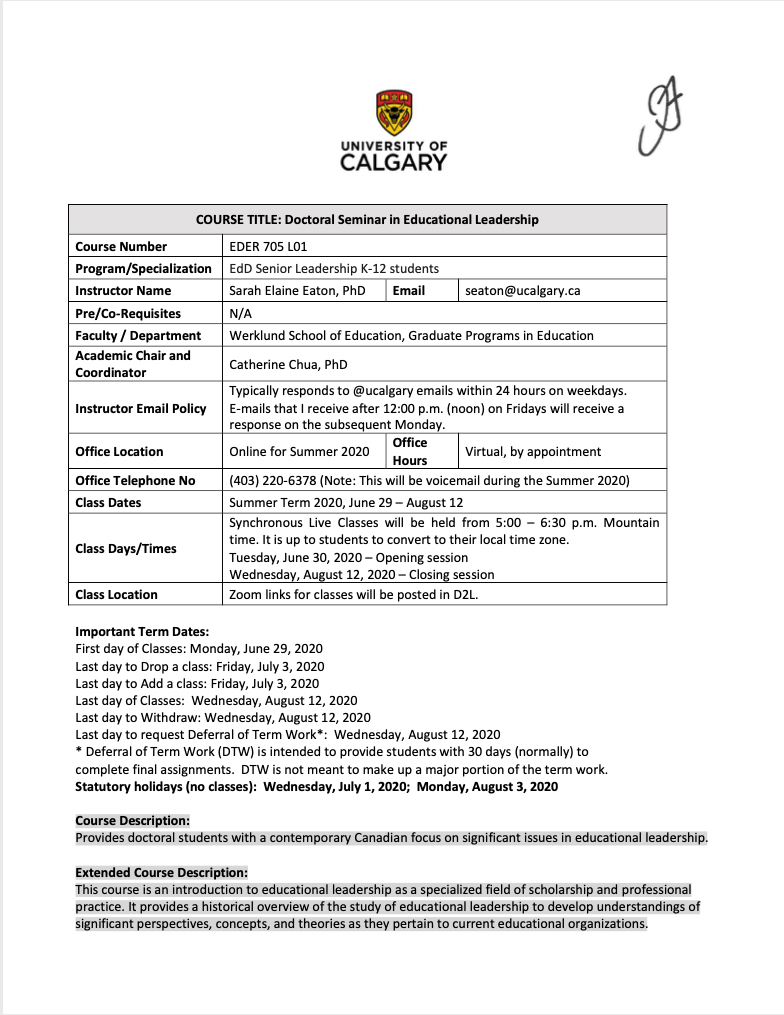
I am excited to be teaching two summer courses starting at the end of June. One of them is this course:
EDER 705: Doctoral Seminar in Educational Leadership
Course Description:
Provides doctoral students with a contemporary Canadian focus on significant issues in educational leadership.
Extended Course Description:
This course is an introduction to educational leadership as a specialized field of scholarship and professional practice. It provides a historical overview of the study of educational leadership to develop understandings of significant perspectives, concepts, and theories as they pertain to current educational organizations.
Learner Outcomes:
The course readings, topics, and learning tasks have been chosen to help students to:
familiarize themselves with diverse historical and contemporary theoretical perspectives/paradigms in educational administration and leadership;
critically examine educational issues using current research literature to understand differing assumptions, values, and methods that are used to study and understand education; and
develop an in-depth understanding of their own assumptions and beliefs about the value and role of leadership practice in public education.
Course Design and Delivery:
This course will be offered fully online, using D2L and Zoom.
This course is only available to students enrolled in the Doctor of Education program. If you are interested in learning more about our graduate program offerings, check out the Werklund School of Education web page.
Applications for next year open in September 2020. It’s not too early to start planning for 2021!
_________________________________
Share or Tweet this: Summer 2020 Course – EDER 705: Doctoral Seminar in Educational Leadership https://wp.me/pNAh3-2uO
This blog has had over 2 million views thanks to readers like you. If you enjoyed this post, please “like” it or share it on social media. Thanks!
Sarah Elaine Eaton, PhD, is a faculty member in the Werklund School of Education, and the Educational Leader in Residence, Academic Integrity, University of Calgary, Canada. Opinions are my own and do not represent those of the University of Calgary.
Lots of people have been asking me about using Zoom to proctor exams. I’ve taught over 100 online courses, between the graduate courses I’ve taught for the Werklund School of Education and dozens of continuing education courses.
Combining that experience with research expertise in academic integrity, I can say that using Zoom to proctor written exams is a bad idea. Here’s why:
1. Zoom is not a substitute for a professional proctoring service
Professional proctoring services are sophisticated, both in terms of technology and operations. Asking an individual professor to proctor an online exam using Zoom as a makeshift solution is a bad idea. Most instructors are not trained on how to proctor online exams.
Given that some instructors are also working from home, while managing child care and family responsibilities, it is even less likely that they could do an excellent job of online invigilation, especially for a large class.
2. Creates additional technology barriers for students
Not all students have web cams or reliable Internet service. Requiring students to have cameras on and stream video during an exam could put some students at a technological disadvantage. If you suddenly require them to buy a web cam, you could be adding financial stress to the equation as well.
At our university, we cannot penalize students if they do not have a video camera. If you did not tell students at the time they registered for the course that a web cam would be required for the course, it is unethical to suddenly make it a requirement partway through the course. If we want students to act with integrity, we must demonstrate integrity in how we run our courses… Changing the rules as you go along just isn’t ethical.
3. Things are not always as they seem
My colleague, D’Arcy Norman, shared this post on how and why the video feed is not necessarily trustworthy. Go read his post. Watch his video. They try it yourself and see how easy it is to create a video background that makes it look like you’re in front of your camera when you’re not. (Hint: It is really easy.)
Besides, if an instructor suspects exam misconduct are they going to use Zoom as their evidence? How would they actually be able to prove it? I mean unless a student has crib notes out in plain view, the case management for that could get messy fast. Chances are high, I would say, that an allegation of academic misconduct could be dismissed (in the student’s favour) if the evidence is not strong enough.
There are few benefits and many potential complications with using Zoom to proctor written exams, especially for large classes. Of course, the exception to this would be individual oral exam where the student interacts in real time with the examiner. That could be do-able via Zoom. In the case of graduate student thesis defences, it may be the only option, but the examination committee must take steps to verify the identity of the student if they are not personally known to at least one of the examiners.
My recommendation is to consider alternate assessments if possible. If it is not possible, then consider a professional online exam proctoring service. Trying to use Zoom to MacGyver your exam invigilation of written tests is probably not going to serve the purpose of upholding integrity.
Note: This post was updated on April 13, 2020 to clarify that I am specifically referring to written exams in this post.
Share or Tweet this: 3 Reasons why proctoring an exam using Zoom is a bad idea https://wp.me/pNAh3-2rO
This blog has had over 2 million views thanks to readers like you. If you enjoyed this post, please “like” it or share it on social media. Thanks!
Sarah Elaine Eaton is a faculty member in the Werklund School of Education, and the Educational Leader in Residence, Academic Integrity, University of Calgary, Canada. Opinions are my own and do not represent those of the University of Calgary.
The primary question our research addressed was: (RQ1) What strategies do in-service teachers employ to support struggling pre-service teachers in field education?
A secondary question addressed was: (RQ2) How can postsecondary institutions better facilitate placements where a pre-service teacher is struggling before the field placement begins, given the legislative restrictions that exist with regard to privacy?
The research is complete now and as a result, we have developed an entirely open access educational resource to help both pre-service teachers (e.g. teacher trainees) and the mentor teachers they work with. Here are the key themes we identified through our research:
Don’t Do This Job in Isolation: Seek Support
Guide and Model What You Want to See
Provide Immediate and Frequent Feedback
Communicate: Early, Often, Directly, Honestly, and Clearly
Remember the Big Picture
Set Clear and High Expectations
Support Engagement in Self-Reflection
Reflect on the Preservice Teacher’s Difficulties
Recognize Early Warning Signs and Don’t Ignore Them
Identify the Preservice Teacher’s Current Skill Level
Create Goals
Download a full copy of the resource free of charge here:
Burns, A., Eaton, S. E., Gereluk, D., Mueller, K., & Craig, H. L. (2019). Supporting Struggling Pre-Service Teachers: A Guide for Mentor Teachers. Retrieved from Calgary, AB: http://hdl.handle.net/1880/111439
Share or Tweet this: Supporting struggling pre-service teachers: A guide for mentor teachers – https://wp.me/pNAh3-2pq
This blog has had over 2 million views thanks to readers like you. If you enjoyed this post, please “like” it or share it on social media. Thanks!
Sarah Elaine Eaton is a faculty member in the Werklund School of Education, and the Educational Leader in Residence, Academic Integrity, University of Calgary, Canada. Opinions are my own and do not represent those of the University of Calgary.


 Posted by Sarah Elaine Eaton, Ph.D.
 I am excited to be teaching two summer courses starting at the end of June. One of them is this course: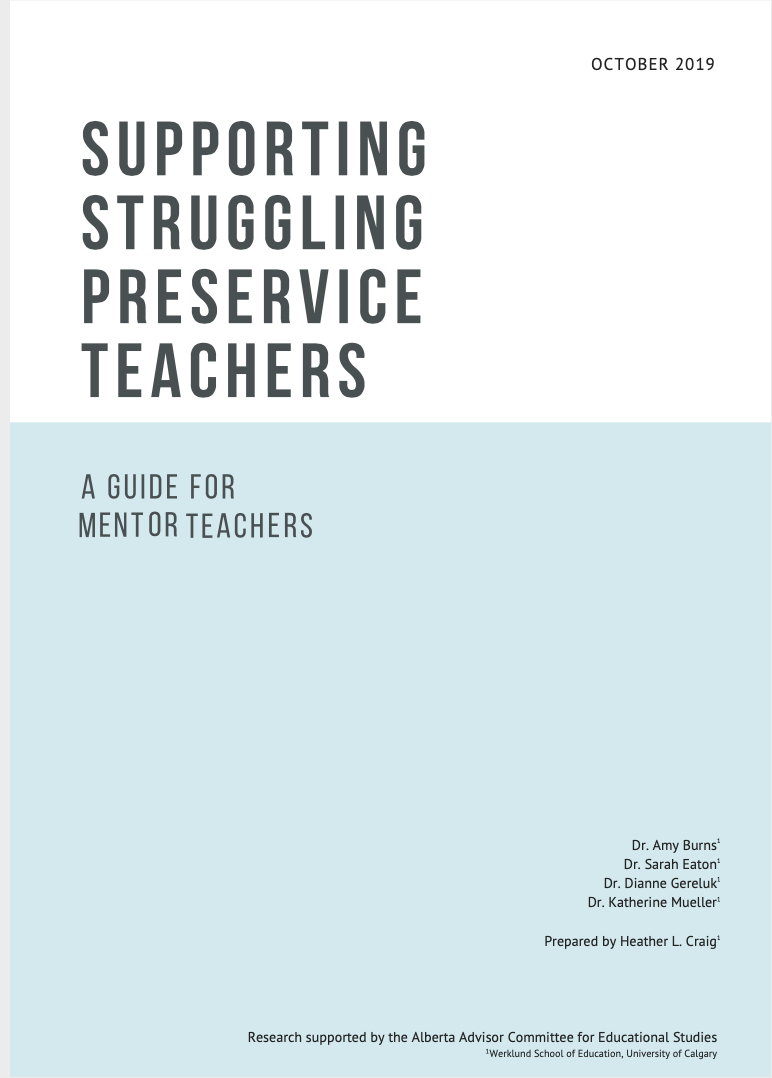

 Learning, Teaching and Leadership
You must be logged in to post a comment.