Accreditation and Certification Fraud in IT

December 27, 2024

Many people in the academic integrity world are already familiar with contract cheating websites, those that deal in the business of buying and selling exams, bespoke term papers, theses, and exam questions and answers.

But this business isn’t limited to the millions of K-12, high school and post-secondary students. The exam fraud business is alive and well for professional accreditation exams for folks who either want to bypass a formal university degree or to supplement existing credentials.

For example, in the IT industry credentials are often the golden key to new opportunities. Certifications and accreditations (allegedly) validate technical skills, offering (so-called) proof that a candidate has the expertise needed for a professional role. 

Taking into account supply and demand, with job candidates being in high supply and well-paying jobs being in high demand, certification and accreditation fraud is alive and well in the IT industry, as well as other industries. This is a trend employers cannot afford to ignore.

Exposing the Fraud: How Buying and Selling of Certification Exam Questions Works

Certification fraud occurs when individuals falsify credentials, purchase counterfeit certifications, or misuse legitimate certifications obtained by others. But there’s this sneaky grey area that exists when a person actually sits a professional exam themselves, but they’ve prepared by buying the exam questions and/or the answers from an online vendor.

I won’t name specific companies that do this in this post, because I’m not in the habit of advertising for these fraudsters, but I want to show you how they work, so here are some screenshots:

Screenshot #1: Home page

A website screenshot. Black background, with text in white and blue. Some of the text is quoted in the narrative that follows.

At the top of this website, the company claims that 94% of the exam questions that they sold were “almost the same” and that 97% of customers passed the exam using their materials. (Who knows what happened to the other 3%…?) Finally, 98% of customers found the “study guides” effective and helpful.

There’s that phrase that we commonly see on contract cheating websites, “study guide”. For the uninitiated, this is a euphemism for “exam questions”. 

Screenshot #2: Saying it like it is: Not affiliated with any certification provider
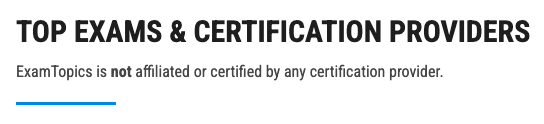
A website screenshot. White background with black text.

In this screenshot the company states plainly that they are not affiliated or certified by any certification provider. Reading between the lines, the message is ‘caveat emptor’ or ‘buyer beware’. They are telling you upfront that they are in the business of selling exam questions and make no guarantees about their products.

Screenshot #3: Samples of accreditation exam questions for sale
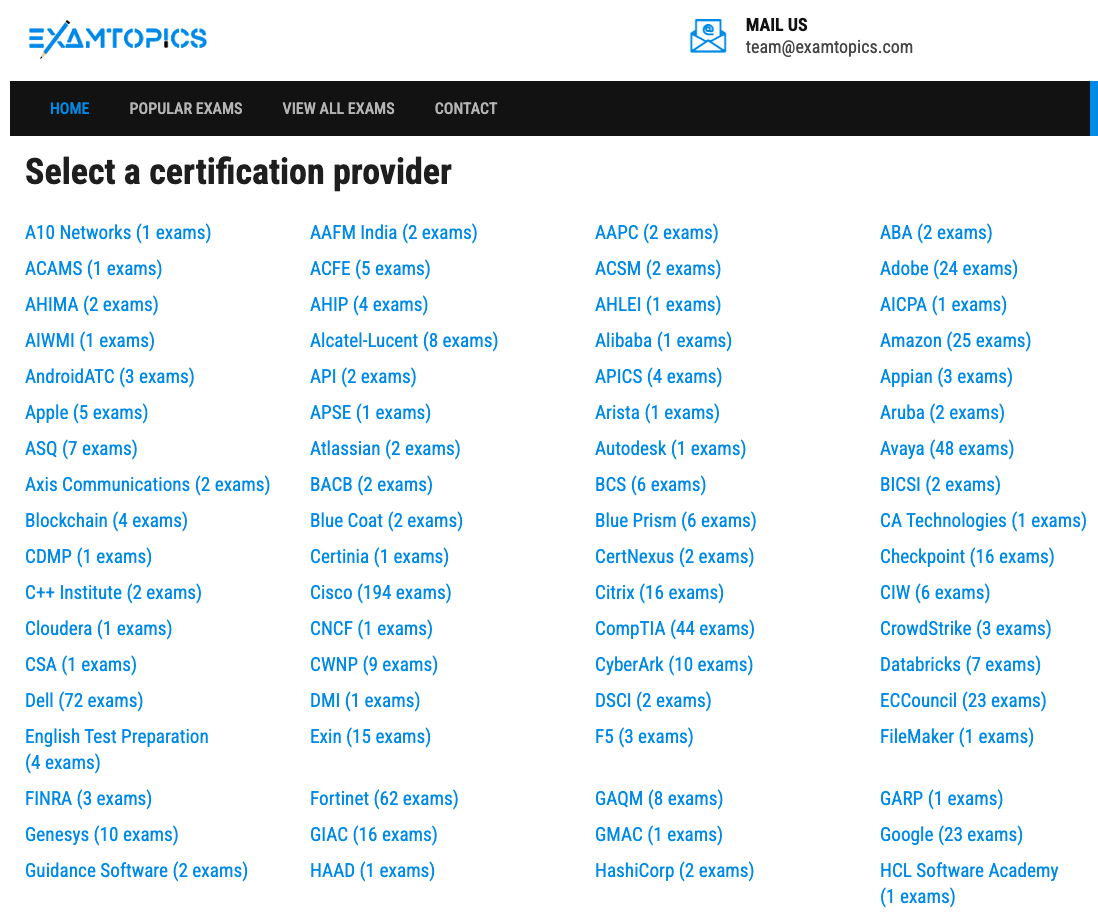
A website screenshot. White background. Black task bar with light grey text. There are lists of texts written in blue.

Look at all the options: You can buy exam questions for certifications offered by DELL, English language proficiency exams, Citrix, Adobe, and Amazon, and Google just to name a few. 

Screenshot #4: More samples of certification provider exam questions for sale.
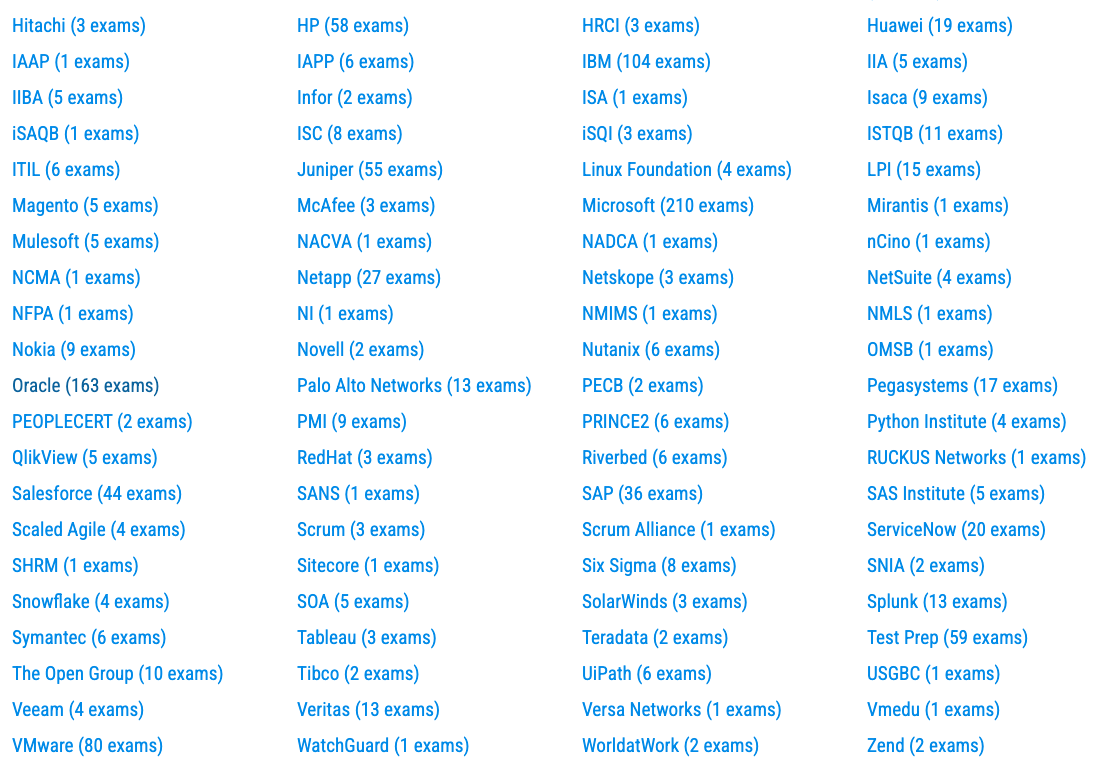
A website screenshot. White background. Black task bar with light grey text. There are lists of texts written in blue.

But wait! There’s more! You can buy exam questions for certifications offers by Oracle, IBM, SAP, and others.

Assessment Security

Sites like compromise the assessment security of certification exams that are meant to qualify individuals to do a particular job. If this term is new to you, I recommend Professor Phill Dawson’s book, Defending Assessment Security in a Digital World. For a quick (and free) overview, of Phill’s work, this slide deck from one of his presentations is worth checking out.

Businesses that buy and sell exam certification questions engage in fraudulent practices undermine trust in the certification system and create significant risks for employers.

Consequences for Employers

Hiring someone with counterfeit credentials can have dire consequences. Unqualified employees may lack the technical skills to handle complex tasks, leading to project delays, costly errors, or even security breaches. Beyond the financial impact, fraudulent certifications can erode team morale, as employees with genuine qualifications may feel undervalued when working alongside those who faked their way in.

What Employers and Hiring Managers can Do

Employers, and especially hiring managers and those working in HR, must take proactive steps to safeguard their hiring processes. Some of you may be asking if this kind of practice is actually illegal. I’m not a lawyer, but what I can say is that although contact cheating for students is illegal in countries like Australia, the UK, and Ireland, if you’re not a student, then you might get to live a proverbial grey zone. To the best of my knowledge, it is not actually illegal to buy and sell questions for professional certification exams in most countries of the world.

So, what can employers do? First, trust but verify! Verifying certifications directly with issuing organizations is one step. Many certification bodies offer easy online verification tools to confirm a candidate’s credentials. Additionally, employers should stay informed about recognized accreditation standards and avoid unverified institutions. 

Having said this, verification of credentials and certification won’t help if someone has bought exam questions online and then taken the test themselves. Their results could be ‘verifiable’ in a sense, because there’s an assumption that a person who has passed an exam had the knowledge to do so. But when someone buys their exam questions before sitting the test, it means that they have prepared for an exam and may not necessarily have internalized the knowledge or skills that should match the certification they receive from passing an exam. An exam is one measure of knowledge, but it isn’t the only one. 

Having prospective employees demonstrate their skills and respond to technical questions that could only be answered if the person has the knowledge to back up their documentation can also help. One possibility is to give an interviewee a real-world scenario that could happen at your organization. Ask them how they would go about problem-solving it. If they struggle or stumble, it could be a sign that they lack the necessary skills for the job. (It could also be a sign that they’re just nervous or that interviewing isn’t their strength. So let me also make a plug here for having an inclusive and equitable interviewing process.)

Investing in robust, inclusive, and equitable hiring practices not only protects an organization from the pitfalls of fraud but also helps to create a culture of accountability and excellence. By placing a premium on authentic certifications combined with demonstrable knowledge and skills and inclusive hiring practices, employers signal their commitment to integrity and ensure they are building a team of qualified professionals.

Bottom line: If you’re hiring someone who says they have an IT certification based on taking exams, it’s worth it to find out if they actually have the knowledge and skills to do the job. 

And this is just one example of one site. Rest assured that it is not the only one out there. Exam cheating companies like this one don’t exist in isolation. They’re in the game to make money, and lots of it. 

In an industry where skills and knowledge drive success, vigilance against certification and accreditation fraud is not optional—it is a driver of success.

Future Outlook

Fraud and corruption are alive and well education and industry. There is a growing community of sleuths, scholars, and activists who are ready to sniff out fraud and expose it and naïveté about these matters is quickly going out of fashion. 

There may have been a time when it was acceptable—or even fashionable—to clutch your pearls, proclaim moral outrage, or just refuse to accept that educational and professional fraud are more commonplace than you might have previously thought. GenAI is here to stay, and so are companies whose business is educational, accreditation, scientific, and professional fraud. These companies are profitable because they have customers willing to pay for their goods and services.

Vigilance, sleuthing, and exposing fraud are very much on trend as we move ahead into the new year. And if you’re a hiring manager, taking steps to protect the integrity of your operations is definitely part of the job in 2025 and beyond.

References and Further Reading

Carmichael, J. (2023, June 7). Understanding Fake Degrees and Credential Fraud in Higher Ed. The Evollution: A Modern Campus Illumination. https://evolllution.com/programming/credentials/understanding-fake-degrees-and-credential-fraud-in-higher-ed/

Eaton, S. E., & Carmichael, J. (2022). The Ecosystem of Commercial Academic Fraud. In. Calgary, Canada: University of Calgary. https://dx.doi.org/10.11575/PRISM/40330

Eaton, S. E., Carmichael, J., & Pethrick, H. (Eds.). (2023). Fake degrees and credential fraud in higher education. Springer. https://doi.org/10.1007/978-3-031-21796-8

Related posts

________________________

Share this post: Accreditation and Certification Fraud in IT – https://drsaraheaton.com/2024/12/27/accreditation-and-certification-fraud-in-the-it-world/

This blog has had over 3 million views thanks to readers like you. If you enjoyed this post, please “like” it or share it on social media. Thanks!

Sarah Elaine Eaton, PhD, is a Professor and Research Chair in the Werklund School of Education at the University of Calgary, Canada. Opinions are my own and do not represent those of my employer. 


UNESCO Women for Ethical AI: outlook study on artificial intelligence and gender

October 30, 2024

Over the past few months I have had the tremendous opportunity to work with an incredible group of women under the direction of Assistant Director-General (ADG) for Social and Human Sciences of UNESCO. Our collective produced this report that was launched today at a special conference in Paris:

UNESCO Women for Ethical AI: outlook study on artificial intelligence and gender

https://unesdoc.unesco.org/ark:/48223/pf0000391719

Here is our agenda from today’s conference:

I joined today’s conference online. Here are a few pics that I snapped during the presentations:

________________________

Share this post:
UNESCO Women for Ethical AI: outlook study on artificial intelligence and gender – https://drsaraheaton.com/2024/10/30/unesco-women-for-ethical-ai-outlook-study-on-artificial-intelligence-and-gender/

This blog has had over 3 million views thanks to readers like you. If you enjoyed this post, please “like” it or share it on social media. Thanks!

Sarah Elaine Eaton, PhD, is a Professor and Research Chair in the Werklund School of Education at the University of Calgary, Canada. Opinions are my own and do not represent those of my employer.


3 Reasons why proctoring an exam using Zoom is a bad idea

March 31, 2020

Lots of people have been asking me about using Zoom to proctor exams. I’ve taught over 100 online courses, between the graduate courses I’ve taught for the Werklund School of Education and dozens of continuing education courses.

Combining that experience with research expertise in academic integrity, I can say that using Zoom to proctor written exams is a bad idea. Here’s why:

1. Zoom is not a substitute for a professional proctoring service

Professional proctoring services are sophisticated, both in terms of technology and operations. Asking an individual professor to proctor an online exam using Zoom as a makeshift solution is a bad idea. Most instructors are not trained on how to proctor online exams.

Given that some instructors are also working from home, while managing child care and family responsibilities, it is even less likely that they could do an excellent job of online invigilation, especially for a large class.

2. Creates additional technology barriers for students

Not all students have web cams or reliable Internet service. Requiring students to have cameras on and stream video during an exam could put some students at a technological disadvantage. If you suddenly require them to buy a web cam, you could be adding financial stress to the equation as well.

At our university, we cannot penalize students if they do not have a video camera. If you did not tell students at the time they registered for the course that a web cam would be required for the course, it is unethical to suddenly make it a requirement partway through the course. If we want students to act with integrity, we must demonstrate integrity in how we run our courses… Changing the rules as you go along just isn’t ethical.

3. Things are not always as they seem

My colleague, D’Arcy Norman, shared this post on how and why the video feed is not necessarily trustworthy. Go read his post. Watch his video. They try it yourself and see how easy it is to create a video background that makes it look like you’re in front of your camera when you’re not. (Hint: It is really easy.)

Besides, if an instructor suspects exam misconduct are they going to use Zoom as their evidence? How would they actually be able to prove it? I mean unless a student has crib notes out in plain view, the case management for that could get messy fast. Chances are high, I would say, that an allegation of academic misconduct could be dismissed (in the student’s favour) if the evidence is not strong enough.

There are few benefits and many potential complications with using Zoom to proctor written exams, especially for large classes. Of course, the exception to this would be individual oral exam where the student interacts in real time with the examiner. That could be do-able via Zoom. In the case of graduate student thesis defences, it may be the only option, but the examination committee must take steps to verify the identity of the student if they are not personally known to at least one of the examiners.

My recommendation is to consider alternate assessments if possible. If it is not possible, then consider a professional online exam proctoring service. Trying to use Zoom to MacGyver your exam invigilation of written tests is probably not going to serve the purpose of upholding integrity.

Note: This post was updated on April 13, 2020 to clarify that I am specifically referring to written exams in this post.

Related posts:

_________________________________________

Share or Tweet this: 3 Reasons why proctoring an exam using Zoom is a bad idea https://wp.me/pNAh3-2rO

This blog has had over 2 million views thanks to readers like you. If you enjoyed this post, please “like” it or share it on social media. Thanks!

Sarah Elaine Eaton is a faculty member in the Werklund School of Education, and the Educational Leader in Residence, Academic Integrity, University of Calgary, Canada. Opinions are my own and do not represent those of the University of Calgary.


Language Learning and Technology – Showcase of Student Work

September 1, 2018

University of Calgary logoThis post showcases the work of students in Language Teaching and Technology (EDER 669.73), which is a Master’s of Education course. Students who take this course are enrolled in the Language and Literacy Specialization program.

This showcase features the work of students enrolled in the Summer 2018 semester. The students whose work is featured here have given me explicit written permission to share their projects publicly on my blog. I am so proud of the work they have done in an intensive 6-week course.

These projects are examples of authentic assessment for learning at the graduate level. I challenged students to conceptualize, design and develop a project that they could actually use in their own teaching context. Projects were to be tailored to the age, language proficiency level and context of their learners. The results are individualized to each student’s particular professional practice.

Projects had to be evidence-based, supported by relevant research and grounded within pedagogical frameworks, such as TPACK or some other framework that students selected and provided a rationale for.

Check out the amazing projects they created:

Kiran Basran – Language Adapted English 10: Resource and Collaboration Site for Teachers of LAE 10 – https://kiranbasran21.wixsite.com/lae10

Kirsten Cavanaugh – The Name Jar Project – https://kirstencavanaugh.wixsite.com/thenamejarproject

Renee Clark – Canadian Language Benchmark 6 “Buying a Home” Module – https://ellwithrenee.weebly.com/

Danielle Derosier – Life is a Story! What Does Your Say? – https://oralstorytelling.weebly.com/

Soda Pich – English Speech for Beginners – http://englishspeech.my-free.website

Donna Seitz – Signs, Signs, Everywhere Signs – http://summersession.pbworks.com/w/page/127497797/Home%20Page

Jane Tyrell – Student Identity Project – https://jtyrrell1.wixsite.com/student-identity

Man Xu – Stop Motion Movie – https://stopmotion-animation-by-manxu.weebly.com/

Shelam Zhou – Canadian Song Bird – http://blog.sina.com.cn/canadiansongbird

______________________________________________________

Share or Tweet this:  Language Learning and Technology – Showcase of Student Work https://wp.me/pNAh3-2la

This blog has had over 2 million views thanks to readers like you. If you enjoyed this post, please “like” it or share it on social media. Thanks!

Sarah Elaine Eaton is a faculty member in the Werklund School of Education, University of Calgary, Canada.

Opinions are my own and do not represent those of the Werklund School of Education or the University of Calgary.


Living Reading List for Language Learning and Technology

July 3, 2018

U of C logo - 2015I am trying something a little different with my course readings for the Master of Education summer course I am teaching, Language Learning and Technology, a living reading list.

We are required to list the course readings in our syllabus. This helps keep everyone organized and allows students to be fully prepared for their course. The problem is that many of our students are eager change agents who often bring in additional resources that everyone finds useful. So in addition to including a basic set of readings in the course outline, I will update this post throughout the course as a living list of readings, with contributions of gems we find along the way to promote co-creation of knowledge with and along side these very capable graduate students.

Official course materials (as posted in the syllabus)

This page contains a list of all your course readings. One of the readings is no longer freely available on the Internet, but I have posted it below as a .pdf, under Fair Dealing, as approved by the University of Calgary Copyright office.

Required text

Publication Manual of the American Psychological Association. (2010). (Sixth ed.). Washington, D.C: American Psychological Association.

Week 3 Readings

Benson, S. K. & Ward, C. L. (2013). Teaching with technology: Using TPACK to understand teaching expertise in online higher education. Journal of Educational Computing Research, 48 (2), 153-172. doi:10.2190/EC.48.2.c

Harris, J. B., & Hofer, M. J. (2011). Technological pedagogical content knowledge (TPACK) in action: A descriptive study of secondary teachers’; curriculum-based, technology-related instructional planning. Journal of Research on Technology in Education, 43(3), 211-229. Retrieved from http://files.eric.ed.gov/fulltext/EJ918905.pdf

Mishra, P., & Koehler, M. (2009). Too cool for school? No way! Using the TPACK framework: You can have your hot tools and teach with them, too. Learning & Leading with Technology, 36(7), 14-18. Retrieved from http://files.eric.ed.gov/fulltext/EJ839143.pdf

Mishra, P., Koehler, M. J., & Kereluik, K. (2009). Looking back to the future of educational technology. TechTrends, 53(5), 48-53.

Romrell, D., Kidder, L., & Wood, E. (2014). The SAMR Model as a Framework for Evaluating mLearning. Online Learning: Official Journal Of The Online Learning Consortium, 18(2). Retrieved from https://olj.onlinelearningconsortium.org/index.php/olj/article/view/435

van Olphen, M. (2008). World language teacher education and educational technology: A look into CK, PCK, and TPACK. Annual meeting of the American Educational Research Association (AERA).

Week 4 Readings

Gaebel, M. (2013). MOOCs: Massive open online courses. European University Association Occasional Papers, 2-17. Retrieved from http://www.eua.be/news/13-02-25/Massive_Open_Online_Courses_MOOCs_EUA_to_look_at_development_of_MOOCs_and_trends_in_innovative_learning.aspx

Ham, J.J., & Schnabel, M.A. (2011). Web 2.0 virtual design studio: social networking as facilitator of design education. Architectural Science Review(54)2, 108-116. Doi: 10.1080/00038628.2011.582369.

Marshall, S. (2014.)  Exploring the ethical implications of MOOCs. Distance Education(35)2, 250-262. doi: 10.1080/01587919.2014.917706.

U.S. Department of State Bureau of Educational and Cultural Affairs. (n.d.). MOOC for English-Teaching Professionals. Retrieved from http://www.americanenglish.state.gov/mooc-english-teaching-professionals

Week 5 Readings

Cornillie, F., Thorne, S. L., & Desmet, P. (eds.) (2012). Digital games for language learning: Challenges and opportunities. ReCALL Journal, 24(3).doi:10.1017/S0958344012000134

deHaan, J., Kuwada, K., & Ree, W. M. (2010). The effect of interactivity with a music video game on second language vocabulary recall. Language, Learning & Technology, 14(2), 74+. Retrieved from http://www.lltjournal.org/item/2689

Mifsud, C. L., Vella, R., & Camilleri, L. (2013). Attitudes towards and effects of the use of video games in classroom learning with specific reference to literacy attainment. Research In Education, 90(90), 32+.

Reinders, H. & Wattana, S. (2014).  Can I say something? The effects of digital game play on willingness to communicate.  Language Learning and Technology, 18(2). Retrieved from http://www.lltjournal.org/item/2858

Additional Resources

This part of the list contains the additional resources that the students and I collaboratively added throughout the course:

Alharbi, H., & Jacobsen, M. (2017). Tracking the Design and Development of a Six Module miniMOOC for Quality Graduate Supervision Paper presented at the AECT Annual Conference. Retrieved from https://members.aect.org/pdf/Proceedings/proceedings17/2017/17_04.pdf

Akyol, Z., & Garrison, D. R. (2011). Understanding cognitive presence in an online and blended community of inquiry: Assessing outcomes and processes for deep approaches to learning. British Journal of Educational Technology, 42(2), 233-250.

Anderson, T., Rourke, L., Garrison, D. R., & Archer, W. (2001). Assessing teacher presence in a computer conferencing context. Journal of Asynchronous Learning Networks, 5(2), 1-17.

Barber, M., Donnelly K., & Rizvi S. (2013). An avalanche is coming. Higher education and the revolution ahead. Retrieved from Institute for Public Policy website: http://www.ippr.org/publications/an-avalanche-is-coming-higher-education-andthe-revolution-ahead

Bralić, A., & Divjak, B. (2018). Integrating MOOCs in traditionally taught courses: Achieving learning outcomes with blended learning. International Journal of Educational Technology in Higher Education, 15(1), 1-16.

Cagiltay, N. E., Ozcelik, E., & Ozcelik, N. S. (2015). The effect of competition on learning in games. Computers & Education, 87(1), 35-41.

Dörnyei, Z. (2001). Motivational Strategies in the Language Classroom. Cambridge: Cambridge University Press

Common Sense Education. (2016, July, 12). How to apply the SAMR model with Ruben Puentedura. .  Retrieved from https://www.youtube.com/watch?v=ZQTx2UQQvbU

Common Sense Media. (2018). Digital Citizenship. Retrieved July 18, 2018, from https://www.commonsense.org/education/digital-citizenship

Duenas, M. (2004). The whats, whys, hows and whos of content-based instruction in second/foreign language education. International Journal of English Studies, 4(1), 73-96.

Eaton, S. E. (2011). The Need For Increased Integration of Technology and Digital Skills in the Literacy Field in Canada  Retrieved from https://files.eric.ed.gov/fulltext/ED526087.pdf

Eaton, S. E. (2012). Why some teachers will never love technology (and that’s O.K.).  Retrieved from https://drsaraheaton.wordpress.com/2012/04/24/why-some-teachers-will-never-love-technology-and-thats-o-k/

Gaebel, M. (2013). MOOCs: Massive open online courses. European University Association Occasional Papers, 2-17. Retrieved from http://www.eua.be/news/13-02-25/Massive_Open_Online_Courses_MOOCs_EUA_to_look_at_development_of_MOOCs_and_trends_in_innovative_learning.aspx

Garrison, D. R., Anderson, T., & Archer, W. (2000). Critical inquiry in a text-based environment: Computer conferencing in higher education. The Internet and Higher Education, 2(2-3), 87-105.

Garrison, D. R., Anderson, T., & Archer, W. (2001). Critical thinking, cognitive presence, and computer conferencing in distance education. American Journal of Distance Education, 15(1). doi:10.1080/08923640109527071

Garrison, D. R., & Akyol, Z. (2013). Toward the development of a metacognition construct for communities of inquiry. The Internet and Higher Education, 17, 84-89.

Golonka, E.M., Bowles, A. R., Frank, V.M., Richardson, D.L., & Freynik, S. (2014). Technologies for Foreign Language Learning: A Review of Technology Types and Their Effectiveness. Computer Assisted Language Learning, 27(1), 70-105.

Hai-Jew, S. (2010). An instructional design approach to updating an online course curriculum. Educause Review Online. Retrieved from http://www.educause.edu/ero/article/instructional-design-approach-updating-online-course-curriculum

Hoban, G. & Neilson, W. (2014).  Creating a narrated stop-motion animation to explain science: The affordances of “Slowmation” for generating discussion.  Teaching and Teacher Education42(1), 68-78. DOI:  https://doi.org/10.1016/j.tate.2014.04.007

Hughes, A. (2003). Testing for language teachers (2nd ed.). Cambridge: Cambridge University Press.

Hutchison, A., Beschorner, B., & Schmidt-Crawford, D. (2012). Exploring the use of the iPad for literacy learning. The Reading Teacher, 66(1), 15.

Jacobs, G., & Farrell, T. (2003). Understanding and implementing the CLT (Communicative Language Teaching) paradigm. RELC Journal, 34(1), 5-30.

Keat, Jane B., Strickland, Martha J., & Marinak, Barbara A. (2009). Child Voice: How Immigrant Children Enlightened Their Teachers with a Camera. Early Childhood Education Journal, 37(1).

Korda, R J, Clements, M S, & Dixon, J. (2011). Socioeconomic inequalities in the diffusion of health technology: Uptake of coronary procedures as an exampleSocial Science & Medicine 72(2). 222-22. Doi: https://doi.org/10.1016/j.socscimed.2010.11.002

Kumar Basak, S., Wotto, M., & Bélanger, P. (2018). E-learning, M-learning and D-learning: Conceptual definition and comparative analysis. E-Learning and Digital Media, 15(4), 191-216. doi:10.1177/2042753018785180

Liu, E. Z. (2011). Avoiding internet addiction when integrating digital games into Teaching. Social Behavior and Personality: An International Journal, 39(10), 1325-1335. doi:10.2224/sbp.2011.39.10.1325

Martin, A. R. (2015). Is MOOC madness here to stay? an institutional legitimacy study of employers (Order No. 3714173).

Mifsud, C. L., Vella, R., & Camilleri, L. (2013). Attitudes towards and effects of the use of video games in classroom learning with specific reference to literacy attainment. Research In Education, 90(90), 32+. Retrieved from  http://journals.sagepub.com.ezproxy.lib.ucalgary.ca/doi/abs/10.7227/RIE.90.1.3

Museelwhite, C., Martson, H. R. and Freeman, S. (2016). From needy and dependent to  independent homo ludens: Exploring digital gaming and older people. Games and Aging.   11 (1), 3-6. DOI: 10.1177/1555412015605220

Pariser, E. (2011). The filter bubble: How the new personalized web is changing what we read and how we think. New York: Penguin Books.

Prensky, M. (2001). Digital natives, digital immigrants (part 1). On the Horizon, 9(5), 1-6. doi:https://doi.org/10.1108/10748120110424816

Rogers, E. (1997). Diffusion of human factors design: Resistances and how to overcome them. Proceedings of the human factors and ergonomics society…annual meeting, 1(1). Retrieved from http://journals.sagepub.com.ezproxy.lib.ucalgary.ca/doi/pdf/10.1177/107118139704100101

Stoller, F. (2008). Content-based instruction (N. V. Deusen-Scholl & N. H. Hornberger, Eds.). In Encyclopedia of language and education (Vol. 4, Second and foreign language education, pp. 59-70). New York: Springer.

Turow, J. (2013). The daily you: How the new advertising industry is defining your identity and your worth. New Haven: Yale University Press.

Wu, I. X. Y. ; Kee, J. C. Y. ; Threapleton, D. E. ; Ma, R. C. W. ; Lam, V. C. K. ; Lee, E. K. P., Wong, S. Y. S. & Chung, V. C. H.(2018). Effectiveness of smartphone technologies on glycaemic control in patients with type 2 diabetes: systematic review with meta-analysis of  17 trials. Obesity Reviews. 19(6), p.825-838.


______________________________________________________

Share or Tweet this: Living Reading List for Language Learning and Technology https://wp.me/pNAh3-2jW

This blog has had over 2 million views thanks to readers like you. If you enjoyed this post, please “like” it or share it on social media. Thanks!

Sarah Elaine Eaton is a faculty member in the Werklund School of Education, University of Calgary, Canada.

Opinions are my own and do not represent those of the Werklund School of Education or the University of Calgary.