Embracing AI as a Teaching Tool: Practical Approaches for the Post-plagiarism Classroom

March 23, 2025

Artificial intelligence (AI) has moved from a futuristic concept to an everyday reality. Rather than viewing AI tools like ChatGPT as threats to academic integrity, forward-thinking educators are discovering their potential as powerful teaching instruments. Here’s how you can meaningfully incorporate AI into your classroom while promoting critical thinking and ethical technology use.

Making AI Visible in the Learning Process

One of the most effective approaches to teaching with AI is to bring it into the open. When we demystify these tools, students develop a more nuanced understanding of the tools’ capabilities and limitations.

Start by dedicating class time to explore AI tools together. You might begin with a demonstration of how ChatGPT or similar tools respond to different types of prompts. Ask students to compare the quality of responses when the tool is asked to:

  • Summarize factual information
  • Analyze a complex concept
  • Solve a problem in your discipline
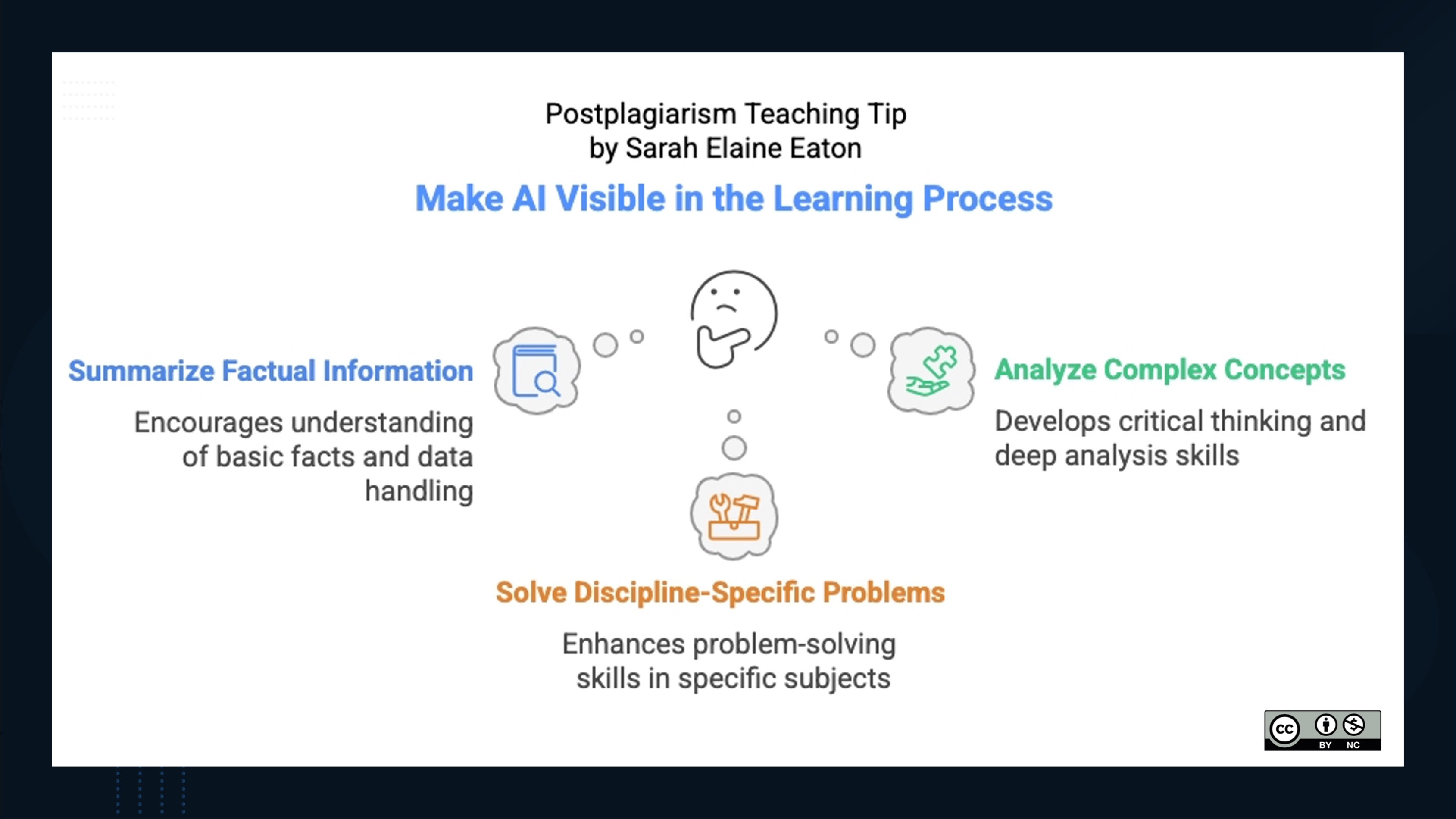
A teaching tip infographic titled "Postplagiarism Teaching Tip by Sarah Elaine Eaton: Make AI Visible in the Learning Process." The infographic features a central image of a thinking face emoji, with three connected bubbles highlighting different aspects of AI integration in learning:

Summarize Factual Information (blue): Encourages understanding of basic facts and data handling, represented by an icon of a document with a magnifying glass.

Analyze Complex Concepts (green): Develops critical thinking and deep analysis skills, represented by an icon of a puzzle piece.

Solve Discipline-Specific Problems (orange): Enhances problem-solving skills in specific subjects, represented by an icon of tools (wrench and screwdriver).
In the bottom right corner, there’s a Creative Commons license (CC BY-NC) icon.

Have students identify where the AI excels and where it falls short. Hands-on experience that is supervised by an educator helps students understand that while AI can be impressive and  capable, it has clear boundaries and weaknesses.

From AI Drafts to Critical Analysis

AI tools can quickly generate content that serves as a starting point for deeper learning. Here is a step-by-step approach for using AI-generated drafts as teaching material:

  1. Assignment Preparation: Choose a topic relevant to your course and generate a draft response using an AI tool such as ChatGPT.
  2. Collaborative Analysis: Share the AI-generated draft with students and facilitate a discussion about its strengths and weaknesses. Prompt students with questions such as:
    • What perspectives are missing from this response?
    • How could the structure be improved?
    • What claims require additional evidence?
    • How might we make this content more engaging or relevant?

The idea is to bring students into conversations about AI, to build their critical thinking and also have them puzzle through the strengths and weaknesses of current AI tools.

  • Revision Workshop: Have students work individually or in groups to revised an AI draft into a more nuanced, complete response. This process teaches students that the value lies not in generating initial content (which AI can do) but in refining, expanding, and critically evaluating information (which requires human judgment).
  • Reflection: Ask students to document what they learned through the revision process. What gaps did they identify in the AI’s understanding? How did their human perspective enhance the work? Building in meta-cognitive awareness is one of the skills that assessment experts such as Bearman and Luckin (2020) emphasize in their work.

This approach shifts the educational focus from content creation to content evaluation and refinement—skills that will remain valuable regardless of technological advancement.

Teaching Fact-Checking Through Deliberate Errors

AI systems often present information confidently, even when that information is incorrect or fabricated. This characteristic makes AI-generated content perfect for teaching fact-checking skills.

Try this classroom activity:

  1. Generate Content with Errors: Use an AI tool to create content in your subject area, either by requesting information you know contains errors or by asking about obscure topics where the AI might fabricate details.
  2. Fact-Finding Mission: Provide this content to students with the explicit instruction to identify potential errors and verify information. You might structure this as:
    • Individual verification of specific claims
    • Small group investigation with different sections assigned to each group
    • A whole-class collaborative fact-checking document
  3. Source Evaluation: Have students document not just whether information is correct, but how they determined its accuracy. This reinforces the importance of consulting authoritative sources and cross-referencing information.
  4. Meta-Discussion: Use this opportunity to discuss why AI systems make these kinds of errors. Topics might include:
  • How large language models are trained
  • The concept of ‘hallucination’ in AI
  • The difference between pattern recognition and understanding
  • Why AI might present incorrect information with high confidence

These activities teach students not just to be skeptical of AI outputs but to develop systematic approaches to information verification—an essential skill in our information-saturated world.

Case Studies in AI Ethics

Ethical considerations around AI use should be explicit rather than implicit in education. Develop case studies that prompt students to engage with real ethical dilemmas:

  1. Attribution Discussions: Present scenarios where students must decide how to properly attribute AI contributions to their work. For example, if an AI helps to brainstorm ideas or provides an outline that a student substantially revises, how could this be acknowledged?
  2. Equity Considerations: Explore cases highlighting AI’s accessibility implications. Who benefits from these tools? Who might be disadvantaged? How might different cultural perspectives be underrepresented in AI outputs?
  3. Professional Standards: Discuss how different fields are developing guidelines for AI use. Medical students might examine how AI diagnostic tools should be used alongside human expertise, while creative writing students could debate the role of AI in authorship.
  4. Decision-Making Frameworks: Help students develop personal guidelines for when and how to use AI tools. What types of tasks might benefit from AI assistance? Where is independent human work essential?

These discussions help students develop thoughtful approaches to technology use that will serve them well beyond the classroom.

Implementation Tips for Educators

As you incorporate these approaches into your teaching, consider these practical suggestions:

  • Start small with one AI-focused activity before expanding to broader integration
  • Be transparent with students about your own learning curve with these technologies
  • Update your syllabus to clearly outline expectations for appropriate AI use
  • Document successes and challenges to refine your approach over time
  • Share experiences with colleagues to build institutional knowledge

Moving Beyond the AI Panic

The concept of postplagiarism does not mean abandoning academic integrity—rather, it calls for reimagining how we teach integrity in a technologically integrated world. By bringing AI tools directly into our teaching practices, we help students develop the critical thinking, evaluation skills, and ethical awareness needed to use these technologies responsibly.

When we shift our focus from preventing AI use to teaching with and about AI, we prepare students not just for academic success, but for thoughtful engagement with technology throughout their lives and careers.

References

Bearman, M., & Luckin, R. (2020). Preparing university assessment for a world with AI: Tasks for human intelligence. In M. Bearman, P. Dawson, R. Ajjawi, J. Tai, & D. Boud (Eds.), Re-imagining University Assessment in a Digital World (pp. 49-63). Springer International Publishing. https://doi.org/10.1007/978-3-030-41956-1_5 

Eaton, S. E. (2023). Postplagiarism: Transdisciplinary ethics and integrity in the age of artificial intelligence and neurotechnology. International Journal for Educational Integrity, 19(1), 1-10. https://doi.org/10.1007/s40979-023-00144-1

Edwards, B. (2023, April 6). Why ChatGPT and Bing Chat are so good at making things up. Arts Technica. https://arstechnica.com/information-technology/2023/04/why-ai-chatbots-are-the-ultimate-bs-machines-and-how-people-hope-to-fix-them/ 

________________________

Share this post: Embracing AI as a Teaching Tool: Practical Approaches for the Postplagiarism Classroom – https://drsaraheaton.com/2025/03/23/embracing-ai-as-a-teaching-tool-practical-approaches-for-the-post-plagiarism-classroom/

This blog has had over 3.7 million views thanks to readers like you. If you enjoyed this post, please ‘Like’ it using the button below or share it on social media. Thanks!

Sarah Elaine Eaton, PhD, is a Professor and Research Chair in the Werklund School of Education at the University of Calgary, Canada. Opinions are my own and do not represent those of my employer.


Postplagiarism in THE

January 15, 2025

How lovely to wake up this morning and see an article about postplagiarism in Times Higher Education. Karen Kenny from Exeter University writes about the six tenets and then extends the discussion to assessment.

It seems that the idea of postplagiarism is catching on. Dr. Rahul Kumar and I have launched a postplagiarism online community, where we share blogs, news, articles, and translations of the work into other languages. You can check out all our resources over on our other site.

________________________

Share this post: Postplagiarism in THE – https://drsaraheaton.com/2025/01/15/postplagiarism-in-the/

This blog has had over 3.7 million views thanks to readers like you. If you enjoyed this post, please ‘Like’ it using the button below or share it on social media. Thanks!

Sarah Elaine Eaton, PhD, is a Professor and Research Chair in the Werklund School of Education at the University of Calgary, Canada. Opinions are my own and do not represent those of my employer. 


Upcoming Talk: From Plagiarism to Postplagiarism: Navigating the GenAI Revolution in Higher Education

January 3, 2025
An promo announcement on a white background. There is a red stripe down the left-hand site. The University of Calgary logo appears on the top right. The following text is written in black, orange and red:
From Plagiarism to Postplagiarism: Navigating the GenAI Revolution in Higher Education
The first 2025 public presentation about #Postplagiarism
is now open for registration!

Free and open to the public.
Join us in person or via webinar.
January 29, 2025| 12:00 – 13:00 Mountain time

https://workrooms.ucalgary.ca/event/3854045

Join us for our first presentation of 2025:

From Plagiarism to Postplagiarism: Navigating the GenAI Revolution in Higher Education

Format: Hybrid (in person or live stream)

I am delighted to kick off a speaker series on GenAI hosted by my colleague, Dr. Soroush Sabbaghan, through the Centre for Artificial Intelligence Ethics, Literacy, and Integrity (CAIELI) at the University of Calgary.

Description

Generative AI (GenAI) is transforming teaching, learning, and assessment in higher education.

Learn to integrate GenAI effectively while maintaining academic integrity and enhancing student agency.

Dr. Sarah Eaton shares innovative strategies that promote critical thinking and original scholarship. Explore how GenAI reshapes academic practices and discover proactive approaches to leverage its potential.

This session equips educators, administrators, and policymakers to lead purposefully in a dynamic academic landscape.

Speaker bio

Sarah Elaine Eaton is a Professor and research chair at the Werklund School of Education at the University of Calgary (Canada). She is an award-winning educator, researcher, and leader. She leads transdisciplinary research teams focused on the ethical implications of advanced technology use in educational contexts. Dr. Eaton also holds a concurrent appointment as an Honorary Associate Professor, Deakin University, Australia.

More Details

Date: January 29, 2025

Time: 12:00 – 13:00 Mountain time

This talk is free and open to the public, but there are only 20 seats available to join us in person! We can also accommodate folks online.

Get more details and register here.

________________________

Share this post: Upcoming talk: From Plagiarism to Postplagiarism: Navigating the GenAI Revolution in Higher Education – https://drsaraheaton.com/2025/01/03/upcoming-talk-from-plagiarism-to-postplagiarism-navigating-the-genai-revolution-in-higher-education/

This blog has had over 3.7 million views thanks to readers like you. If you enjoyed this post, please “like” it or share it on social media. Thanks!

Sarah Elaine Eaton, PhD, is a Professor and Research Chair in the Werklund School of Education at the University of Calgary, Canada. Opinions are my own and do not represent those of my employer. 


Three tips for future-proofing academic and research integrity this year

January 2, 2025

In my 2024 annual editorial for the International Journal for Educational Integrity, was entitled, ’Future-proofing integrity in the age of artificial intelligence and neurotechnology: prioritizing human rights, dignity, and equity

Here are three things you can do to prioritize human rights and dignity when it comes to policies and procedures to address allegations of academic or research misconduct:

Use a human-rights-by-design approach to developing, revising, and implementing policies by conducting a comprehensive review of existing academic integrity policies. Update policies to explicitly incorporate human rights principles, ensuring they address fair process, privacy, equitable treatment, and respect for human dignity. It is essential to involve individuals from representative groups in this process.

Provide ongoing training, education, and support to faculty, staff, and students about human rights principles and how they apply to misconduct investigations and case management. Create orientation programs that explain expectations for ethical conduct while respecting diverse cultural perspectives. Offer workshops and resources, peer mentoring programs, and support services.

Focus on continuous improvement and quality assurance of ethics and integrity practices by gathering feedback from students, faculty, staff and relevant stakeholders. Regularly review misconduct case management processes and data to ensure equitable treatment across different demographics.

Implementing human rights principles into misconduct investigations and case management helps to create more effective and sustainable learning environments. This approach prioritizes people over punishment, dignity over draconianism, and compassion over callousness.

Read the full article here: https://edintegrity.biomedcentral.com/articles/10.1007/s40979-024-00175-2 

Related post:

Future-proofing integrity in the age of artificial intelligence and neurotechnology: Prioritizing human rights, dignity, and equity

________________________

Share this post: Three tips for future-proofing academic and research integrity this year – https://drsaraheaton.com/2025/01/02/three-tips-for-future-proofing-academic-and-research-integrity-this-year/

This blog has had over 3 million views thanks to readers like you. If you enjoyed this post, please “like” it or share it on social media. Thanks!

Sarah Elaine Eaton, PhD, is a Professor and Research Chair in the Werklund School of Education at the University of Calgary, Canada. Opinions are my own and do not represent those of my employer. 


6 Tenets of Postplagiarism: Writing in the Age of Artificial Intelligence

February 25, 2023
An infographic showing the 6 tenets of the post-plagiarism age. There is a circle with six points extending from it. There is an icon of a brain at the centre. These ideas were developed from the book, Plagiarism in Higher Education: Tackling Tough Topics in Academic Integrity (2021) by S. E. Eaton.

In the final chapter of Plagiarism in Higher Education: Tackling Tough Topics in Academic Integrity (2021) I contemplate the future of plagiarism and academic integrity. I introduced the idea of life in a postplagiarism world; thinking about the impact of artificial intelligence on writing. Here, I expand on those ideas. These 6 tenets characterize the post-plagiarism age:

Hybrid Human-AI Writing Will Become Normal

Hybrid writing, co-created by human and artificial intelligence together is becoming prevalent. Soon it will be the norm. Trying to determine where the human ends and where the artificial intelligence begins is pointless and futile.

Human Creativity is Enhanced

Human creativity is enhanced, not threatened by artificial intelligence. Humans can be inspired and inspire others. Humans may even be inspired by artificial intelligence, but our ability to imagine, inspire, and create remains boundless and inexhaustible.

Language Barriers Disappear

One’s first language will begin to matter less and less as tools become available for humans to understand each other in countless languages.

Humans can Relinquish Control, but not Responsibility

Humans can retain control over what they write, but they can also relinquish control to artificial intelligence tools if they choose. Although humans can relinquish control, they do not relinquish responsibility for what is written. Humans can – and must – remain accountable for fact-checking, verification procedures, and truth-telling. Humans are also responsible for how AI-tools are developed.

Attribution Remains Important

It always has been, and always will be, appropriate and desirable to appreciate, admire, and respect our teachers, mentors, and guides. Humans learn in community with one another, even when they are learning alone. Citing, referencing, and attribution remain important skills.

Historical Definitions of Plagiarism No Longer Apply

Historical definitions of plagiarism will not be rewritten because of artificial intelligence; they will be transcended. Policy definitions can – and must – adapt.

Translations of the Six Tenets of Postplagiarism

Since I first shared the Six Tenets of Postplagiarism, the infographic has been translated into French and Spanish. I am very grateful to the translators, who put in time and effort to go through the points in detail. Here are the translated versions:

Les 6 Principes du Postplagiat (French)

This translation was done by Dr. Elaine Beaulieu at the University of Ottawa, Canada.

Colleagues at the Université du Québec à Montréal (Canada), also wrote a web article in French. It is available here: https://collimateur.uqam.ca/collimateur/6-principes-de-lapres-plagiat-a-lere-de-lia/

6 Principios del Posplagio (Spanish)

The Spanish translation was done by Beatriz Moya, PhD candidate at the University of Calgary.

More Resources on PostPlagiarism

Check out my video on this topic on YouTube: https://youtu.be/NxFMMw1QZX0

Check out my article in University World News on this topic: “Artificial intelligence and academic integrity, post-plagiarism”

_________________________________

Share this:  6 Tenets of Postplagiarism: Writing in the Age of Artificial Intelligence https://drsaraheaton.wordpress.com/2023/02/25/6-tenets-of-postplagiarism-writing-in-the-age-of-artificial-intelligence/

This blog has had over 3 million views thanks to readers like you. If you enjoyed this post, please “like” it or share it on social media. Thanks!

Sarah Elaine Eaton, PhD, is a faculty member in the Werklund School of Education, and the Educational Leader in Residence, Academic Integrity, University of Calgary, Canada. Opinions are my own and do not represent those of the University of Calgary.