Decriminalizing the Language of Academic Integrity

October 2, 2025

The first time I heard about decriminalizing the language and processes we use to address cases of plagiarism and other forms of academic misconduct; I was riveted. It was at an academic integrity conference in Richmond, Virginia and the lead presenter was Dr. James Earl Orr, who presented together with students on how a developmental and supportive approach to academic misconduct case management can help lead students towards academic success while still holding them responsible for their behaviour.  James Earl Orr, writing together with Karita Orr, published an excellent article on using restorative practices to resolve academic integrity violations.

When I was writing the University of Calgary’s academic integrity Handbook for Academic Staff and Teaching Assistants, I took the opportunity to apply what I had learned from listening to Dr. Orr at conferences and reading his work by including a section on how to decriminalize the language we use to talk about academic misconduct.

Academic integrity violations are rarely criminal in nature and yet, much of the language we use when addressing plagiarism and academic cheating is legalistic, setting the stage for criminalizing student behaviour. One step towards taking a more learner-centred approach to misconduct is to decriminalize the language we use to talk about breaches of academic integrity.

Front cover: Student Academic Integrity Faculty Handbook
Front cover of the Student Academic Integrity Faculty Handbook, published by the Taylor Institute for Teaching and Learning at the University of Calgary

The following is an excerpt from the University of Calgary’s academic integrity Handbook for Academic Staff and Teaching Assistants that provides practical guidance on how to do this:

“We know that words matter and the language we use is important. A full list of terms related to academic misconduct is available in our policy. It should be noted that the terms “academic integrity” and “academic misconduct” are not interchangeable.

Academic integrity is about acting ethically in teaching, learning and research contexts. We do not report, investigate or manage cases of academic integrity. We report, investigate and manage cases of academic misconduct.

Academic misconduct is what happens when individuals do not act with integrity. This is currently the language used in our policy and procedures. When speaking and writing about academic misconduct, we can use the terms “breaches of integrity or “violations of integrity” as synonyms for academic misconduct.

At the University of Calgary we take a proactive approach to academic integrity, including in the language we use and in keeping the focus on teaching, learning and fairness to students. In our conversations with students and others, it can be helpful to use the language of integrity that focuses on education and support” (Eaton, 2022, p. 13).

See the table below, which is also an expert from our handbook (with a few minor updates):

The language of academic integrity

Preferred
language
Language
to avoid 
Explanation
Hold responsible Guilt
Guilty

The words “guilt” and “guilty” do not appear anywhere in our
polices or procedures. We do not find students guilty of academic misconduct, but instead we hold them responsible for their
behaviours.
Sanctions
Consequence
Outcome
Punish
Punishment

When disciplinary actions are taken in response to academic
misconduct, we do not use the terms “punish” or “punishment”
in our institutional documents. We opt instead for “sanctions”,
“discipline,” “consequences” or “outcome” which can include educational responses depending on the misconduct.
Hearing Trial 
The University of Calgary does not conduct trials related to
academic misconduct.
In other countries, various forms of academic misconduct can be
considered an offense under the criminal code and students may
be required to attend a criminal trial. That is not the case at the
University of Calgary or anywhere in Canada.
In the case of an appeal, a hearing might occur. In rare cases, an appeal case might escalate to an externally reviewed case in court, but these proceedings are not administered by the university itself.

When I talk about taking a postplagiarism approach to academic integrity I am talking about disrupting historically adversarial and antagonistic approaches to misconduct that pit students against their teachers. It is time to move past crime-and-punishment approaches to student misconduct where students are the villains and teachers are the heroes. When we talk about postplagiarism we talk about social justice and student success as being intertwined, and we focus on students as stewards of the future, who will be best equipped for an increasingly complex world when they understand the importance of ethical decision-making, both in theory and in practice.

Postplagiarism does not mean anything goes, and nor does it mean that we turn a blind eye to misconduct. Postplagiarism is about finding socially just ways to address misconduct include relationally, restoration, and the preservation of dignity and human rights. When we decriminalize language related to student misconduct, we are taking a step towards dignity and   student success.

Our University of Calgary’s academic integrity Handbook for Academic Staff and Teaching Assistants is an open access handbook with a Creative Commons license. This means you can share and adapt the material, providing the original work is properly attributed.

If this is helpful to you, please share this with others.

References and Further Reading

Eaton, S. E. (2022). Student Academic Integrity: A Handbook for Academic Staff and Teaching Assistants. University of Calgary, Taylor Institute for Teaching and Learning Guide Series. https://taylorinstitute.ucalgary.ca/resources/student-academic-integrity-handbook

Eaton, S. E. (2023). Postplagiarism: Transdisciplinary ethics and integrity in the age of artificial intelligence and neurotechnology. International Journal for Educational Integrity, 19(1), 1–10. https://doi.org/10.1007/s40979-023-00144-1

Eaton, S. E. (2025). Global Trends in Education: Artificial Intelligence, Postplagiarism, and Future-focused Learning for 2025 and Beyond – 2024–2025 Werklund Distinguished Research Lecture. International Journal for Educational Integrity, 21(1), 12. https://doi.org/10.1007/s40979-025-00187-6

Orr, J. E., & Hall, J. (2018). Student-led case adjudication: Promoting student learning through peer-to-peer engagement. 25th Annual International Center for Academic Integrity (ICAI) Conference, Richmond, VA.

Orr, J. E., & Orr, K. (2023). Restoring honor and integrity through integrating restorative practices in academic integrity with student leaders. Journal of Academic Ethics, 21, 55–70. https://doi.org/10.1007/s10805-021-09437-x

Orr, J. E., & Orren, S. (2018, March 4). The Development & Implementation of a Campus Academic Integrity Education Program. 25th Annual International Center for Academic Integrity (ICAI) Conference, Richmond, VA.

______________

Share this post: Decriminalizing the Language of Academic Integrity – https://drsaraheaton.com/2025/10/02/decriminalizing-the-language-of-academic-integrity/

Sarah Elaine Eaton, PhD, is a Professor and Research Chair in the Werklund School of Education at the University of Calgary, Canada. Opinions are my own and do not represent those of my employer.


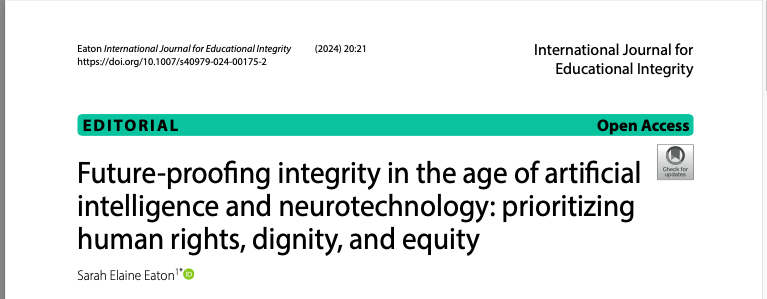
Future-proofing integrity in the age of artificial intelligence and neurotechnology: Prioritizing human rights, dignity, and equity

November 13, 2024

Once a year I write an editorial for the International Journal for Educational Integrity. I take a big idea, ground it in literature written by some of the best in the world and then call for ways to improve our field even more. In 2023 I wrote about Postplagiarism and in 2022, I focused on equity, diversity, inclusion, accessibility and decolonization as new priorities for academic integrity. Here is this year’s editorial:

Future-proofing integrity in the age of artificial intelligence and neurotechnology: prioritizing human rights, dignity, and equity

A screenshot of an article title page. There is black text on a white background with a green banner at the top.
Here is a link to the original: https://edintegrity.biomedcentral.com/articles/10.1007/s40979-024-00175-2

Abstract

In this article I argue for the prioritisation of human rights when developing and implementing misconduct policies. Existing approaches may be perpetuate inequities, particularly for individuals from marginalised groups. A human-rights-by-design approach, which centres human rights in policy development, revision, and implementation, ensuring that every individual is treated with dignity and respect.

Recommendations for implementing a human-rights approach to misconduct investigations and case management are offered, covering areas such as procedural fairness, privacy, equity, and the right to education. Additional topics covered are the need to limit surveillance technologies, and the need to recognize that not all use of artificial intelligence tools automatically constitutes misconduct. I disentangle

the differences between equity and equality and explain how both are important when considering ethics and integrity. A central argument of this paper is that a human-rights-by-design approach to integrity does not diminish standards but rather strengthens educational systems by cultivating ethical awareness and respect for personhood. I conclude with a call to action with a seven-point plan for institutions to adopt a human-rights-based approach to ethics and integrity. In the age of artificial intelligence and neurotechnology, insisting on human rights and dignity when we investigate and address misconduct allegations is an ethical imperative that has never been more important.

Keywords Academic misconduct, Academic dishonesty, Plagiarism, Policy, Human rights, Restorative justice, Artificial intelligence, Neurotechnology, Higher education, Education

Commentary

As I reflect on the current state of academic and research integrity, I am struck by a glaring omission in our discussions: the connection between misconduct and human rights. We often treat these as separate entities, failing to recognize the profound impact that misconduct investigations and policies can have on the fundamental rights of individuals. This oversight is particularly concerning in the age of artificial intelligence (AI) and neurotechnology, where the potential for harm is magnified.

Take, for example, the case of a professor in Canada who physically assaulted international students accused of plagiarism. This horrifying example demonstrates how the pursuit of academic integrity can be twisted into a justification for degrading and inhumane treatment, violating the very principles of dignity and respect that should guide our actions. While this is an extreme case, it highlights the need for a fundamental shift in our approach.

In this editorial, I offer a call to action to move beyond simply adhering to legal requirements and embrace a ‘human-rights-by-design’ approach that embeds human rights principles into our policies and practices. This means ensuring procedural fairness throughout investigations, safeguarding the privacy of individuals, and recognizing the right to be presumed innocent until there is proof to the contrary. It also requires us to acknowledge the diverse backgrounds and circumstances of our students and staff, striving for equitable treatment that addresses systemic inequalities and provides the support needed for everyone to succeed.

In the face of rapidly evolving technologies like AI, we must be especially vigilant in upholding human rights. The temptation to rely on unproven AI detection tools or to rush to judgement based on suspicion rather than evidence is strong, but it is a path that leads us away from justice and fairness. We cannot allow fear or expediency to erode our commitment to human dignity.

By centring human rights in our approach to integrity, we can create educational and research environments that are not only ethically sound but also truly just and equitable. This is not about lowering standards; it is about building a culture of integrity that upholds the inherent worth of every individual.

________________________

Share this post: Future-proofing integrity in the age of artificial intelligence and neurotechnology: Prioritizing human rights, dignity, and equity – https://drsaraheaton.com/2024/11/13/future-proofing-integrity-in-the-age-of-artificial-intelligence-and-neurotechnology-prioritizing-human-rights-dignity-and-equity/
This blog has had over 3 million views thanks to readers like you. If you enjoyed this post, please “like” it or share it on social media. Thanks!

Sarah Elaine Eaton, PhD, is a Professor and Research Chair in the Werklund School of Education at the University of Calgary, Canada. Opinions are my own and do not represent those of my employer.


Workshop: Exploring Racism and Academic Integrity through a Circle Process

October 16, 2020

ATESL 2020I’m excited to partner with colleagues from Norquest College and the Alberta Council on Academic Integrity to present this workshop at the Alberta Teachers’ of English as a Second Language (ATESL) 2020 E- Conference: Seeds of Possibility: Curiosity, Drive, and Innovation.

Workshop Description

In this session participants will explore and experience the Circle of Courage and circle process by engaging in a dialogue on anti-racism and racism related to academic misconduct.

The Circle of Courage (Brendtro, Brokenleg, & Van Bockern, 2005) is a model of resilience and positive development based on Indigenous values of Belonging, Mastery, Independence and Generosity. Applied together with a circle process, this way of approaching the relational space in classrooms helps create the conditions for students and instructors to engage more authentically and openly in difficult complex topics. As a holistic approach to discussion this a way to spur conversation about the dynamic faced by English as additional language learners.

Keywords: Academic integrity; Restorative Justice; Restorative Practices; Circle Process; Racism

Reference:

Brendtro, L., Brokenleg, M., & Bockern, V. (2005). The circle of courage and positive psychology. Reclaiming Children and Youth, 14(3). 130-136.

Workshop Materials

You can download our workshop materials for free from here: http://hdl.handle.net/1880/112689

Presenter bios

Sheryl Boisvert, B.Ed, CPA, CGA is currently a full-time instructor at NorQuest College. Though she has performed a variety of roles since 2001, Sheryl has found being an instructor to be the most fulfilling.  She has always believed that students gain a better understanding of the material they learn when they can go beyond textbook theory and put concepts into practice.

Nazanin Teymouri, MBA, is as an instructor at NorQuest College in the Faculty of Business, Environment, and Technology. Currently her time at the college is split between teaching and co-leading research initiatives on academic integrity. With a background in communication and business, her focus is on analysis, cultural understanding, and collaboration aimed at bettering the learning environment.

Jamie Ahksistowaki Medicine Crane is Blackfoot from Kainai and Piikani, an activist, advocate, educator, and multi-disciplinary artist. Shes very passionate in education and is currently working with NorQuest College as a curriculum developer- in regards to Indigenous education, history and perspectives, building faculty capacity, supporting curriculum development and Indigenization strategy.

Sarah Elaine Eaton, PhD, is an Associate Professor at the Werklund School of Education, University of Calgary. She is a long-standing member of ATESL. Her research focuses on academic integrity.

_________________________________________

Share or Tweet this: Exploring Racism and Academic Integrity through a Circle Process – https://drsaraheaton.wordpress.com/2020/10/16/exploring-racism-and-academic-integrity-through-a-circle-process/

This blog has had over 2 million views thanks to readers like you. If you enjoyed this post, please “like” it or share it on social media. Thanks!

Sarah Elaine Eaton, PhD, is a faculty member in the Werklund School of Education, and the Educational Leader in Residence, Academic Integrity, University of Calgary, Canada. Opinions are my own and do not represent those of the University of Calgary.