Ethical Reasons to Avoid Using AI Apps for Student Assessment

September 10, 2024

It’s the start of a new school year here in North America. We are into the second week of classes and already I am hearing from administrators in both K-12 and higher education institutions who are frustrated with educators who have turned to ChatGPT and other publicly-available Gen AI apps to help them assess student learning.

Although customized AI apps designed specifically to assist with the assessment of student learning already exist, many educators do not yet have access to such tools. Instead, I am hearing about educators turning to large language models (LLMs) like ChatGPT to help them provide formative or summative assessment of students’ work. There are some good reasons not to avoid using ChatGPT or other LLMs to assess student learning.

I expect that not everyone will agree with these points, please take them with the spirit in which they are intended, which to provide guidance on ethical ways to teach, learn, and assess students’ work.

8 Tips on Why Educators Should Avoid Using AI Apps to Help with Assessment of Student Learning

Intellectual Property

In Canada at least, a student’s work is their intellectual property. Unless you have permission to use it outside of class, then avoid doing so. The bottom line here is that student’s intellectual work is not yours to share to a large-language model (LLM) or any other third party application, with out their knowledge and consent.

Privacy

A student’s personal data, including their name, ID number and other details should never be uploaded to an external app without consent. One reason for this blog post is to respond to stories I am hearing about educators uploading entire student essays or assignments, including the cover page with all the identifying information, to a third-party GenAI app.

Data security

Content uploaded to an AI tool may be added to its database and used to train the tool. Uploading student assignments to GenAI apps for feedback poses several data security risks. These include potential breaches of data storage systems, privacy violations through sharing sensitive student information, and intellectual property concerns. Inadequate access controls or encryption could allow unauthorized access to student work. 

AI model vulnerabilities might enable data extraction, while unintended leakage could occur through the AI app’s responses. If the educator’s account is compromised, it could expose all of the uploaded assignments. The app’s policies may permit third-party data sharing, and long-term data persistence in backups or training sets could extend the risk timeline. Also, there may be legal and regulatory issues around sharing student data, especially for minors, without proper consent.

Bias

AI apps are known to be biased. Feedback generated by an AI app can be biased, unfair, and even racist. To learn more check out this article published in Nature. AI models can perpetuate existing biases present in their training data, which may not represent diverse student populations adequately. Apps might favour certain writing styles (e.g., standard American English), cultural references, or modes of expression, disadvantaging students from different backgrounds. 

Furthermore, the AI’s feedback could be inconsistent across similar submissions or fail to account for individual student progress and needs. Additionally, the app may not fully grasp nuanced or creative approaches, leading to standardized feedback that discourages unique thinking.

Lack of context

An AI app does not know your student like you do. Although GenAI tools can offer quick assessments and feedback, they often lack the nuanced understanding of a student’s unique context, learning style, and emotional or physical well-being. Overreliance on AI-generated feedback might lead to generic responses, diminishing the personal connection and meaningful interaction that educators provide, which are vital for effective learning.

Impersonal

AI apps can provide generic feedback, but as an educator, you can personalize feedback to help the student grow. AI apps can provide generic feedback but may not help to scaffold a student’s learning. Personalized feedback is crucial, as it fosters individual student growth, enhances understanding, and encourages engagement with the material. Tailoring feedback to specific strengths and weaknesses helps students recognize their progress and areas needing improvement. In turn, this helps to build their confidence and motivation. 

Academic Integrity

Educators model ethical behaviour, this includes transparent and fair assessment. If you are using tech tools to assess student learning, it is important to be transparent about it. In this post, I write more about how and why deceptive and covert assessment tactics are unacceptable.

Your Employee Responsibilities

If your job description includes assessing student work , you may be violating your employment contract if you offload assessment to an AI app.

Concluding Thoughts

Unless your employer has explicitly given you permission to use AI apps for assessing student work then, at least for now, consider providing feedback and assessment in the ways expected by your employer. If we do not want students to use AI apps to take shortcuts, then it is up to us as educators to model the behavior we expect from students.

I understand that educators have excessive and exhausting workloads. I appreciate that we have more items on our To Do Lists than is reasonable. I totally get it that we may look for shortcuts and ways to reduce our workload. The reality is that although Gen AI may have the capability to help with certain tasks, not all employers have endorsed their use in same way.

Not all institutions or schools have artificial intelligence policies or guideline, so when in doubt, ask your supervisor if you are not sure about the expectations. Again, there is a parallel here with student conduct. If we expect students to avoid using AI apps unless we make it explicit that it is OK, then the same goes for educators. Avoid using unauthorized tech tools for assessment without the boss knowing about it.

I am not suggesting that Gen AI apps don’t have the capability to assist with AI, but I am suggesting that many educational institutions have not yet approved the use of such apps for use in the workplace. Trust me, when there are Gen AI apps to help with the heaviest aspects of our workload as educators, I’ll be at the front of the line to use them. In the meantime, there’s a balance to be struck between what AI can do and what one’s employer may permit us to use AI for. It’s important to know the difference — and to protect your livelihood.

Related post:

The Use of AI-Detection Tools in the Assessment of Student Work https://drsaraheaton.wordpress.com/2023/05/06/the-use-of-ai-detection-tools-in-the-assessment-of-student-work/

____________________________

Share this post:
Ethical Reasons to Avoid Using AI Apps for Student Assessment – https://drsaraheaton.com/2024/09/10/ethical-reasons-to-avoid-using-ai-apps-for-student-assessment/

This blog has had over 3.6 million views thanks to readers like you. If you enjoyed this post, please “like” it or share it on social media. Thanks!

Sarah Elaine Eaton, PhD, is a faculty member in the Werklund School of Education at the University of Calgary, Canada. Opinions are my own and do not represent those of my employer.

Sarah Elaine Eaton, PhD, Editor-in-Chief, International Journal for Educational Integrity


Exploring the Contemporary Intersections of Artificial Intelligence and Academic Integrity

May 17, 2022
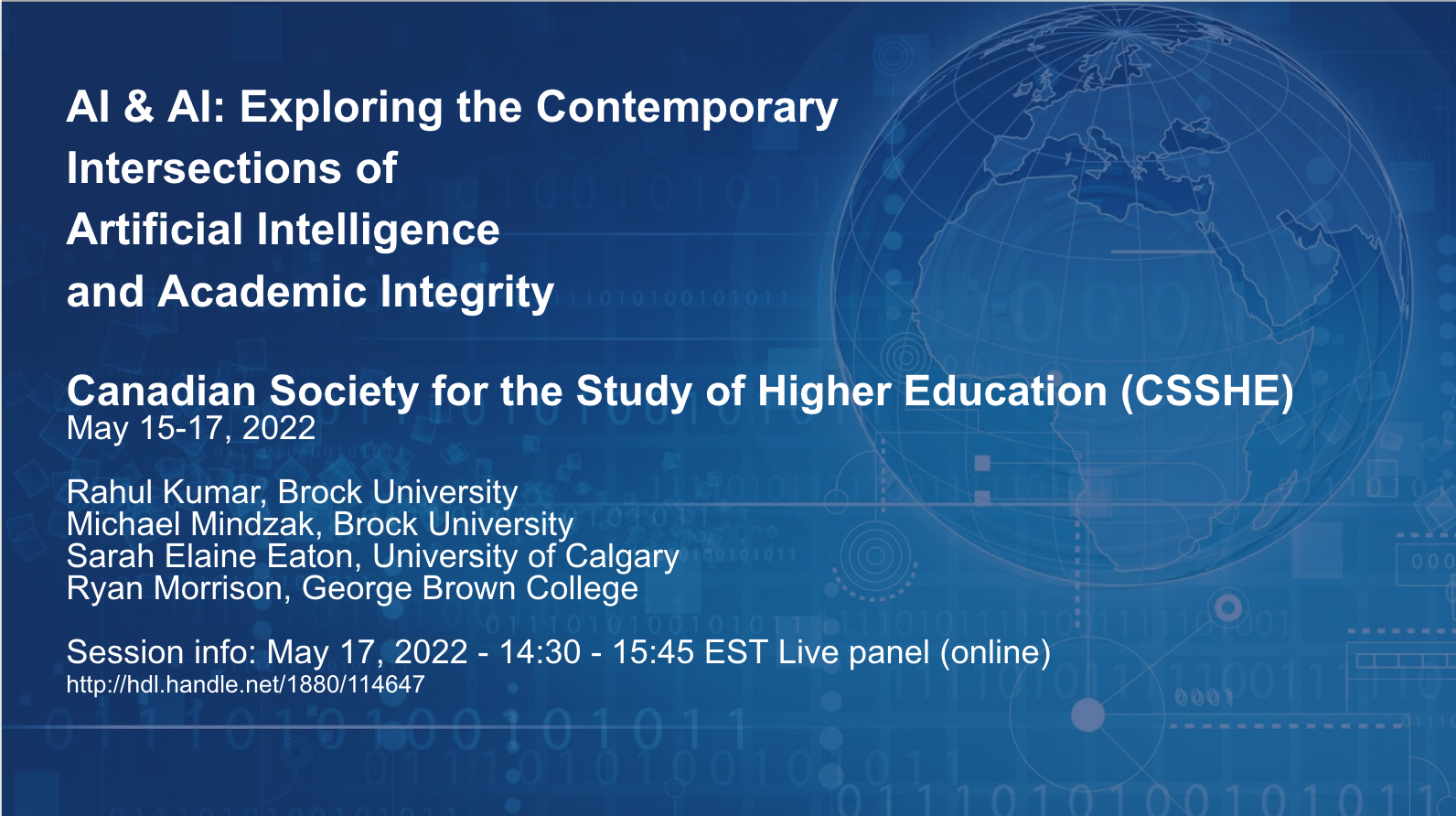
Title slide from CSSHE 2022 panel discussion: AI & AI: Exploring the contemporary intersections of artificial intelligence and academic integrity (Kumar, Mindzak, Eaton & Morrison)

For more than a year there have been small teams of us across Canada studying the impact of artificial intelligence on academic integrity. Today I am pleased to be part of a panel discussion on this topic at the annual conference of the Canadian Society for the Study of Higher Education (CSSHE), which is part of Congress 2022.

Our panel is led by Rahul Kumar (Brock University, Canada), together with Michael Mindzak (Brock University, Canada) and Ryan Morrison (George Brown College, Canada)

Here is the information about our panel:

Session G3: Panel: AI & AI: Exploring the Contemporary Intersections of Artificial Intelligence and Academic Integrity (Live, remote) 

Panel Chair: Rahul Kumar 

  • Rahul Kumar (Brock University): Ethical application with practical examples
  • Michael Mindzak (Brock University): Implications on labour 
  • Ryan Morrison (George Brown College): Large language models: An overview for educators 
  • Sarah Elaine Eaton (University of Calgary): Academic integrity and assessment 

We have developed a combined slide deck for our panel discussion today. You can download the entire slide deck from the link noted in the citation below:

Kumar, R., Mindzak, M., Morrison, R., & Eaton, S. E. (2022, May 17). AI & AI: Exploring the contemporary intersections of artificial intelligence and academic integrity [online]. Paper presented at the Canadian Society for the Study of Higher Education (CSSHE). http://hdl.handle.net/1880/114647

Related posts:

New project: Artificial Intelligence and Academic Integrity: The Ethics of Teaching and Learning with Algorithmic Writing Technologies – https://drsaraheaton.wordpress.com/2022/04/19/new-project-artificial-intelligence-and-academic-integrity-the-ethics-of-teaching-and-learning-with-algorithmic-writing-technologies/

Keywords: artificial intelligence, large language models, GPT-3, academic integrity, academic misconduct, plagiarism, higher education, teaching, learning, assessment

_________________________________

Share or Tweet this: Exploring the Contemporary Intersections of Artificial Intelligence and Academic Integrity https://drsaraheaton.wordpress.com/2022/05/17/exploring-the-contemporary-intersections-of-artificial-intelligence-and-academic-integrity/

This blog has had over 3 million views thanks to readers like you. If you enjoyed this post, please “like” it or share it on social media. Thanks!

Sarah Elaine Eaton, PhD, is a faculty member in the Werklund School of Education, and the Educational Leader in Residence, Academic Integrity, University of Calgary, Canada. Opinions are my own and do not represent those of the University of Calgary.


Academic Integrity: Transforming Invisible work into Visible and Valued Work

July 7, 2021

In a previous post I talked about how the work of academic integrity is often invisible and unrecognized. Today I wanted to share some exciting news. Over the past couple of years, colleagues at the University of Calgary have been working hard to update an old and outdated manual to address hiring, merit assessment, tenure and promotion for academic staff.

In the fall of 2020, I had an opportunity to connect with the two project leads, Dr. Florentine Strzelczyk and Dr. Francine Smith, to speak specifically about matters relating to ethics and integrity. We talked about the invisible nature of academic integrity work and how I’d heard anecdotally from colleagues that for those without a formal leadership appointment, such as an Associate Dean who investigates and adjudicates academic misconduct allegations and cases, had no formal mechanism to have work relating to academic integrity recognized when it came to our bi-annual review as faculty members. Similarly, there was no formal way to showcase this work in an application for hiring, tenure or promotion.

Dr. Strzelczyk and Dr. Smith listened closely and asked insightful questions about how academic integrity work could be better recognized as legitimate academic work at our university. Generally, our work as professors is broadly classified into three main categories: Research, Teaching, and Service. The amount of time we spend working in each area depends on the type of appointment you have, but in most cases, academic staff are expected to contribute to all three areas.

We had an open and collegial exchange about which categories academic integrity work would fall into. There are a limited number of us at our university who conduct research into academic integrity, so instead we focused on teaching and service. It became obvious that academic integrity work certainly counts towards service when it involves reporting and preparing evidence when a breach of integrity (i.e., academic misconduct) is suspected. We also talked about how it should also be recognized as a teaching and learning contribution. We talked about the need to recognize effort that goes into conceptualizing, designing, and implementing ethical assessments, for example. We explored the idea that when a professor takes time to prepare materials to teach their students how to learn ethically (e.g., developing tip sheets for their students on how to cite and reference properly) that these activities are related to teaching and learning, rather than service. We talked about how faculty work relating to academic integrity isn’t about teaching or service, but rather teaching and service.

I was really impressed with how my colleagues listened and responded. They incorporated changes into the handbook that I’m really quite ecstatic about and I wanted to share with you the specific language around these updates, so that if you are thinking about updating your own faculty handbooks on your campus, this might serve as a model.

The new University of Calgary GFC Academic Staff Criteria & Process Handbook was officially approved last month by our General Faculties Council (GFC) one of the highest governance bodies of the university. In the handbook, academic integrity is now officially recognized as part of our Teaching (Section 1.3) and Service (Section 1.4) responsibilities. The specific passages where academic integrity is highlighted are as follows: 

“Teaching may take different forms such as direct or classroom instruction at undergraduate and/or graduate levels, as well as competency-based education, and/or field and practicum supervision. Teaching activities may include lectures, seminars, tutorials, laboratories, clinical sets, advising/counselling, creating lesson plans, assessments, grading, and examinations, and upholding academic integrity. Delivery of instruction and support of student learning may be face-to-face, on-line and blended and may occur inside and outside of the classroom, on and off campus (including land-based education), in collaboration with other instructors, other faculties, associated institutions, community organizations or with Indigenous knowledge-keepers and communities.” (Bolding added).

GFC Academic Staff Criteria & Process Handbook (Section 1.3.3, p. 10)

and

“Service to the University may include participation in Program or Unit-level, Department or Division, Faculty, and University committees, councils, task forces, ad hoc teams, and governing bodies, or other parts of the University including the Faculty Association. Activities that contribute to upholding academic and research integrity across various parts of the academy shall also be considered as important service contributions to the University.” (Bolding added).

GFC Academic Staff Criteria & Process Handbook (Section 1.4.3, p. 11)

This is the first time, to the best of my knowledge, that academic has been explicitly named in our institutional faculty handbook in this way. To say I am excited about this is an understatement!

The details of exactly how this work can be recognized has yet to be determined, and the devil is always in the details, as they say. Nevertheless, we now have a mechanism by which it can be recognized and that in itself is a huge step forward.

I am hopeful that this will provide colleagues on campus with a means to move academic integrity work from being invisible to being not only visible, but also valued. I also hope that other institutions, both universities and colleges alike, will take similar action to ensure that the work that goes into upholding and enacting academic and research integrity is clearly acknowledged as being legitimate and important contributions to the role of an academic staff member.

_____

Share or Tweet this: Academic Integrity: Transforming Invisible work into Visible and Valued Work – https://drsaraheaton.wordpress.com/2021/07/07/academic-integrity-transforming-invisible-work-into-visible-and-valued-work/

This blog has had over 2 million views thanks to readers like you. If you enjoyed this post, please “like” it or share it on social media. Thanks!

Sarah Elaine Eaton, PhD, is a faculty member in the Werklund School of Education, and the Educational Leader in Residence, Academic Integrity, University of Calgary, Canada.

Opinions are my own and do not represent those of the University of Calgary or anyone else.


Academic Integrity: Resource for Teaching Assistants

September 16, 2019

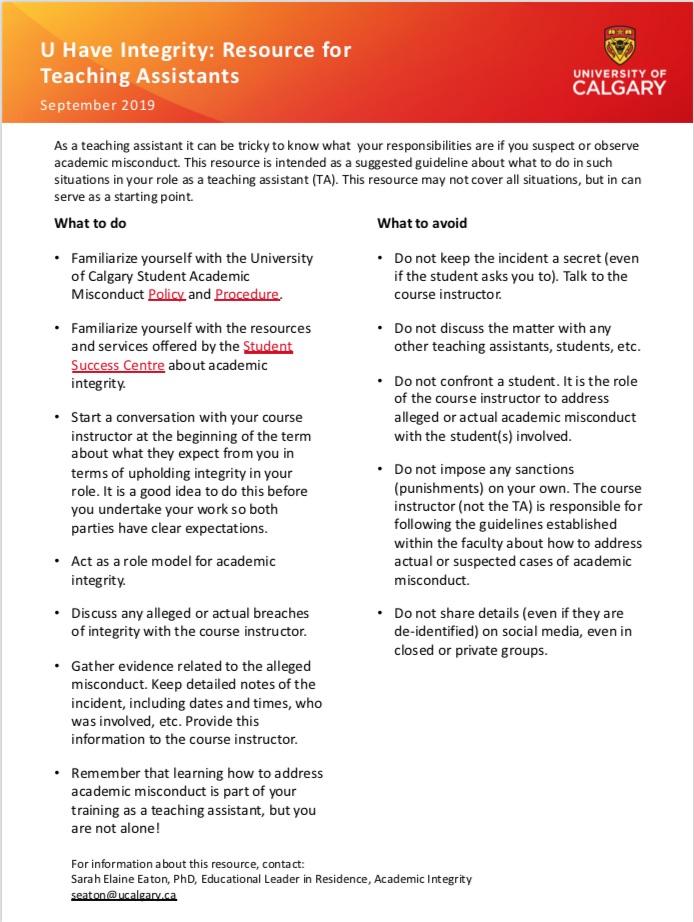
Academic Integrity resource for teaching assistants

Academic Integrity resource for teaching assistants

As a Teaching Assistant (TA) it can be tricky to know what your responsibilities are if you suspect or observe academic misconduct. This resource is intended to help both TAs and course instructors about the roles and responsibilities teaching assistants play in upholding academic integrity at the University of Calgary.

Teaching assistants are responsible for acting with integrity, maintaining the privacy of all parties involved and reporting any suspected or actual cases of academic misconduct to the course instructor. TAs are not responsible for confronting student(s) who may be allegedly responsible for academic misconduct and nor are they responsible for imposing sanctions (discipline). It is the responsibility of the course instructor to follow the guidelines established by their faculty for responding to allegations of academic misconduct.

Open communication between course instructors and teaching assistants is key. Establishing expectations early in the term, before issues might arise can be very helpful for teaching assistants.

It is important for teaching assistants to know they are not alone when it comes to upholding academic integrity.

This one-page tip sheet is intended as a suggested guideline to help teaching assistants figure out what to do if they encounter or suspect a breach of academic integrity. This handout is not exhaustive and it may not cover all situations. This resource was developed specifically for teaching assistants at the University of Calgary and may not apply to TAs at other institutions.

Here is a link to this free and downloadable .pdf resource: U Have Integrity: Resource for Teaching Assistants.

Here is the text of the .pdf for anyone wanting a quick read:

As a teaching assistant it can be tricky to know what your responsibilities are if you suspect or observe academic misconduct. This resource is intended as a suggested guideline about what to do in such situations in your role as a teaching assistant (TA). This resource may not cover all situations, but in can serve as a starting point. 

What to do 

  • Familiarize yourself with the University of Calgary Student Academic Misconduct Policy and Procedure. 
  • Familiarize yourself with the resources and services offered by the Student Success Centre about academic integrity. 
  • Start a conversation with your course instructor at the beginning of the term about what they expect from you in terms of upholding integrity in your role. It is a good idea to do this before you undertake your work so both parties have clear expectations. 
  • Act as a role model for academic integrity. 
  • Discuss any alleged or actual breaches of integrity with the course instructor. 
  • Gather evidence related to the alleged misconduct. Keep detailed notes of the incident, including dates and times, who was involved, etc. Provide this information to the course instructor. 
  • Remember that learning how to address academic misconduct is part of your training as a teaching assistant, but you are not alone! 

What to avoid 

  • Do not keep the incident a secret (even if the student asks you to). Talk to the course instructor. 
  • Do not discuss the matter with any other teaching assistants, students, etc. 
  • Do not confront a student. It is the role of the course instructor to address alleged or actual academic misconduct with the student(s) involved. 
  • Do not impose any sanctions (punishments) on your own. The course instructor (not the TA) is responsible for following the guidelines established within the faculty about how to address actual or suspected cases of academic misconduct. 
  • Do not share details (even if they are de-identified) on social media, even in closed or private groups.

Related posts:

______________________________________________________

Share or Tweet this: Academic Integrity: Resource for Teaching Assistants https://wp.me/pNAh3-2oQ

This blog has had over 2 million views thanks to readers like you. If you enjoyed this post, please “like” it or share it on social media. Thanks!

Sarah Elaine Eaton is a faculty member in the Werklund School of Education, and the Educational Leader in Residence, Academic Integrity, University of Calgary, Canada. Opinions are my own and do not represent those of the University of Calgary.


The impact of tech on how instructors teach and how students learn

April 3, 2018

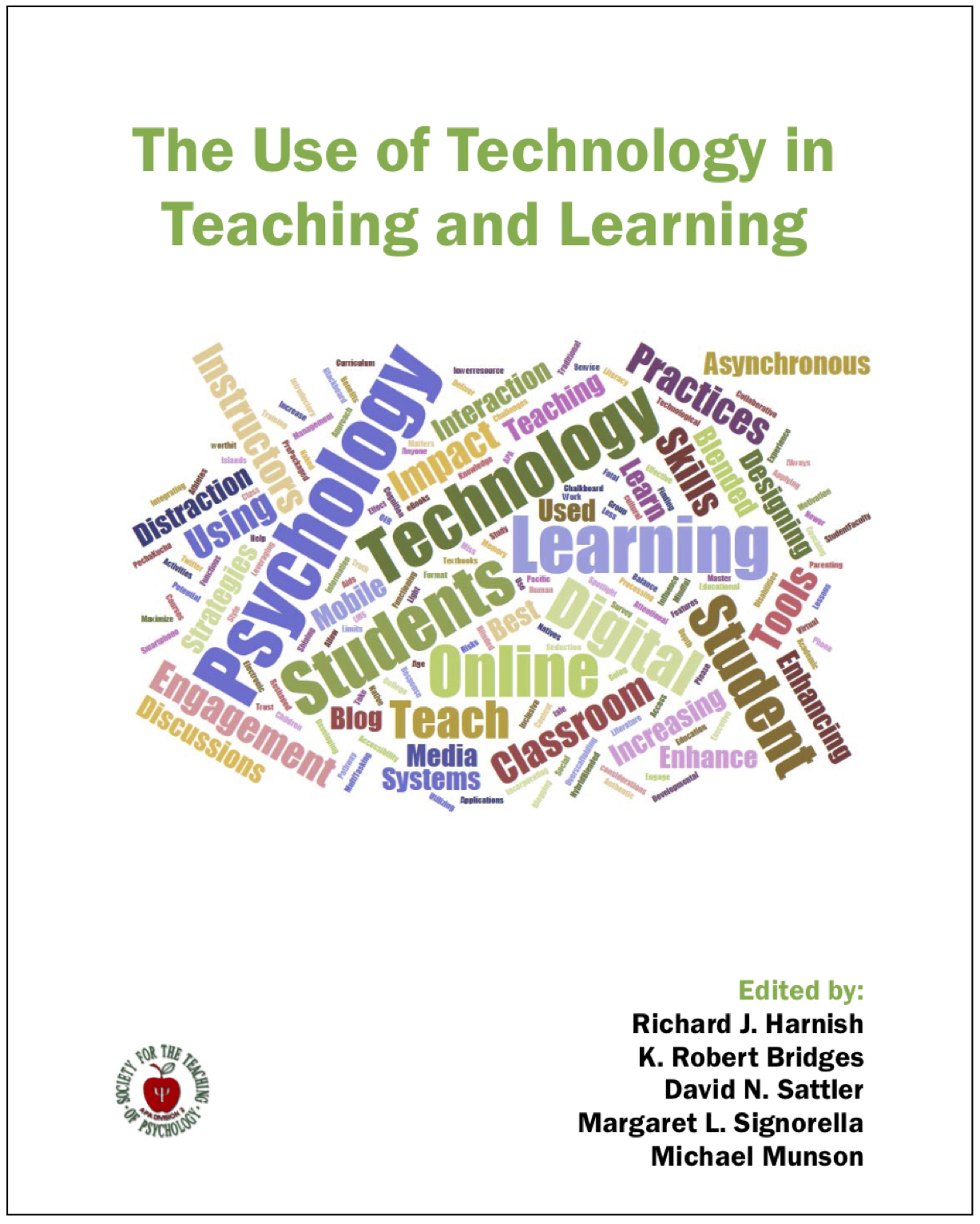
Use of tech cover.jpgI am thrilled to share a new book chapter that’s just been published. The chapter is, “The impact of technology on how instructors teach and how students learn”. It part of, The Use of Technology in Teaching and Learning, edited by Richard Harnish, K. Robert Bridges, David N. Sattler, Margaret L. Signorella and Michael Munson. It is published by the Society for the Teaching of Psychology. (I know, I know, I’m not a psychologist, but the topic fits with one of my areas of interest.)

In this chapter I talk about how technology is impacting educators in terms of their pedagogical knowledge and classroom practice, as well as how tech impacts how students learn.

One of the best things about this book is that is freely available online! You can download your own copy from: https://teachpsych.org/ebooks/useoftech

In fact, the publishers have an entire collection of free books that anyone can download on topics ranging from academic advising to research on teaching, among others. Check them out here: https://teachpsych.org/ebooks/index.php

On a personal note, I have to say that I really appreciate contributing to works that are Open Access, so readers from anywhere can download, read and enjoy. There’s much to be said for this kind of publishing model and as a writer and a scholar, being able to share my work in this way is energizing.

______________________________________________________

Share or Tweet this: The impact of tech on how instructors teach and how students learn

This blog has had over 1.8 million views thanks to readers like you. If you enjoyed this post, please “like” it or share it on social media. Thanks!

Sarah Elaine Eaton is a faculty member in the Werklund School of Education, University of Calgary, Canada.

Opinions are my own and do not represent those of the Werklund School of Education or the University of Calgary.