Just published! Ethics and Integrity in Teacher Education (Eaton & Khan, eds.)

January 5, 2023

We are pleased to share that our edited volume, Ethics and Integrity in Teacher Education, has just been published. 

Front cover of the edited volume, Ethics and Integrity in Teacher Education

Here is an overview of the book that Zeenath Reza Khan and I edited, with contributions from authors in Canada, Australia, the United Kingdom, UAE, Sweden and Mexico.

Book Description

This book addresses issues related to ethics and integrity in teacher training. Authors pay special attention to the role ethics plays in teaching practice and the importance of establishing expectations for students to learn with integrity from a young age. The book celebrates global perspectives on ethics and integrity for pre-service teachers, acknowledging that although some aspects of ethics are universal, the ways in which these are implemented can vary. Contributors present original research, case studies, and recommendations for practice and teaching.

The book draws on a range of theoretical and conceptual foundations including applied ethics, academic integrity, and moral education.

Table of Contents

Additional Details

Publisher: Springer

Book doi: https://doi.org/10.1007/978-3-031-16922-9

Hardcover ISBN: 978-3-031-16921-2 (Published 02 January, 2023)

Softcover ISBN: 978-3-031-16924-3

eBook ISBN: 978-3-031-16922-9Published: 01 January 2023

Number of Pages: XIII, 178

_________________________________

Share or Tweet this: Just published! Ethics and Integrity in Teacher Education (Eaton & Khan, eds.) – https://wp.me/pNAh3-2RW

This blog has had over 3 million views thanks to readers like you. If you enjoyed this post, please “like” it or share it on social media. Thanks! Sarah Elaine Eaton, PhD, is a faculty member in the Werklund School of Education, and the Educational Leader in Residence, Academic Integrity, University of Calgary, Canada. Opinions are my own and do not represent those of the University of Calgary.


Sarah’s Thoughts: Artificial Intelligence and Academic Integrity

December 9, 2022

The release of ChatGPT has everyone abuzz about artificial intelligence. I’ve been getting lots of questions about our research project Artificial Intelligence and Academic Integrity: The Ethics of Teaching and Learning with Algorithmic Writing Technologies. We are ready to start data collection in January so I do not yet have results to share. Our team has two preliminary papers under review, but I won’t say much about them until they are published.

In the meantime, I wanted to share some high level thoughts on the topic since many of you have been asking. Even though I am on Research and Scholarship Leave (RSL, a.k.a. sabbatical) this year, I’ve got another big project on the go that is taking up a lot of my time and focus right now, in addition to the research project above. I am serving as the Editor-in-Chief of the the Handbook of Academic Integrity (2nd ed.) The first edition of the Handbook was edited by Tracey Bretag who passed away in 2020.

The second edition is well underway and I’ve been working with an amazing team of Section Editors (giving a wave of gratitude to the team: Brenda M. Stoesz, Silvia Rossi, Joseph F. Brown, Guy Curtis, Irene Glendinning, Ceceilia Parnther, Loreta Tauginienė, Zeenath Reza Khan, and Wendy Sutherland-Smith). We have more than 100 chapters in the second edition, including some from the first edition as well as lots of new chapters. (Giving a wave of gratitude to all the contributors! Thank you for your amazing contributions!) It is a massive project and it has been a major focus of my sabbatical.

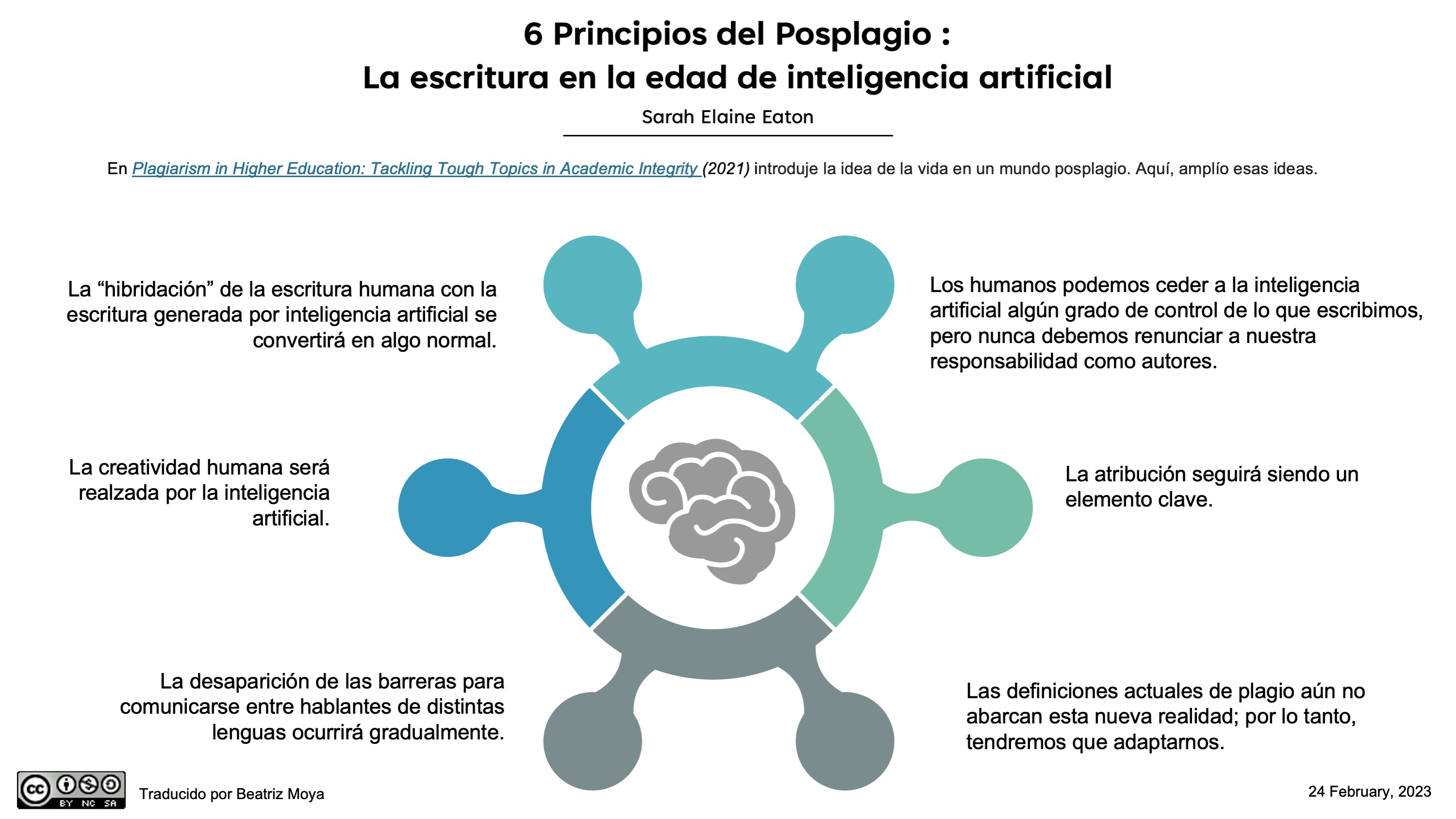
Suffice to say, I have not had a spare moment to put fingers to keyboard to write in depth about this topic on social media, but I wanted to share a few high level ideas here. I will have to unpack them in a future blog post or maybe an editorial, but for now, let me just say that I think the moral panic over the use of artificial intelligence is not the answer. But so you know where I stand on the issue, here are some thoughts:

I am happy to chat more, but let me just say that if you are afraid of an explosion of cheating in your classes because of ChatGPT or any other new technological advance, you are not alone, but honestly, technology isn’t the problem.

Stay tuned for more…

Related posts:

Artificial Intelligence and Academic Integrity: The Ethics of Teaching and Learning with Algorithmic Writing Technologies 

University of Calgary Graduate Assistant (Research) (GAR) – Job posting “Artificial Intelligence and Academic Integrity: The Ethics of Teaching and Learning with Algorithmic Writing” https://drsaraheaton.wordpress.com/2022/11/30/university-of-calgary-research-assistant-job-posting-artificial-intelligence-and-academic-integrity-the-ethics-of-teaching-and-learning-with-algorithmic-writing/

_________________________________

Share or Tweet this: Sarah’s Thoughts: Artificial Intelligence and Academic Integrity https://drsaraheaton.wordpress.com/2022/12/09/sarahs-thoughts-artificial-intelligence-and-academic-integrity/

This blog has had over 3 million views thanks to readers like you. If you enjoyed this post, please “like” it or share it on social media. Thanks! Sarah Elaine Eaton, PhD, is a faculty member in the Werklund School of Education, and the Educational Leader in Residence, Academic Integrity, University of Calgary, Canada. Opinions are my own and do not represent those of the University of Calgary.


Forthcoming book: Fake Degrees and Fraudulent Credentials in Higher Education

October 16, 2022
Front cover of the book, Fake Degrees and Fraudulent Credentials in Higher Education, edited by Sarah Elaine Eaton, Jamie Carmichael, and Helen Pethrick. Published 2023 by Springer.

We are pleased to share the news that our edited book, Fake Degrees and Fraudulent Credentials in Higher Education, has been submitted for publication (Eaton, Carmichael, and Pethrick, eds.) to Springer Nature. The book is slated for publication in early 2023.

Book description

This book addresses an important topic in higher education: credential fraud. This includes, but is not limited to, fake degrees, diploma mills, admissions fraud, and cheating on standardized admissions tests. The book directly addresses fake and fraudulent credentials in higher education. It explores transcript tampering and fraud in varsity athletics and discusses lazy practices in the higher education hiring processes that open the door for professors without proper credentials to get jobs in post-secondary institutions. 

The book also discusses how technology is being used to stop the proliferation of fake and fraudulent credentials in a variety of ways, including blockchain technology.

Table of Contents

Here is a sneak preview of the table of contents:

Chapter 1: Fake Degrees and Credential Fraud, Contract Cheating, and Paper Mills: Overview and Historical Perspectives – Sarah Elaine Eaton & Jamie Carmichael

Chapter 2: Admissions Fraud in Canadian Higher Education – Jamie Carmichael & Sarah Elaine Eaton

Chapter 3: Yesterday, Today, and Tomorrow: A Tour of Axact, the “World’s Largest Diploma Mill” – Allen Ezell

Chapter 4: Bridging Today to Tomorrow: A Historical and Technological Review of Credential Exchange in Higher Education within Canada – Joanne Duklas

Chapter 5: Fair play, Fraud, or Fixed? Athletic Credentials in US Higher Education – Kirsten Hextrum

Chapter 6: Corruption in Admissions, Recruitment, Qualifications and Credentials: from Research into Quality Assurance – Stella-Maris Orim & Irene Glendinning

Chapter 7: Avoiding Favouritism in the Recruitment Practice of Turkish Higher Education Institutions Özgür Çelik & Salim Razı

Chapter 8: None of the Above: Integrity Concerns of Standardized English Proficiency Tests – Soroush Sabbaghan & Ismaeil Fazel

Chapter 9: Examining the Problem of Fraudulent English Test Scores: What Can Canadian Higher Education Institutions Learn? – Angela Clark

Chapter 10: There is no culture? A Framework for Addressing Admissions Fraud – Brendan DeCoster

Chapter 11: Security Risks, Fake Degrees, and Other Fraud: A Topic Modelling Approach – Jamie Carmichael & Sarah Elaine Eaton 

Chapter 12: Are You for Real? Lessons for the Academy About Professors with Fake or Fraudulent Degrees – Sarah Elaine Eaton & Jamie Carmichael

Chapter 13: Fake Degrees and Fake Degrees and Fraudulent Credentials in Higher Education: Conclusions and Future Directions – Jamie Carmichael & Sarah Elaine Eaton

About the editors

Sarah Elaine Eaton

Werklund School of Education, University of Calgary, Calgary, Alberta, Canada.

Sarah Elaine Eaton, PhD, is an Associate Professor of Education at the University of Calgary, Canada, where she also serves as the inaugural Educational Leader in Residence, Academic Integrity. Eaton’s research focuses on academic ethics in higher education. Her work can be found in the British Educational Research Journal, the Journal of Academic Ethics, the Journal of Educational Thought and Interchange, among other places. She is the Editor-in-Chief of the International Journal for Educational Integrity (Springer Nature) and co-founder and co-editor of Canadian Perspectives on Academic Integrity. In 2020 she received the national Research and Scholarship award from the Canadian Society for the Study of Higher Education (CSSHE) for her contributions to research on academic integrity in Canadian higher education.

Jamie J. Carmichael

Carleton University, Ottawa, Ontario, Canada.

Jamie Carmichael is the Associate Registrar of Scheduling and Systems at Carleton University. She is responsible for the construction of the university timetable, scheduling and administration of examinations, the operation of two examination centres for students with disabilities, a university-wide space management system, and other core student administrative systems. Since 2009, she has received ten service excellence nominations for her work that ranges from information technology projects, team acknowledgment to innovation.

Carmichael’s research lies at the intersection of academic integrity and machine learning, with graduate education in Applied Science in Technology Information Management (Engineering). She has presented or co-presented at national and international conferences and is often called up on by specialized groups in higher education to present on her work.

Helen Pethrick

University of Calgary, Calgary, Alberta, Canada.

Helen Pethrick, MA, is a researcher and educator in Calgary, Alberta, Canada. Research areas include academic integrity in higher education, post-secondary student mental health and well-being, and peer mentorship in educational settings.

Related posts:

Fake Degrees and Fraudulent Credentials: Research Project Update

Scholarships Without Scruples: 3 Signs of Bogus Scholarships and Scams

Why Universities and Colleges Need Clear Policies to Deal with Fake COVID-19 Vaccination Records and Test Results

Degrees of Deceit: A Webinar

_________________________________

Share or Tweet this: Forthcoming book: Fake Degrees and Fraudulent Credentials in Higher Educationhttps://drsaraheaton.wordpress.com/2022/10/16/forthcoming-book-fake-degrees-and-fraudulent-credentials-in-higher-education/

This blog has had over 3 million views thanks to readers like you. If you enjoyed this post, please “like” it or share it on social media. Thanks!

Sarah Elaine Eaton, PhD, is a faculty member in the Werklund School of Education, and the Educational Leader in Residence, Academic Integrity, University of Calgary, Canada. Opinions are my own and do not represent those of the University of Calgary.


Contract Cheating and Freedom of Expression: How the Chicago Principles Can Help You Promote Academic Integrity on Your Campus

October 4, 2022
woman wearing brown shirt carrying black leather bag on front of library books
Photo by Abby Chung on Pexels.com

It’s that time of the year again, when contract cheating and unethical tutoring companies hand out flyers to students as they enter classrooms and leave them all over campus – littered in classrooms, strewn on benches, tacked to bulletin boards, and so on. Historically, it has been difficult for some schools to have these advertisements removed because the companies behind them have claimed censorship and threatened legal action against the institution. However, there is reason for hope, especially if your school as a Statement on Free Expression. Let me explain.

Although the original Chicago statement – and others that were modelled on it – were created to support freedom of expression, there is a small but important detail about the limitations of free speech on campus that is relevant to academic integrity. In the original version of the Chicago Principles of Freedom of Expression, it states:

“The freedom to debate and discuss the merits of competing ideas does not, of course, mean that individuals may say whatever they wish, wherever they wish. The University may restrict expression that violates the law, that falsely defames a specific individual, that constitutes a genuine threat or harassment, that unjustifiably invades substantial privacy or confidentiality interests, or that is otherwise directly incompatible with the functioning of the University.” (Chicago Principles of Freedom of Expression, p. 2, emphasis added.)

I am not a lawyer, but I am a policy scholar. (You can find out more about my academic work on higher education policy here, here, and here, for example.) When examining policy, the devil is in the details, as they say. In this case, there is an argument to be made that when contract cheating companies and unethical tutoring businesses advertise on our campuses, they are acting in a manner that is directly incompatible with the functioning of the university. As such, the institution has a right to remove advertisements from campus that promote academic misconduct.

Every school that has developed its own statement of free expression based on the Chicago principles may have this important detail included that gives it leverage to curtail the blatant advertising of contract cheating services the school, including those in Canada. For example, in 2019, the Alberta government mandated that all post-secondary institutions in the province develop a statement to affirm freedom of expression that aligned with the Chicago Principles on Free Speech. Like all higher education institutions in the province of Alberta, the University of Calgary followed the government mandate, making a formal public announcement on December 16, 2019 that it had published its Statement on Free Expression. Our institutional Statement on Free Expression is publicly available. For quick reference, here is the .pdf statement: https://www.ucalgary.ca/provost/sites/default/files/StatementonFreeExpression.pdf 

The University of Calgary statement includes this sentence: “Free expression is subject to limitations imposed by law and, on our campuses, by University policies and procedures related to the functioning of the University.”

I brought this detail to the attention of our Provost at the time, Dr. Dru Marshall, pointing out that this could give the university leverage to reasonably remove advertisements for contract cheating services.  The Provost agreed and informed me that she would instruct Caretaking to have the advertisements on campus removed on this basis. We currently have an Interim Provost, Dr. Penny Werthner and I recently brought this information to her attention and she responded that she too, would take action.

Any post-secondary institution that has a Statement on Free Expression based on the Chicago principles, may be in a position to mandate the removal of advertisements that promote academic misconduct. Of course, this would need the agreement of the Provost or equivalent. I am sure that some lawyers could debate the nuances of some of this language and its implications. As I said, I am not a lawyer, but it would seem to me that in the case of Alberta at least, given that the provincial government mandated that every post-secondary institution in the province develop its own Statement on Free Expression based on the Chicago principles, and that universities and colleges across North America have widely adopted such statements that would have no doubt been scrutinized by lawyers ad nauseam, this is a policy loophole that could actually work in favour of the institution. There is a strong argument to be made that removal of advertisements that promote academic misconduct is not censorship, because communications that interfere with the functioning of the university (and that includes communications that promote academic misconduct) can reasonably be removed. This is not censorship; it is protecting the integrity of the institution.

If you live in jurisdiction that does not have legislation prohibiting the supply or advertisement of contract cheating services, but your school has a statement on free expression based on the Chicago principles, here are 5 things you can do:

  • Share this blog post with your Provost / Vice-President Academic (or equivalent). Let them consider how the school’s statement can help to promote academic integrity.
  • Ask the Provost (or equivalent) to instruct the head of caretaking that custodial should be instructed to remove the flyers and other advertisements that litter the classrooms and other areas of campus.
  • Ask the Provost to inform the others on the executive leadership team (e.g., vice provost of student affairs, vice provost of teaching and learning, and so on) and deans to share this information with others in their respective units.
  • Request that this information be shared at the next meeting of the University Senate (or in Alberta, the General Faculties Council) to ensure it is widely communicated.
  • Ask how you can help. If your school has an academic committee or task force, offer to join and actively contribute to the ongoing work of upholding academic integrity at your own institution.

Institutions can take action against contract cheating. The annual International Day of Action Against Contract Cheating is fast approaching. It’s on October 19 this year. If your school hasn’t already signed up, you can still do so. Widespread removal of contract cheating advertisements could be a campus-wide event that students, staff, and administrators all participate in on that day, and every day.

_______________________________

Share or Tweet this: Contract Cheating and Freedom of Expression: How the Chicago Principles Can Help You Promote Academic Integrity on Your Campus – https://drsaraheaton.wordpress.com/2022/10/04/contract-cheating-and-freedom-of-expression-how-the-chicago-principles-can-help-you-promote-academic-integrity-on-your-campus/

This blog has had over 3 million views thanks to readers like you. If you enjoyed this post, please “like” it or share it on social media. Thanks!

Sarah Elaine Eaton, PhD, is a faculty member in the Werklund School of Education, and the Educational Leader in Residence, Academic Integrity, University of Calgary, Canada. Opinions are my own and do not represent those of the University of Calgary.


Now Published: Contract Cheating in Higher Education

August 11, 2022
Eaton, Curtis, Clare, Stoesz, Seeland & Rundle cover

Now published: Contract Cheating in Higher Education: Global Perspectives on Theory, Practice, and Policy (Eaton, Curtis, Stoesz, Clare, Rundle, & Seeland, 2022). This volume, published by Palgrave MacMillan, includes twenty chapters from contributors across Australia, North America, and Europe:

  1. Introduction: Contract cheating and introduction to the problem. – Curtis, G. J., Clare, J., Rundle, K., Eaton, S. E., Stoesz, B. M., & Seeland, J.
  2. What can we learn from measuring crime when looking to quantify the prevalence and incidence of contract cheating? – Clare, J., & Rundle, K.
  3. Limitations of contract cheating research. –  Krásničan, V., Foltýnek, T., & Dlabolová, D. H.
  4. Essay mills and contract cheating from a legal point of view. – Draper, M.
  5. Leveraging college copyright ownership against file-sharing and contract cheating websites. – Seeland, J., Eaton, S. E., & Stoesz, B. M.
  6. The encouragement of file sharing behaviours through technology and social media: Impacts on student cheating behaviours and academic piracy. – Rogerson, A. M.
  7. Higher education assessment design. – Sutherland-Smith, W., & Dawson, P.
  8. Critical thinking as an antidote to contract cheating. – Stoesz, B. M., Eaton, S. E., & Seeland, J.
  9. Contract cheating and the Dark Triad traits. – Baran, L., & Jonason, P. K.
  10. Contract cheating: The influence of attitudes and emotions. – Curtis, G. J., & Tindall, I. K.
  11. Applying situational crime prevention techniques to contract cheating. – Clare, J.
  12. Presentation, Properties and Provenance: the three Ps of identifying evidence of contract-cheating in student assignments. – Crockett, R.
  13. “(Im)possible to prove”: Formalising academic judgement evidence in contract cheating cases using bibliographic forensics. – Ellis, C., Rogerson, A. M., House, D., & Murdoch, K.
  14. Aligning academic quality and standards with academic integrity – Glendinning, I.
  15. Addressing contract cheating through staff-student partnerships. – Lancaster, T.
  16. The extortionate cost of contract cheating. – Veeran-Colton, T., Sefcik, L., & Yorke, J.
  17. The rise of contract cheating in graduate education. –  Parnther, C.
  18. Listening to ghosts: A qualitative study of narratives from contract cheating writers from the 1930s onwards. – Eaton, S. E., Stoesz, B. M., & Seeland, J.
  19. Assessment brokering and collaboration: Ghostwriter and student academic literacies. – Thacker, E. J.
  20. Conclusion – Eaton, S. E., Stoesz, B. M., Seeland, J. Curtis, G. J., Clare, J., & Rundle, K. 

Updates:

October 4, 2022 – The final proofs have been submitted to the publisher. The book now moves into production and should be available very soon!

October 28, 2022 – The book has now been published!

_______________________________

Share or Tweet this: New Book Coming Soon: Contract Cheating in Higher Education – https://drsaraheaton.wordpress.com/2022/08/11/new-book-coming-soon-contract-cheating-in-higher-education/

This blog has had over 3 million views thanks to readers like you. If you enjoyed this post, please “like” it or share it on social media. Thanks!

Sarah Elaine Eaton, PhD, is a faculty member in the Werklund School of Education, and the Educational Leader in Residence, Academic Integrity, University of Calgary, Canada. Opinions are my own and do not represent those of the University of Calgary.