Stop wasting my time! AI Agents Infiltrate Scholarly Publishing

February 6, 2026

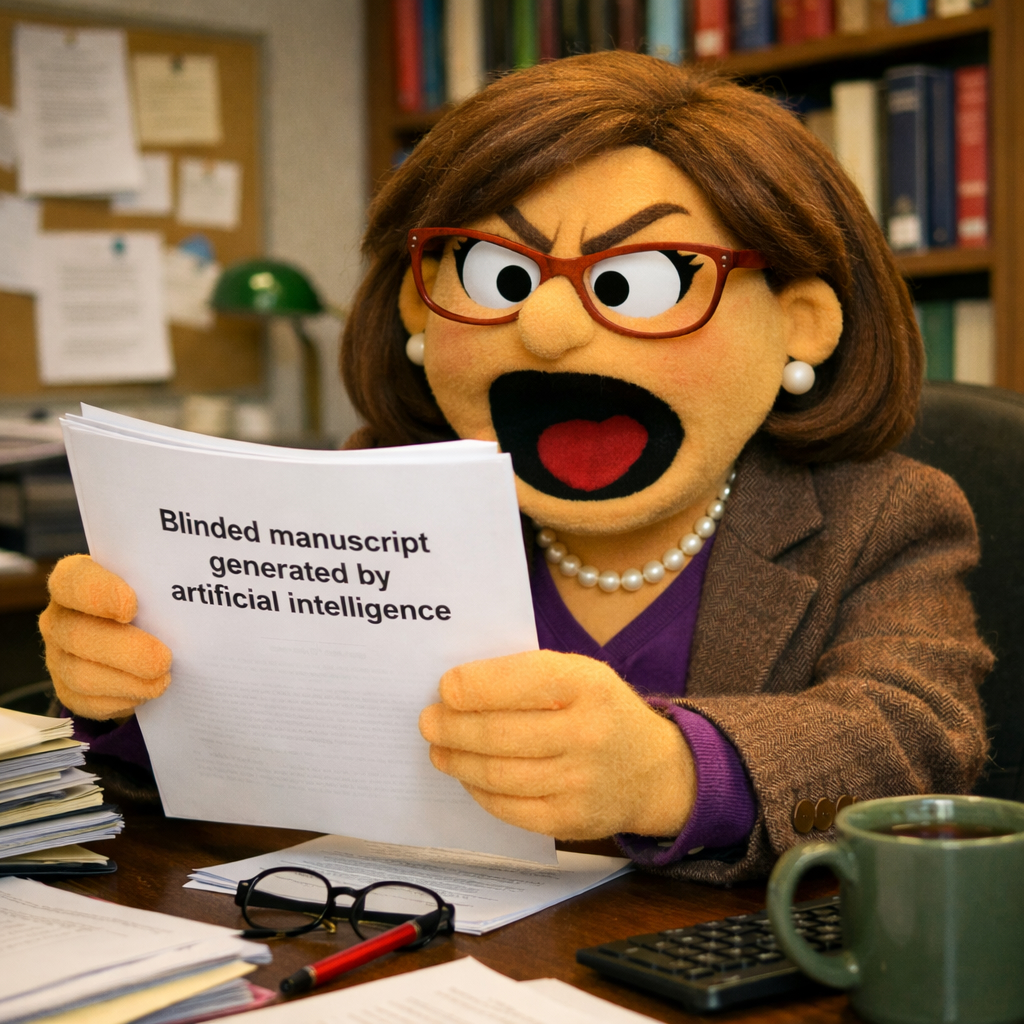
As the Editor-in-Chief of the International Journal for Educational Integrity, I have witnessed (and become super frustrated with) threats to academic publishing and research integrity from Gen AI. Don’t get me wrong, I am not opposed to AI, but I have been clear in my research and writing that technology can be used in good and helpful ways or ways that are unethical and inappropriate. Recently, our editorial office received a manuscript with the file name ‘Blinded manuscript generated by artificial intelligence.’

My reaction was, “Are you kidding me?! Well, that’s bold!” Although the honesty of the title may be rarity, the submission itself is symptomatic of a burgeoning crisis in academic publishing: the rise of ‘AI slop.’ Since the proliferation of large language models (LLMs), we have seen a dramatic increase in submissions. Now, I’m pretty sure that a portion of the manuscripts we are receiving are written entirely by AI agents or bots, sending submissions on behalf of authors.

ChatGPT generated image. A puppet seated at a desk in an office, holding a printed document titled “Blinded manuscript generated by artificial intelligence.” The desk is covered with papers, a pair of glasses, a pen, and a coffee mug, with bookshelves and a bulletin board visible in the background.

As a journal editor, let me be clear: The volume of manuscripts you send out does not equate to the value to the readership. It is not that I oppose the use of AI carte blanche, but I do object to manuscripts prepared and sent by bots, with no human interaction in the process. If a manuscript does not bring value to our readers, it gets an immediate desk rejections, and for good reason.

The Problem with AI Slop in Research

Academic journals exist to advance the frontiers of human knowledge. A manuscript is expected to contribute new and original findings to scholarship and science. AI-generated papers, by their very nature, struggle to meet this requirement.

  • Lack of Empirical Depth: AI excels at synthesizing existing information but cannot conduct original fieldwork, clinical trials, or archival research. It mimics the structure of a study without performing the substance of it.
  • Axiological Misalignment: There is a gap between the automated generation of text and the values-driven process of human inquiry. Research requires a commitment to truth, ethics, and accountability, qualities a machine cannot possess.
  • The Echo Chamber Effect: These submissions often present fabricated or corrupted  citations or circular logic that offers little to no utility to the reader. They clutter the ecosystem without moving the needle on critical conversations.

Upholding the Integrity of the Record

Our editorial board remains committed to a rigorous peer-review process, but let’s be clear: the ‘publish or perish’ culture, now supercharged by Gen AI, is threatening to overwhelm the very systems meant to ensure quality.

If an academic paper submitted for publication does not offer an original contribution or if it lacks the human oversight necessary to guarantee its validity, it has no place in a scholarly journal. We in a postplagiarism era where the focus must shift from merely detecting copied text to evaluating the originality of thought and the integrity of the research process. Postplagiarism does not mean that we throw out academic and research integrity or that ‘anything goes’. We recognize that co-creation with GenAI may be normal for some writers today. But having an AI agent write and submit manuscripts on your behalf wastes everyone’s time.

To our contributors: scholarship is a human endeavor. We value your insights, your unique perspectives, and your rigorous labour. In the meantime, we will continue with our commitment to quality, and I expect that the journal’s rejection rate will continue to be high as we focus on papers that bring value to our readership.

______________

Share this post: Stop wasting my time! AI Agents Infiltrate Scholarly Publishing – https://drsaraheaton.com/2026/02/06/stop-wasting-my-time-ai-agents-infiltrate-scholarly-publishing/

Sarah Elaine Eaton, PhD, is a Professor and Research Chair in the Werklund School of Education at the University of Calgary, Canada. Opinions are my own and do not represent those of my employer.


ChatGPT is in classrooms. What now?

February 2, 2026

“What should we be assessing exactly?” This was a question one of our research participants asked when we interviewed them as part of our project on artificial intelligence and academic integrity, sponsored by a University of Calgary Teaching Grant.

In an article published in The Conversation, we provide highlights of the results from our interviews with 28 educators across Canada, as well as our analysis of 15 years of research that looked at how AI affects education. (Spoiler alert: AI is a double-edged sword for educators and there are no easy answers.)

Alt text: Screenshot of The Conversation website showing a blurred smartphone screen with the ChatGPT app icon. Overlaid headline reads, “ChatGPT is in classrooms. How should educators now assess student learning?”
Screenshot from The Conversation.

We emphasize that, “in a post-plagiarism context, we consider that humans and AI co-writing and co-creating does not automatically equate to plagiarism.” Check out the full article in The Conversation.

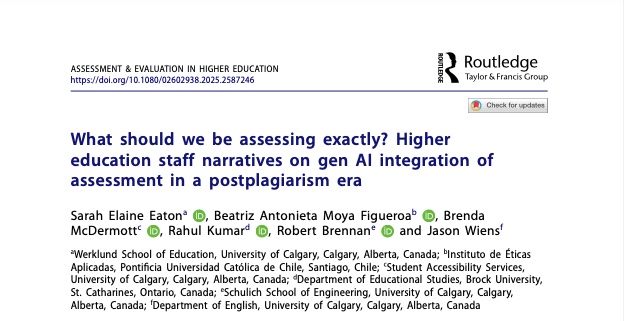
You can check out the scholarly paper that we published in Assessment and Evaluation in Higher Education that goes into more detail about the methods and findings of our interviews.

I’d like to give a shoutout to all the project team members who worked with us on various aspects of this research: Robert (Bob) Brennan (Schulich School of Engineering, University of Calgary), Jason Weins (Faculty of Arts, University of Calgary), Brenda McDermott (Student Accessibility Services, University of Calgary), Rahul Kumar (Faculty of Education, Brock University), Beatriz Moya (Instituto de Éticas Aplicadas, Pontificia Universidad Católica de Chile) and the student research assistants who helped along the way (who have now all successfully graduated and moved on to the next phase of their careers): Jonathan Lesage, Helen Pethrick, and Mawuli Tay.

Related posts:

What Should We Be Assessing in a World with AI? Insights from Higher Education Educators – https://drsaraheaton.com/2025/11/25/what-should-we-be-assessing-in-a-world-with-ai-insights-from-higher-education-educators/

______________

Share this post: ChatGPT is in classrooms. What now? https://drsaraheaton.com/2026/02/02/chatgpt-is-in-classrooms-what-now/

Sarah Elaine Eaton, PhD, is a Professor and Research Chair in the Werklund School of Education at the University of Calgary, Canada. Opinions are my own and do not represent those of my employer.


What Should We Be Assessing in a World with AI? Insights from Higher Education Educators

November 25, 2025

The arrival of generative AI tools such as ChatGPT has disrupted how we think about assessment in higher education. As educators, we’re facing a critical question: What should we actually be assessing when students have access to these powerful tools?

Our recent study explored how 28 Canadian higher education educators are navigating this challenge. Through in-depth interviews, we discovered that educators are positioning themselves as “stewards of learning with integrity” – carefully drawing boundaries between acceptable and unacceptable uses of chatbots in student assessments.

Screenshot of an academic journal article header from Assessment & Evaluation in Higher Education, published by Routledge. The article title reads: “What should we be assessing exactly? Higher education staff narratives on gen AI integration of assessment in a postplagiarism era.” Authors listed are Sarah Elaine Eaton, Beatriz Antonieta Moya Figueroa, Brenda McDermott, Rahul Kumar, Robert Brennan, and Jason Wiens, with institutional affiliations including University of Calgary, Pontificia Universidad Católica de Chile, Brock University, and others. The DOI link is visible at the top: https://doi.org/10.1080/02602938.2025.2587246.

Where Educators Found Common Ground

Across disciplines, participants agreed that prompting skills and critical thinking are appropriate to assess with chatbot integration. Prompting requires students to demonstrate foundational knowledge, clear communication skills, and ethical principles like transparency and respect. Critical thinking assessments can leverage chatbots’ current limitations – their unreliable arguments, weak fact-checking, and inability to explain reasoning – positioning students as evaluators of AI-generated content.

The Nuanced Territory of Writing Assessment

Writing skills proved far more controversial. Educators accepted chatbot use for brainstorming (generating initial ideas) and editing (grammar checking after independent writing), but only under specific conditions: students must voice their own ideas, complete the core writing independently, and critically evaluate any AI suggestions.

Notably absent from discussions was the composition phase – the actual process of developing and organizing original arguments. This silence suggests educators view composition as distinctly human cognitive work that should remain student-generated, even as peripheral tasks might accommodate technological assistance.

Broader Concerns

Participants raised important challenges beyond specific skill assessments: language standardization that erases student voice, potential for overreliance on AI, blurred authorship boundaries, and untraceable forms of academic misconduct. Many emphasized that students training to become professional communicators shouldn’t rely on AI for core writing tasks.

Moving Forward

Our findings suggest that ethical AI integration in assessment requires more than policies, it demands ongoing conversations about what makes learning authentic in technology-mediated environments. Educators need support in identifying which ‘cognitive offloads’ are appropriate, understanding how AI works, and building students’ evaluative judgment skills.

The key insight? Assessment in the AI era isn’t about banning technology, but about distinguishing between tasks where AI can enhance learning and those where independent human cognition remains essential. As one participant reflected: we must continue asking ourselves, “What should we be assessing exactly?”

The postplagiarism era requires us to protect academic standards while preparing students for technology-rich professional environments – a delicate balance that demands ongoing dialogue, flexibility, and our commitment to learning and student success.

Read the full article: https://doi.org/10.1080/02602938.2025.2587246

______________

Share this post: What Should We Be Assessing in a World with AI? Insights from Higher Education Educators – https://drsaraheaton.com/2025/11/25/what-should-we-be-assessing-in-a-world-with-ai-insights-from-higher-education-educators/

Sarah Elaine Eaton, PhD, is a Professor and Research Chair in the Werklund School of Education at the University of Calgary, Canada. Opinions are my own and do not represent those of my employer.


AI Use and Ethics Among Jordanian University Students

November 19, 2025

885 university students in Jordan “generally viewed AI use for tasks such as translation, literature reviews, and exam preparation as ethically acceptable, whereas using AI to cheat or fully complete assignments was widely regarded as unacceptable.”

Check out the latest article in the International Journal for Educational Integrity by Marwa M. Alnsour, Hamzeh Almomani, Latifa Qouzah, Mohammad Q.M. Momani, Rasha A. Alamoush & Mahmoud K. AL-Omiri, “Artificial intelligence usage and ethical concerns among Jordanian University students: a cross-sectional study“.

Screenshot of the title page of a research article published in the International Journal for Educational Integrity. The article is titled “Artificial intelligence usage and ethical concerns among Jordanian University students: a cross-sectional study.” It is marked as “Research” and “Open Access” with a purple header. Authors listed are Marwa M. Alnsour, Hamzeh Almomani, Latifa Qouzah, Mohammad Q.M. Momani, Rasha A. Alamoush, and Mahmoud K. Al-Omiri. The DOI link and journal details appear at the top.

Synopsis

This cross-sectional study examined artificial intelligence usage patterns and ethical awareness among 885 higher education students across various disciplines. Findings showed how Jordanian university students engage with AI tools like ChatGPT in their academic work.

Key Findings

High AI Adoption: A substantial 78.1% of students reported using AI during their studies, with approximately half using it weekly or daily. ChatGPT emerged as the most popular tool (85.2%), primarily used for answering academic questions (53.9%) and completing assignments (46.4%).

Knowledge Gaps: Although 57.5% considered themselves moderately to very knowledgeable about AI, only 44% were familiar with ethical guidelines. Notably, 41.8% were completely unaware of principles guiding AI use, revealing a significant gap between usage and ethical understanding.

Disciplinary Differences: Science and engineering students demonstrated the highest usage rates and knowledge levels, while humanities students showed lower engagement but expressed the strongest interest in training. Health sciences students displayed greater ethical concerns, possibly reflecting the high-stakes nature of their field.

Ethical Perceptions: Students generally viewed AI use for translation, proofreading, literature reviews, and exam preparation as acceptable. However, 39.8% had witnessed unethical AI use, primarily involving cheating or total dependence on AI. Only 35% expressed concern about ethical implications, suggesting many may not fully recognize potential risks.

Demographic Patterns: Female students demonstrated higher ethical awareness than males. Older students and those in advanced programs (particularly PhD students) showed greater AI knowledge and ethical consciousness, with each additional year of age correlating with increased awareness scores.

Training Needs: More than three quarters (76.7%) of students expressed interest in professional training on ethical AI use, with 83.7% agreeing that guidance is necessary. However, 46.6% indicated their institutions had not provided adequate support (which should surprise exactly no one, since similar findings have been found in other studies.)

Implications

The author call for Jordanian universities to develop clear, discipline-specific ethical guidelines and structured training programs. The researchers recommend implementing mandatory online modules, discipline-tailored workshops, and establishing dedicated AI ethics bodies to promote responsible use. These findings underscore the broader challenge facing higher education globally: ensuring students can leverage AI’s benefits while maintaining academic integrity and developing critical thinking skills.

______________

Share this post: AI Use and Ethics Among Jordanian University Students https://drsaraheaton.com/2025/11/19/ai-use-and-ethics-among-jordanian-university-students/

Sarah Elaine Eaton, PhD, is a Professor and Research Chair in the Werklund School of Education at the University of Calgary, Canada. Opinions are my own and do not represent those of my employer.


A Brief History of Postplagiarism: Or, Why Fabrication is Not the New Flattery

October 13, 2025
Infographic titled "Postplagiarism: A Brief History" by Sarah Elaine Eaton, PhD, showing a timeline from 2021 to 2025 that highlights key milestones in the development of the concept of postplagiarism.
2021: Eaton introduces postplagiarism in her book Plagiarism in Higher Education, building on Rebecca Moore Howard’s work.
2023: Eaton explicitly defines postplagiarism in an article published in the International Journal for Educational Integrity.
2024: Eaton and Kumar launch www.postplagiarism.com, offering multilingual translations and open-access content.
2025: Rahul Kumar publishes the first empirical study on postplagiarism in the same journal, analyzing student reactions.

I am always excited to hear about new work that showcases postplagiarism. Imagine my dismay when I read a new article, published in an (allegedly) peer-reviewed journal, that foregrounded the tenets of postplagiarism, but was rife with fabricated sources, including references to work attributed to me, but that I never wrote.

I have opted not to ‘name and shame’ the authors. Anyone who is curious enough need only do an Internet search to find the offending article and those who wrote it.

Instead, I prefer to take a more productive approach. Here I provide a brief timeline of the development of postplagiarism as both a framework and a theory:

2021: Plagiarism in Higher Education: Tackling Tough Topics in Academic Integrity

The book begins with a history of plagiarism. Then, I discuss plagiarism in modern times. In the concluding chapter I contemplate the future of plagiarism. Building on the scholarship of Rebecca Moore Howard, I proposed that  the age of generative artificial intelligence (Gen AI) could launch us into a post-plagiarism era in which human-AI hybrid writing becomes the norm.

2023: Expanding on the ideas first presented in the final chapter of my book, I wrote my first article dedicated to the topic: “Postplagiarism: Transdisciplinary ethics and integrity in the age of artificial intelligence and neurotechnology”, published in the International Journal for Educational Integrity.

2024: Dr. Rahul Kumar (Brock University, Canada) and I launch our website, http://www.postplagiarism.com. We provide open access resources free of charge. Thanks to the generosity of colleagues and friends who speak multipole language, we offer translations of the postplagiarism infographic in multiple languages.

Also, in this year, Rahul Kumar begins a study to test the tenets of postplagiarism.

2025: Rahul Kumar publishes the results of the first empirical article on the tenets of postplagiarism. His article, “Understanding PSE students’ reactions to the postplagiarism concept: a quantitative analysis” is published in the International Journal for Educational Integrity.

If you see references to our work on postplagiairsm as we have conceptualized it that pre-date our work, dig deeper to see if the work is real. There are now fabricated sources published on the Internet that do not — and never did — exist.

Imitation is flattery, as the saying goes. This quip has been used as a way to dismiss plagiarism concerns, as students learn to imitate great writers by quoting them without attribution. The saying digs deep into cultural and historical understandings that are beyond the scope of a blog post. What I can say is that in the postplagiarism era, fabrication is not the new flattery.

One of the tenets of postplagiarism is that humans can relinquish control over what they write to an AI, but we do not relinquish responsibility. The irony of seeing fabricated references about postplagiarism in fabricated is as absurd as it is puzzling. There is no need to fabricate references to post plagiarism, especially since we provide numerous free and open access to resources and research on the topic.

______________

Share this post: A Brief History of Postplagiarism: Or, Why Fabrication is Not the New Flattery – https://drsaraheaton.com/2025/10/13/a-brief-history-of-postplagiarism-or-why-fabrication-is-not-the-new-flattery/

Sarah Elaine Eaton, PhD, is a Professor and Research Chair in the Werklund School of Education at the University of Calgary, Canada. Opinions are my own and do not represent those of my employer.