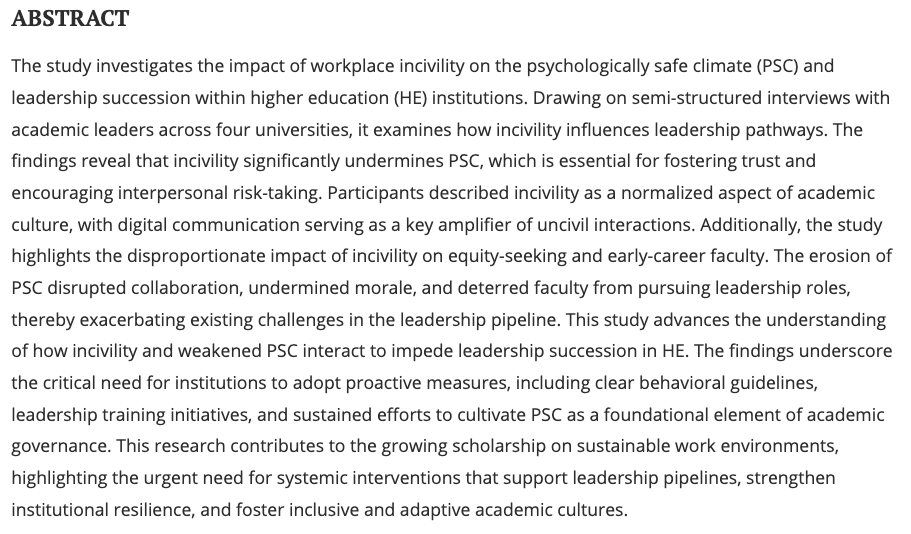
When Leda invited me to join her later for a project on psychological safety and leadership succession in higher education, I accepted right away. This topic is important one and it rarely gets discussed in the literature on academic integrity, but as we know, professional and collegial ethics are part of a comprehensive approach to academic integrity.
As we point out in the abstract and in the main body of the article, there is a disproportionate impact of incivility on equity-seeking and early-career faculty. In other words, those who are already marginalized and experience barriers and discrimination are more likely to be on the receiving end of workplace incivility and hostility.
I’ve said it before and I’ll say it again: There can be no integrity without equity. We need to think more about the way that higher education as a system allows for the perpetuation of discrimination and harm, not only for students, but also for faculty and staff. If the workplace is not a psychologically safe environment, then employees cannot thrive.
I invite you to check out the article, which is open access and free to read and download.
Sarah Elaine Eaton, PhD, is a Professor and Research Chair in the Werklund School of Education at the University of Calgary, Canada. Opinions are my own and do not represent those of my employer.
Academic misconduct cases can leave professors feeling frustrated, especially when outcomes don’t align with their expectations. These emotions are understandable and how faculty respond to disappointing rulings can impact their professional standing; relationships with colleagues and students; and future effectiveness in addressing misconduct.
Here are five common mistakes professors make when they disagree with academic misconduct decisions—and better approaches to consider.
1. Venting to Students About the Decision
The Mistake: Discussing the case details or expressing frustration about the ruling with other students, either in class or informal settings.
Why It Backfires: This behavior undermines institutional authority, creates an uncomfortable environment for students, and may violate confidentiality requirements. Students lose confidence in the system and may question whether they’ll receive fair treatment.
Better Approach: Process your concerns through appropriate channels. If you need to discuss the case, speak with department chairs, ombudspersons, or trusted colleagues who understand confidentiality requirements.
2. Making Public Complaints on Social Media or Forums
The Mistake: Posting about the case on social media, academic forums, or other public platforms, even when avoiding specific names.
Why It Backfires: Public complaints damage professional relationships and institutional reputation. Even anonymous posts can often be traced back to their authors. This approach also models poor conflict resolution for students and colleagues.
Better Approach: Use internal grievance procedures or professional development opportunities to address systemic concerns. Focus energy on improving processes rather than criticizing past decisions.
3. Refusing to Participate in Future Misconduct Proceedings
The Mistake: Declining to serve on academic integrity committees or refusing to report suspected misconduct because of disagreement with previous outcomes.
Why It Backfires: Withdrawal from the process eliminates your voice from future decisions and reduces the system’s effectiveness. This stance also shifts additional burden to colleagues who continue participating.
Better Approach: Stay engaged while working to improve the system. Use your experience to advocate for clearer guidelines, better training, or procedural improvements that address your concerns.
4. Treating the Student Differently in Future Interactions
The Mistake: Allowing disappointment about the ruling to affect how you interact with the student in subsequent courses, recommendations, or professional settings.
Why It Backfires: This behavior constitutes unprofessional conduct and potential retaliation. It undermines the educational mission and creates legal risks for both you and the institution.
Better Approach: Maintain professional boundaries and treat all students equitably. If you find it difficult to interact objectively with the student, consider recusing yourself from situations where bias might affect your judgment.
5. Bypassing Established Processes
The Mistake: Going directly to senior administrators, board members, or external parties without following institutional procedures for investigations, appeals, or grievances.
Why It Backfires: Skipping proper channels damages relationships with immediate supervisors and colleagues. It also reduces the likelihood that your concerns will receive serious consideration, as decision-makers prefer to see that established processes were followed.
Better Approach: Work through designated channels first. Document your concerns clearly and present them through official appeal mechanisms. If these prove insufficient, seek guidance from faculty governance bodies or professional organizations.
Moving Forward Constructively
Disagreement with academic misconduct decisions stems from genuine concern for educational standards and fairness. Channel this concern into productive action by focusing on prevention, process improvement, and professional development rather than relitigating past cases.
Consider these constructive alternatives: participate in policy review committees, mentor colleagues on documentation practices, advocate for faculty training on academic integrity, or contribute to scholarship on effective misconduct prevention.
The goal is not to eliminate disagreement with misconduct decisions—different perspectives strengthen academic integrity systems. The goal is to express disagreement in ways that improve outcomes for everyone involved while maintaining the professional standards that serve our educational mission.
Sarah Elaine Eaton, PhD, is a Professor and Research Chair in the Werklund School of Education at the University of Calgary, Canada. Opinions are my own and do not represent those of my employer.
I have been doing a lot of travelling lately, giving talks on postplagiarsm and academic integrity in the age of generative artificial intelligence. Recently I was at the Calgary airport and ask I was going through the security screening process, I took out my laptop and placed it in the bin to be screened. A staff member pointed to my laptop and asked, “Are you a professor at the University of Calgary?!”
She recognized the laptop sticker. It says #UHaveIntegrity, which is the slogan for our academic integrity campaign at the University of Calgary.
I replied, “Yes! Yes, I am! Are you a student?” She replied yes, that she was a majoring in political science.
It was most inspiring moment I have ever had going through airport security!
Shifting the Conversation
Traditional academic integrity messaging often starts from a deficit model, emphasizing what students should not do and the consequences of misconduct. This approach inadvertently positions students as potential cheaters rather than developing adults.
The #UHaveIntegrity campaign reframes this conversation. We acknowledge and celebrate students as whole human beings with existing ethical foundations. Our role as educators shifts from policing to supporting their continued development.
From Classroom to Career
Academic integrity transcends assignment submissions and exam protocols. It forms the foundation for ethical decision-making that extends beyond graduation. The research literature demonstrates that students who develop strong ethical frameworks during their education carry these principles into their professional lives (e.g., Guerrero-Dib et al., 2020; Tammeleht et al., 2022).
When we recognize that students already have integrity, we create space for authentic dialogue about ethical challenges rather than simply enforcing rules. Students become active participants in their ethical development rather than passive recipients of policy statements.
Supporting Student Success
The #UHaveIntegrity campaign represents our commitment to supporting student learning and academic success. By starting from a position of trust, we establish educational environments where:
Students feel empowered to ask questions about citation and collaboration
Errors become learning opportunities rather than character judgments
Discussions about integrity focus on growth rather than compliance
Moving Toward Postplagiarism
The #UHaveIntegrity campaign exemplifies what we call postplagiarism pedagogy—an educational approach that moves beyond rule-based instruction to consider how learning, writing, and collaboration can happen ethically in the age of generative AI.
Postplagiarism does not mean ignoring source citation or academic honesty. Instead, it acknowledges that students develop as writers in a world where information flows differently than in previous generations. ChatGPT was released almost two and half years ago, in November 2022. Here we are in 2025 and our historical norms around citing and referencing are inadequate in the age of remix, mashup, and co-creation with GenAI.
By starting from the premise that students have integrity, educators can engage in richer conversations about:
How knowledge creation occurs in digital environments
Why proper attribution matters in different contexts
How collaboration and individual work intersect in contemporary scholarship
In a small-scale study led by my colleague, Dr. Soroush Sabbaghan, we interviewed ten graduate students about their use of GenAI. They told us that they want and need guidance and support to use GenAI ethically. They also wanted agency to use GenAI tools to help them do their research. They wanted GenAI tools to help them amplify their own voices and discover new perspectives. Although our study was small, the findings are worthy of consideration. You can check out the article here if you are interested.
Moving Forward Together
The sticker on my laptop serves as a daily reminder of our responsibility as educators. It’s up to us educators to create learning environments that nurture the integrity students already possess, providing them with the knowledge and skills to navigate increasingly complex ethical landscapes.
The next time you encounter academic integrity challenges in your classroom, remember: your students have integrity. The question is not about instilling values they lack, but supporting their application of existing values to new academic contexts.
#UHaveIntegrity is more than a hashtag. It is our University of Calgary commitment to educational partnerships built on integrity and mutual respect.
University of Calgary Academic Integrity Week 2025
This year at the University of Calgary, we’ll mark Academic Integrity Week from October 14-17. Our themes are artificial intelligence and engaging students as partners in academic integrity. We are excited to engage with students on these important topics!
References
Guerrero-Dib, J. G., Portales, L., & Heredia-Escorza, Y. (2020). Impact of academic integrity on workplace ethical behaviour. International Journal for Educational Integrity, 16(1), 2. https://doi.org/10.1007/s40979-020-0051-3
Sabbaghan, S., & Eaton, S. E. (2025). Navigating the ethical frontier: Graduate students’ experiences with generative AI-mediated scholarship. International Journal of Artificial Intelligence in Education. https://doi.org/10.1007/s40593-024-00454-6
Tammeleht, A., Löfström, E., & Rodríguez-Triana, j. M. J. (2022). Facilitating development of research ethics and integrity leadership competencies. International Journal for Educational Integrity, 18(1), 1–23. https://doi.org/10.1007/s40979-022-00102-3
Sarah Elaine Eaton, PhD, is a Professor and Research Chair in the Werklund School of Education at the University of Calgary, Canada. Opinions are my own and do not represent those of my employer.
The landscape of academic integrity continues to evolve. Don’t get me wrong. There are timeless aspects to academic integrity that remain constant, like everyone in the educational eco-system following established expectations that are clearly communicated and supported.
Having said that, our world has changed a lot since COVID-19. Digital learning is pretty much embedded into the educational systems of every high-income county and many others, too.
Our approach to plagiarism and academic misconduct must evolve with new developments in technology. The traditional model—focused on catching and punishing—has reached its limits. With a post-plagiarism framework we can prepare students for their future while honouring their dignity.
Moving Beyond Detection and Punishment
The plagiarism detection industry grew from legitimate concerns about academic misconduct. However, this approach positions students as potential cheaters rather than emerging scholars. Detection software creates an atmosphere of suspicion rather than trust. Students submit work feeling anxious about false positives rather than proud of their learning.
Universities spend millions (billions?) on detection services annually. These resources could support student learning instead. What if we redirected these funds toward writing centers, tutoring programs, and faculty development?
Students as Partners in Academic Integrity
A post-plagiarism approach positions students as partners. They help develop academic integrity policies. They contribute to classroom discussions about citation practices. They mentor peers in proper source use.
Student partnership requires trust. Faculty must believe students want to succeed honestly. Students must trust faculty to guide rather than police. This mutual trust creates space for authentic learning.
Students who participate in policy development understand expectations better. They develop ownership of academic integrity standards. These experiences prepare them for professional environments where ethical conduct matters.
Preserving Dignity in Digital Learning
Technology changes how we learn and create knowledge. AI writing tools now generate sophisticated text. Students need skills to use these tools ethically.
A post-plagiarism approach acknowledges this reality. Rather than banning technology, we teach students to use it responsibly. We help them understand when AI assistance is appropriate and when independent work matters.
Preserving dignity means treating students as capable decision-makers. They need practice making ethical choices about technology use. Our guidance should focus on developing judgment rather than following rules.
Preparing Students for Tomorrow’s Challenges
Today’s students will work in environments transformed by automation and AI. Their value will come from distinctly human capabilities—critical thinking, creativity, collaboration, and ethical reasoning.
Citation skills matter less than attribution. Students need to evaluate sources critically, synthesize diverse perspectives, and contribute original insights. A post-plagiarism framework prioritizes these higher-order skills.
Assessment methods can evolve accordingly. Assignments that ask students to demonstrate their thinking process resist plagiarism naturally. Projects requiring personal reflection or real-world application showcase authentic learning.
A Blueprint for Change
Practical steps toward a post-plagiarism future include:
Redesign assessments to emphasize process over product
Involve students in academic integrity policy development
Teach technology literacy alongside information literacy
Invest in support systems rather than detection systems
Create classroom cultures that value original thinking
This blueprint requires institutional commitment. Faculty need professional development opportunities. Administrators need courage to question established practices. Students need meaningful involvement in governance.
Conclusion
A post-plagiarism framework offers hope. It acknowledges technological reality while preserving educational values. It treats students as partners rather than suspects. It prepares graduates who understand integrity as professional responsibility rather than compliance obligation.
The future of education requires this shift. Our students deserve learning environments that honor their dignity, nurture their capabilities, and prepare them for tomorrow’s challenges. By moving beyond plagiarism detection toward partnership, we create educational experiences worthy of their potential.
Sarah Elaine Eaton, PhD, is a Professor and Research Chair in the Werklund School of Education at the University of Calgary, Canada. Opinions are my own and do not represent those of my employer.
This teaching resource explores an innovative pedagogical approach for developing AI literacy in a postplagiarism era. The document outlines a method of teaching fact-checking skills by having students critically evaluate AI-generated content containing deliberate errors. It provides practical guidance for educators on creating content with strategic inaccuracies, structuring verification activities, teaching source evaluation through a 5-step process, understanding AI error patterns, and implementing these exercises throughout courses. By engaging students in systematic verification processes, this approach helps develop metacognitive awareness, evaluative judgment, and appropriate skepticism when consuming AI-generated information. The resource emphasizes assessing students on their verification process rather than solely on error detection, preparing them to navigate an information landscape where distinguishing fact from fiction is increasingly challenging yet essential.
Here is a downloadable .pdf of this teaching activity:
In a postplagiarism era, one of the most valuable skills we can teach students is how to critically evaluate AI-generated content. This can help them to cultivate meta-cognition and evaluative judgement, which have been identified as important skills for feedback and evaluation (e.g., Bearman and Luckin, 2020; Tai et al., 2018). Gen AI tools present information with confidence, regardless of accuracy. This characteristic creates an ideal opportunity to develop fact-checking competencies that serve students throughout their academic and professional lives.
Creating Content with Strategic Errors
Begin by generating content through an AI tool that contains factual inaccuracies. There are several approaches to ensure errors are present:
Ask the AI about obscure topics where it lacks sufficient training data
Request information about recent events beyond its knowledge cutoff
Pose questions about specialized fields with technical terminology
Combine legitimate questions with subtle misconceptions in your prompts
For example, ask a Large Language Model (LLM), such as ChatGPT (or any similar tool) to ‘Explain the impact of the Marshall-Weaver Theory on educational psychology’. There is no such theory, at least to the best of my knowledge. I have fabricated it for the purposes of illustration. The GenAI will likely fabricate details, citations, and research.
Structured Verification Activities
Provide students with the AI-generated content and clear verification objectives. Structure the fact-checking process as a systematic investigation.
First, have students highlight specific claims that require verification. This focuses their attention on identifying testable statements versus general information.
Next, assign verification responsibilities using different models:
Individual verification where each student investigates all claims
Jigsaw approach where students verify different sections then share findings
Team-based verification where groups compete to identify the most inaccuracies
Require students to document their verification methods for each claim. This documentation could include:
Sources consulted
Search terms used
Alternative perspectives considered
Confidence level in their verification conclusion
Requiring students to document how they verified each claim can help them develop meta-cognitive awareness about their own learning and experience how GenAI’s outputs should be treated with some skepticism and gives them specific strategies to verify content for themselves.
Teaching Source Evaluation: A 5-Step Process
The fact-checking process creates a natural opportunity to reinforce source evaluation skills.
As teachers, we can guide students to follow a 5-step plan to learn how to evaluate the reliability, truthfulness, and credibility of sources.
Step 1: Distinguish between primary and secondary sources. (A conversation about how terms such as ‘primary source’ and ‘secondary source’ can mean different things in different academic disciplines could also be useful here.)
Step 2: Recognize the difference between peer-reviewed research and opinion pieces. For opinion pieces, editorials, position papers, essays, it can be useful to talk about how these different genres are regarded in different academic subject areas. For example, in the humanities, an essay can be considered an elevated form of scholarship; however, in the social sciences, it may be considered less impressive than research that involves collecting empirical data from human research participants.
Step 3: Evaluate author credentials and institutional affiliations. Of course, we want to be careful about avoiding bias when doing this. Just because an author may have an affiliation with an ivy league university, for example, that does not automatically make them a credible source. Evaluating credentials can — and should — include conversations about avoiding and mitigating bias.
Step 4: Identify publication date and relevance. Understanding the historical, social, and political context in which a piece was written can be helpful.
Step 5: Consider potential biases in information sources. Besides bias about an author’s place of employment, consider what motivations they may have. This can include a personal or political agenda, or any other kind of motive. Understanding a writer’s biases can help us evaluate the credibility of what they write.
Connect these skills to your subject area by discussing authoritative sources specific to your field. What makes a source trustworthy in history differs from chemistry or literature.
Understanding Gen AI Error Patterns
One valuable aspect of this exercise goes beyond identifying individual errors to recognizing patterns in how AI systems fail. As educators, we can facilitate discussions about:
Why AI presents speculative information as factual
How AI systems blend legitimate information with fabricated details
Connect these skills to your subject area by discussing authoritative sources specific to your field. What makes a source trustworthy in history differs from chemistry or literature.
Practical Implementation
Integrate these fact-checking exercises throughout your course rather than as a one-time activity. Start with simple verification tasks and progress to more complex scenarios. Connect fact-checking to course content by using AI-generated material related to current topics.
Assessment should focus on the verification process rather than simply identifying errors. Evaluate students on their systematic approach, source quality, and reasoning—not just error detection.
As AI-generated content becomes increasingly prevalent, fact-checking skills are an important academic literacy skill. By teaching students to approach information with appropriate skepticism and verification methods, we prepare them to navigate a postplagiarism landscape where distinguishing fact from fiction becomes both more difficult and more essential.
References
Eaton, S. E. (2023). Postplagiarism: Transdisciplinary ethics and integrity in the age of artificial intelligence and neurotechnology. International Journal for Educational Integrity, 19(1), 1-10. https://doi.org/10.1007/s40979-023-00144-1
Tai, J., Ajjawi, R., Boud, D., Dawson, P., & Panadero, E. (2018). Developing evaluative judgement: enabling students to make decisions about the quality of work. Higher Education, 76(3), 467-481. https://doi.org/10.1007/s10734-017-0220-3
Sarah Elaine Eaton, PhD, is a Professor and Research Chair in the Werklund School of Education at the University of Calgary, Canada. Opinions are my own and do not represent those of my employer.


 Posted by Sarah Elaine Eaton, Ph.D.


 Learning, Teaching and Leadership
You must be logged in to post a comment.