Fake Degrees, Fraudulent Credentials and the Ecosystem of Commercial Academic Fraud

April 10, 2025

Since 2020 I’ve been working with a number of collaborators on projects related to fake degrees, diploma mills, and credential fraud. One of the people I have had the privilege of working with is FBI Special Agent (ret.), Allen Ezell, who is one of the world’s leading experts on  fake degrees and accreditation fraud. 

I’ve spent countless hours on the phone with Allen and have exchanged dozens, if not hundreds, of e-mails with him, over the years. Now in his 80s, Allen is one of the world’s finest experts on the topic. He contributed a fascinating chapter called “Yesterday, today, and tomorrow: A tour of Axact, the ‘World’s Largest Diploma Mill’” to our book, Fake Degrees and Fraudulent Credentials in Higher Education

We also learned from other contributors to the book that the companies who sell fake credentials don’t stop there. They can also provide contact cheating services (often under the guise of ‘research services’), fake admission letters, fake transcripts, fraud in standardized testing (e.g., sending impersonators to write English language proficiency tests), and much more. 

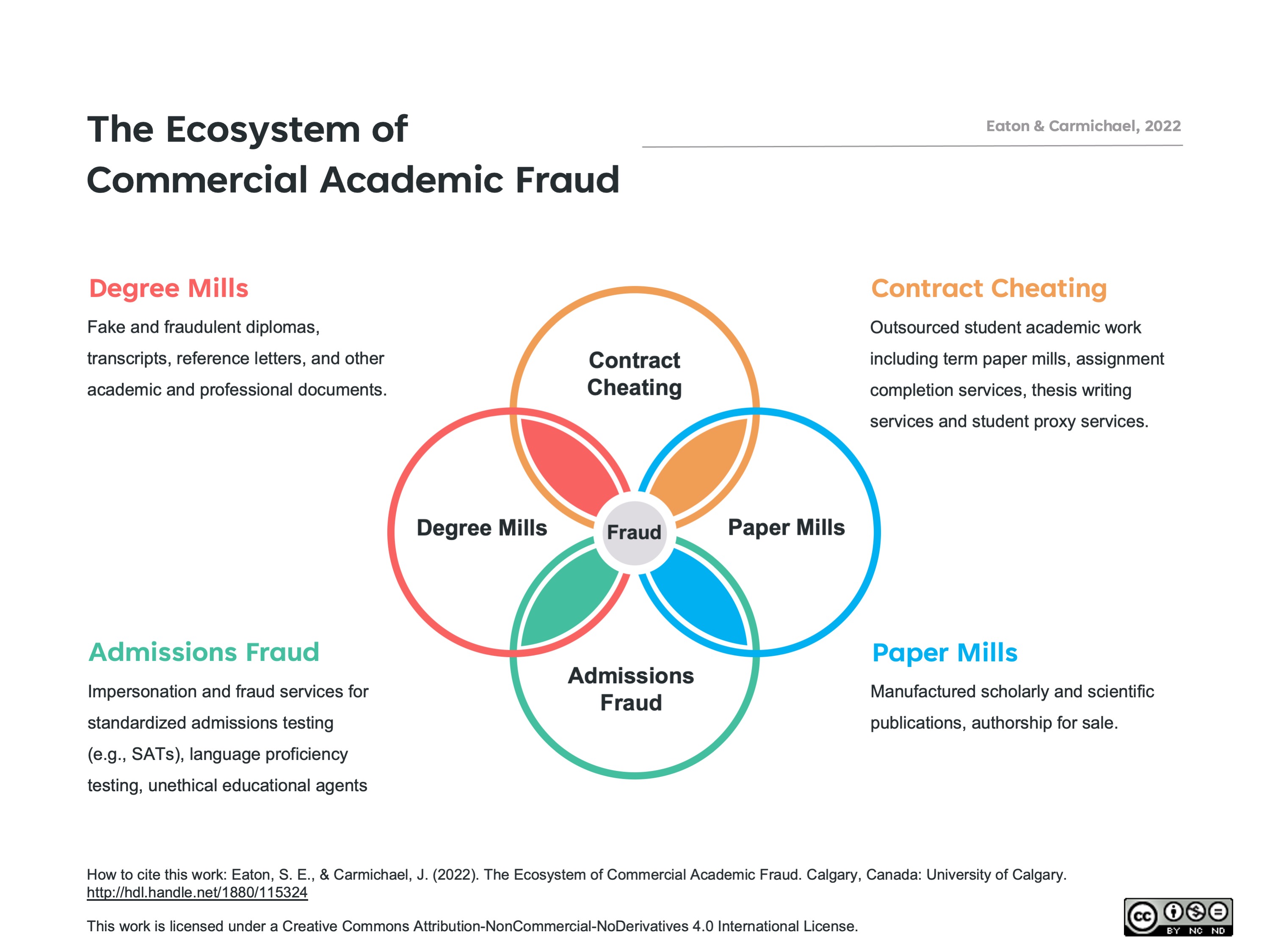
In the introduction for the book, we connect the dots to show how admissions fraud, contract cheating (e.g., term paper mills), scientific and scholarly paper mills, and fake degrees and fraudulent credentials are all connected. We synthesize the key ideas in this infographic:

Diagram titled "The Ecosystem of Commercial Academic Fraud" by Eaton & Carmichael (2022), showing four overlapping colored circles, each representing a type of academic fraud, with "Fraud" in the center where all circles overlap. The categories are: Degree Mills (red): Fake and fraudulent diplomas, transcripts, reference letters, and other academic and professional documents. Contract Cheating (orange): Outsourced student academic work including term paper mills, assignment completion services, thesis writing services, and student proxy services. Admissions Fraud (green): Impersonation and fraud services for standardized admissions testing (e.g., SATs), language proficiency testing, and unethical educational agents. Paper Mills (blue): Manufactured scholarly and scientific publications, authorship for sale. Each category overlaps in the center to show they are part of a broader ecosystem of fraud. The image includes a citation and Creative Commons license at the bottom.

It is difficult to get a handle on the exact size and scope of the industry, but based on what we know, we estimated that the industry is worth at least $21 Billion USD, and we figure that is a low estimate.

Throughout the past half-decade, we’ve developed a number of resources related to these topics. I’ve posted about them previously, but I figured it might be helpful if I gathered some of them into a single blog post. They are all freely available as open access resources.

Counterfeit Credentials: 13 Recommendations for Higher Education Professionals
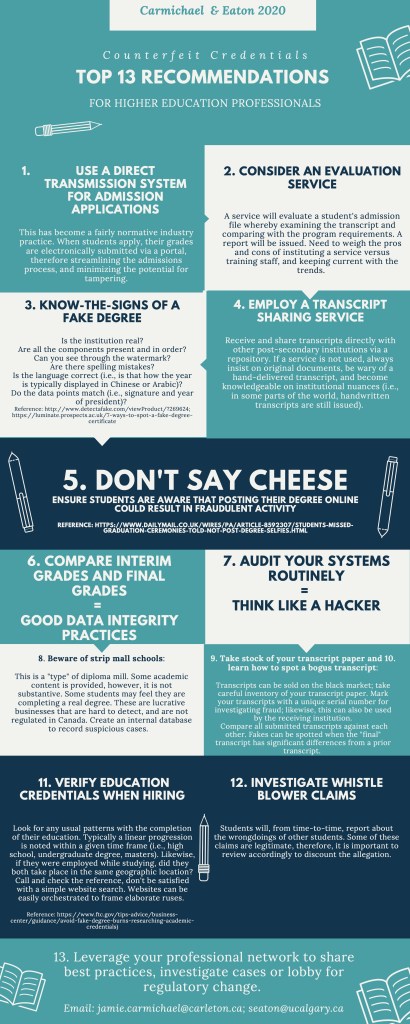
Infographic titled "Counterfeit Credentials: Top 13 Recommendations for Higher Education Professionals" by Carmichael & Eaton (2020). It offers guidance to help institutions detect and prevent the use of fake degrees and fraudulent documents in admissions and hiring. The recommendations are:
1.	Use a direct transmission system for admission applications – Electronic grade submissions reduce tampering.
2.	Consider an evaluation service – Evaluate transcripts against program requirements.
3.	Know the signs of a fake degree – Check for authenticity, spelling, watermarks, correct language, matching data points.
4.	Employ a transcript sharing service – Use secure repositories or verify hand-delivered transcripts.
5.	Don't say cheese – Warn students not to post degrees online due to risk of fraud.
6.	Compare interim and final grades – Ensures data integrity.
7.	Audit your systems routinely – Think like a hacker to uncover weaknesses.
8.	Beware of strip mall schools – Diploma mills that mimic real institutions; create internal databases for tracking.
9.	Take stock of your transcript paper – Use serial numbers and compare for inconsistencies.
10.	Learn how to spot a bogus transcript – Identify fakes by comparing submitted transcripts.
11.	Verify education credentials when hiring – Check for linear academic progression and verify references beyond website searches.
12.	Investigate whistleblower claims – Some student reports may be legitimate and need proper review.
13.	Leverage your professional network – Share practices, investigate cases, or lobby for change.
References and contact emails (jamie.carmichael@carleton.ca; seaton@ucalgary.ca) are included for further information.

This infographic is intended mainly for registrars, admissions staff, admissions committees and others whose work involves assessing the credentials of applicants for university and college programs. 

Scholarships Without Scruples

In this infographic, Jamie Carmichael and I share signs of scholarship scams, which is one from of educational fraud:

Infographic titled “Scholarships Without Scruples – 3 Signs of Scholarship Scams.” Credit Card Required: Don’t give out your credit card number. Legitimate scholarship applications never ask for this information. Discount in Disguise: You should not have to buy anything to receive a scholarship. Legit scholarships never require payment for goods or services. Tax Trickery: Legit scholarships are taxed differently than earned income. If proper tax documentation isn’t provided, it may not be a real scholarship. At the bottom: “Find out more” – Contact information for Sarah Elaine Eaton (University of Calgary, seaton@ucalgary.ca) and Jamie Carmichael (Carleton University, Jamie.Carmichael@Carleton.ca). Footer text: “Scholarship scams are real. Learn how to protect yourself!”

When it comes to education fraud, there are many angles to consider. There is certainly a need for more research, awareness, and advocacy on these topics, especially as GenAI can make these types of fraud easier.

Below are some related posts and further resources that I hope you find helpful.

Related posts

References and Resources

  • Carmichael, J. (2023, June 7). Understanding Fake Degrees and Credential Fraud in Higher Ed. The Evollution: A Modern Campus Illumination. https://evolllution.com/programming/credentials/understanding-fake-degrees-and-credential-fraud-in-higher-ed/
  • Carmichael, J. J. (2024). Reframing and Broadening Adversarial Stylometry for Academic Integrity. In S. E. Eaton (Ed.), Second Handbook of Academic Integrity (pp. 1467-1485). Springer Nature Switzerland. https://doi.org/10.1007/978-3-031-54144-5_148 
  • Carmichael, J., & Eaton, S. E. (2020). Counterfeit Credentials: Top 13 Recommendations for Higher Education Professionals (Infographic). University of Calgary. http://hdl.handle.net/1880/113042 
  • Clark, A. (2023). Examining the problem of fraudulent English test scores: What can Canadian higher education institutions learn? In S. E. Eaton, J. J. Carmichael, & H. Pethrick (Eds.), Fake Degrees and Fraudulent Credentials in Higher Education (pp. 187-207). Springer International Publishing. https://doi.org/10.1007/978-3-031-21796-8_9 
  • Çelik, Ö., & Razı, S. (2023). Avoiding favouritism in the recruitment practice of Turkish higher education institutions. In S. E. Eaton, J. J. Carmichael, & H. Pethrick (Eds.), Fake Degrees and Fraudulent Credentials in Higher Education (pp. 153-167). Springer International Publishing. https://doi.org/10.1007/978-3-031-21796-8_7 
  • DeCoster, B. (2023). There is no culture? A framework for addressing admissions fraud. In S. E. Eaton, J. J. Carmichael, & H. Pethrick (Eds.), Fake Degrees and Fraudulent Credentials in Higher Education (pp. 209-226). Springer International Publishing. https://doi.org/10.1007/978-3-031-21796-8_10 
  • Duklas, J. (2023). Bridging to tomorrow: A historical and technological review of credential exchange in higher education within Canada. In S. E. Eaton, J. J. Carmichael, & H. Pethrick (Eds.), Fake Degrees and Fraudulent Credentials in Higher Education (pp. 95-113). Springer International Publishing. https://doi.org/10.1007/978-3-031-21796-8_4
  • Eaton, S. E., & Carmichael, J. (2020). Scholarships without scruples (Infographic). University of Calgary: http://hdl.handle.net/1880/113044
  • Eaton, S. E., & Carmichael, J. (2022). The Ecosystem of Commercial Academic Fraud. University of Calgary. https://dx.doi.org/10.11575/PRISM/40330
  • Eaton, S. E., Carmichael, J., & Pethrick, H. (Eds.). (2023). Fake degrees and credential fraud in higher education. Springer. https://doi.org/10.1007/978-3-031-21796-8
  • Ezell, A. (2023). Yesterday, today, and tomorrow: A tour of Axact, the “World’s Largest Diploma Mill”. In S. E. Eaton, J. J. Carmichael, & H. Pethrick (Eds.), Fake Degrees and Fraudulent Credentials in Higher Education (pp. 49-94). Springer International Publishing. https://doi.org/10.1007/978-3-031-21796-8_3 
  • Hextrum, K. (2023). Fair play, fraud, or fixed? Athletic credentials in U.S. higher education. In S. E. Eaton, J. J. Carmichael, & H. Pethrick (Eds.), Fake Degrees and Fraudulent Credentials in Higher Education (pp. 115-132). Springer International Publishing. https://doi.org/10.1007/978-3-031-21796-8_5
  • Orim, S.-M., & Glendinning, I. (2023). Corruption in admissions, recruitment, qualifications and credentials: From research into quality assurance. In S. E. Eaton, J. J. Carmichael, & H. Pethrick (Eds.), Fake Degrees and Fraudulent Credentials in Higher Education (pp. 133-151). Springer International Publishing. https://doi.org/10.1007/978-3-031-21796-8_6
  • Sabbaghan, S., & Fazel, I. (2023). None of the above: Integrity concerns of standardized English proficiency tests. In S. E. Eaton, J. J. Carmichael, & H. Pethrick (Eds.), Fake Degrees and Fraudulent Credentials in Higher Education (pp. 169-185). Springer International Publishing. https://doi.org/10.1007/978-3-031-21796-8_8

–——–-

Share this post: Fake Degrees, Fraudulent Credentials and the Ecosystem of Commercial Academic Fraud – https://drsaraheaton.com/2025/04/10/fake-degrees-fraudulent-credentials-and-the-ecosystem-of-commercial-academic-fraud/

This blog has had over 3.7 million views thanks to readers like you. If you enjoyed this post, please ‘Like’ it using the button below or share it on social media. Thanks!

Sarah Elaine Eaton, PhD, is a Professor and Research Chair in the Werklund School of Education at the University of Calgary, Canada. Opinions are my own and do not represent those of my employer. 


Accreditation and Certification Fraud in IT

December 27, 2024

Many people in the academic integrity world are already familiar with contract cheating websites, those that deal in the business of buying and selling exams, bespoke term papers, theses, and exam questions and answers.

But this business isn’t limited to the millions of K-12, high school and post-secondary students. The exam fraud business is alive and well for professional accreditation exams for folks who either want to bypass a formal university degree or to supplement existing credentials.

For example, in the IT industry credentials are often the golden key to new opportunities. Certifications and accreditations (allegedly) validate technical skills, offering (so-called) proof that a candidate has the expertise needed for a professional role. 

Taking into account supply and demand, with job candidates being in high supply and well-paying jobs being in high demand, certification and accreditation fraud is alive and well in the IT industry, as well as other industries. This is a trend employers cannot afford to ignore.

Exposing the Fraud: How Buying and Selling of Certification Exam Questions Works

Certification fraud occurs when individuals falsify credentials, purchase counterfeit certifications, or misuse legitimate certifications obtained by others. But there’s this sneaky grey area that exists when a person actually sits a professional exam themselves, but they’ve prepared by buying the exam questions and/or the answers from an online vendor.

I won’t name specific companies that do this in this post, because I’m not in the habit of advertising for these fraudsters, but I want to show you how they work, so here are some screenshots:

Screenshot #1: Home page

A website screenshot. Black background, with text in white and blue. Some of the text is quoted in the narrative that follows.

At the top of this website, the company claims that 94% of the exam questions that they sold were “almost the same” and that 97% of customers passed the exam using their materials. (Who knows what happened to the other 3%…?) Finally, 98% of customers found the “study guides” effective and helpful.

There’s that phrase that we commonly see on contract cheating websites, “study guide”. For the uninitiated, this is a euphemism for “exam questions”. 

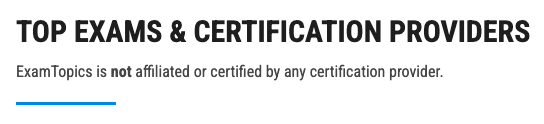
Screenshot #2: Saying it like it is: Not affiliated with any certification provider

A website screenshot. White background with black text.

In this screenshot the company states plainly that they are not affiliated or certified by any certification provider. Reading between the lines, the message is ‘caveat emptor’ or ‘buyer beware’. They are telling you upfront that they are in the business of selling exam questions and make no guarantees about their products.

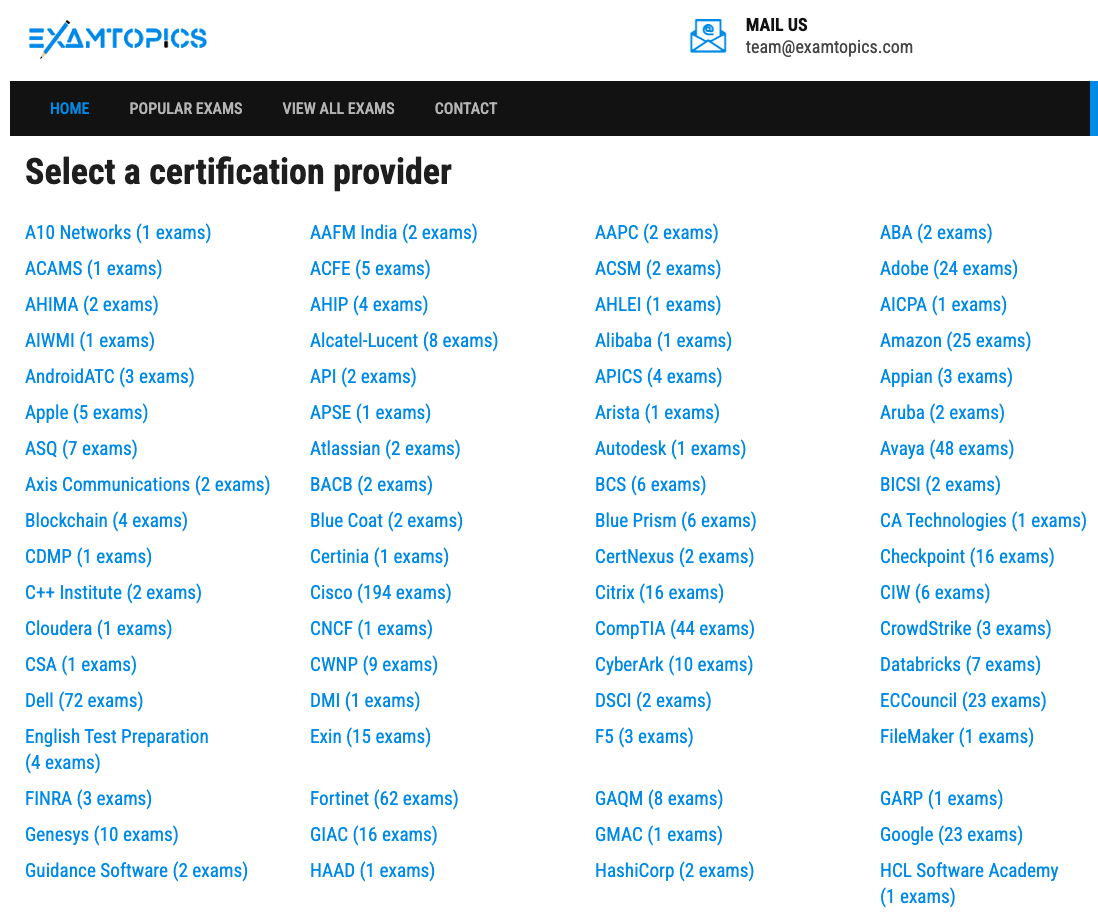
Screenshot #3: Samples of accreditation exam questions for sale

A website screenshot. White background. Black task bar with light grey text. There are lists of texts written in blue.

Look at all the options: You can buy exam questions for certifications offered by DELL, English language proficiency exams, Citrix, Adobe, and Amazon, and Google just to name a few. 

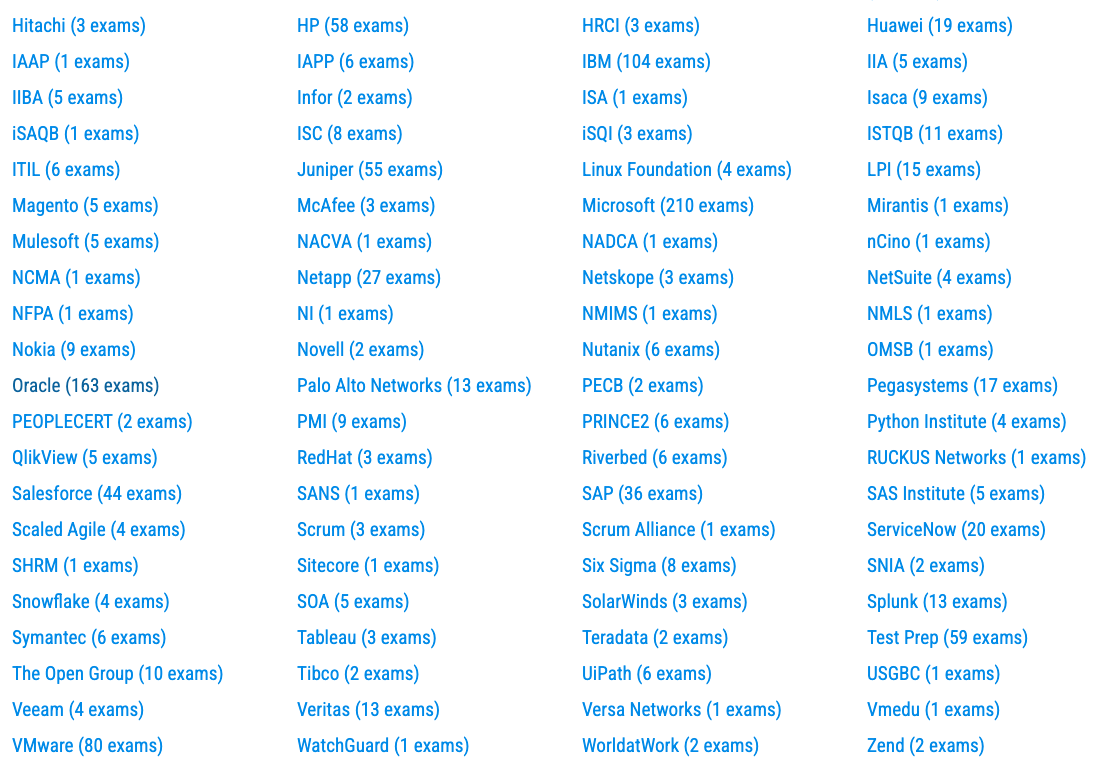
Screenshot #4: More samples of certification provider exam questions for sale.

A website screenshot. White background. Black task bar with light grey text. There are lists of texts written in blue.

But wait! There’s more! You can buy exam questions for certifications offers by Oracle, IBM, SAP, and others.

Assessment Security

Sites like compromise the assessment security of certification exams that are meant to qualify individuals to do a particular job. If this term is new to you, I recommend Professor Phill Dawson’s book, Defending Assessment Security in a Digital World. For a quick (and free) overview, of Phill’s work, this slide deck from one of his presentations is worth checking out.

Businesses that buy and sell exam certification questions engage in fraudulent practices undermine trust in the certification system and create significant risks for employers.

Consequences for Employers

Hiring someone with counterfeit credentials can have dire consequences. Unqualified employees may lack the technical skills to handle complex tasks, leading to project delays, costly errors, or even security breaches. Beyond the financial impact, fraudulent certifications can erode team morale, as employees with genuine qualifications may feel undervalued when working alongside those who faked their way in.

What Employers and Hiring Managers can Do

Employers, and especially hiring managers and those working in HR, must take proactive steps to safeguard their hiring processes. Some of you may be asking if this kind of practice is actually illegal. I’m not a lawyer, but what I can say is that although contact cheating for students is illegal in countries like Australia, the UK, and Ireland, if you’re not a student, then you might get to live a proverbial grey zone. To the best of my knowledge, it is not actually illegal to buy and sell questions for professional certification exams in most countries of the world.

So, what can employers do? First, trust but verify! Verifying certifications directly with issuing organizations is one step. Many certification bodies offer easy online verification tools to confirm a candidate’s credentials. Additionally, employers should stay informed about recognized accreditation standards and avoid unverified institutions. 

Having said this, verification of credentials and certification won’t help if someone has bought exam questions online and then taken the test themselves. Their results could be ‘verifiable’ in a sense, because there’s an assumption that a person who has passed an exam had the knowledge to do so. But when someone buys their exam questions before sitting the test, it means that they have prepared for an exam and may not necessarily have internalized the knowledge or skills that should match the certification they receive from passing an exam. An exam is one measure of knowledge, but it isn’t the only one. 

Having prospective employees demonstrate their skills and respond to technical questions that could only be answered if the person has the knowledge to back up their documentation can also help. One possibility is to give an interviewee a real-world scenario that could happen at your organization. Ask them how they would go about problem-solving it. If they struggle or stumble, it could be a sign that they lack the necessary skills for the job. (It could also be a sign that they’re just nervous or that interviewing isn’t their strength. So let me also make a plug here for having an inclusive and equitable interviewing process.)

Investing in robust, inclusive, and equitable hiring practices not only protects an organization from the pitfalls of fraud but also helps to create a culture of accountability and excellence. By placing a premium on authentic certifications combined with demonstrable knowledge and skills and inclusive hiring practices, employers signal their commitment to integrity and ensure they are building a team of qualified professionals.

Bottom line: If you’re hiring someone who says they have an IT certification based on taking exams, it’s worth it to find out if they actually have the knowledge and skills to do the job. 

And this is just one example of one site. Rest assured that it is not the only one out there. Exam cheating companies like this one don’t exist in isolation. They’re in the game to make money, and lots of it. 

In an industry where skills and knowledge drive success, vigilance against certification and accreditation fraud is not optional—it is a driver of success.

Future Outlook

Fraud and corruption are alive and well education and industry. There is a growing community of sleuths, scholars, and activists who are ready to sniff out fraud and expose it and naïveté about these matters is quickly going out of fashion. 

There may have been a time when it was acceptable—or even fashionable—to clutch your pearls, proclaim moral outrage, or just refuse to accept that educational and professional fraud are more commonplace than you might have previously thought. GenAI is here to stay, and so are companies whose business is educational, accreditation, scientific, and professional fraud. These companies are profitable because they have customers willing to pay for their goods and services.

Vigilance, sleuthing, and exposing fraud are very much on trend as we move ahead into the new year. And if you’re a hiring manager, taking steps to protect the integrity of your operations is definitely part of the job in 2025 and beyond.

References and Further Reading

Carmichael, J. (2023, June 7). Understanding Fake Degrees and Credential Fraud in Higher Ed. The Evollution: A Modern Campus Illumination. https://evolllution.com/programming/credentials/understanding-fake-degrees-and-credential-fraud-in-higher-ed/

Eaton, S. E., & Carmichael, J. (2022). The Ecosystem of Commercial Academic Fraud. In. Calgary, Canada: University of Calgary. https://dx.doi.org/10.11575/PRISM/40330

Eaton, S. E., Carmichael, J., & Pethrick, H. (Eds.). (2023). Fake degrees and credential fraud in higher education. Springer. https://doi.org/10.1007/978-3-031-21796-8

Related posts

________________________

Share this post: Accreditation and Certification Fraud in IT – https://drsaraheaton.com/2024/12/27/accreditation-and-certification-fraud-in-the-it-world/

This blog has had over 3 million views thanks to readers like you. If you enjoyed this post, please “like” it or share it on social media. Thanks!

Sarah Elaine Eaton, PhD, is a Professor and Research Chair in the Werklund School of Education at the University of Calgary, Canada. Opinions are my own and do not represent those of my employer. 


Book launch: Fake Degrees and Fraudulent Credentials in Higher Education

March 7, 2023

Carleton University Innovation Hub is pleased to host this public event.

Fake Degrees and Fraudulent Credentials in Higher Education

Join editors/authors Sarah Elaine Eaton, Jamie J. Carmichael, and Helen Pethrick in the Innovation Hub on Friday March 24, 2023 for the launch of their new book Fake Degrees and Fraudulent Credentials in Higher Education. This hybrid event will feature reading from the book and continue an important conversation facing many people in the world today.

Event Date: March 24th, 11:00 am – 12:00 (Eastern Standard Time)  

Event Location: Innovation Hub, 2020 Nicol Building, Carleton University or online

Hybrid Option:  A zoom Link will be provided via email to event registrants.

For more information or to register – https://carleton.ca/innovationhub/book-launch/

Related posts

_________________________________

Share or Tweet this: Book launch: Fake Degrees and Fraudulent Credentials in Higher Education https://wp.me/pNAh3-2SD

This blog has had over 3 million views thanks to readers like you. If you enjoyed this post, please “like” it or share it on social media. Thanks!

Sarah Elaine Eaton, PhD, is a faculty member in the Werklund School of Education, and the Educational Leader in Residence, Academic Integrity, University of Calgary, Canada. Opinions are my own and do not represent those of the University of Calgary.


Fake Degrees and Fraudulent Credentials in Higher Education: A Synopsis of the Book

January 28, 2023

Fake Degrees and Fraudulent Credentials in Higher Education was published by Springer Nature in January, 2023. It features over a dozen chapters on various topics related the broad theme of credential fraud.

The introductory chapter includes an overview and historical perspectives of key issues. In this opening chapter, the authors connect the dots between the industries that supply fake degrees and fraudulent academic documents (including but not limited to bogus reference letters and tampered transcripts) to the contract cheating industries (e.g., term paper mills, student proxy services, and examination impersonators who take tests on behalf students) and to the admissions fraud industry. In addition, a connection is made to the scholarly paper mill industry which includes various violations of scientific publication ethics including fake data, fabricated scholarly articles and authorship for sale.

We present these connected industries through our Ecosystem of Commercial Academic Fraud model (Eaton & Carmichael, 2022). They synthesize what is known about the size and scope of the industry, estimating its valuation to be at least $21 Billion USD.

In Chapter Two, Jamie Carmichael and I (who are Canadian) argue that Canada is vulnerable to admission and credential fraud. This argument will be substantiated through (i) a survey that spanned coast-to-coast within Canada, (ii) media review that targeted the response to Operation Varsity Blues in Canadian newspapers, and (iii) a comparative analysis with another survey on this topic to gauge how Canada is fairing compared to others across the globe. This data triangulation resulted in an in-depth examination of admissions fraud in Canada, with 14 recommendations for practitioners, researchers, and those involved in policy reform.

In the third chapter, FBI Special Agent (retired), Allen Ezell, takes readers on a tour of “Axact, the world’s largest diploma mill”. Ezell has more than 40 years of experience investigating “fake high schools, colleges, universities, and counterfeiters” (p. 53). He writes that, “Axact is a classic example of a criminal enterprise. Even its own employees refer to it as the tower of frauds and house of lies.” (p. 49). This chapter is the longest in the book by far, spanning 49 pages, complete with concrete details, photos, and insider information not available anywhere else. Ezell explains that diploma mills, “are professional operations that take planning, preparation, and organization to run smoothly. Like legitimate businesses, they have business models, conduct market studies, have financial forecasts, perform cost analyses, set daily/ weekly/monthly sales goals, and offer sales incentives. They constantly survey their competition, and actions by law enforcement and regulators, to determine the direction the wind is blowing.” (p. 53)

Chapter Four, by Joanne Duklas, addresses how “digitization and technology have improved electronic exchange practices in the areas of document and data management and reduced occurrences of fraud thereby encouraging greater trust in the verification and assessment process for admission and transfer” (p. 95). Duklas discusses how background checks regularly show evidence of misrepresentation and fraud. Duklas’s in-depth exploration of  key issues related to electronic exchange processes. She provides details about Canada’s national document exchange network, MyCreds™ | MesCertif™, launched in 2020. She notes that, “Building solid bridges (technical infrastructure, standards, legislation, policies, and procedures) between issuers and receivers of official documents remains important for a trusted, quality assured ecosystem. Various technology solutions are solving credential fraud and creating greater trust in the chain of custody and bone fides of official documents.” (p. 110)

In Chapter 5, Kirsten Hextrum “considers how legal athletic admissions mirror the largest college admission conspiracy in US history: Operation Varsity Blues (OVB)” (p.  115). Hextrum analyzed 1487 college athletes’ demographic data; 47 life- history interviews with college athletes; and admission-related documents. Her results reveal how athletes invest to develop athletic talent, disputing college leaders’ claims that athletic admissions create diverse cohorts. She addresses important issues related to equity, diversity, and inclusion, as her findings show that “athletic investments create homogenous cohorts as White, middle-class youth are overrepresented as college athletes.” (p. 115). In addition, Hextrum discusses, “how colleges authenticate athletes’ credentials” (p. 115), finding that “universities use inconsistent and arbitrary measures—sometimes admitting athletes with little sport experience” (p. 115). Hextrum’s findings indicate that “athletic admissions misalign with the public’s interest because they are fixed to favour White, middle-class athletes and remain vulnerable to fraud” (p. 115).

In the next chapter, Stella-Maris Orim and Irene Glendinning, write about “Corruption in Admissions, Recruitment, Qualifications and Credentials” from the perspective of quality assurance. They draw on research conducted in 2017–2018 for the Council of Higher Education Accreditation’s International Quality Group (CIQG) “into how Accreditation and Quality Assurance Bodies (AQABs) respond to corruption” (p. 133). They address the question: Who is responsible for reducing corruption in education and research? (p. 133). They present findings from their empirical research, leading them to their evidence-informed conclusion that “higher education providers around the world are aware of corruption, fraud and malpractice in student assessment.”, but that “that much less attention has been given by institutions to the types of integrity breaches that we have looked at in this chapter, fraud in admissions and recruitment and in credentials and qualifications” (p. 145).

Chapter 7, by Özgür Çelik and Salim Razı, addresses favouritism and professorial recruitment practices in Turkish higher education institutions. They address the issue of fraud and corruption indirectly, through an analysis of 66 news stories that address favourtism in Turkish universities. They discuss how favouritism erodes public trust, noting that “the negative consequences of favouritism are far-reaching” (p. 154). Their findings showed that nepotism, cronyism, and patronage, were key areas of concern. They found that when specific individuals were identified for academic positions that customized job descriptions can be written so that only that particular individual could be deemed qualified. Although their chapter focuses specifically on Turkey, there are lessons that are transferrable to other countries with regards to corrupt hiring practices in higher education and other sectors.

The next two chapters address fraud in standardized English-language proficiency testing. Soroush Sabbaghan and Ismaeil Fazel’s chapter aims to “shed light on the complexities and the apparent disconnect between equity, integrity, fairness, and justice in standardized language proficiency tests and the integrity issues that can arise as a result” (p. 169). They point out that “at their core, standardized procedures imposed by testing centers ignore the fact that test-takers come from different socio-economic and sociocultural backgrounds with different interests, motivations and experiences of learning and using English” (p. 171). For those interested in exploring issues related to equity, diversity, and inclusion of international students, this chapter is a must read.

Angela Clark continues the discussion of fraud and corruption in English-language proficiency exams in her chapter that explores fraudulent test scores. Clark argues that “relying on a single language proficiency test score to determine an individual’s readiness is problematic, and also problematic is the lack of related academic research and data to help guide admissions decision-making” (p. 187). Clark presents concrete recommendations for “institutional stakeholders with ways to become better informed about these tests and their impact and approaches to help international NNES [non-native English-speaker] students succeed within their new academic disciplines and new academic culture” (p. 187) that include reconsidering admission criteria (p. 199) and instituting a post-entry language assessment (PELA) (p. 199).

In Chapter Ten, Brendan DeCoster uses systems theory to address admissions fraud. DeCoster explores the “culture of admissions fraud” in the United States. He proposes “a five-level framework for analyzing admissions fraud, noting how individuals, small groups and firms, larger firms, institutions, and political entities all play roles in establishing definitions of fraud, investigating fraud, prosecuting fraud, committing fraud, abetting fraud, and countering fraud” (p. 209). The five levels include micro, metaxy, meso, macro, and acro, and he provides examples for each level in his chapter.

Next, Jamie Carmichael leads a chapter on topic modelling, “an unsupervised machine learning technique commonly used in computer science as a research method” (p. 227). In this novel study, “data from 30 websites selling fake degrees were manually scraped, observations noted, and a topic model was built to identify risks within the dataset”, demonstrating that “that topic modeling can identify security risks by providing an environmental scan of the threat.” (p. 227). Twenty evidence-based recommendations are offered for higher education security professionals, senior leaders, and researchers.

In the penultimate chapter, together with Jamie Carmichael, I explore “what can happen when professor and educational leaders have fake or fraudulent degrees or other qualifications. We present four key issues: (a) the threat to institutional reputation; (b) the threat to the credentials awarded by the institutions; (c) the impact on students; and (d) material costs to the organization. Then, we propose seven recommendations to prevent or address academic qualification fraud: (a) verify applicant credentials; (b) develop or update internal risk assessment plans; (c) conduct an internal qualifications audit; (d) develop or update institutional codes of conduct; (e) develop an internal process to investigate allegations of credential fraud; (f) develop and follow internal quality assurance processes for courses, programs, and curricula; and (g) Develop or update crisis communications plans to include credential fakery or fraud. We conclude by emphasizing that moral outrage will not solve the problem of academic credential fraud.” (p. 251).

In our final chapter, we summarize key findings from the book, grouping them into “seven main categories: (a) historical perspectives and terminology; (b) a trend of global indifference; (c) criminal enterprises and security; (d) fraud in standardized language proficiency testing; (e) athletic credentialism; (f) the role of the institution; (g) hiring, and (h) technology. We discuss the significance and limitations of the book, concluding with calls to action for more research and resources to better understand and address the growing problem of the ecosystem of academic fraud that continues to grow” (p. 269).

This book was a passion project that we undertook during COVID-19. We hope it is useful to others who are dedicated to upholding academic integrity and raising awareness about the threats posed to higher education by fake degrees, fraud, corruption, and quackery.

Related posts

Just published! Fake Degrees and Fraudulent Credentials in Higher Education

Fake Degrees and Fraudulent Credentials: Research Project Update

Scholarships Without Scruples: 3 Signs of Bogus Scholarships and Scams

Why Universities and Colleges Need Clear Policies to Deal with Fake COVID-19 Vaccination Records and Test Results

Degrees of Deceit: A Webinar

_________________________________

Share or Tweet this: Fake Degrees and Fraudulent Credentials in Higher Education: A Synopsis of the Book https://drsaraheaton.wordpress.com/2023/01/28/fake-degrees-and-fraudulent-credentials-in-higher-education-a-synopsis-of-the-book/

This blog has had over 3 million views thanks to readers like you. If you enjoyed this post, please “like” it or share it on social media. Thanks!

Sarah Elaine Eaton, PhD, is a faculty member in the Werklund School of Education, and the Educational Leader in Residence, Academic Integrity, University of Calgary, Canada. Opinions are my own and do not represent those of the University of Calgary.


Just published! Fake Degrees and Fraudulent Credentials in Higher Ed

January 12, 2023

We are excited to share the news that our edited book, Fake Degrees and Fraudulent Credentials in Higher Education, has been published (Eaton, Carmichael, and Pethrick, eds.) by Springer Nature.

On a personal note, I learned a tremendous amount from all of the collaborators on this project. This has truly been a dream team to work with and I’m so proud of everyone. Each chapter is unique, insightful, and full of eye-opening information.

Book description

This book addresses an important topic in higher education: credential fraud. This includes, but is not limited to, fake degrees, diploma mills, admissions fraud, and cheating on standardized admissions tests. The book directly addresses fake and fraudulent credentials in higher education. It explores transcript tampering and fraud in varsity athletics and discusses lazy practices in the higher education hiring processes that open the door for professors without proper credentials to get jobs in post-secondary institutions. 

The book also discusses how technology is being used to stop the proliferation of fake and fraudulent credentials in a variety of ways, including blockchain technology.

Table of Contents

Here is a sneak preview of the table of contents:

Chapter 1: Fake Degrees and Credential Fraud, Contract Cheating, and Paper Mills: Overview and Historical Perspectives – Sarah Elaine Eaton & Jamie Carmichael

Chapter 2: Admissions Fraud in Canadian Higher Education – Jamie Carmichael & Sarah Elaine Eaton

Chapter 3: Yesterday, Today, and Tomorrow: A Tour of Axact, the “World’s Largest Diploma Mill” – Allen Ezell

Chapter 4: Bridging Today to Tomorrow: A Historical and Technological Review of Credential Exchange in Higher Education within Canada – Joanne Duklas

Chapter 5: Fair play, Fraud, or Fixed? Athletic Credentials in US Higher Education – Kirsten Hextrum

Chapter 6: Corruption in Admissions, Recruitment, Qualifications and Credentials: from Research into Quality Assurance – Stella-Maris Orim & Irene Glendinning

Chapter 7: Avoiding Favouritism in the Recruitment Practice of Turkish Higher Education Institutions – Özgür Çelik & Salim Razı

Chapter 8: None of the Above: Integrity Concerns of Standardized English Proficiency Tests – Soroush Sabbaghan & Ismaeil Fazel

Chapter 9: Examining the Problem of Fraudulent English Test Scores: What Can Canadian Higher Education Institutions Learn? – Angela Clark

Chapter 10: There is No Culture? A Framework for Addressing Admissions Fraud – Brendan DeCoster

Chapter 11: Security Risks, Fake Degrees, and Other Fraud: A Topic Modelling Approach – Jamie Carmichael & Sarah Elaine Eaton 

Chapter 12: Are You for Real? Lessons for the Academy About Professors with Fake or Fraudulent Degrees – Sarah Elaine Eaton & Jamie Carmichael

Chapter 13: Fake Degrees and Fake Degrees and Fraudulent Credentials in Higher Education: Conclusions and Future Directions – Jamie Carmichael & Sarah Elaine Eaton

About the editors

Sarah Elaine Eaton

Werklund School of Education, University of Calgary, Calgary, Alberta, Canada.

Sarah Elaine Eaton, PhD, is an Associate Professor of Education at the University of Calgary, Canada, where she also serves as the inaugural Educational Leader in Residence, Academic Integrity. Eaton’s research focuses on academic ethics in higher education. Her work can be found in the British Educational Research Journal, the Journal of Academic Ethics, the Journal of Educational Thought and Interchange, among other places. She is the Editor-in-Chief of the International Journal for Educational Integrity (Springer Nature) and co-founder and co-editor of Canadian Perspectives on Academic Integrity. In 2020 she received the national Research and Scholarship award from the Canadian Society for the Study of Higher Education (CSSHE) for her contributions to research on academic integrity in Canadian higher education.

Jamie J. Carmichael

Carleton University, Ottawa, Ontario, Canada.

Jamie Carmichael is the Associate Registrar of Scheduling and Systems at Carleton University. She is responsible for the construction of the university timetable, scheduling and administration of examinations, the operation of two examination centres for students with disabilities, a university-wide space management system, and other core student administrative systems. Since 2009, she has received ten service excellence nominations for her work that ranges from information technology projects, team acknowledgment to innovation.

Carmichael’s research lies at the intersection of academic integrity and machine learning, with graduate education in Applied Science in Technology Information Management (Engineering). She has presented or co-presented at national and international conferences and is often called up on by specialized groups in higher education to present on her work.

Helen Pethrick

University of Calgary, Calgary, Alberta, Canada.

Helen Pethrick, MA, is a researcher and educator in Calgary, Alberta, Canada. Research areas include academic integrity in higher education, post-secondary student mental health and well-being, and peer mentorship in educational settings.

Related posts:

Fake Degrees and Fraudulent Credentials: Research Project Update

Scholarships Without Scruples: 3 Signs of Bogus Scholarships and Scams

Why Universities and Colleges Need Clear Policies to Deal with Fake COVID-19 Vaccination Records and Test Results

Degrees of Deceit: A Webinar

_________________________________

Share or Tweet this: Just published!Fake Degrees and Fraudulent Credentials in Higher Educationhttps://drsaraheaton.wordpress.com/2023/01/12/just-published-fake-degrees-and-fraudulent-credentials-in-higher-ed/

This blog has had over 3 million views thanks to readers like you. If you enjoyed this post, please “like” it or share it on social media. Thanks!

Sarah Elaine Eaton, PhD, is a faculty member in the Werklund School of Education, and the Educational Leader in Residence, Academic Integrity, University of Calgary, Canada. Opinions are my own and do not represent those of the University of Calgary.