The Impact of Workplace Incivility on Higher Education

August 23, 2025

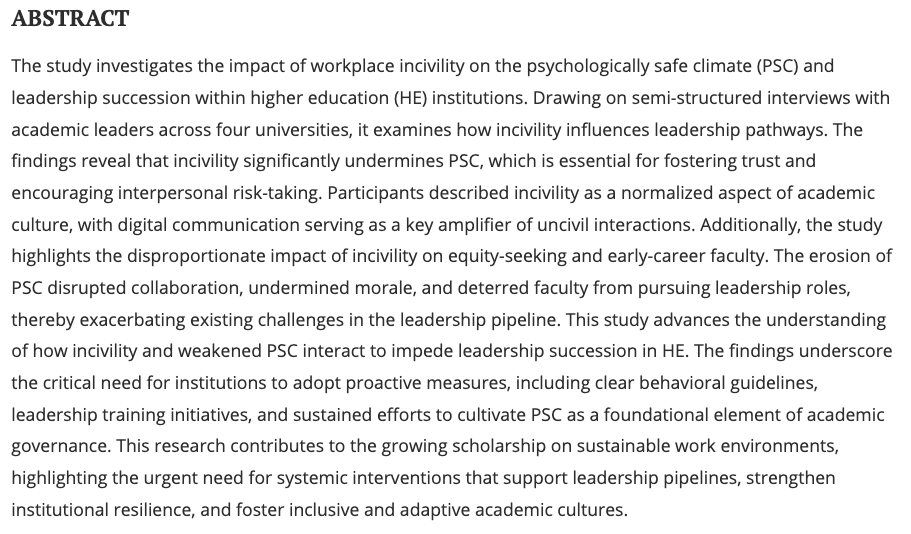
I am pleased to have collaborated with Dr. Leda Stawnychko and Ms. Rafi Mehnaz on this new article, “Exploring the impact of workplace incivility on psychological safety and leadership succession in higher education” in the International Journal for Leadership in Education.

I first met Leda Stawnychko when she was an EdD student at the University of Calgary. I had the pleasure of serving on her supervisory committee to support her doctor of education research project on Leadership Development Experiences of Department Chairs at a Canadian University.

When Leda invited me to join her later for a project on psychological safety and leadership succession in higher education, I accepted right away. This topic is important one and it rarely gets discussed in the literature on academic integrity, but as we know, professional and collegial ethics are part of a comprehensive approach to academic integrity.

As we point out in the abstract and in the main body of the article, there is a disproportionate impact of incivility on equity-seeking and early-career faculty. In other words, those who are already marginalized and experience barriers and discrimination are more likely to be on the receiving end of workplace incivility and hostility.

I’ve said it before and I’ll say it again: There can be no integrity without equity. We need to think more about the way that higher education as a system allows for the perpetuation of discrimination and harm, not only for students, but also for faculty and staff. If the workplace is not a psychologically safe environment, then employees cannot thrive.

I invite you to check out the article, which is open access and free to read and download.

________________________

Share this post: The Impact of Workplace Incivility on Higher Education – https://drsaraheaton.com/2025/08/23/the-impact-of-workplace-incivility-on-higher-education/

Sarah Elaine Eaton, PhD, is a Professor and Research Chair in the Werklund School of Education at the University of Calgary, Canada. Opinions are my own and do not represent those of my employer.

How Not to Respond: 5 Mistakes Professors Make After Misconduct Rulings

May 28, 2025

Academic misconduct cases can leave professors feeling frustrated, especially when outcomes don’t align with their expectations. These emotions are understandable and how faculty respond to disappointing rulings can impact their professional standing; relationships with colleagues and students; and future effectiveness in addressing misconduct.

Here are five common mistakes professors make when they disagree with academic misconduct decisions—and better approaches to consider.

1. Venting to Students About the Decision

The Mistake: Discussing the case details or expressing frustration about the ruling with other students, either in class or informal settings.

Why It Backfires: This behavior undermines institutional authority, creates an uncomfortable environment for students, and may violate confidentiality requirements. Students lose confidence in the system and may question whether they’ll receive fair treatment.

Better Approach: Process your concerns through appropriate channels. If you need to discuss the case, speak with department chairs, ombudspersons, or trusted colleagues who understand confidentiality requirements.

2. Making Public Complaints on Social Media or Forums

The Mistake: Posting about the case on social media, academic forums, or other public platforms, even when avoiding specific names.

Why It Backfires: Public complaints damage professional relationships and institutional reputation. Even anonymous posts can often be traced back to their authors. This approach also models poor conflict resolution for students and colleagues.

Better Approach: Use internal grievance procedures or professional development opportunities to address systemic concerns. Focus energy on improving processes rather than criticizing past decisions.

3. Refusing to Participate in Future Misconduct Proceedings

The Mistake: Declining to serve on academic integrity committees or refusing to report suspected misconduct because of disagreement with previous outcomes.

Why It Backfires: Withdrawal from the process eliminates your voice from future decisions and reduces the system’s effectiveness. This stance also shifts additional burden to colleagues who continue participating.

Better Approach: Stay engaged while working to improve the system. Use your experience to advocate for clearer guidelines, better training, or procedural improvements that address your concerns.

4. Treating the Student Differently in Future Interactions

The Mistake: Allowing disappointment about the ruling to affect how you interact with the student in subsequent courses, recommendations, or professional settings.

Why It Backfires: This behavior constitutes unprofessional conduct and potential retaliation. It undermines the educational mission and creates legal risks for both you and the institution.

Better Approach: Maintain professional boundaries and treat all students equitably. If you find it difficult to interact objectively with the student, consider recusing yourself from situations where bias might affect your judgment.

5. Bypassing Established Processes

The Mistake: Going directly to senior administrators, board members, or external parties without following institutional procedures for investigations, appeals, or grievances.

Why It Backfires: Skipping proper channels damages relationships with immediate supervisors and colleagues. It also reduces the likelihood that your concerns will receive serious consideration, as decision-makers prefer to see that established processes were followed.

Better Approach: Work through designated channels first. Document your concerns clearly and present them through official appeal mechanisms. If these prove insufficient, seek guidance from faculty governance bodies or professional organizations.

Moving Forward Constructively

Disagreement with academic misconduct decisions stems from genuine concern for educational standards and fairness. Channel this concern into productive action by focusing on prevention, process improvement, and professional development rather than relitigating past cases.

Consider these constructive alternatives: participate in policy review committees, mentor colleagues on documentation practices, advocate for faculty training on academic integrity, or contribute to scholarship on effective misconduct prevention.

The goal is not to eliminate disagreement with misconduct decisions—different perspectives strengthen academic integrity systems. The goal is to express disagreement in ways that improve outcomes for everyone involved while maintaining the professional standards that serve our educational mission.

________________________

Share this post: How Not to Respond: 5 Mistakes Professors Make After Misconduct Rulings – https://drsaraheaton.com/2025/05/28/how-not-to-respond-5-mistakes-professors-make-after-misconduct-rulings/

Sarah Elaine Eaton, PhD, is a Professor and Research Chair in the Werklund School of Education at the University of Calgary, Canada. Opinions are my own and do not represent those of my employer.


The GenAI Gender Gap

January 10, 2025

There is a gender gap when it comes to GenAI.

Just 26.3% of the European Union’s artificial intelligence (AI) professionals are women, according to a report from LinkedIn.

In my work with of the Women for Ethical AI (W4EAI) UNESCO platform, we had similar findings in our gender outlook study.

An AI-generated image of a group of women.

There are no easy solutions to this gap, but for those working in this area, some five concrete things you can do to promote gender inclusion (and equity in general) are:

  • 
Invite women into leadership roles, strategic planing for artificial intelligence and advanced technology.
  • Ensure that policies explicitly include women, girls, and other equity-deserving groups.
  • Invite women (and in particular, early career women and those who are precariously employed) to share and showcase their expertise and knowledge (and compensate them for their contributions).
  • Create formal sponsorship programs for women and girls who want to develop their knowledge and cp-competencies related to AI, with ongoing opportunities for learning and skill development.
An AI-generated image of a group of women.

There are a myriad of ethical complexities when it comes to artificial intelligence and gender is only one of them. Acknowledging inequalities and then working to support equity, fairness, and justice will remain ongoing work in the years to come.

References

AI in the EU: 2024 Trends and Insights from LinkedIn. (2024). https://economicgraph.linkedin.com/content/dam/me/economicgraph/en-us/PDF/AI-in-the-EU-Report.pdf

United Nations Educational Scientific and Cultural Organization (UNESCO). (2024). UNESCO Women for Ethical AI: Outlook study on artificial intelligence and gender. https://unesdoc.unesco.org/ark:/48223/pf0000391719

________________________

Share this post: The GenAI Gender Gap – https://drsaraheaton.com/2025/01/10/the-genai-gender-gap/

This blog has had over 3.7 million views thanks to readers like you. If you enjoyed this post, please ‘Like’ it using the button below or share it on social media. Thanks!

Sarah Elaine Eaton, PhD, is a Professor and Research Chair in the Werklund School of Education at the University of Calgary, Canada. Opinions are my own and do not represent those of my employer. 


IELTS Exam Fraud: Is large-scale cheating really a shock to anyone?

January 7, 2025
A screenshot from an online news story. There is a photo of students taking an exam. There is black text on a white background.

The headline reads, “IELTS exam fraud scandal ‘shocks’ Indonesia“, as reported by Vietnam.vn. The article goes on to offer details about large-scale cheating on English-language proficiency testing, saying that, “Faced with the increasing incidence of fraud, many prestigious universities around the world have adjusted their admission policies, especially regarding IELTS requirements.”

Contract cheating and exam proxies (i.e., impersonators) are at the heart of the scandal, with customers each paying about 47,000,000 Vietnamese Dong (which seems to convert to about $1851 USD or $2650 CAD, according to one online currency exchange website).

The article reports that these cheating incidents have caused schools in Singapore, Australia, and the US to raise the minimum test score for entrance to certain programs. (I am puzzled as to why schools think that raising the minimum score for admissions will prevent cheating on standardized texts used as an entrance requirement? My guess is that it might just drive up the price of fraud…)

Two chapters from our edited book, Fake Degrees and Fraudulent Credentials in Higher Education (Eaton, Carmichael, and Pethrick, 2023) are worth mentioning, as the authors of both chapters raised the alarm about the issue of large-scale global cheating on English language proficiency exams.

Soroush Sabbaghan (University of Calgary) and Ismaeil Fazel (University of British Columbia) in their chapter, ‘None of the above: Integrity concerns of standardized English proficiency tests’, “shed light on the complexities and the apparent disconnect between equity, integrity, fairness, and justice in standardized language proficiency tests and the integrity issues that can arise as a result.”

Angela Clark (York University), in her chapter, “Examining the Problem of Fraudulent English Test Scores: What Can Canadian Higher Education Institutions Learn?”, argues that “relying on a single language proficiency test score to determine an individual’s readiness is problematic, and also problematic is the lack of related academic research and data to help guide admissions decision-making”. She looks at media reports from the UK, US, and Canada, noting that, “Media reports and a lack of data serve to promote distrust of the language testing process and the test scores that institutions receive.”

Cheating on English language proficiency exams is nothing new and nor is it isolated to any one country.

Both of these chapters are thoroughly researched and well written. If you’re interested in the topic of fraud in English language exams, I recommend checking them out. In the meantime, large-scale cheating on standardized tests and the related problem of admissions fraud should shock exactly no one.

References

Clark, A. (2023). Examining the problem of fraudulent English test scores: What can Canadian higher education institutions learn? In S. E. Eaton, J. J. Carmichael, & H. Pethrick (Eds.), Fake Degrees and Fraudulent Credentials in Higher Education (pp. 187-207). Springer International Publishing. https://doi.org/10.1007/978-3-031-21796-8_9 

IELTS exam fraud scandal “shocks” Indonesia. (2024, December 28). Vietnam.vn. https://www.vietnam.vn/en/be-boi-thi-ho-ielts-rung-dong-indonesia/

Sabbaghan, S., & Fazel, I. (2023). None of the above: Integrity concerns of standardized English proficiency tests. In S. E. Eaton, J. J. Carmichael, & H. Pethrick (Eds.), Fake Degrees and Fraudulent Credentials in Higher Education (pp. 169-185). Springer International Publishing. https://doi.org/10.1007/978-3-031-21796-8_8 

Related posts:

________________________

Share this post: IELTS Exam Fraud: Is large-scale cheating really a shock to anyone? https://drsaraheaton.com/2025/01/07/ielts-exam-fraud-is-large-scale-cheating-really-a-shock-to-anyone/

This blog has had over 3.7 million views thanks to readers like you. If you enjoyed this post, please ‘Like’ it using the button below or share it on social media. Thanks!

Sarah Elaine Eaton, PhD, is a Professor and Research Chair in the Werklund School of Education at the University of Calgary, Canada. Opinions are my own and do not represent those of my employer. 


Embracing Open Access: My Scholarly Commitment to Shared Knowledge

December 8, 2024

As I prepare for the 2024-2025 Werklund Distinguished Research Lecture, I’ve been reflecting about how important it is to make scholarly work accessible to all. Open access (OA) is more than just a publishing model—it is a philosophy that challenges traditional barriers to knowledge dissemination and embodies the true spirit of academic scholarship.

Breaking Down Barriers to Knowledge

Historically (at least in my lived historical experience in higher education), academic research has been locked behind expensive paywalls, creating a significant divide that extends far beyond academic institutions. This exclusionary model particularly impacts researchers and knowledge seekers who find themselves on the margins of academic privilege. Researchers in middle and low-income countries (LMICs) often struggle to access scholarly and scientific literature and independent scholars and community practitioners face substantial financial barriers to staying current in their fields. Students and educators with limited institutional resources find themselves cut off from the latest scholarly insights, and curious members of the public are shut out from understanding complex academic work that could potentially transform their understanding of the world.

The Ethical Imperative of Sharing

Research is fundamentally about advancing human understanding, and restricting access undermines this core mission. Open access is commitment to knowledge as a public good, enabling a more dynamic and inclusive approach to scholarly communication. By removing economic and institutional barriers, we create opportunities for faster dissemination of critical findings, increased global collaboration, and unprecedented transparency in research methodologies. This approach allows for more rapid scientific and social progress, breaking down the traditional silos that have long constrained academic discourse.

Amplifying Research Impact

Contrary to traditional concerns, open access actually enhances the visibility and influence of scholarly work. Publications that are freely available receive more citations and reach broader audiences. This expanded reach afforded through OA creates opportunities for interdisciplinary and transdisciplinary connections that might otherwise remain unexplored, allowing research to transcend the narrow confines of specialized academic journals and engage with a more diverse intellectual ecosystem.

Personal Commitment and Broader Vision

As I prepare for this lecture, I am reflecting deeply about my commitment to open access (OA). One of my goals is to create a more equitable, informed, and connected world. This isn’t only about making documents freely downloadable, but also about cultivating a more inclusive intellectual landscape where knowledge can flow freely, unencumbered by economic or institutional constraints.

Practical Pathways to Open Access

For researchers considering this path, the journey involves strategic choices and institutional engagement. I am grateful for the privilege of working at the University of Calgary where researchers can self-archive their works into our institutional digital repository, PRISM. 

Our university supports infrastructures that recognize and reward open access scholarship. Not everyone has this privilege.

Navigating Copyright and Publisher Agreements

Having said all this, I also recognize that it is important to abide by existing copyright agreements with publishers. Academic publishing involves complex legal and contractual relationships. Each publication typically comes with specific copyright terms that must be honoured (both ethically and legally), which may limit immediate or unrestricted sharing. 

Because of this, I won’t be able to share all my work with a Creative Commons licence— not if a publisher holds the copyright. It does mean that I will look for creative and ethical ways to maximize access while maintaining professional integrity and contractual obligations.

Concluding reflections

Open access is not just about free downloads—it’s about free thinking, free exploration, and our commitment to knowledge being a universal right, not a privileged access. The longer I work in higher education, the more I am thinking about the future of knowledge, teaching, learning, and creating opportunities for others to thrive. This is really what is driving me right now — creating opportunities for others to thrive. Making as much of my work freely available as open access resources is one way I can do this.

Here are some places you can find my work:

Google Scholar

Research Gate

University of Calgary PRISM digital repository

As we get closer to the lecture, I’ll be making more and more of my work available as free open access downloads. I’ll keep you updated as we get closer to the lecture.

Related posts

Re-released as a Free Open Access Resource: 101 Ways to Market Your Language Program (2002)

________________________

Share this post: Embracing Open Access: My Scholarly Commitment to Shared Knowledge – https://drsaraheaton.com/2024/12/08/embracing-open-access-my-scholarly-commitment-to-shared-knowledge/

This blog has had over 3 million views thanks to readers like you. If you enjoyed this post, please “like” it or share it on social media. Thanks!

Sarah Elaine Eaton, PhD, is a Professor and Research Chair in the Werklund School of Education at the University of Calgary, Canada. Opinions are my own and do not represent those of my employer.