How Not to Respond: 5 Mistakes Professors Make After Misconduct Rulings

May 28, 2025

Academic misconduct cases can leave professors feeling frustrated, especially when outcomes don’t align with their expectations. These emotions are understandable and how faculty respond to disappointing rulings can impact their professional standing; relationships with colleagues and students; and future effectiveness in addressing misconduct.

Here are five common mistakes professors make when they disagree with academic misconduct decisions—and better approaches to consider.

1. Venting to Students About the Decision

The Mistake: Discussing the case details or expressing frustration about the ruling with other students, either in class or informal settings.

Why It Backfires: This behavior undermines institutional authority, creates an uncomfortable environment for students, and may violate confidentiality requirements. Students lose confidence in the system and may question whether they’ll receive fair treatment.

Better Approach: Process your concerns through appropriate channels. If you need to discuss the case, speak with department chairs, ombudspersons, or trusted colleagues who understand confidentiality requirements.

2. Making Public Complaints on Social Media or Forums

The Mistake: Posting about the case on social media, academic forums, or other public platforms, even when avoiding specific names.

Why It Backfires: Public complaints damage professional relationships and institutional reputation. Even anonymous posts can often be traced back to their authors. This approach also models poor conflict resolution for students and colleagues.

Better Approach: Use internal grievance procedures or professional development opportunities to address systemic concerns. Focus energy on improving processes rather than criticizing past decisions.

3. Refusing to Participate in Future Misconduct Proceedings

The Mistake: Declining to serve on academic integrity committees or refusing to report suspected misconduct because of disagreement with previous outcomes.

Why It Backfires: Withdrawal from the process eliminates your voice from future decisions and reduces the system’s effectiveness. This stance also shifts additional burden to colleagues who continue participating.

Better Approach: Stay engaged while working to improve the system. Use your experience to advocate for clearer guidelines, better training, or procedural improvements that address your concerns.

4. Treating the Student Differently in Future Interactions

The Mistake: Allowing disappointment about the ruling to affect how you interact with the student in subsequent courses, recommendations, or professional settings.

Why It Backfires: This behavior constitutes unprofessional conduct and potential retaliation. It undermines the educational mission and creates legal risks for both you and the institution.

Better Approach: Maintain professional boundaries and treat all students equitably. If you find it difficult to interact objectively with the student, consider recusing yourself from situations where bias might affect your judgment.

5. Bypassing Established Processes

The Mistake: Going directly to senior administrators, board members, or external parties without following institutional procedures for investigations, appeals, or grievances.

Why It Backfires: Skipping proper channels damages relationships with immediate supervisors and colleagues. It also reduces the likelihood that your concerns will receive serious consideration, as decision-makers prefer to see that established processes were followed.

Better Approach: Work through designated channels first. Document your concerns clearly and present them through official appeal mechanisms. If these prove insufficient, seek guidance from faculty governance bodies or professional organizations.

Moving Forward Constructively

Disagreement with academic misconduct decisions stems from genuine concern for educational standards and fairness. Channel this concern into productive action by focusing on prevention, process improvement, and professional development rather than relitigating past cases.

Consider these constructive alternatives: participate in policy review committees, mentor colleagues on documentation practices, advocate for faculty training on academic integrity, or contribute to scholarship on effective misconduct prevention.

The goal is not to eliminate disagreement with misconduct decisions—different perspectives strengthen academic integrity systems. The goal is to express disagreement in ways that improve outcomes for everyone involved while maintaining the professional standards that serve our educational mission.

________________________

Share this post: How Not to Respond: 5 Mistakes Professors Make After Misconduct Rulings – https://drsaraheaton.com/2025/05/28/how-not-to-respond-5-mistakes-professors-make-after-misconduct-rulings/

Sarah Elaine Eaton, PhD, is a Professor and Research Chair in the Werklund School of Education at the University of Calgary, Canada. Opinions are my own and do not represent those of my employer.


UHaveIntegrity: A Strengths-Based Approach to Academic Integrity at the University of Calgary

May 9, 2025
AltText: The image shows a closed laptop with a honeycomb-patterned cover on a wooden surface. On top of the laptop, there is a rectangular sticker that reads "#UHaveIntegrity" with the "integrity" part in red text. The sticker also includes a small logo for the University of Calgary.

I have been doing a lot of travelling lately, giving talks on postplagiarsm and academic integrity in the age of generative artificial intelligence. Recently I was at the Calgary airport and ask I was going through the security screening process, I took out my laptop and placed it in the bin to be screened. A staff member pointed to my laptop and asked, “Are you a professor at the University of Calgary?!”

She recognized the laptop sticker. It says #UHaveIntegrity, which is the slogan for our academic integrity campaign at the University of Calgary.

I replied, “Yes! Yes, I am! Are you a student?” She replied yes, that she was a majoring in political science.

It was most inspiring moment I have ever had going through airport security!

Shifting the Conversation

Traditional academic integrity messaging often starts from a deficit model, emphasizing what students should not do and the consequences of misconduct. This approach inadvertently positions students as potential cheaters rather than developing adults.

The #UHaveIntegrity campaign reframes this conversation. We acknowledge and celebrate  students as whole human beings with existing ethical foundations. Our role as educators shifts from policing to supporting their continued development.

From Classroom to Career

Academic integrity transcends assignment submissions and exam protocols. It forms the foundation for ethical decision-making that extends beyond graduation. The research literature demonstrates that students who develop strong ethical frameworks during their education carry these principles into their professional lives (e.g., Guerrero-Dib et al., 2020; Tammeleht et al., 2022).

When we recognize that students already have integrity, we create space for authentic dialogue about ethical challenges rather than simply enforcing rules. Students become active participants in their ethical development rather than passive recipients of policy statements.

Supporting Student Success

The #UHaveIntegrity campaign represents our commitment to supporting student learning and academic success. By starting from a position of trust, we establish educational environments where:

  • Students feel empowered to ask questions about citation and collaboration
  • Errors become learning opportunities rather than character judgments
  • Discussions about integrity focus on growth rather than compliance

Moving Toward Postplagiarism

The #UHaveIntegrity campaign exemplifies what we call postplagiarism pedagogy—an educational approach that moves beyond rule-based instruction to consider how learning, writing, and collaboration can happen ethically in the age of generative AI.

Postplagiarism does not mean ignoring source citation or academic honesty. Instead, it acknowledges that students develop as writers in a world where information flows differently than in previous generations. ChatGPT was released almost two and half years ago, in November 2022. Here we are in 2025 and our historical norms around citing and referencing are inadequate in the age of remix, mashup, and co-creation with GenAI.

By starting from the premise that students have integrity, educators can engage in richer conversations about:

  • How knowledge creation occurs in digital environments
  • Why proper attribution matters in different contexts
  • How collaboration and individual work intersect in contemporary scholarship

In a small-scale study led by my colleague, Dr. Soroush Sabbaghan, we interviewed ten graduate students about their use of GenAI. They told us that they want and need guidance and support to use GenAI ethically. They also wanted agency to use GenAI tools to help them do their research. They wanted GenAI tools to help them amplify their own voices and discover new perspectives. Although our study was small, the findings are worthy of consideration. You can check out the article here if you are interested.

Moving Forward Together

The sticker on my laptop serves as a daily reminder of our responsibility as educators. It’s up to us educators to create learning environments that nurture the integrity students already possess, providing them with the knowledge and skills to navigate increasingly complex ethical landscapes.

The next time you encounter academic integrity challenges in your classroom, remember: your students have integrity. The question is not about instilling values they lack, but supporting their application of existing values to new academic contexts.

#UHaveIntegrity is more than a hashtag. It is our University of Calgary commitment to educational partnerships built on integrity and mutual respect.

University of Calgary Academic Integrity Week 2025

This year at the University of Calgary, we’ll mark Academic Integrity Week from October 14-17. Our themes are artificial intelligence and engaging students as partners in academic integrity. We are excited to engage with students on these important topics!

References

Guerrero-Dib, J. G., Portales, L., & Heredia-Escorza, Y. (2020). Impact of academic integrity on workplace ethical behaviour. International Journal for Educational Integrity, 16(1), 2. https://doi.org/10.1007/s40979-020-0051-3 

Sabbaghan, S., & Eaton, S. E. (2025). Navigating the ethical frontier: Graduate students’ experiences with generative AI-mediated scholarship. International Journal of Artificial Intelligence in Education. https://doi.org/10.1007/s40593-024-00454-6 

Tammeleht, A., Löfström, E., & Rodríguez-Triana, j. M. J. (2022). Facilitating development of research ethics and integrity leadership competencies. International Journal for Educational Integrity, 18(1), 1–23. https://doi.org/10.1007/s40979-022-00102-3

________________________

Share this post: #UHaveIntegrity: A Strengths-Based Approach to Academic Integrity – https://drsaraheaton.com/2025/05/09/uhaveintegrity-a-strengths-based-approach-to-academic-integrity-at-the-university-of-calgary/

Sarah Elaine Eaton, PhD, is a Professor and Research Chair in the Werklund School of Education at the University of Calgary, Canada. Opinions are my own and do not represent those of my employer.


Gemini Live: Breaking Educational Barriers with AI

April 19, 2025

Gemini Live is Google’s new conversational AI assistant that responds to voice commands in real-time. Unlike text-based interactions, Gemini Live allows for natural, flowing conversations. This voice-first approach opens new possibilities for accessibility in educational settings. It was released last month, and I just got around to trying it today. Here’s how it went:

I was impressed by the tool’s interactivity and speed. In this test I scanned a laptop sticker with the hashtag #UHaveIntegrity, which is from our academic integrity campaign at the University of Calgary. The app correctly identified it and gave me a brief description.

I did a few subsequent tests with other items afterwards. It did not always have 100% accuracy, but with additional prompting, it corrected errors and provided updated information.

I can think of a variety of uses for this kind of app for teaching and learning. In particular, I am excited about the possibilities to enhance accessibility, inclusion, and equity.

Breaking Down Barriers with Voice Interaction

The voice interface of Gemini Live can remove some barriers for students. Students with mobility limitations, visual impairments, or reading difficulties can participate in learning activities through speech. This creates a more level playing field in the classroom.

Imagine a scenario where a teacher uses Gemini Live to help a student with dyslexia engage with research projects. The student could ask questions verbally and receive information without struggling with text. This hypothetical case illustrates how voice interaction might lead to increased confidence and class participation.

Multilingual Support for Diverse Classrooms

Language barriers often create obstacles in education. Gemini Live supports multiple languages and can translate between them. This feature helps:

  • Non-native English speakers follow lessons in their first language
  • International students integrate into new learning environments
  • Teachers communicate with students from different linguistic backgrounds
  • Parents who speak other languages stay involved in their children’s education

Learning Accommodations Made Simple

Every student learns differently. Gemini Live can adapt content to different learning needs. Here are some examples:

  1. It can explain complex concepts in simpler terms for students who need additional support
  2. It provides alternative explanations when students don’t understand a topic the first time
  3. It offers audio descriptions of visual content for visually impaired students
  4. It can generate study materials in different formats to match learning preferences

Real-Time Assistance in the Classroom

Teachers often struggle to provide individual attention to every student in a classroom. Gemini Live can serve as an additional resource that students can turn to when they need help. This can reduce wait times and frustration.

As a hypothetical example, a high school math teacher could implement Gemini Live as a ‘homework helper’ station in the classroom. Students who get stuck on problems could ask Gemini Live for guidance without waiting for the teacher to become available. This approach would allow more students to receive timely support while waiting for personalized attention from their teacher.

Digital Equity Through Voice Access

Not all students have equal access to technology or equal ability to use traditional interfaces. Voice technology lowers the technical barriers to using digital tools. Students without keyboards, mice, or touchscreens can still access information and complete assignments through voice commands.

Practical Implementation Tips

In thinking about how we could use use Gemini Live and similar tools for accessibility and inclusion, here are some ideas:

  • Create specific prompts that students can use to get help with different subjects
  • Set up dedicated stations where students can interact with Gemini Live
  • Teach students how to ask effective questions
  • Combine Gemini Live with other AI tools for a comprehensive accessibility solution

Challenges and Considerations

It is important for teachers to be aware that the tool is not perfect (at least as it currently stands). Although Gemini Live offers benefits, it currently has certain limitations.

  • Voice recognition may struggle with some speech patterns or accents
  • Private conversations require appropriate spaces to avoid classroom disruption
  • Students need guidance on when AI assistance is appropriate and when it isn’t
  • Technology should supplement, not replace, human teaching and interaction

Looking Forward

As AI assistants like Gemini Live continue to evolve, they will provide even more tools for inclusive education. The most successful classrooms will be those that thoughtfully blend technology with human instruction.

By incorporating Gemini Live into teaching practices, educators can create learning environments that accommodate more students. The goal isn’t just to make education accessible but to ensure every student feels valued and included in the learning process. When we remove barriers to education, we unlock potential — and that’s one of the most fun parts of being an educator.

–——–-

Share this post: Gemini Live: Breaking Educational Barriers with AI – https://drsaraheaton.com/2025/04/19/gemini-live-breaking-educational-barriers-with-ai/

This blog has had over 3.7 million views thanks to readers like you. If you enjoyed this post, please ‘Like’ it using the button below or share it on social media. Thanks!

Sarah Elaine Eaton, PhD, is a Professor and Research Chair in the Werklund School of Education at the University of Calgary, Canada. Opinions are my own and do not represent those of my employer. 


Promotion to Professor: Reflecting on a Three-Decade Journey

June 25, 2024

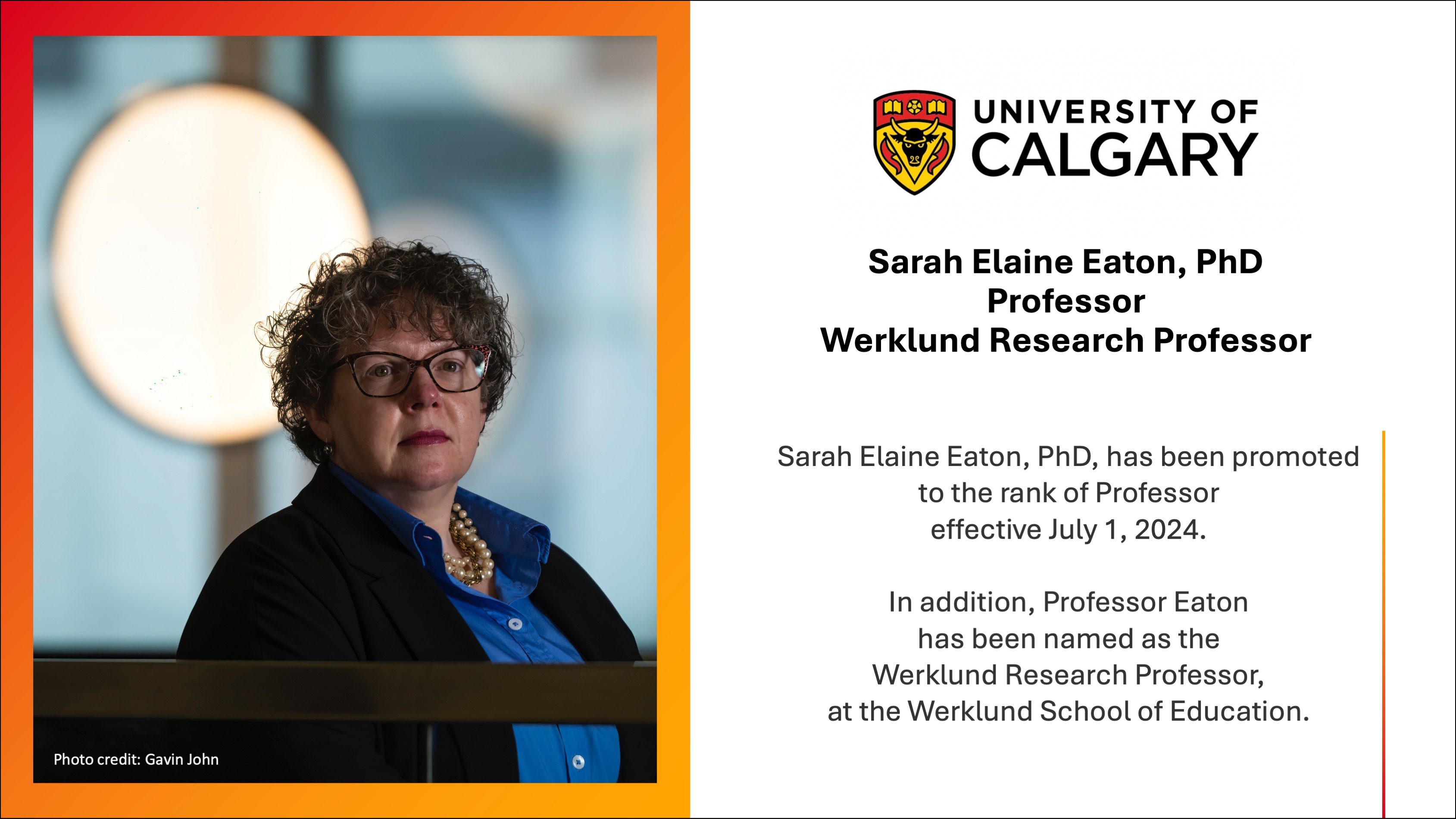
It has been a while since I have blogged. Life has been non-stop this year, but I wanted to take a moment to share some good news. I have been promoted to the rank of Professor, effective July 1, 2024. A few months back, I was also named as the Werklund Research Professor, which is a prestigious research chair in the Werklund School of Education.

AltText: An announcement postcard. On the left is a photo of a woman with curly hair wearing glasses, a blue shirt, a black jacket and a pearl necklace. The are is an abstract background and the photo is framed in red and orange. On the right is the University of Calgary logo and black text that reads: Sarah Elaine Eaton, PhD, Professor, Werklund Research Professor. Sarah Elaine Eaton, PhD, has been promoted to the rank of Professor effective July 1, 2024.

In addition, Professor Eaton has been named as the Werklund Research Professor, at the Werklund School of Education.

I have long had a passion for integrity and ethics. I am grateful to have an opportunity to focus on ethics in my scholarship, advocacy, and leadership. The Werklund Research Professorship is a prestigious research chair, internally funded through the philanthropic generosity of Dr. David Werklund, the named patron of the Werklund School of Education. To the best of my knowledge, this is the first time anywhere in the world that a research chair role has focused on academic and research integrity. I am honoured to take up this work to advance scholarship related to ethics and integrity in higher education.

I was a first-generation student. Neither of my parents finished high school. When I was a child, my mother drilled into me that there was nothing more important than getting an education, working hard, and being independent. I have written about this, and part of my early life here. I started working when I was 15 and my first job was in a grocery store. When I first applied to university after graduating from secondary school, I had no idea how to go about filling out the application. Like many first-in-family students, I did not even know what questions to ask. I received modest scholarships throughout my studies, but I also worked, often at multiple part-time jobs, to pay the bills (including tuition), buy books, and put food on the table. I wasn’t something that I felt was a hardship, it was just something I did.

The promotion to full professor comes after 30 years of teaching at the University of Calgary. From 1994 to 2016, I taught on contract as a sessional instructor. After 22 years of precarious employment, I secured a tenure-track role in 2016. In 2020, I was promoted to associate professor with tenure. When considered in the context of the entirety of career, advancements are neither quick, nor easy. For more than two decades, I worked on semester-to-semester contracts, never knowing for sure if I would be employed in the following term until the contract actually came through. I established and successfully ran a consulting company that I maintained for twenty years, serving clients in industry, non-profit, and government. I enjoyed that work (mostly), but there were many aspects of running a business that I was horrible at.

There are plenty of things I am not good at, but I have always excelled at writing, reading, and synthesizing large amounts of information. I love working with students and I am well suited to online teaching and graduate supervision. I have not always had the luxury of being able to do work that I am good at and I recognize that it is a privilege to have a job where I can use my talents. For me, being a professor more than a job, though. It has been a lifelong dream. The reality of higher education is much harsher, more exhausting, and outright merciless than I ever imagined, and yet, I still want to be here.

One reason for this, is that there is much work to be done to preserve and sustain ethics and integrity in science, scholarly publication, teaching, learning, and educational administration. Generative artificial intelligence (Gen AI) has brought new twists on perennial challenges. Systemic barriers to academic success persist and there is plenty of research to show that corrupt and unfair systems can contribute to academic and research misconduct. Although I am interested in helping individuals uphold academic integrity, it is a fool’s errand to ignore the systemic inequities, barriers, and discrimination that are embedded into educational systems that perpetuate harm.

As I reflect back and plan forward, my goal now is to focus on doing what I can to leave the higher education system better than I found it. I plan to do this by raising awareness about systemic ethical issues and advocating for change to benefit students and staff, particularly those from equity-deserving groups. I look forward to continuing and expanding international collaborations (especially with colleagues at CRADLE Deakin University, where I hold the role of Honorary Associate Professor) and mentoring and supervising doctoral students, along with teaching and serving in leadership roles in the coming years.

____________________________

Share this post: Promotion to Professor: Reflecting on a Three-Decade Journey https://drsaraheaton.wordpress.com/2024/06/25/promotion-to-professor-reflecting-on-a-three-decade-journey/

This blog has had over 3.6 million views thanks to readers like you. If you enjoyed this post, please “like” it or share it on social media. Thanks!

Sarah Elaine Eaton, PhD, is a faculty member in the Werklund School of Education at the University of Calgary, Canada. Opinions are my own and do not represent those of my employer.

Sarah Elaine Eaton, PhD, Editor-in-Chief, International Journal for Educational Integrity


New project: Artificial Intelligence and Academic Integrity: The Ethics of Teaching and Learning with Algorithmic Writing Technologies

April 19, 2022

Today the University of Calgary announced the recipients of the 2022 Teaching and Learning Grants. I’m pleased to share that our project was among those awarded funding. Here are the details of our project:

Artificial Intelligence and Academic Integrity: The Ethics of Teaching and Learning with Algorithmic Writing Technologies

Research Team (all from the University of Calgary)

  • Sarah Elaine Eaton, PhD, Werklund School of Education, Principal Investigator
  • Robert Brennan, PhD, Schulich School of Engineering, Co-Investigator
  • Jason Wiens, PhD, Department of English, Faculty of Arts, Co-Investigator
  • Brenda McDermott, PhD, Student Accessibility Services, Co-Investigator
  • Helen Pethrick, MA, Project Manager
  • Beatriz Moya, PhD student, Werklund School of Education, Research Assistant
  • Jonathan Lesage, MSc student, Schulich School of Engineering, Research Assistant

Focus area (as aligned with University of Calgary research priority areas): Innovation and entrepreneurial thinking 

Grant type: Scholarship of Teaching and Learning (SoTL) Grants

Project scope: This project will be conducted at the University of Calgary. Data will be collected from faculty and students, upon successful ethics approval of the project.

Funding amount: $40,000 CAD

Project duration: 2022-2025

Project status

This project just received funding and have submitted documentation to have the project set up in the university systems. We are waiting for that step to be approved. In the meantime, we are preparing our application to the Conjoint Faculties Research Ethics Board (CFREB) at the University of Calgary.

Please note: This is an internal University of Calgary grant. We are not able to include any external collaborators in this particular project.

_________________________________

Share or Tweet this: New project: Artificial Intelligence and Academic Integrity: The Ethics of Teaching and Learning with Algorithmic Writing Technologieshttps://drsaraheaton.wordpress.com/2022/04/19/new-project-artificial-intelligence-and-academic-integrity-the-ethics-of-teaching-and-learning-with-algorithmic-writing-technologies/

This blog has had over 3 million views thanks to readers like you. If you enjoyed this post, please “like” it or share it on social media. Thanks!

Sarah Elaine Eaton, PhD, is a faculty member in the Werklund School of Education, and the Educational Leader in Residence, Academic Integrity, University of Calgary, Canada. Opinions are my own and do not represent those of the University of Calgary.