“What should we be assessing exactly?” This was a question one of our research participants asked when we interviewed them as part of our project on artificial intelligence and academic integrity, sponsored by a University of Calgary Teaching Grant.
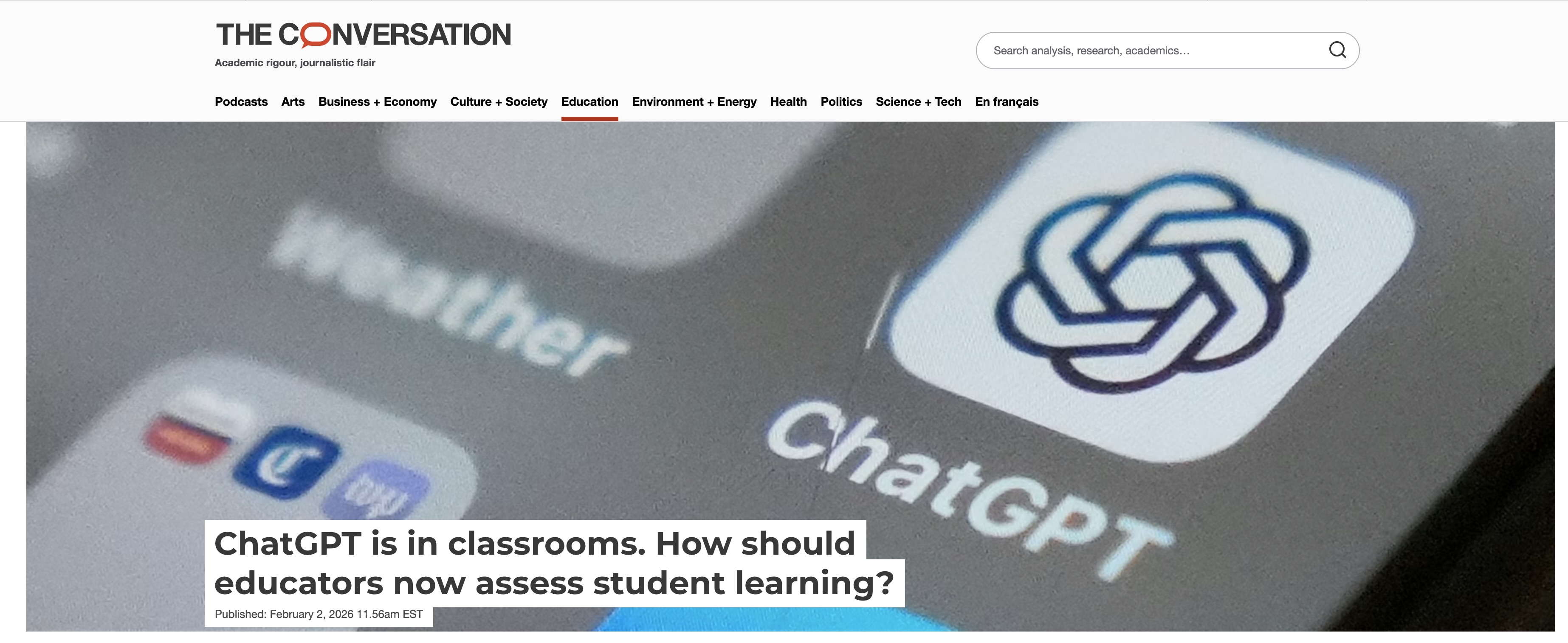
In an article published in The Conversation, we provide highlights of the results from our interviews with 28 educators across Canada, as well as our analysis of 15 years of research that looked at how AI affects education. (Spoiler alert: AI is a double-edged sword for educators and there are no easy answers.)
Screenshot from The Conversation.
We emphasize that, “in a post-plagiarism context, we consider that humans and AI co-writing and co-creating does not automatically equate to plagiarism.” Check out the full article in The Conversation.
You can check out the scholarly paper that we published in Assessment and Evaluation in Higher Education that goes into more detail about the methods and findings of our interviews.
I’d like to give a shoutout to all the project team members who worked with us on various aspects of this research: Robert (Bob) Brennan (Schulich School of Engineering, University of Calgary), Jason Weins (Faculty of Arts, University of Calgary), Brenda McDermott (Student Accessibility Services, University of Calgary), Rahul Kumar (Faculty of Education, Brock University), Beatriz Moya (Instituto de Éticas Aplicadas, Pontificia Universidad Católica de Chile) and the student research assistants who helped along the way (who have now all successfully graduated and moved on to the next phase of their careers): Jonathan Lesage, Helen Pethrick, and Mawuli Tay.
Sarah Elaine Eaton, PhD, is a Professor and Research Chair in the Werklund School of Education at the University of Calgary, Canada. Opinions are my own and do not represent those of my employer.
The arrival of generative AI tools such as ChatGPT has disrupted how we think about assessment in higher education. As educators, we’re facing a critical question: What should we actually be assessing when students have access to these powerful tools?
Our recent study explored how 28 Canadian higher education educators are navigating this challenge. Through in-depth interviews, we discovered that educators are positioning themselves as “stewards of learning with integrity” – carefully drawing boundaries between acceptable and unacceptable uses of chatbots in student assessments.
Where Educators Found Common Ground
Across disciplines, participants agreed that prompting skills and critical thinking are appropriate to assess with chatbot integration. Prompting requires students to demonstrate foundational knowledge, clear communication skills, and ethical principles like transparency and respect. Critical thinking assessments can leverage chatbots’ current limitations – their unreliable arguments, weak fact-checking, and inability to explain reasoning – positioning students as evaluators of AI-generated content.
The Nuanced Territory of Writing Assessment
Writing skills proved far more controversial. Educators accepted chatbot use for brainstorming (generating initial ideas) and editing (grammar checking after independent writing), but only under specific conditions: students must voice their own ideas, complete the core writing independently, and critically evaluate any AI suggestions.
Notably absent from discussions was the composition phase – the actual process of developing and organizing original arguments. This silence suggests educators view composition as distinctly human cognitive work that should remain student-generated, even as peripheral tasks might accommodate technological assistance.
Broader Concerns
Participants raised important challenges beyond specific skill assessments: language standardization that erases student voice, potential for overreliance on AI, blurred authorship boundaries, and untraceable forms of academic misconduct. Many emphasized that students training to become professional communicators shouldn’t rely on AI for core writing tasks.
Moving Forward
Our findings suggest that ethical AI integration in assessment requires more than policies, it demands ongoing conversations about what makes learning authentic in technology-mediated environments. Educators need support in identifying which ‘cognitive offloads’ are appropriate, understanding how AI works, and building students’ evaluative judgment skills.
The key insight? Assessment in the AI era isn’t about banning technology, but about distinguishing between tasks where AI can enhance learning and those where independent human cognition remains essential. As one participant reflected: we must continue asking ourselves, “What should we be assessing exactly?”
The postplagiarism era requires us to protect academic standards while preparing students for technology-rich professional environments – a delicate balance that demands ongoing dialogue, flexibility, and our commitment to learning and student success.
Sarah Elaine Eaton, PhD, is a Professor and Research Chair in the Werklund School of Education at the University of Calgary, Canada. Opinions are my own and do not represent those of my employer.
When we talk about academic integrity in universities, we often focus on preventing plagiarism and cheating. But what if our very approach to enforcing these standards is unintentionally creating barriers for some of our most vulnerable students?
My recent research explores how current academic integrity policies and practices can negatively affect neurodivergent students—those with conditions like ADHD, dyslexia, Autism, and other learning differences. Our existing systems, structures, and policies can further marginalize students with cognitive differences.
The Problem with One-Size-Fits-All
Neurodivergent students face unique challenges that can be misunderstood or ignored. A dyslexic student who struggles with citation formatting isn’t necessarily being dishonest. They may be dealing with cognitive processing differences that make these tasks genuinely difficult. A student with ADHD who has trouble managing deadlines and tracking sources is not necessarily lazy or unethical. They may be navigating executive function challenges that affect time management and organization. Yet our policies frequently treat these struggles as potential misconduct rather than as differences that deserve support.
Yet our policies frequently treat these struggles as potential misconduct rather than as differences that deserve support.
The Technology Paradox for Neurodivergent Students
Technology presents a particularly thorny paradox. On one hand, AI tools such as ChatGPT and text-to-speech software can be academic lifelines for neurodivergent students, helping them organize thoughts, overcome writer’s block, and express ideas more clearly. These tools can genuinely level the playing field.
On the other hand, the same technologies designed to catch cheating—especially AI detection software—appear to disproportionately flag neurodivergent students’ work. Autistic students or those with ADHD may be at higher risk of false positives from these detection tools, potentially facing misconduct accusations even when they have done their own work. This creates an impossible situation: the tools that help are the same ones that might get students in trouble.
Moving Toward Epistemic Plurality
So what’s the solution? Epistemic plurality, or recognizing that there are multiple valid ways of knowing and expressing knowledge. Rather than demanding everyone demonstrate learning in the exact same way, we should design assessments that allow for different cognitive styles and approaches.
This means:
Rethinking assessment design to offer multiple ways for students to demonstrate knowledge
Moving away from surveillance technologies like remote proctoring that create anxiety and accessibility barriers
Building trust rather than suspicion into our academic cultures
Designing universally, so accessibility is built in from the start rather than added as an afterthought
What This Means for the Future
In the postplagiarism era, where AI and technology are seamlessly integrated into education, we move beyond viewing academic integrity purely as rule-compliance. Instead, we focus on authentic and meaningful learning and ethical engagement with knowledge.
This does not mean abandoning standards. It means recognizing that diverse minds may meet those standards through different pathways. A student who uses AI to help structure an essay outline isn’t necessarily cheating. They may be using assistive technology in much the same way another student might use spell-check or a calculator.
Call to Action
My review of existing research showed something troubling: we have remarkably little data about how neurodivergent students experience academic integrity policies. The studies that exist are small, limited to English-speaking countries, and often overlook the voices of neurodivergent individuals themselves.
We need larger-scale research, global perspectives, and most importantly, we need neurodivergent students to be co-researchers and co-authors in work about them. “Nothing about us without us” is not just a slogan, but a call to action for creating inclusive academic environments.
Key Messages
Academic integrity should support learning, not create additional barriers for students who already face challenges. By reimagining our approaches through a lens of neurodiversity and inclusion, we can create educational environments where all students can thrive while maintaining academic standards.
Academic integrity includes and extends beyond student conduct; it means that everyone in the learning system acts with integrity to support student learning. Ultimately, there can be no integrity without equity.
Read the whole article here: Eaton, S. E. (2025). Neurodiversity and academic integrity: Toward epistemic plurality in a postplagiarism era. Teaching in Higher Education. https://doi.org/10.1080/13562517.2025.2583456
Sarah Elaine Eaton, PhD, is a Professor and Research Chair in the Werklund School of Education at the University of Calgary, Canada. Opinions are my own and do not represent those of my employer.
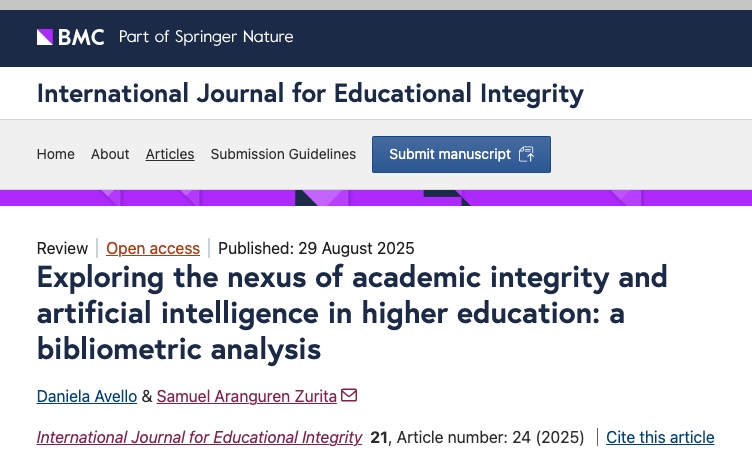
One of the great joys of being a journal editor is getting to share good news when a new article is published. I am going to make more of an effort to do this on my blog because the International Journal for Educational Integrity is a high quality (Q1) journal with lots to offer when it comes to academic integrity. We accept only about 10% of manuscripts submitted to the journal, so having an article published is a great achievment!
Artificial intelligence has created new opportunities in higher education, enhancing teaching and learning methods for both students and educators. However, it has also posed challenges to academic integrity.
Objective
To describe the evolution of scientific production on academic integrity and artificial intelligence in higher education.
Methodology
A bibliometric analysis was carried out using VOSviewer software and the Bibliometrix package in R. A total of 467 documents published between 2017 and 2025, retrieved from the Web of Science database, were analyzed.
Results
The analysis reveals a rapid expansion of the field, with an annual growth rate of 71.97%, concentrated in journals specializing in education, academic ethics, and technology. The field has evolved from a focus on the use of artificial intelligence in dishonest practices to the study of its integration in higher education. Four main lines of research were identified: the impact and adoption of artificial intelligence, implications for students, academic dishonesty, and associated psychological factors.
Conclusions
The field is at an early stage of development but is expanding rapidly, albeit with fragmented evolution, limited collaboration between research teams, and high editorial dispersion. The analysis shows a predominance of descriptive approaches, leaving room for the development of theoretical frameworks.
Originality or value
This study provides an overview and updated of the evolution of research on artificial intelligence and academic integrity, identifying trends, collaborations, and conceptual gaps. It highlights the need to promote theoretical reflection to guide future practice and research on the ethical use of artificial intelligence in higher education.
Sarah Elaine Eaton, PhD, is a Professor and Research Chair in the Werklund School of Education at the University of Calgary, Canada. Opinions are my own and do not represent those of my employer.
One of the tenets of postplgiarism is that artificial intelligence technologies will help us overcome language barriers and understand each other in countless languages (Eaton, 2023).
We already have apps that translate text from photos taken on our phones. These apps help when travelling in countries where you don’t speak the language. Now we have applications extending this idea further into wearable technology.
Wearable technology has existed for years. We wear fitness gadgets on our wrists to track steps. AI technology will become more embedded into the software that drives these devices.
New wearable devices have emerged quickly, with varying levels of success. One example was introduced about a year after ChatGPT was released. The company was called Humane and the device was powered by OpenAI technology.
The Humane pin was wearable technology that included a square-shaped pin and a battery pack that attached magnetically to your shirt or jacket. It was marketed as enabling users to communicate in just about any language (Pierce, 2023). To Star Trek fans, the resemblance to a communicator badge was unmistakable.
The device retailed for $700 US and required a software subscription of $24 USD per month, which provided data coverage for real-time use through their proprietary software based on a Snapdragon processor (Pierce, 2023). The device only worked with the T-Mobile network in the United States. Since I live in Canada and T-Mobile isn’t available here, I never bought one.
Like others, I watched with enthusiasm, hoping the product would succeed so it could expand to other markets. Pre-order sales indicated huge potential for success. By late 2023, the Humane pin was heralded as “Silicon Valley’s ‘next big thing'” (Chokkattu, 2025a). (I can’t help but wonder if the resemblance to a Star Trek communicator badge was part of the allure.)
When tech enthusiasts received the product in 2024, the reviews were dismal. One reviewer gave it 4 out of 10 and called it a “party trick” (Chokkattu, 2024). (Ouch.) The Humane pin did not live up to its promises. Less than a year after its release, the device was dead. HP acquired the company and retired the product at the end of February 2025.
Tech writer Julian Chokkattu declared the device was e-waste and suggested it could be used as a paperweight or stored in a box in the attic. Chokkattu (2025b) says, “In 50 years, you’ll accidentally find it in the attic and then tell your grandkids how this little gadget was once—for a fleeting moment—supposed to be the next big thing.”
Learning from Failure: The Promise Remains
The failure of the Humane AI Pin does not invalidate the vision of AI-powered real-time translation. The device failed because of execution problems—poor battery life, overheating, an annoying projector interface, and limited functionality (Chokkattu, 2024). The core AI translation capabilities were among the features that actually worked.
Real-time translation represents one of the most compelling applications of generative AI. When the technology works seamlessly, it can transform human communication. The Humane pin showed us what not to do: create a standalone device with too many functions, none executed well.
The future of AI translation likely lies not in dedicated hardware but in integration with devices we already use. Our smartphones, earbuds, and smart glasses will become the vehicles for breaking down language barriers. The underlying AI models continue to improve rapidly, and the infrastructure for real-time translation grows more robust.
The Humane pin’s failure teaches us that good ideas require good execution. But we should not abandon the goal of using AI to help humans understand each other across languages. That goal remains as important as ever in our increasingly connected world. The technology will improve, the interfaces will become more intuitive, and the promise of the postplagiarism tenet—that language barriers will begin to disappear—will eventually be realized.
The Humane AI pin may be dead, but we should keep our hope alive that AI technology will help us overcome language barriers and provide new opportunities for communication.
Eaton, S. E. (2023). Postplagiarism: Transdisciplinary ethics and integrity in the age of artificial intelligence and neurotechnology. International Journal for Educational Integrity, 19(1), 1–10. https://doi.org/10.1007/s40979-023-00144-1
Sarah Elaine Eaton, PhD, is a Professor and Research Chair in the Werklund School of Education at the University of Calgary, Canada. Opinions are my own and do not represent those of my employer.


 Posted by Sarah Elaine Eaton, Ph.D.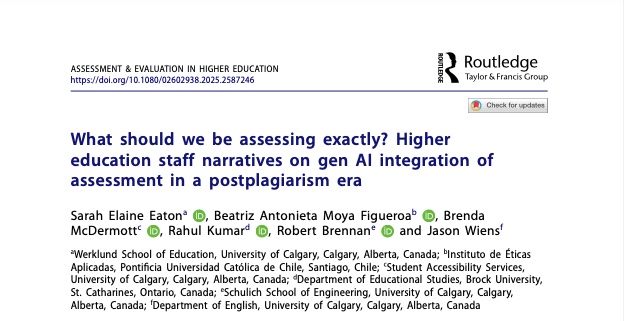


 Learning, Teaching and Leadership
You must be logged in to post a comment.