Gemini Live: Breaking Educational Barriers with AI

April 19, 2025

Gemini Live is Google’s new conversational AI assistant that responds to voice commands in real-time. Unlike text-based interactions, Gemini Live allows for natural, flowing conversations. This voice-first approach opens new possibilities for accessibility in educational settings. It was released last month, and I just got around to trying it today. Here’s how it went:

I was impressed by the tool’s interactivity and speed. In this test I scanned a laptop sticker with the hashtag #UHaveIntegrity, which is from our academic integrity campaign at the University of Calgary. The app correctly identified it and gave me a brief description.

I did a few subsequent tests with other items afterwards. It did not always have 100% accuracy, but with additional prompting, it corrected errors and provided updated information.

I can think of a variety of uses for this kind of app for teaching and learning. In particular, I am excited about the possibilities to enhance accessibility, inclusion, and equity.

Breaking Down Barriers with Voice Interaction

The voice interface of Gemini Live can remove some barriers for students. Students with mobility limitations, visual impairments, or reading difficulties can participate in learning activities through speech. This creates a more level playing field in the classroom.

Imagine a scenario where a teacher uses Gemini Live to help a student with dyslexia engage with research projects. The student could ask questions verbally and receive information without struggling with text. This hypothetical case illustrates how voice interaction might lead to increased confidence and class participation.

Multilingual Support for Diverse Classrooms

Language barriers often create obstacles in education. Gemini Live supports multiple languages and can translate between them. This feature helps:

  • Non-native English speakers follow lessons in their first language
  • International students integrate into new learning environments
  • Teachers communicate with students from different linguistic backgrounds
  • Parents who speak other languages stay involved in their children’s education

Learning Accommodations Made Simple

Every student learns differently. Gemini Live can adapt content to different learning needs. Here are some examples:

  1. It can explain complex concepts in simpler terms for students who need additional support
  2. It provides alternative explanations when students don’t understand a topic the first time
  3. It offers audio descriptions of visual content for visually impaired students
  4. It can generate study materials in different formats to match learning preferences

Real-Time Assistance in the Classroom

Teachers often struggle to provide individual attention to every student in a classroom. Gemini Live can serve as an additional resource that students can turn to when they need help. This can reduce wait times and frustration.

As a hypothetical example, a high school math teacher could implement Gemini Live as a ‘homework helper’ station in the classroom. Students who get stuck on problems could ask Gemini Live for guidance without waiting for the teacher to become available. This approach would allow more students to receive timely support while waiting for personalized attention from their teacher.

Digital Equity Through Voice Access

Not all students have equal access to technology or equal ability to use traditional interfaces. Voice technology lowers the technical barriers to using digital tools. Students without keyboards, mice, or touchscreens can still access information and complete assignments through voice commands.

Practical Implementation Tips

In thinking about how we could use use Gemini Live and similar tools for accessibility and inclusion, here are some ideas:

  • Create specific prompts that students can use to get help with different subjects
  • Set up dedicated stations where students can interact with Gemini Live
  • Teach students how to ask effective questions
  • Combine Gemini Live with other AI tools for a comprehensive accessibility solution

Challenges and Considerations

It is important for teachers to be aware that the tool is not perfect (at least as it currently stands). Although Gemini Live offers benefits, it currently has certain limitations.

  • Voice recognition may struggle with some speech patterns or accents
  • Private conversations require appropriate spaces to avoid classroom disruption
  • Students need guidance on when AI assistance is appropriate and when it isn’t
  • Technology should supplement, not replace, human teaching and interaction

Looking Forward

As AI assistants like Gemini Live continue to evolve, they will provide even more tools for inclusive education. The most successful classrooms will be those that thoughtfully blend technology with human instruction.

By incorporating Gemini Live into teaching practices, educators can create learning environments that accommodate more students. The goal isn’t just to make education accessible but to ensure every student feels valued and included in the learning process. When we remove barriers to education, we unlock potential — and that’s one of the most fun parts of being an educator.

–——–-

Share this post: Gemini Live: Breaking Educational Barriers with AI – https://drsaraheaton.com/2025/04/19/gemini-live-breaking-educational-barriers-with-ai/

This blog has had over 3.7 million views thanks to readers like you. If you enjoyed this post, please ‘Like’ it using the button below or share it on social media. Thanks!

Sarah Elaine Eaton, PhD, is a Professor and Research Chair in the Werklund School of Education at the University of Calgary, Canada. Opinions are my own and do not represent those of my employer. 


Fake Degrees, Fraudulent Credentials and the Ecosystem of Commercial Academic Fraud

April 10, 2025

Since 2020 I’ve been working with a number of collaborators on projects related to fake degrees, diploma mills, and credential fraud. One of the people I have had the privilege of working with is FBI Special Agent (ret.), Allen Ezell, who is one of the world’s leading experts on  fake degrees and accreditation fraud. 

I’ve spent countless hours on the phone with Allen and have exchanged dozens, if not hundreds, of e-mails with him, over the years. Now in his 80s, Allen is one of the world’s finest experts on the topic. He contributed a fascinating chapter called “Yesterday, today, and tomorrow: A tour of Axact, the ‘World’s Largest Diploma Mill’” to our book, Fake Degrees and Fraudulent Credentials in Higher Education

We also learned from other contributors to the book that the companies who sell fake credentials don’t stop there. They can also provide contact cheating services (often under the guise of ‘research services’), fake admission letters, fake transcripts, fraud in standardized testing (e.g., sending impersonators to write English language proficiency tests), and much more. 

In the introduction for the book, we connect the dots to show how admissions fraud, contract cheating (e.g., term paper mills), scientific and scholarly paper mills, and fake degrees and fraudulent credentials are all connected. We synthesize the key ideas in this infographic:

Diagram titled "The Ecosystem of Commercial Academic Fraud" by Eaton & Carmichael (2022), showing four overlapping colored circles, each representing a type of academic fraud, with "Fraud" in the center where all circles overlap. The categories are: Degree Mills (red): Fake and fraudulent diplomas, transcripts, reference letters, and other academic and professional documents. Contract Cheating (orange): Outsourced student academic work including term paper mills, assignment completion services, thesis writing services, and student proxy services. Admissions Fraud (green): Impersonation and fraud services for standardized admissions testing (e.g., SATs), language proficiency testing, and unethical educational agents. Paper Mills (blue): Manufactured scholarly and scientific publications, authorship for sale. Each category overlaps in the center to show they are part of a broader ecosystem of fraud. The image includes a citation and Creative Commons license at the bottom.

It is difficult to get a handle on the exact size and scope of the industry, but based on what we know, we estimated that the industry is worth at least $21 Billion USD, and we figure that is a low estimate.

Throughout the past half-decade, we’ve developed a number of resources related to these topics. I’ve posted about them previously, but I figured it might be helpful if I gathered some of them into a single blog post. They are all freely available as open access resources.

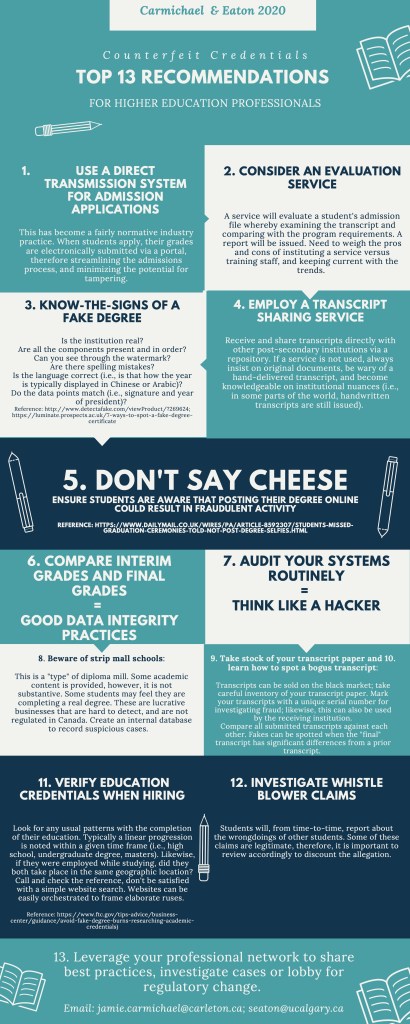
Counterfeit Credentials: 13 Recommendations for Higher Education Professionals

Infographic titled "Counterfeit Credentials: Top 13 Recommendations for Higher Education Professionals" by Carmichael & Eaton (2020). It offers guidance to help institutions detect and prevent the use of fake degrees and fraudulent documents in admissions and hiring. The recommendations are:
1.	Use a direct transmission system for admission applications – Electronic grade submissions reduce tampering.
2.	Consider an evaluation service – Evaluate transcripts against program requirements.
3.	Know the signs of a fake degree – Check for authenticity, spelling, watermarks, correct language, matching data points.
4.	Employ a transcript sharing service – Use secure repositories or verify hand-delivered transcripts.
5.	Don't say cheese – Warn students not to post degrees online due to risk of fraud.
6.	Compare interim and final grades – Ensures data integrity.
7.	Audit your systems routinely – Think like a hacker to uncover weaknesses.
8.	Beware of strip mall schools – Diploma mills that mimic real institutions; create internal databases for tracking.
9.	Take stock of your transcript paper – Use serial numbers and compare for inconsistencies.
10.	Learn how to spot a bogus transcript – Identify fakes by comparing submitted transcripts.
11.	Verify education credentials when hiring – Check for linear academic progression and verify references beyond website searches.
12.	Investigate whistleblower claims – Some student reports may be legitimate and need proper review.
13.	Leverage your professional network – Share practices, investigate cases, or lobby for change.
References and contact emails (jamie.carmichael@carleton.ca; seaton@ucalgary.ca) are included for further information.

This infographic is intended mainly for registrars, admissions staff, admissions committees and others whose work involves assessing the credentials of applicants for university and college programs. 

Scholarships Without Scruples

In this infographic, Jamie Carmichael and I share signs of scholarship scams, which is one from of educational fraud:

Infographic titled “Scholarships Without Scruples – 3 Signs of Scholarship Scams.” Credit Card Required: Don’t give out your credit card number. Legitimate scholarship applications never ask for this information. Discount in Disguise: You should not have to buy anything to receive a scholarship. Legit scholarships never require payment for goods or services. Tax Trickery: Legit scholarships are taxed differently than earned income. If proper tax documentation isn’t provided, it may not be a real scholarship. At the bottom: “Find out more” – Contact information for Sarah Elaine Eaton (University of Calgary, seaton@ucalgary.ca) and Jamie Carmichael (Carleton University, Jamie.Carmichael@Carleton.ca). Footer text: “Scholarship scams are real. Learn how to protect yourself!”

When it comes to education fraud, there are many angles to consider. There is certainly a need for more research, awareness, and advocacy on these topics, especially as GenAI can make these types of fraud easier.

Below are some related posts and further resources that I hope you find helpful.

Related posts

References and Resources

  • Carmichael, J. (2023, June 7). Understanding Fake Degrees and Credential Fraud in Higher Ed. The Evollution: A Modern Campus Illumination. https://evolllution.com/programming/credentials/understanding-fake-degrees-and-credential-fraud-in-higher-ed/
  • Carmichael, J. J. (2024). Reframing and Broadening Adversarial Stylometry for Academic Integrity. In S. E. Eaton (Ed.), Second Handbook of Academic Integrity (pp. 1467-1485). Springer Nature Switzerland. https://doi.org/10.1007/978-3-031-54144-5_148 
  • Carmichael, J., & Eaton, S. E. (2020). Counterfeit Credentials: Top 13 Recommendations for Higher Education Professionals (Infographic). University of Calgary. http://hdl.handle.net/1880/113042 
  • Clark, A. (2023). Examining the problem of fraudulent English test scores: What can Canadian higher education institutions learn? In S. E. Eaton, J. J. Carmichael, & H. Pethrick (Eds.), Fake Degrees and Fraudulent Credentials in Higher Education (pp. 187-207). Springer International Publishing. https://doi.org/10.1007/978-3-031-21796-8_9 
  • Çelik, Ö., & Razı, S. (2023). Avoiding favouritism in the recruitment practice of Turkish higher education institutions. In S. E. Eaton, J. J. Carmichael, & H. Pethrick (Eds.), Fake Degrees and Fraudulent Credentials in Higher Education (pp. 153-167). Springer International Publishing. https://doi.org/10.1007/978-3-031-21796-8_7 
  • DeCoster, B. (2023). There is no culture? A framework for addressing admissions fraud. In S. E. Eaton, J. J. Carmichael, & H. Pethrick (Eds.), Fake Degrees and Fraudulent Credentials in Higher Education (pp. 209-226). Springer International Publishing. https://doi.org/10.1007/978-3-031-21796-8_10 
  • Duklas, J. (2023). Bridging to tomorrow: A historical and technological review of credential exchange in higher education within Canada. In S. E. Eaton, J. J. Carmichael, & H. Pethrick (Eds.), Fake Degrees and Fraudulent Credentials in Higher Education (pp. 95-113). Springer International Publishing. https://doi.org/10.1007/978-3-031-21796-8_4
  • Eaton, S. E., & Carmichael, J. (2020). Scholarships without scruples (Infographic). University of Calgary: http://hdl.handle.net/1880/113044
  • Eaton, S. E., & Carmichael, J. (2022). The Ecosystem of Commercial Academic Fraud. University of Calgary. https://dx.doi.org/10.11575/PRISM/40330
  • Eaton, S. E., Carmichael, J., & Pethrick, H. (Eds.). (2023). Fake degrees and credential fraud in higher education. Springer. https://doi.org/10.1007/978-3-031-21796-8
  • Ezell, A. (2023). Yesterday, today, and tomorrow: A tour of Axact, the “World’s Largest Diploma Mill”. In S. E. Eaton, J. J. Carmichael, & H. Pethrick (Eds.), Fake Degrees and Fraudulent Credentials in Higher Education (pp. 49-94). Springer International Publishing. https://doi.org/10.1007/978-3-031-21796-8_3 
  • Hextrum, K. (2023). Fair play, fraud, or fixed? Athletic credentials in U.S. higher education. In S. E. Eaton, J. J. Carmichael, & H. Pethrick (Eds.), Fake Degrees and Fraudulent Credentials in Higher Education (pp. 115-132). Springer International Publishing. https://doi.org/10.1007/978-3-031-21796-8_5
  • Orim, S.-M., & Glendinning, I. (2023). Corruption in admissions, recruitment, qualifications and credentials: From research into quality assurance. In S. E. Eaton, J. J. Carmichael, & H. Pethrick (Eds.), Fake Degrees and Fraudulent Credentials in Higher Education (pp. 133-151). Springer International Publishing. https://doi.org/10.1007/978-3-031-21796-8_6
  • Sabbaghan, S., & Fazel, I. (2023). None of the above: Integrity concerns of standardized English proficiency tests. In S. E. Eaton, J. J. Carmichael, & H. Pethrick (Eds.), Fake Degrees and Fraudulent Credentials in Higher Education (pp. 169-185). Springer International Publishing. https://doi.org/10.1007/978-3-031-21796-8_8

–——–-

Share this post: Fake Degrees, Fraudulent Credentials and the Ecosystem of Commercial Academic Fraud – https://drsaraheaton.com/2025/04/10/fake-degrees-fraudulent-credentials-and-the-ecosystem-of-commercial-academic-fraud/

This blog has had over 3.7 million views thanks to readers like you. If you enjoyed this post, please ‘Like’ it using the button below or share it on social media. Thanks!

Sarah Elaine Eaton, PhD, is a Professor and Research Chair in the Werklund School of Education at the University of Calgary, Canada. Opinions are my own and do not represent those of my employer. 


Dignity: A Foundation of Academic Integrity

April 8, 2025

In our pursuit of knowledge, we often focus on policies, consequences, and detection systems. Yet at the heart of academic integrity lies something fundamental: human dignity.

When we produce original work, we honor our intellectual journey and the dignity of those whose ideas we build upon. Attribution acknowledges that knowledge creation is a collaborative endeavor spanning generations.

Academic integrity shouldn’t be about avoiding punishment, but rather, about recognizing the worth in honest intellectual exchange. It’s understanding that shortcuts diminish our growth and the trust that sustains scholarly communities.

As educators and learners, we can frame integrity less as compliance and more as respect – for ourselves, peers, and institutions that facilitate collective wisdom. When we approach academic work with dignity as our compass, integrity follows.

–——–-

Share this post: Dignity: A Foundation of Academic Integrity – https://drsaraheaton.com/2025/04/08/dignity-a-foundation-of-academic-integrity/

This blog has had over 3.7 million views thanks to readers like you. If you enjoyed this post, please ‘Like’ it using the button below or share it on social media. Thanks!

Sarah Elaine Eaton, PhD, is a Professor and Research Chair in the Werklund School of Education at the University of Calgary, Canada. Opinions are my own and do not represent those of my employer. 


Celebrating 5 Years of Integrity Hour in Canadian Higher Education

March 31, 2025

Five years ago we started Integrity Hour, an online community of Practice by and for Canadian higher education #AcademicIntegrity enthusiasts, professionals, educators, researchers, and students. 

Today we had our five-year celebration, which also served as a closure of sorts. After serving as a co-steward of the community almost since the beginning, Dr. Beatriz Moya has started the next chapter of her career. 

We are working with some of our long-standing partners to reconceptualize what the next iteration of Integrity Hour will look like. For now, we will take a little pause as we regroup.

At our anniversary celebration meeting today, Brooklin Schneider encouraged us to share this guide widely, so we are posting it here, as an open access resource: “Integrity Hour: A Guide to  Developing and Facilitating an Online Community of Practice for Academic Integrity”.

Our collective outputs have been collaboratively conceptualized and co-developed. Here are a couple of other resources we have worked on over the years:

Reflections on the first year of Integrity Hour: An online community of practice for academic integrity

Academic Integrity Leadership and Community Building in Canadian Higher Education

In my remarks today I shared that being part of this weekly community of practice has influenced and informed my thinking, advocacy, and practice in way I could never have imagined. 

My gratitude to everyone who has been part of our community, sharing wisdom, knowledge, and resources. What an incredible half a decade it has been!

________________________

Share this post: Celebrating 5 Years of Integrity Hour in Canadian Higher Education – https://drsaraheaton.com/2025/03/31/celebrating-5-years-of-integrity-hour-in-canadian-higher-education/

This blog has had over 3.7 million views thanks to readers like you. If you enjoyed this post, please ‘Like’ it using the button below or share it on social media. Thanks!

Sarah Elaine Eaton, PhD, is a Professor and Research Chair in the Werklund School of Education at the University of Calgary, Canada. Opinions are my own and do not represent those of my employer. 


Academic Integrity on Trial: Mark Carney’s Case and the Politics of Plagiarism

March 29, 2025

Gosh, we humans love a good scandal, don’t we? The recent allegations against Liberal leader Mark Carney regarding plagiarism in his 1995 Oxford doctoral thesis raise important questions about how we define, detect, and respond to plagiarism in academic and public life.

Drawing from both the specifics of Carney’s case and broader discussions about academic integrity, several important themes emerge:

The Pattern of Plagiarism Witch Hunts

In my January 2024 blog post, “Plagiarism Witch Hunts Cause Harm,” about the case of former Harvard University President, Dr. Claudine Gay, I pointed out that we appear to be in an era where plagiarism is increasingly weaponized against public figures. Following the resignation of Dr. Gay amid plagiarism allegations, we have seen a troubling pattern of using academic integrity as a political weapon rather than an educational concern. 

This weaponization is particularly concerning when we consider the broader landscape of academic integrity issues. 

In my 2020 investigation “Is the Hon. Demetrios Nicolaides, Alberta Minister of Advanced Education involved with contract cheating?”, I showed how careful we must be in assessing evidence before making accusations. That investigation highlighted the need for rigorous verification when claiming someone has violated academic integrity, especially when political motivations might be involved. For the record, the analysis that I conducted for that blog post took me several days to complete.

The National Post’s investigation of Carney’s thesis identified several instances of alleged plagiarism, including unattributed quotes and paraphrasing from authors such as Michael Porter and Jeremy Stein. This follows a pattern seen in previous high-profile cases where decades-old academic work is scrutinized through modern lenses of academic integrity.

The Complexities of Defining Plagiarism

One critical aspect highlighted across these cases is the lack of universal agreement on what constitutes plagiarism. There is no singular or universally accepted definition of plagiarism. Oxford University defines it as “presenting work or ideas from another source as your own.” However, interpretations of definitions, as well as the definitions themselves can vary from one university to the next, as I have pointed out elsewhere.

In Carney’s case, his doctoral supervisor defended his work, stating she saw “no evidence of plagiarism in the thesis,” whereas academics consulted by the National Post disagreed. One professor, Dr. Geoffrey Sigalet, a political science professor at the University of British Columbia Okanagan (UBCO) stated that the unattributed quotes are “what we call plagiarism.” According to the National Post article, Dr. Sigalet is a member of the UBCO’s institutional president’s advisory committee on student discipline, “which handles cases of plagiarism for the university”. This disagreement underscores the subjectivity in evaluating academic integrity.

If you are curious about the UBCO Rules for President’s Advisory Committee on Student Discipline, they are publicly available here. Of note is that in allegations of academic misconduct, section 9.c of the regulations state that the committee must “provide the student with a copy of the Statement of Case and any documentary evidence and list of any witnesses”, and it is expected that the individual alleged to have engaged in misconduct has a right to know the case being brought against them before the matter is decided. This is a basic principle of procedural fairness in academic misconduct investigations and case management.

Upon reading the National Post article, one question that I had was: was Mr. Carney informed of the allegations before they were investigated?

Post-Facto Investigations and Their Consequences

The timing of these allegations is noteworthy. Investigating work completed nearly 30 years ago raises questions about motives and impact. As I have pointed out previously when I commented on the Dr. Claudine Gay case, “a retroactive investigation into a person’s academic work while they were a student is often an exercise in discrediting someone in their current professional role.”

For Carney, these allegations emerge as he serves as Liberal Leader and campaigns in a federal election—timing that raises questions about political motivations rather than genuine concerns about academic integrity.

The Role of Academic Supervision

An often-overlooked aspect of these cases is the responsibility of academic supervisors. I asked this question with respect to the Dr. Claudine Gay case, and it bears repeating: Where are all the graduate supervisors? In Carney’s case, his supervisor, Dr. Margaret Meyer, Oxford University has defended his work, noting it was “evaluated and approved by a faculty committee.” 

This comment is not insignificant because highlights the collective responsibility of the academic community in ensuring academic integrity. As in other high-profile cases of student PhD theses being scrutinized for plagiarism post-graduation, a big question — and I mean, a really big question —is, how could the academic supervisors, faculty committee members, and academic examiners, allow a student to pass their PhD thesis if it was rife with plagiarism? We may never be able to answer this question in this case, or in the cases of countless other allegations of academic misconduct that arise after a student has graduated.

If we take a wraparound approach to student success, then everyone in the educational ecosystem plays a role in supporting to students to write and research ethically. This is, quite literally, our job as professors.

So, Did Mark Carney Plagiarize or Not?

The answer is, I don’t know. When I conduct an analysis of text for possible plagiarism, it is a meticulously in-depth and detailed process. I start with the allegedly plagiarized text and I go through it line-by-line comparing it to the original sources from which text has been allegedly lifted without attribution. That can show whether or not there is a potential ‘text match’. There are examples of possible text matches in the National Post article, but they are selective. I cannot make a call on whether or not there was plagiarism based on excerpts. I would want to see the full texts (original and allegedly plagiarized), not bits and pieces.

If we can identify a possible text match, then we need to look for additional evidence. Was this sloppy scholarship or poor academic literacy? For example, were the original sources perhaps listed in the bibliography, but the direct quotations were not attributed in the main body of the text? In the context of the entire thesis, would it appear as though the student was deliberately trying to deceive their supervisor or academic advisory committee. (Intent to deceive is difficult, if not impossible to prove in many cases.) 

Were there drafts of the work that were reviewed by the supervisor or committee that commented on the content, as well as as technical aspects of citing and referencing? If not, how was the student supported to ensure that their research was done properly?

When I conduct an analysis of text for plagiarism, it can take me days or weeks, depending on the length of the text and the complexity of the case. When an individual’s reputation is on the line, I take even greater care, knowing that my findings might have an impact on their career or their future. There can be a great deal at stake in high-profile cases of plagiarism. A thorough investigation takes time and expertise and quite frankly, any plagiarism expert worth their reputation would insist on taking the time they need before drawing conclusions in such matters.

So, dear readers, if you are looking for me to weigh in with a definitive stance on this case, you are going to be disappointed. I simply have too many questions to draw a reasonable conclusion on the matter. 

Human Rights and Due Process

What I can say is this: due process, procedural fairness, and human rights matter. When we allege, investigate, and manage cases of plagiarism or misconduct, the accused, regardless of whether they are a student, a professor, a politician, or anyone else, deserves at the very least to have their human rights upheld. 

Even though Article 11 of the United Nations Universal Declaration of Human Rights states everyone is “entitled to a fair and public hearing by an independent and impartial tribunal” in case after case of public allegations of plagiarism, we can observe that there is due process is often bypassed, with accused individuals presumed to be guilty and forced to prove their own innocence.

The topic of how basic human rights and dignity are dismissed in academic cheating cases is something I have written about in some detail. No matter who you are, if you are accused of misconduct, you have the right to be treated with basic human dignity while the matter is under investigation and being decided. Whether you are a member of the United Conservative Party of Alberta alleged to have engaged in contract cheating, a Black woman who is president of Harvard University accused of plagiarism, or the liberal prime minister of Canada, human beings are entitled to dignity and due process.

Moving Forward: Balance in Academic Integrity

The Carney case, like those before it, shows a need for a balanced approach to academic integrity that:

  1. Distinguishes between technical citation errors (i.e., sloppiness) and an outright intention to deceive (even if intent is difficult to prove).
  2. Considers the standards and practices of the time when work was produced.
  3. Respects due process and presumes innocence until proven guilty.
  4. Acknowledges the shared responsibility of academic communities, and in particular, the responsibilities of graduate supervisors and academic advisors.
  5. Recognizes when allegations may be politically motivated.
  6. Prioritizes educational responses over punitive approaches (i.e., providing students with an opportunity to learn how to cite and reference properly).

Rather than using plagiarism as a weapon to discredit public figures, we could focus on strengthening current academic integrity practices and supporting students and researchers to write and research well, which includes proper attribution. Academic integrity is a foundation for ethical decision-making in everyday life and in one’s career.

As we evaluate these allegations against Mark Carney, we should consider not just the specific instances cited but also the context, timing, and potential consequences of how we frame and respond to questions of academic and professional integrity in public life. 

Final note

For what it is worth, if this case had been against Pierre Poilievre instead of Mark Carney, my position would be exactly the same, because integrity matters no matter which side of the political bench you sit on.

________________________

Share this post: Academic Integrity on Trial: Mark Carney’s Case and the Politics of Plagiarism – https://drsaraheaton.com/2025/03/29/academic-integrity-on-trial-mark-carneys-case-and-the-politics-of-plagiarism/

This blog has had over 3.7 million views thanks to readers like you. If you enjoyed this post, please ‘Like’ it using the button below or share it on social media. Thanks!

Sarah Elaine Eaton, PhD, is a Professor and Research Chair in the Werklund School of Education at the University of Calgary, Canada. Opinions are my own and do not represent those of my employer.