AI Use and Ethics Among Jordanian University Students

November 19, 2025

885 university students in Jordan “generally viewed AI use for tasks such as translation, literature reviews, and exam preparation as ethically acceptable, whereas using AI to cheat or fully complete assignments was widely regarded as unacceptable.”

Check out the latest article in the International Journal for Educational Integrity by Marwa M. Alnsour, Hamzeh Almomani, Latifa Qouzah, Mohammad Q.M. Momani, Rasha A. Alamoush & Mahmoud K. AL-Omiri, “Artificial intelligence usage and ethical concerns among Jordanian University students: a cross-sectional study“.

Screenshot of the title page of a research article published in the International Journal for Educational Integrity. The article is titled “Artificial intelligence usage and ethical concerns among Jordanian University students: a cross-sectional study.” It is marked as “Research” and “Open Access” with a purple header. Authors listed are Marwa M. Alnsour, Hamzeh Almomani, Latifa Qouzah, Mohammad Q.M. Momani, Rasha A. Alamoush, and Mahmoud K. Al-Omiri. The DOI link and journal details appear at the top.

Synopsis

This cross-sectional study examined artificial intelligence usage patterns and ethical awareness among 885 higher education students across various disciplines. Findings showed how Jordanian university students engage with AI tools like ChatGPT in their academic work.

Key Findings

High AI Adoption: A substantial 78.1% of students reported using AI during their studies, with approximately half using it weekly or daily. ChatGPT emerged as the most popular tool (85.2%), primarily used for answering academic questions (53.9%) and completing assignments (46.4%).

Knowledge Gaps: Although 57.5% considered themselves moderately to very knowledgeable about AI, only 44% were familiar with ethical guidelines. Notably, 41.8% were completely unaware of principles guiding AI use, revealing a significant gap between usage and ethical understanding.

Disciplinary Differences: Science and engineering students demonstrated the highest usage rates and knowledge levels, while humanities students showed lower engagement but expressed the strongest interest in training. Health sciences students displayed greater ethical concerns, possibly reflecting the high-stakes nature of their field.

Ethical Perceptions: Students generally viewed AI use for translation, proofreading, literature reviews, and exam preparation as acceptable. However, 39.8% had witnessed unethical AI use, primarily involving cheating or total dependence on AI. Only 35% expressed concern about ethical implications, suggesting many may not fully recognize potential risks.

Demographic Patterns: Female students demonstrated higher ethical awareness than males. Older students and those in advanced programs (particularly PhD students) showed greater AI knowledge and ethical consciousness, with each additional year of age correlating with increased awareness scores.

Training Needs: More than three quarters (76.7%) of students expressed interest in professional training on ethical AI use, with 83.7% agreeing that guidance is necessary. However, 46.6% indicated their institutions had not provided adequate support (which should surprise exactly no one, since similar findings have been found in other studies.)

Implications

The author call for Jordanian universities to develop clear, discipline-specific ethical guidelines and structured training programs. The researchers recommend implementing mandatory online modules, discipline-tailored workshops, and establishing dedicated AI ethics bodies to promote responsible use. These findings underscore the broader challenge facing higher education globally: ensuring students can leverage AI’s benefits while maintaining academic integrity and developing critical thinking skills.

______________

Share this post: AI Use and Ethics Among Jordanian University Students https://drsaraheaton.com/2025/11/19/ai-use-and-ethics-among-jordanian-university-students/

Sarah Elaine Eaton, PhD, is a Professor and Research Chair in the Werklund School of Education at the University of Calgary, Canada. Opinions are my own and do not represent those of my employer.


Latest IJEI article is out! “Exploring the nexus of academic integrity and artificial intelligence in higher education: a bibliometric analysis” 

August 29, 2025

One of the great joys of being a journal editor is getting to share good news when a new article is published. I am going to make more of an effort to do this on my blog because the International Journal for Educational Integrity is a high quality (Q1) journal with lots to offer when it comes to academic integrity. We accept only about 10% of manuscripts submitted to the journal, so having an article published is a great achievment!

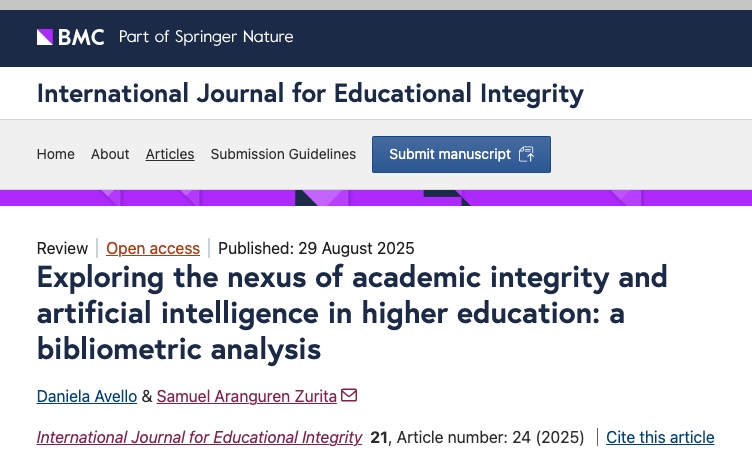
Check out the latest article, “Exploring the nexus of academic integrity and artificial intelligence in higher education: a bibliometric analysis” by Daniela Avello and Samuel Aranguren Zurita.

The image shows a webpage from the International Journal for Educational Integrity, part of Springer Nature. The header includes navigation links for Home, About, Articles, and Submission Guidelines, along with a "Submit manuscript" button. The featured article is titled "Exploring the nexus of academic integrity and artificial intelligence in higher education: a bibliometric analysis" by Daniela Avello and Samuel Aranguren Zurita. It is marked as open access, published on 29 August 2025, and appears in volume 21, article number 24. Citation options are available at the bottom.

Abstract

Background

Artificial intelligence has created new opportunities in higher education, enhancing teaching and learning methods for both students and educators. However, it has also posed challenges to academic integrity.

Objective

To describe the evolution of scientific production on academic integrity and artificial intelligence in higher education.

Methodology

A bibliometric analysis was carried out using VOSviewer software and the Bibliometrix package in R. A total of 467 documents published between 2017 and 2025, retrieved from the Web of Science database, were analyzed.

Results

The analysis reveals a rapid expansion of the field, with an annual growth rate of 71.97%, concentrated in journals specializing in education, academic ethics, and technology. The field has evolved from a focus on the use of artificial intelligence in dishonest practices to the study of its integration in higher education. Four main lines of research were identified: the impact and adoption of artificial intelligence, implications for students, academic dishonesty, and associated psychological factors.

Conclusions

The field is at an early stage of development but is expanding rapidly, albeit with fragmented evolution, limited collaboration between research teams, and high editorial dispersion. The analysis shows a predominance of descriptive approaches, leaving room for the development of theoretical frameworks.

Originality or value

This study provides an overview and updated of the evolution of research on artificial intelligence and academic integrity, identifying trends, collaborations, and conceptual gaps. It highlights the need to promote theoretical reflection to guide future practice and research on the ethical use of artificial intelligence in higher education.

Check out the full article here.

________________________

Share this post: Latest IJEI article is out! “Exploring the nexus of academic integrity and artificial intelligence in higher education: a bibliometric analysis” – https://drsaraheaton.com/2025/08/29/latest-ijei-article-is-out-exploring-the-nexus-of-academic-integrity-and-artificial-intelligence-in-higher-education-a-bibliometric-analysis/

Sarah Elaine Eaton, PhD, is a Professor and Research Chair in the Werklund School of Education at the University of Calgary, Canada. Opinions are my own and do not represent those of my employer.


Three tips for future-proofing academic and research integrity this year

January 2, 2025

In my 2024 annual editorial for the International Journal for Educational Integrity, was entitled, ’Future-proofing integrity in the age of artificial intelligence and neurotechnology: prioritizing human rights, dignity, and equity

Here are three things you can do to prioritize human rights and dignity when it comes to policies and procedures to address allegations of academic or research misconduct:

Use a human-rights-by-design approach to developing, revising, and implementing policies by conducting a comprehensive review of existing academic integrity policies. Update policies to explicitly incorporate human rights principles, ensuring they address fair process, privacy, equitable treatment, and respect for human dignity. It is essential to involve individuals from representative groups in this process.

Provide ongoing training, education, and support to faculty, staff, and students about human rights principles and how they apply to misconduct investigations and case management. Create orientation programs that explain expectations for ethical conduct while respecting diverse cultural perspectives. Offer workshops and resources, peer mentoring programs, and support services.

Focus on continuous improvement and quality assurance of ethics and integrity practices by gathering feedback from students, faculty, staff and relevant stakeholders. Regularly review misconduct case management processes and data to ensure equitable treatment across different demographics.

Implementing human rights principles into misconduct investigations and case management helps to create more effective and sustainable learning environments. This approach prioritizes people over punishment, dignity over draconianism, and compassion over callousness.

Read the full article here: https://edintegrity.biomedcentral.com/articles/10.1007/s40979-024-00175-2 

Related post:

Future-proofing integrity in the age of artificial intelligence and neurotechnology: Prioritizing human rights, dignity, and equity

________________________

Share this post: Three tips for future-proofing academic and research integrity this year – https://drsaraheaton.com/2025/01/02/three-tips-for-future-proofing-academic-and-research-integrity-this-year/

This blog has had over 3 million views thanks to readers like you. If you enjoyed this post, please “like” it or share it on social media. Thanks!

Sarah Elaine Eaton, PhD, is a Professor and Research Chair in the Werklund School of Education at the University of Calgary, Canada. Opinions are my own and do not represent those of my employer. 


How to Get Your Academic Article Published in a High Quality Journal

January 2, 2024
An info graphic with a title, by-line and five blocks of text. There is a graphic of a pencil with five arrows coming out of it.

This month marks the beginning of my fourth year as editor-in-chief of the International Journal for Educational Integrity. Before that I served as co-editor and before that, I served as a reviewer and article author. Last year, the journal received its first impact factor (4.6), putting it in the 95th percentile of all journals in the field of educational research. Since that happened, the number of submissions the journal has received seems to have skyrocketed. Every week I am reviewing submissions from authors eager to have their work published in a Q1 (top quartile) academic journal. In this post I offer five tips on how to get your work published in a top-ranking journal.

Tip #1: Read the Aims and Scope

Ensure your manuscript fits with the aims and scope of the journal. The number one reason I reject manuscripts outright without sending them for peer review is that the topic of the manuscript has no relevance whatsoever to our journal. Reputable journals publish their aims and scope on their website. As an example, here are the Aims and Scope of the International Journal for Educational Integrity

As an interdisciplinary journal, we receive submissions from just about every academic field you can imagine, but just because a journal is interdisciplinary does not mean that anything goes. When I get a manuscript about the efficacy rates of a pesticide or new developments related to geo-spatial heat maps, I reject it automatically because the topic is outside the scope of our journal. Manuscripts that are about education broadly, but that have no direct connection to ethics and integrity, also get a desk rejection.

If you want to publish your article in a high quality journal, ensure it aligns with the aims and scope of the journal.

Tip #2: Focus on Quality

Poor-quality writing is one of the main reasons manuscripts get a desk rejection. Ensure the quality of your manuscript is your top priority. Markers of quality include, but are not limited to, writing that is comprehensible and error-free. (The odd typo can be fixed during the revision process.) Quality also means including a literature review that demonstrates that you understand previous scholarship in the field, a detailed methods section, and an in-depth analysis. The findings should show original contributions to the field, along with the limitations of the work.

Articles that are theoretical or conceptual in nature should still have a clear structure and be organized in a way that the reader can follow. The problem/gap/hook heuristic is one way to frame a conceptual article so that the value to the reader is clear.

Submissions that are difficult to read, either because of poor writing or because they lack organization, are more likely to be rejected. This does not mean that all articles have to follow a cookie-cutter formula. Unconventional articles can be interesting and valuable, but the reader still has to be able to follow them.

Tip #3: Follow the Submission Guidelines

Ensure your submission fits with the submission guidelines of the journal. Do not wait for a desk rejection and then tell the editor you can reformat the manuscript. Submit according to the guidelines.

I have had prospective authors argue with me via e-mail when I reject or request a revision to their submissions on the basis that their manuscript does not follow the journal’s guidelines. Arguing with an editor about how you do not have time or interest in submitting according to the journal’s guidelines is unlikely to persuade an editor that your submission should be reviewed. Saying that you will revise or reformat the submission only if your article is accepted is a fast track to a rejection.

Tip #4: Do Your Homework

Read recently published articles in the journal to understand what kinds of submissions make the cut. It can also be helpful to understand who the editors and editorial board members are and how their expertise contributes to the journal.

I reviewed a submission that claimed that female students were inherently prone to academic cheating because of their gender. (The main argument was that women are more morally corrupt than men.) Um…. Pardon me?!

Needless to say that the submission was problematic (and rejected) for a number of reasons, not the least of which was a lack of scientific basis for the claims made in the submission. As I conducted my preliminary editorial review, it occurred to me that the authors probably had no idea that the editor was a woman… And why would they, when only 8% of editors-in-chief of academic journals are women? It might not have even occurred to them to check. (If they had, they could have saved themselves the trouble of submitting…)

A quick check of the Editorial Board can give you a glimpse into who provides leadership for a journal. Reviewing the information about the editorial board is likely to provide an incomplete picture at best, but it can be helpful.

Tip #5: Provide Value 

Ensure that your manuscript adds something new to the existing knowledge base. The best academic articles provide value to the reader and the wider scientific or scholarly community. Always keep your reader in mind. One reason submissions get rejected is that the authors are so self-absorbed in themselves and their own ideas or goals is that they fail to consider individual readers as well as the collective readership of the journal as a whole.

When prospective authors beg me to publish their article because they need a publication to graduate, get hired, keep their jobs, or get promoted, my heart aches. This is a sign of systemic dysfunction of academia in general, but it is a one that a journal editor cannot solve. The article itself must provide value to the reader or the piece is unlikely to get published. The more value you can provide to the readers, the more likely it is your manuscript will be published in a high-quality journal.

There are lots of other things to say about how to get your work published in a high-quality academic journal, but I’ll stop for now, as this covers some of the basics. I hope these tips are helpful for getting your academic work published in the coming year(s).

____________________________

Share this post: How to Get Your Academic Article Published in a High Quality Journal – https://drsaraheaton.wordpress.com/2024/01/02/how-to-get-your-academic-article-published-in-a-high-quality-journal/

This blog has had over 3 million views thanks to readers like you. If you enjoyed this post, please “like” it or share it on social media. Thanks!

Sarah Elaine Eaton, PhD, is a faculty member in the Werklund School of Education at the University of Calgary, Canada. Opinions are my own and do not represent those of my employer.

Sarah Elaine Eaton, PhD, Editor-in-Chief, International Journal for Educational Integrity


#ICAI2021 Re-cap: My Reflections on International Collaborations

March 5, 2021

I was delighted to take part in three sessions for the International Center for Academic Integrity (ICAI) conference, which was held online this week. With over 1200 registrants, this was the largest ICAI conference ever.

In terms of my own contributions to the conference, this year I focused on collaborative work with others. For me, this means that the work is conceptualized and developed jointly, every step of the way. The end result is stronger, more interesting, and more dynamic than if it had been created by any one individual alone. In an article I co-authored with Rachael Edino a few years ago, we showed that academic integrity research in Canada has mostly been small scale and has lacked collaboration across institutions and across countries. Ever since, I have been on a mission to actively engage in and promote research collaborations that not only include researchers from multiple institutions, but extend to international partnerships, too. I am super excited to say that goal was certainly achieved through collaborative presentations at this year’s ICAI conference, as I had the opportunity to showcase work with 6 colleagues and 1 PhD student, spread out across 7 countries. Here’s a recap:

Student Perspectives on the Impact of Race in Educational Surveillance and Proctoring Technologies

Parnther & Eaton #ICAI2021 Slide 1

Ceceilia Parnther, St. John’s University, USA

Sarah Elaine Eaton, University of Calgary, Canada

Presentation date: March 1, 2021

# of registered session participants: 349

Parnther & Eaton #ICAI2021 Slide 2

Session re-cap: We brought a critical race perspective to electronic and remote proctoring technologies that have become prevalent during COVID-19. E-proctoring is a rapidly growing technology for higher-education institutions. Although this technology is promoted as a method to promote academic integrity by offering faculty control over the remote testing environment, students have expressed concern and anxiety about these monitoring tools. Specifically, students note anxiety and discomfort resulting from the use of these tools. These feelings may be exacerbated for students of colour due to the algorithmic biases that position whiteness as normative. We interrogate the ethical complexities of e-proctoring and other academic integrity technologies through the lens of equity and diversity.

A Chilean Perspective on Academic Integrity During COVID-19: Analyzing Possible Benefits and Challenges of Online Learning Communities

Moya & Eaton #ICAI2021 - Slide 1

Beatriz Moya Figueroa, University of Calgary, Canada

Sarah Elaine Eaton, University of Calgary, Canada

Presentation date: March 1, 2021

# of registered session participants: 78

Overview: Beatriz is a new PhD student studying with me at the University of Calgary. This session marked Beatriz’s debut into the international academic integrity community. Due to COVID-19, Beatriz has remained in her home country of Chile throughout the pandemic and has not yet been able to physically come to Canada. She has been getting to know members of the Canadian academic integrity community by joining into our weekly Integrity Hour. This experience of working virtually across several months during Beatriz’s first year as a PhD students served as the basis for this collaborative session.

Session description: The COVID-19 pandemic pushed Chilean universities towards a quick transition into emergency remote teaching. Moreover, faculty identified a rapid increase in academic misconduct cases and the need to promote an academic integrity culture in their institutions. This new scenario called for new strategies to exchange academic integrity practices to help face the pandemic’s obstacles. In this presentation, we analyze the possible benefits and challenges of online learning communities for Chilean higher education institutions inspired by the experience of the Canadian “Integrity hour” online learning community. We also discuss new opportunities as the effects of COVID-19.

You can check out the video recording of our session here.

Publishing Your Academic Integrity Research: Advice From the Editorial Board of the International Journal for Educational Integrity

IJEI Presentation #ICAI2021

Sarah Elaine Eaton, University of Calgary, Canada

Tomáš Foltýnek, Mendel University in Brno, Czech Republic

Zeenath Reza Khan, University of Wollongong in Dubai (UOWD), UAE

Thomas Lancaster, Imperial College London, UK

Ann Rogerson, University of Wollongong, Australia

Presentation date: March 4, 2021

# of registered session participants: 77

Whova - Screen Shot 2021-03-05 at 12.13.28 PM - IJEI

Session recap: We offered an interactive workshop on how to publish your academic integrity research. This session is offered by editorial board members of the International Journal for Educational Integrity.

Learning Outcomes:
Understand what makes excellent quality academic integrity research; what is publishable in a high-quality peer-reviewed journal and what is not; Understand how to prepare a manuscript for submission to a peer-reviewed scholarly journal; Learn how the journals’ scope and submission guidelines are important for prospective authors; Discuss pitfalls of the publication process and how to avoid them; and Gain insights into what double-blind peer review is and how it works. Check out an abbreviated session recording here.

Reflections: This session was the most logistically complex, by far. We had 5 presenters co-presenting in real time from 5 countries across 5 very different time zones. The session was held at 14:00 Eastern, which meant that Ann Rogerson was just rolling out of bed at 06:00 the next day in Wollongong. Needless to say, she arrived with coffee in hand. Meanwhile, Zeenath Reza Khan was looking forward to going to bed after the workshop, as the session was starting at 11:00 p.m. for her over in Dubai. It was noon for me in Calgary, 19:00 for Thomas Lancaster in the UK, and 20:00 for Tomáš Foltýnek in Brno.

This was the first time the five of us had ever co-presented together and our preparations for this session happened entirely asynchronously, using Google slides and also corresponding via e-mail to prepare the entire presentation. We each had slides assigned to us to speak to, but due to the time zones, we did not do a practice run for the session. For me, this was the most incredible presentation as it was truly a privilege to collaborate with so many dedicated colleagues from so many corners of the world. I can’t say for sure, but I think we might have been the most internationally diverse presentation team at this year’s conference.

Concluding Reflections

The conference organizers did a tremendous job of planning and delivering an excellent online event. None of the sessions I took part in either as a co-presenter or as a participant had any technical issues, which really speaks to how much preparation went into this conference prior to the event and “in the background” during the conference itself.

As others with expertise in educational technology will attest, the technology works best when it is invisible. That is to say, when there are technology problems, everyone turns their focus to the tech issues, often at the expense of developing human connections. In this case, the technology itself was very much invisible and the opportunity to connect with fellow collaborators in a very human sense was a highlight of the conference for me.

I think the most remarkable part of co-presenting all of these sessions is that the virtual environment facilitated and provided opportunities to collaborate across countries and time zones. Although I have had the pleasure of meeting Ann Rogerson and Thomas Lancaster in person at previous events, I have yet to meet any of my other fellow collaborators “in real life”. I very much look forward to the day when that happens.

In expect that by the time we get the meet face to face, it will be like meeting old friends and we will slip into conversations and laughter easily. To be able to collaborate with so many international colleagues from across continents was a special and remarkable aspect to this virtual conference.

_____

Share or Tweet this: #ICAI2021 Re-cap: My Reflections on International Collaborations – https://drsaraheaton.wordpress.com/2021/03/05/icai21-re-cap-my-reflections-on-international-collaborations/

This blog has had over 2 million views thanks to readers like you. If you enjoyed this post, please “like” it or share it on social media. Thanks!

Sarah Elaine Eaton, PhD, is a faculty member in the Werklund School of Education, and the Educational Leader in Residence, Academic Integrity, University of Calgary, Canada.

Opinions are my own and do not represent those of the University of Calgary or anyone else.