The Impact of Workplace Incivility on Higher Education

August 23, 2025

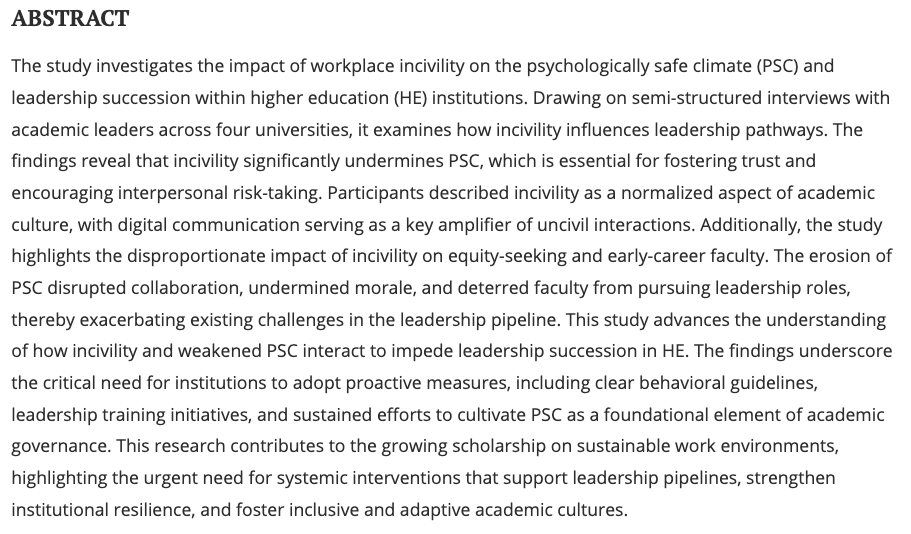
I am pleased to have collaborated with Dr. Leda Stawnychko and Ms. Rafi Mehnaz on this new article, “Exploring the impact of workplace incivility on psychological safety and leadership succession in higher education” in the International Journal for Leadership in Education.

I first met Leda Stawnychko when she was an EdD student at the University of Calgary. I had the pleasure of serving on her supervisory committee to support her doctor of education research project on Leadership Development Experiences of Department Chairs at a Canadian University.

When Leda invited me to join her later for a project on psychological safety and leadership succession in higher education, I accepted right away. This topic is important one and it rarely gets discussed in the literature on academic integrity, but as we know, professional and collegial ethics are part of a comprehensive approach to academic integrity.

As we point out in the abstract and in the main body of the article, there is a disproportionate impact of incivility on equity-seeking and early-career faculty. In other words, those who are already marginalized and experience barriers and discrimination are more likely to be on the receiving end of workplace incivility and hostility.

I’ve said it before and I’ll say it again: There can be no integrity without equity. We need to think more about the way that higher education as a system allows for the perpetuation of discrimination and harm, not only for students, but also for faculty and staff. If the workplace is not a psychologically safe environment, then employees cannot thrive.

I invite you to check out the article, which is open access and free to read and download.

________________________

Share this post: The Impact of Workplace Incivility on Higher Education – https://drsaraheaton.com/2025/08/23/the-impact-of-workplace-incivility-on-higher-education/

Sarah Elaine Eaton, PhD, is a Professor and Research Chair in the Werklund School of Education at the University of Calgary, Canada. Opinions are my own and do not represent those of my employer.

Teaching Fact-Checking Through Deliberate Errors: An Essential AI Literacy Skill

April 23, 2025

Abstract

This teaching resource explores an innovative pedagogical approach for developing AI literacy in a postplagiarism era. The document outlines a method of teaching fact-checking skills by having students critically evaluate AI-generated content containing deliberate errors. It provides practical guidance for educators on creating content with strategic inaccuracies, structuring verification activities, teaching source evaluation through a 5-step process, understanding AI error patterns, and implementing these exercises throughout courses. By engaging students in systematic verification processes, this approach helps develop metacognitive awareness, evaluative judgment, and appropriate skepticism when consuming AI-generated information. The resource emphasizes assessing students on their verification process rather than solely on error detection, preparing them to navigate an information landscape where distinguishing fact from fiction is increasingly challenging yet essential.

Here is a downloadable .pdf of this teaching activity:

Introduction

In a postplagiarism era, one of the most valuable skills we can teach students is how to critically evaluate AI-generated content. This can help them to cultivate meta-cognition and evaluative judgement, which have been identified as important skills for feedback and evaluation (e.g., Bearman and Luckin, 2020; Tai et al., 2018). Gen AI tools present information with confidence, regardless of accuracy. This characteristic creates an ideal opportunity to develop fact-checking competencies that serve students throughout their academic and professional lives.

Creating Content with Strategic Errors

Begin by generating content through an AI tool that contains factual inaccuracies. There are several approaches to ensure errors are present:

  • Ask the AI about obscure topics where it lacks sufficient training data
  • Request information about recent events beyond its knowledge cutoff
  • Pose questions about specialized fields with technical terminology
  • Combine legitimate questions with subtle misconceptions in your prompts

For example, ask a Large Language Model (LLM), such as ChatGPT (or any similar tool) to ‘Explain the impact of the Marshall-Weaver Theory on educational psychology’. There is no such theory, at least to the best of my knowledge. I have fabricated it for the purposes of illustration. The GenAI will likely fabricate details, citations, and research.

Structured Verification Activities

Provide students with the AI-generated content and clear verification objectives. Structure the fact-checking process as a systematic investigation.

First, have students highlight specific claims that require verification. This focuses their attention on identifying testable statements versus general information.

  • Next, assign verification responsibilities using different models:
  • Individual verification where each student investigates all claims
  • Jigsaw approach where students verify different sections then share findings
  • Team-based verification where groups compete to identify the most inaccuracies

Require students to document their verification methods for each claim. This documentation could include:

  • Sources consulted
  • Search terms used
  • Alternative perspectives considered
  • Confidence level in their verification conclusion

Requiring students to document how they verified each claim can help them develop meta-cognitive awareness about their own learning and experience how GenAI’s outputs should be treated with some skepticism and gives them specific strategies to verify content for themselves.

Teaching Source Evaluation: A 5-Step Process

The fact-checking process creates a natural opportunity to reinforce source evaluation skills.

As teachers, we can guide students to follow a 5-step plan to learn how to evaluate the reliability, truthfulness, and credibility of sources.

  • Step 1: Distinguish between primary and secondary sources. (A conversation about how terms such as ‘primary source’ and ‘secondary source’ can mean different things in different academic disciplines could also be useful here.)
  • Step 2: Recognize the difference between peer-reviewed research and opinion pieces. For opinion pieces, editorials, position papers, essays, it can be useful to talk about how these different genres are regarded in different academic subject areas. For example, in the humanities, an essay can be considered an elevated form of scholarship; however, in the social sciences, it may be considered less impressive than research that involves collecting empirical data from human research participants.
  • Step 3: Evaluate author credentials and institutional affiliations. Of course, we want to be careful about avoiding bias when doing this. Just because an author may have an affiliation with an ivy league university, for example, that does not automatically make them a credible source. Evaluating credentials can — and should — include conversations about avoiding and mitigating bias.
  • Step 4: Identify publication date and relevance. Understanding the historical, social, and political context in which a piece was written can be helpful.
  • Step 5: Consider potential biases in information sources. Besides bias about an author’s place of employment, consider what motivations they may have. This can include a personal or political agenda, or any other kind of motive. Understanding a writer’s biases can help us evaluate the credibility of what they write.

Connect these skills to your subject area by discussing authoritative sources specific to your field. What makes a source trustworthy in history differs from chemistry or literature.

Understanding Gen AI Error Patterns

One valuable aspect of this exercise goes beyond identifying individual errors to recognizing patterns in how AI systems fail. As educators, we can facilitate discussions about:

  • Pattern matching versus genuine understanding
  • How training data limitations affect AI outputs
  • The concept of AI ‘hallucination’ and why it occurs
  • Why AI presents speculative information as factual
  • How AI systems blend legitimate information with fabricated details

Connect these skills to your subject area by discussing authoritative sources specific to your field. What makes a source trustworthy in history differs from chemistry or literature.

Practical Implementation

Integrate these fact-checking exercises throughout your course rather than as a one-time activity. Start with simple verification tasks and progress to more complex scenarios. Connect fact-checking to course content by using AI-generated material related to current topics.

Assessment should focus on the verification process rather than simply identifying errors. Evaluate students on their systematic approach, source quality, and reasoning—not just error detection.

As AI-generated content becomes increasingly prevalent, fact-checking skills are an important academic literacy skill. By teaching students to approach information with appropriate skepticism and verification methods, we prepare them to navigate a postplagiarism landscape where distinguishing fact from fiction becomes both more difficult and more essential.

References

Eaton, S. E. (2023). Postplagiarism: Transdisciplinary ethics and integrity in the age of artificial intelligence and neurotechnology. International Journal for Educational Integrity, 19(1), 1-10. https://doi.org/10.1007/s40979-023-00144-1

Edwards, B. (2023, April 6). Why ChatGPT and Bing Chat are so good at making things up. Arts Technica. https://arstechnica.com/information-technology/2023/04/why-ai-chatbots-are-the-ultimate-bs-machines-and-how-people-hope-to-fix-them/

Tai, J., Ajjawi, R., Boud, D., Dawson, P., & Panadero, E. (2018). Developing evaluative judgement: enabling students to make decisions about the quality of work. Higher Education, 76(3), 467-481. https://doi.org/10.1007/s10734-017-0220-3

Disclaimer: This content is crossposted from: https://postplagiarism.com/2025/04/23/teaching-fact-checking-through-deliberate-errors-an-essential-ai-literacy-skill/

________________________

Share this post: Teaching Fact-Checking Through Deliberate Errors: An Essential AI Literacy Skill – https://drsaraheaton.com/2025/04/23/teaching-fact-checking-through-deliberate-errors-an-essential-ai-literacy-skill/

Sarah Elaine Eaton, PhD, is a Professor and Research Chair in the Werklund School of Education at the University of Calgary, Canada. Opinions are my own and do not represent those of my employer.


Academic Integrity on Trial: Mark Carney’s Case and the Politics of Plagiarism

March 29, 2025

Gosh, we humans love a good scandal, don’t we? The recent allegations against Liberal leader Mark Carney regarding plagiarism in his 1995 Oxford doctoral thesis raise important questions about how we define, detect, and respond to plagiarism in academic and public life.

Drawing from both the specifics of Carney’s case and broader discussions about academic integrity, several important themes emerge:

The Pattern of Plagiarism Witch Hunts

In my January 2024 blog post, “Plagiarism Witch Hunts Cause Harm,” about the case of former Harvard University President, Dr. Claudine Gay, I pointed out that we appear to be in an era where plagiarism is increasingly weaponized against public figures. Following the resignation of Dr. Gay amid plagiarism allegations, we have seen a troubling pattern of using academic integrity as a political weapon rather than an educational concern. 

This weaponization is particularly concerning when we consider the broader landscape of academic integrity issues. 

In my 2020 investigation “Is the Hon. Demetrios Nicolaides, Alberta Minister of Advanced Education involved with contract cheating?”, I showed how careful we must be in assessing evidence before making accusations. That investigation highlighted the need for rigorous verification when claiming someone has violated academic integrity, especially when political motivations might be involved. For the record, the analysis that I conducted for that blog post took me several days to complete.

The National Post’s investigation of Carney’s thesis identified several instances of alleged plagiarism, including unattributed quotes and paraphrasing from authors such as Michael Porter and Jeremy Stein. This follows a pattern seen in previous high-profile cases where decades-old academic work is scrutinized through modern lenses of academic integrity.

The Complexities of Defining Plagiarism

One critical aspect highlighted across these cases is the lack of universal agreement on what constitutes plagiarism. There is no singular or universally accepted definition of plagiarism. Oxford University defines it as “presenting work or ideas from another source as your own.” However, interpretations of definitions, as well as the definitions themselves can vary from one university to the next, as I have pointed out elsewhere.

In Carney’s case, his doctoral supervisor defended his work, stating she saw “no evidence of plagiarism in the thesis,” whereas academics consulted by the National Post disagreed. One professor, Dr. Geoffrey Sigalet, a political science professor at the University of British Columbia Okanagan (UBCO) stated that the unattributed quotes are “what we call plagiarism.” According to the National Post article, Dr. Sigalet is a member of the UBCO’s institutional president’s advisory committee on student discipline, “which handles cases of plagiarism for the university”. This disagreement underscores the subjectivity in evaluating academic integrity.

If you are curious about the UBCO Rules for President’s Advisory Committee on Student Discipline, they are publicly available here. Of note is that in allegations of academic misconduct, section 9.c of the regulations state that the committee must “provide the student with a copy of the Statement of Case and any documentary evidence and list of any witnesses”, and it is expected that the individual alleged to have engaged in misconduct has a right to know the case being brought against them before the matter is decided. This is a basic principle of procedural fairness in academic misconduct investigations and case management.

Upon reading the National Post article, one question that I had was: was Mr. Carney informed of the allegations before they were investigated?

Post-Facto Investigations and Their Consequences

The timing of these allegations is noteworthy. Investigating work completed nearly 30 years ago raises questions about motives and impact. As I have pointed out previously when I commented on the Dr. Claudine Gay case, “a retroactive investigation into a person’s academic work while they were a student is often an exercise in discrediting someone in their current professional role.”

For Carney, these allegations emerge as he serves as Liberal Leader and campaigns in a federal election—timing that raises questions about political motivations rather than genuine concerns about academic integrity.

The Role of Academic Supervision

An often-overlooked aspect of these cases is the responsibility of academic supervisors. I asked this question with respect to the Dr. Claudine Gay case, and it bears repeating: Where are all the graduate supervisors? In Carney’s case, his supervisor, Dr. Margaret Meyer, Oxford University has defended his work, noting it was “evaluated and approved by a faculty committee.” 

This comment is not insignificant because highlights the collective responsibility of the academic community in ensuring academic integrity. As in other high-profile cases of student PhD theses being scrutinized for plagiarism post-graduation, a big question — and I mean, a really big question —is, how could the academic supervisors, faculty committee members, and academic examiners, allow a student to pass their PhD thesis if it was rife with plagiarism? We may never be able to answer this question in this case, or in the cases of countless other allegations of academic misconduct that arise after a student has graduated.

If we take a wraparound approach to student success, then everyone in the educational ecosystem plays a role in supporting to students to write and research ethically. This is, quite literally, our job as professors.

So, Did Mark Carney Plagiarize or Not?

The answer is, I don’t know. When I conduct an analysis of text for possible plagiarism, it is a meticulously in-depth and detailed process. I start with the allegedly plagiarized text and I go through it line-by-line comparing it to the original sources from which text has been allegedly lifted without attribution. That can show whether or not there is a potential ‘text match’. There are examples of possible text matches in the National Post article, but they are selective. I cannot make a call on whether or not there was plagiarism based on excerpts. I would want to see the full texts (original and allegedly plagiarized), not bits and pieces.

If we can identify a possible text match, then we need to look for additional evidence. Was this sloppy scholarship or poor academic literacy? For example, were the original sources perhaps listed in the bibliography, but the direct quotations were not attributed in the main body of the text? In the context of the entire thesis, would it appear as though the student was deliberately trying to deceive their supervisor or academic advisory committee. (Intent to deceive is difficult, if not impossible to prove in many cases.) 

Were there drafts of the work that were reviewed by the supervisor or committee that commented on the content, as well as as technical aspects of citing and referencing? If not, how was the student supported to ensure that their research was done properly?

When I conduct an analysis of text for plagiarism, it can take me days or weeks, depending on the length of the text and the complexity of the case. When an individual’s reputation is on the line, I take even greater care, knowing that my findings might have an impact on their career or their future. There can be a great deal at stake in high-profile cases of plagiarism. A thorough investigation takes time and expertise and quite frankly, any plagiarism expert worth their reputation would insist on taking the time they need before drawing conclusions in such matters.

So, dear readers, if you are looking for me to weigh in with a definitive stance on this case, you are going to be disappointed. I simply have too many questions to draw a reasonable conclusion on the matter. 

Human Rights and Due Process

What I can say is this: due process, procedural fairness, and human rights matter. When we allege, investigate, and manage cases of plagiarism or misconduct, the accused, regardless of whether they are a student, a professor, a politician, or anyone else, deserves at the very least to have their human rights upheld. 

Even though Article 11 of the United Nations Universal Declaration of Human Rights states everyone is “entitled to a fair and public hearing by an independent and impartial tribunal” in case after case of public allegations of plagiarism, we can observe that there is due process is often bypassed, with accused individuals presumed to be guilty and forced to prove their own innocence.

The topic of how basic human rights and dignity are dismissed in academic cheating cases is something I have written about in some detail. No matter who you are, if you are accused of misconduct, you have the right to be treated with basic human dignity while the matter is under investigation and being decided. Whether you are a member of the United Conservative Party of Alberta alleged to have engaged in contract cheating, a Black woman who is president of Harvard University accused of plagiarism, or the liberal prime minister of Canada, human beings are entitled to dignity and due process.

Moving Forward: Balance in Academic Integrity

The Carney case, like those before it, shows a need for a balanced approach to academic integrity that:

  1. Distinguishes between technical citation errors (i.e., sloppiness) and an outright intention to deceive (even if intent is difficult to prove).
  2. Considers the standards and practices of the time when work was produced.
  3. Respects due process and presumes innocence until proven guilty.
  4. Acknowledges the shared responsibility of academic communities, and in particular, the responsibilities of graduate supervisors and academic advisors.
  5. Recognizes when allegations may be politically motivated.
  6. Prioritizes educational responses over punitive approaches (i.e., providing students with an opportunity to learn how to cite and reference properly).

Rather than using plagiarism as a weapon to discredit public figures, we could focus on strengthening current academic integrity practices and supporting students and researchers to write and research well, which includes proper attribution. Academic integrity is a foundation for ethical decision-making in everyday life and in one’s career.

As we evaluate these allegations against Mark Carney, we should consider not just the specific instances cited but also the context, timing, and potential consequences of how we frame and respond to questions of academic and professional integrity in public life. 

Final note

For what it is worth, if this case had been against Pierre Poilievre instead of Mark Carney, my position would be exactly the same, because integrity matters no matter which side of the political bench you sit on.

________________________

Share this post: Academic Integrity on Trial: Mark Carney’s Case and the Politics of Plagiarism – https://drsaraheaton.com/2025/03/29/academic-integrity-on-trial-mark-carneys-case-and-the-politics-of-plagiarism/

This blog has had over 3.7 million views thanks to readers like you. If you enjoyed this post, please ‘Like’ it using the button below or share it on social media. Thanks!

Sarah Elaine Eaton, PhD, is a Professor and Research Chair in the Werklund School of Education at the University of Calgary, Canada. Opinions are my own and do not represent those of my employer. 


In Memory of J. Tim Goddard: More Than a Supervisor

January 23, 2025
A photo of J. Tim Goddard sitting on the steps of his artist studio. His black dog is sitting next to him.

The academic world has lost a remarkable educator and mentor with the passing of J. Tim Goddard, former University of Calgary professor and administrator who then went on to serve as  Dean of Education at the University of Prince Edward Island. Tim’s impact on higher education extended far beyond his administrative roles – he was a transformative figure in the lives of countless graduate students, myself included.

As my PhD supervisor from 2005 to 2009, Tim demonstrated an extraordinary ability to balance academic rigour with compassionate mentorship. He took a chance on my research into revenue-generating programs in higher education, recognizing the importance of examining how such initiatives could be administered ethically in an era of government funding cuts.

Tim’s dedication to his students was unwavering, even in the face of profound personal tragedy. In 2006, his daughter Captain Nicola Goddard was the first Canadian female soldier to be killed in combat during her time in Afghanistan. Despite this devastating loss, Tim continued to guide and support his graduate students with remarkable strength and grace.

What set Tim apart was his practical wisdom, delivered through memorable maxims that still guide many of us today. “This isn’t your magnum opus!” and “A good thesis is a finished thesis!” were frequent reminders to stay focused on completion rather than perfection. He had an uncanny ability to guide students back to their research path whenever they strayed too far into tangential explorations.

His mentorship extended beyond the academic realm. When I traveled to Charlottetown to write my thesis, Tim and his wife Sally opened their home to me – a gesture typical of how Tim viewed his students as extended family. Yet this warmth never compromised his high standards; his insistence on impeccable writing, citations, and APA formatting shaped many of us into better scholars.

J. Tim Goddard and Sarah Elaine Eaton in PEI. There is a lighthouse in the left background.

After retiring in 2018, Tim embraced new creative pursuits in painting and novel writing, approaching these endeavours with the same passion he brought to academia. His legacy lives on through the countless educators and researchers he mentored, who continue to apply his teachings in their own work and supervision of the next generation.

Tim Goddard understood that a PhD journey was not just about producing research, but about preparing for a career. He showed us how to be not just scholars, but mentors, teachers, and advocates for our own students. His influence will continue to ripple through generations of educators, researchers, and leaders in higher education.

________________________

Share this post: In Memory of J. Tim Goddard: More Than a Supervisor – https://drsaraheaton.com/2025/01/23/in-memory-of-j-tim-goddard-more-than-a-supervisor/

This blog has had over 3.7 million views thanks to readers like you. If you enjoyed this post, please ‘Like’ it using the button below or share it on social media. Thanks!

Sarah Elaine Eaton, PhD, is a Professor and Research Chair in the Werklund School of Education at the University of Calgary, Canada. Opinions are my own and do not represent those of my employer. 


Neuralink’s Clinical Trials in Canada

January 11, 2025

Last month CBC’s Geoff Leo did a great article on called, ‘No consequences’, for violating human rights in privately funded research in Canada. This was a bit of an eye opener, even for me.

He writes that, “Roughly 85 per cent of clinical trials in Canada are privately funded” and that research undergoes very little scrutiny by anyone.

One of the cases Geoff wrote about involved a research study that ran from 2014-2016 involving Indigenous children in Saskatchewan, aged 12-15, who were research subjects in a study that monitored their brainwaves. Student participants were recruited with the help of a Canadian school board.

The study was led by James Hardt, who runs something called the Biocybernaut Institute, a privately run business. According to Leo, James Hardt claims that “brainwave training can make participants smarter, happier and enable them to overcome trauma. He said it can also allow them to levitate, walk on water and visit angels.”

Geoff Leo digs deep into some of the ethical issues and I recommend reading his article.

So, that was last month. This month, I happened to notice that according to Elon Musk’s Neuralink website, Musk’s product has now been approved by Health Canada to recruit research participants. There’s a bright purple banner at the top of the Neuralink home page showing a Canadian flag that says, “We’ve received approval from Health Canada to begin recruitment for our first clinical trial in Canada”.

A screenshot of the Neuralink.com home page. On the bottom right is a blurred photo of a man wearing a ball cap, who appears to be in a wheelchair and using tubes as medical assistance. There is white text on the right-hand side. At the top is a purple banner with white text and a small Canadian flag.

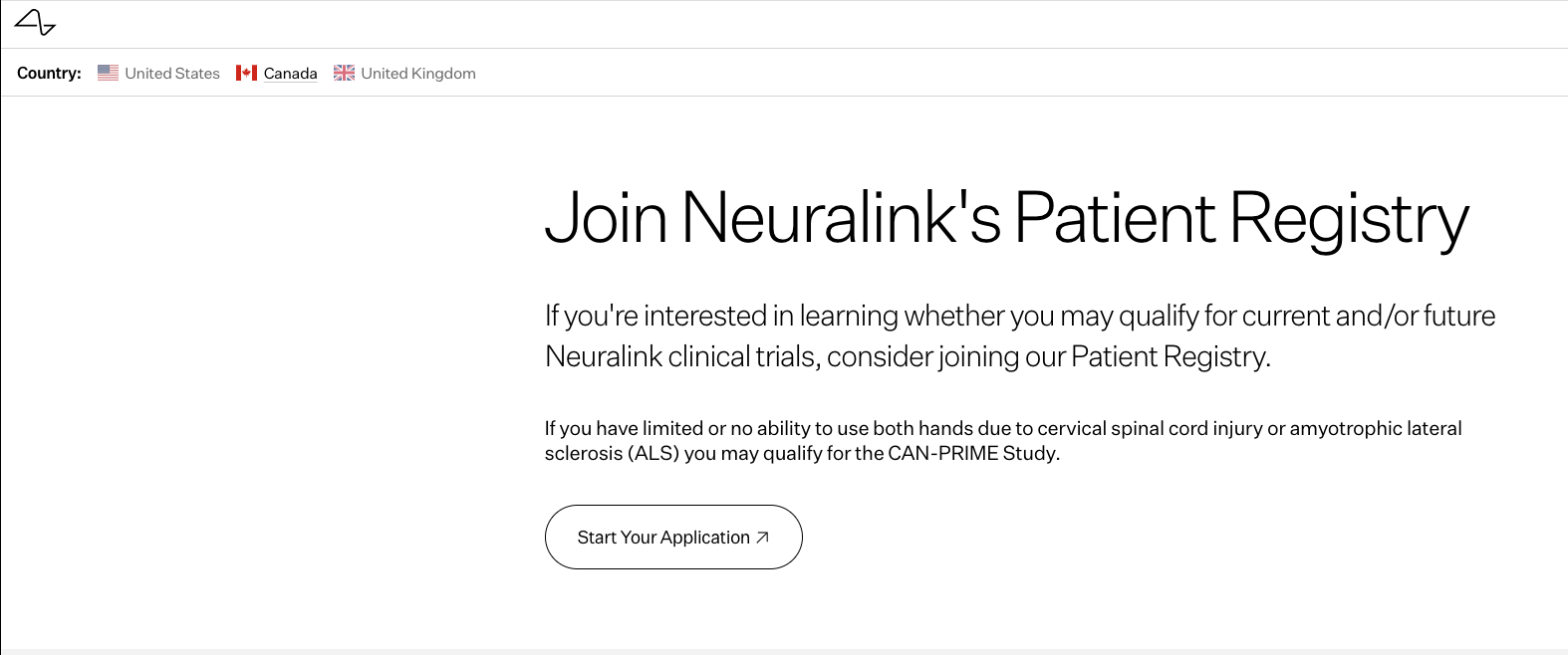
When you click on the link, you get to another page that shows the flags for the US, Canada, and the UK, where clinical trials are either underway or planned, it seems.

A screenshot of a webpage from the Neuralink web site. It has a white background with black text. In the upper left-hand corner there are three small flags, one each for the USA, Canada, and the UK.

The Canadian version is called CAN-PRIME. There’s a YouTube video promo/recruitment video for patients interested in joining, “this revolutionary journey”.

According to the website, “This study involves placing a small, cosmetically invisible implant in a part of the brain that plans movements. The device is designed to interpret a person’s neural activity, so they can operate a computer or smartphone by simply intending to move – no wires or physical movement are required.”

A screenshot from the Neuralink web page. The background is grey with black text.

So, just to connect the dots here… ten years ago in Canada there was a study involving neurotechnology that “exploited the hell out of” Indigenous kids, according to Janice Parente who leads the Human Research Standards Organization

Now we have Elon Musk’s company actively recruiting people from across Canada, the US, and the UK, for research that would involve implanting experimental technology into people’s brains without, it seems, much research ethics oversight at all.

What could possibly go wrong?

Reference

Leo, G. (2024, December 2). ‘No consequences’ for violating human rights in privately funded research in Canada, says ethics expert. https://www.cbc.ca/news/canada/saskatchewan/ethics-research-canada-privately-funded-1.7393063

________________________

Share this post: Neuralink’s Clinical Trials in Canada – https://drsaraheaton.com/2025/01/11/neuralinks-clinical-trials-in-canada/

This blog has had over 3.7 million views thanks to readers like you. If you enjoyed this post, please ‘Like’ it using the button below or share it on social media. Thanks!

Sarah Elaine Eaton, PhD, is a Professor and Research Chair in the Werklund School of Education at the University of Calgary, Canada. Opinions are my own and do not represent those of my employer.