Embracing Open Access: My Scholarly Commitment to Shared Knowledge

December 8, 2024

As I prepare for the 2024-2025 Werklund Distinguished Research Lecture, I’ve been reflecting about how important it is to make scholarly work accessible to all. Open access (OA) is more than just a publishing model—it is a philosophy that challenges traditional barriers to knowledge dissemination and embodies the true spirit of academic scholarship.

Breaking Down Barriers to Knowledge

Historically (at least in my lived historical experience in higher education), academic research has been locked behind expensive paywalls, creating a significant divide that extends far beyond academic institutions. This exclusionary model particularly impacts researchers and knowledge seekers who find themselves on the margins of academic privilege. Researchers in middle and low-income countries (LMICs) often struggle to access scholarly and scientific literature and independent scholars and community practitioners face substantial financial barriers to staying current in their fields. Students and educators with limited institutional resources find themselves cut off from the latest scholarly insights, and curious members of the public are shut out from understanding complex academic work that could potentially transform their understanding of the world.

The Ethical Imperative of Sharing

Research is fundamentally about advancing human understanding, and restricting access undermines this core mission. Open access is commitment to knowledge as a public good, enabling a more dynamic and inclusive approach to scholarly communication. By removing economic and institutional barriers, we create opportunities for faster dissemination of critical findings, increased global collaboration, and unprecedented transparency in research methodologies. This approach allows for more rapid scientific and social progress, breaking down the traditional silos that have long constrained academic discourse.

Amplifying Research Impact

Contrary to traditional concerns, open access actually enhances the visibility and influence of scholarly work. Publications that are freely available receive more citations and reach broader audiences. This expanded reach afforded through OA creates opportunities for interdisciplinary and transdisciplinary connections that might otherwise remain unexplored, allowing research to transcend the narrow confines of specialized academic journals and engage with a more diverse intellectual ecosystem.

Personal Commitment and Broader Vision

As I prepare for this lecture, I am reflecting deeply about my commitment to open access (OA). One of my goals is to create a more equitable, informed, and connected world. This isn’t only about making documents freely downloadable, but also about cultivating a more inclusive intellectual landscape where knowledge can flow freely, unencumbered by economic or institutional constraints.

Practical Pathways to Open Access

For researchers considering this path, the journey involves strategic choices and institutional engagement. I am grateful for the privilege of working at the University of Calgary where researchers can self-archive their works into our institutional digital repository, PRISM. 

Our university supports infrastructures that recognize and reward open access scholarship. Not everyone has this privilege.

Navigating Copyright and Publisher Agreements

Having said all this, I also recognize that it is important to abide by existing copyright agreements with publishers. Academic publishing involves complex legal and contractual relationships. Each publication typically comes with specific copyright terms that must be honoured (both ethically and legally), which may limit immediate or unrestricted sharing. 

Because of this, I won’t be able to share all my work with a Creative Commons licence— not if a publisher holds the copyright. It does mean that I will look for creative and ethical ways to maximize access while maintaining professional integrity and contractual obligations.

Concluding reflections

Open access is not just about free downloads—it’s about free thinking, free exploration, and our commitment to knowledge being a universal right, not a privileged access. The longer I work in higher education, the more I am thinking about the future of knowledge, teaching, learning, and creating opportunities for others to thrive. This is really what is driving me right now — creating opportunities for others to thrive. Making as much of my work freely available as open access resources is one way I can do this.

Here are some places you can find my work:

Google Scholar

Research Gate

University of Calgary PRISM digital repository

As we get closer to the lecture, I’ll be making more and more of my work available as free open access downloads. I’ll keep you updated as we get closer to the lecture.

Related posts

Re-released as a Free Open Access Resource: 101 Ways to Market Your Language Program (2002)

________________________

Share this post: Embracing Open Access: My Scholarly Commitment to Shared Knowledge – https://drsaraheaton.com/2024/12/08/embracing-open-access-my-scholarly-commitment-to-shared-knowledge/

This blog has had over 3 million views thanks to readers like you. If you enjoyed this post, please “like” it or share it on social media. Thanks!

Sarah Elaine Eaton, PhD, is a Professor and Research Chair in the Werklund School of Education at the University of Calgary, Canada. Opinions are my own and do not represent those of my employer.


Re-Released as a Free Open Access Resource: 101 Ways to Market Your Language Program (2002)

December 6, 2024

In 2002, I published the first edition of 101 Ways to Market Your Language Program. I have just re-released the book as a free open access resource under a Creative Commons (CC BY-NC-ND 4.0). The full book is now available as a free download.

How to cite this work:
Eaton, S. E. (2002/2024). 101 Ways to Market Your Language Program: A Practical Guide for Language Schools and Programs (2024 OA ed.). Eaton International Consulting Inc. https://hdl.handle.net/1880/120145

Abstract

2024 Re-release of the 2002 first edition of this book. The author and copyright holder has released this work under a Creative Commons (CC BY-NC-ND 4.0) license.

This book provides 101 ideas and strategies to empower overall marketing efforts: (1) “Put On Your Thinking Cap” (e.g., define the problem before marketing it, set reasonable goals, and create a niche); (2) “Secrets to Boost Your Marketing Power” (e.g., emphasize the benefits, check out the competition, and sell oneself in as many languages as possible); (3) “Marketing Materials: Tools and Tips to Do the Job Better” (e.g., make a brochure, get mentioned in other brochures, and make it easy to phone for information); (4) “Going Beyond the Basics to Increase Enrollment” (e.g, offer volume discounts and guarantees and give away tuition); (5) “Specialty Tips for Programs at Large Institutions” (e.g., make sure the Web site is easy to find, partner with other educational programs, and get the program mentioned in the calendar); (6) “The Power of People: A Human Touch to Increase Enrollment and Polish Your Image” (e.g., build loyalty with host families, establish win-win relationships, and follow exceptional service standards); (7) “Continue Marketing While Your Students are Enrolled” (e.g., meet students at the airport, partner with local businesses, and create happy memories); and (8) “How to Keep Marketing Once Your Program is Finished” (e.g., create an alumni network, review successes and failures, and plan ahead for next year).

Why Am I Re-Releasing This Work?

I have been invited to deliver the Werklund School of Education 2024-2025 Distinguished Research Lecture.

As part of the lead-up to the lecture, I have decided to make as much of my work as I can available as free, open access resources. This is recognition is a once-in-a-career kind of award and I’m working hard to make sure I can deliver. It is a hybrid public event and you can attend in person or online on March 20, 2025. If you’re interested, you can register here.

Since I am both the author and the copyright holder for this book, I can share it however I want. I am more committed now than ever to make as much of my work as possible freely available to others. Over the coming weeks, I’ll be sharing more links to more freely downloadable resources.

I am super grateful to the University of Calgary digital resources team who are helping me to archive these works.

If you know of someone working in second languages who could use a resource on marketing and recruitment for their program, feel free to share this with them.

________________________

Share this post: Re-released as a Free Open Access Resource: 101 Ways to Market Your Language Program (2002) – https://drsaraheaton.com/2024/12/06/re-released-as-a-free-open-access-resource-101-ways-to-market-your-language-program-2002/

This blog has had over 3 million views thanks to readers like you. If you enjoyed this post, please “like” it or share it on social media. Thanks!

Sarah Elaine Eaton, PhD, is a Professor and Research Chair in the Werklund School of Education at the University of Calgary, Canada. Opinions are my own and do not represent those of my employer.


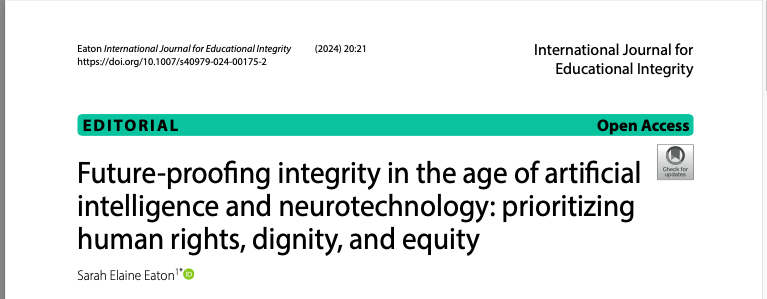
Future-proofing integrity in the age of artificial intelligence and neurotechnology: Prioritizing human rights, dignity, and equity

November 13, 2024

Once a year I write an editorial for the International Journal for Educational Integrity. I take a big idea, ground it in literature written by some of the best in the world and then call for ways to improve our field even more. In 2023 I wrote about Postplagiarism and in 2022, I focused on equity, diversity, inclusion, accessibility and decolonization as new priorities for academic integrity. Here is this year’s editorial:

Future-proofing integrity in the age of artificial intelligence and neurotechnology: prioritizing human rights, dignity, and equity

A screenshot of an article title page. There is black text on a white background with a green banner at the top.
Here is a link to the original: https://edintegrity.biomedcentral.com/articles/10.1007/s40979-024-00175-2

Abstract

In this article I argue for the prioritisation of human rights when developing and implementing misconduct policies. Existing approaches may be perpetuate inequities, particularly for individuals from marginalised groups. A human-rights-by-design approach, which centres human rights in policy development, revision, and implementation, ensuring that every individual is treated with dignity and respect.

Recommendations for implementing a human-rights approach to misconduct investigations and case management are offered, covering areas such as procedural fairness, privacy, equity, and the right to education. Additional topics covered are the need to limit surveillance technologies, and the need to recognize that not all use of artificial intelligence tools automatically constitutes misconduct. I disentangle

the differences between equity and equality and explain how both are important when considering ethics and integrity. A central argument of this paper is that a human-rights-by-design approach to integrity does not diminish standards but rather strengthens educational systems by cultivating ethical awareness and respect for personhood. I conclude with a call to action with a seven-point plan for institutions to adopt a human-rights-based approach to ethics and integrity. In the age of artificial intelligence and neurotechnology, insisting on human rights and dignity when we investigate and address misconduct allegations is an ethical imperative that has never been more important.

Keywords Academic misconduct, Academic dishonesty, Plagiarism, Policy, Human rights, Restorative justice, Artificial intelligence, Neurotechnology, Higher education, Education

Commentary

As I reflect on the current state of academic and research integrity, I am struck by a glaring omission in our discussions: the connection between misconduct and human rights. We often treat these as separate entities, failing to recognize the profound impact that misconduct investigations and policies can have on the fundamental rights of individuals. This oversight is particularly concerning in the age of artificial intelligence (AI) and neurotechnology, where the potential for harm is magnified.

Take, for example, the case of a professor in Canada who physically assaulted international students accused of plagiarism. This horrifying example demonstrates how the pursuit of academic integrity can be twisted into a justification for degrading and inhumane treatment, violating the very principles of dignity and respect that should guide our actions. While this is an extreme case, it highlights the need for a fundamental shift in our approach.

In this editorial, I offer a call to action to move beyond simply adhering to legal requirements and embrace a ‘human-rights-by-design’ approach that embeds human rights principles into our policies and practices. This means ensuring procedural fairness throughout investigations, safeguarding the privacy of individuals, and recognizing the right to be presumed innocent until there is proof to the contrary. It also requires us to acknowledge the diverse backgrounds and circumstances of our students and staff, striving for equitable treatment that addresses systemic inequalities and provides the support needed for everyone to succeed.

In the face of rapidly evolving technologies like AI, we must be especially vigilant in upholding human rights. The temptation to rely on unproven AI detection tools or to rush to judgement based on suspicion rather than evidence is strong, but it is a path that leads us away from justice and fairness. We cannot allow fear or expediency to erode our commitment to human dignity.

By centring human rights in our approach to integrity, we can create educational and research environments that are not only ethically sound but also truly just and equitable. This is not about lowering standards; it is about building a culture of integrity that upholds the inherent worth of every individual.

________________________

Share this post: Future-proofing integrity in the age of artificial intelligence and neurotechnology: Prioritizing human rights, dignity, and equity – https://drsaraheaton.com/2024/11/13/future-proofing-integrity-in-the-age-of-artificial-intelligence-and-neurotechnology-prioritizing-human-rights-dignity-and-equity/
This blog has had over 3 million views thanks to readers like you. If you enjoyed this post, please “like” it or share it on social media. Thanks!

Sarah Elaine Eaton, PhD, is a Professor and Research Chair in the Werklund School of Education at the University of Calgary, Canada. Opinions are my own and do not represent those of my employer.


UNESCO Women for Ethical AI: outlook study on artificial intelligence and gender

October 30, 2024

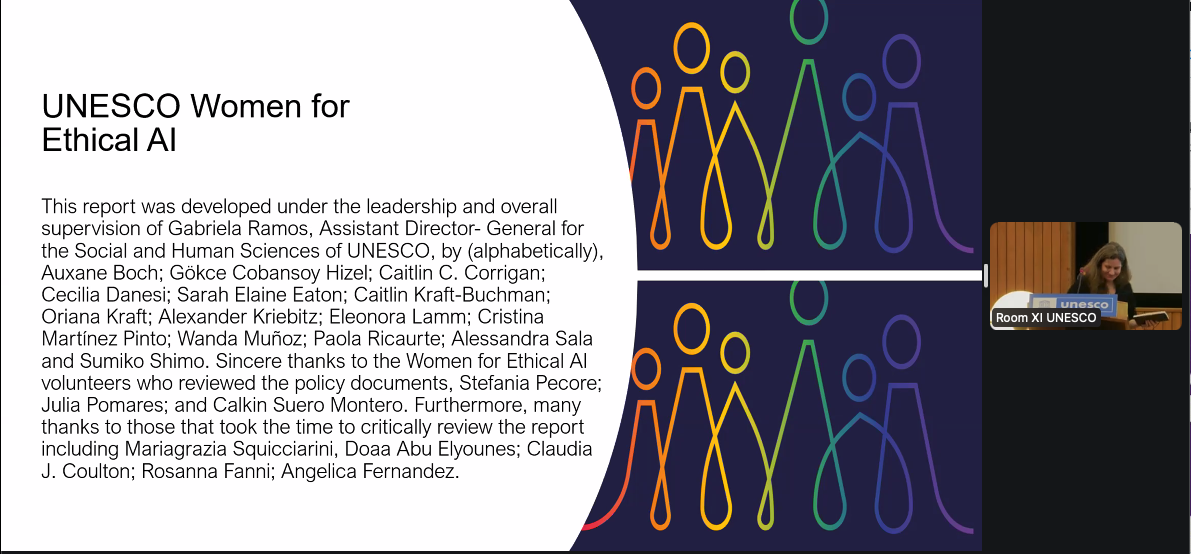
Over the past few months I have had the tremendous opportunity to work with an incredible group of women under the direction of Assistant Director-General (ADG) for Social and Human Sciences of UNESCO. Our collective produced this report that was launched today at a special conference in Paris:

UNESCO Women for Ethical AI: outlook study on artificial intelligence and gender

https://unesdoc.unesco.org/ark:/48223/pf0000391719

Here is our agenda from today’s conference:

I joined today’s conference online. Here are a few pics that I snapped during the presentations:

________________________

Share this post:
UNESCO Women for Ethical AI: outlook study on artificial intelligence and gender – https://drsaraheaton.com/2024/10/30/unesco-women-for-ethical-ai-outlook-study-on-artificial-intelligence-and-gender/

This blog has had over 3 million views thanks to readers like you. If you enjoyed this post, please “like” it or share it on social media. Thanks!

Sarah Elaine Eaton, PhD, is a Professor and Research Chair in the Werklund School of Education at the University of Calgary, Canada. Opinions are my own and do not represent those of my employer.


Event: The Intersection of Academic Integrity and Inclusion: A Fireside Chat

October 10, 2024

Next week is Academic Integrity Week at the Univeristy of Calgary. This year, I have the honour of moderating a fireside chat with one of my very own Werklund School of Education Doctor of Education (EdD) students, Colleen Fleming. 

Join us for a thought-provoking discussion during Academic Integrity Week 2024!

A poster with text in black, red, and orange. The University of Calgary logo appears at the top. On the right-hand side there is art featuring a woman wearing a headset.

Discover the crucial link between academic integrity and inclusion in higher education with our distinguished speaker, Colleen Fleming, EdD student, Werklund School of Education.

Moderated by Dr. Sarah Elaine Eaton, this conversation will explore:

  • Defining academic integrity in an inclusive context
  • Challenges in maintaining integrity across diverse student populations
  • Practical strategies for educators to promote both integrity and inclusion

Don’t miss this opportunity to gain insights from Colleen’s extensive experience as a K-12 practitioner and her cutting-edge doctoral research. Engage in a live Q&A session and contribute to this important conversation.

A bit about Colleen…

A photograph of a woman with chin-length blonde hair. She is wearing a white top. The background is blue.

Colleen Fleming (she/her/hers) is a K-12 practitioner at a designated special education school in Calgary. She has a keen interest in developing a culture of integrity among learners through the promotion of equity, diversity, and inclusion. As a Doctor of Education student at Werklund, her research involves proactively educating students about academic integrity in preparation for higher education.

Event details

Date: October 16, 2024

Time: 12:00 – 1:00 p.m.

Location: University of Calgary, Taylor Family Digital Library, Gallery Hall

https://events.ucalgary.ca/library/event/481166-academic-integrity-and-inclusion-with-colleen-fleming

This event is free and open to the public. Everyone is welcome!

________________________

Share this post: The Intersection of Academic Integrity and Inclusion: A Fireside Chat – https://drsaraheaton.com/2024/10/10/event-the-intersection-of-academic-integrity-and-inclusion-a-fireside-chat/

This blog has had over 3 million views thanks to readers like you. If you enjoyed this post, please “like” it or share it on social media. Thanks!

Sarah Elaine Eaton, PhD, is a Professor and Research Chair in the Werklund School of Education at the University of Calgary, Canada. Opinions are my own and do not represent those of my employer.