Three tips for future-proofing academic and research integrity this year

January 2, 2025

In my 2024 annual editorial for the International Journal for Educational Integrity, was entitled, ’Future-proofing integrity in the age of artificial intelligence and neurotechnology: prioritizing human rights, dignity, and equity

Here are three things you can do to prioritize human rights and dignity when it comes to policies and procedures to address allegations of academic or research misconduct:

Use a human-rights-by-design approach to developing, revising, and implementing policies by conducting a comprehensive review of existing academic integrity policies. Update policies to explicitly incorporate human rights principles, ensuring they address fair process, privacy, equitable treatment, and respect for human dignity. It is essential to involve individuals from representative groups in this process.

Provide ongoing training, education, and support to faculty, staff, and students about human rights principles and how they apply to misconduct investigations and case management. Create orientation programs that explain expectations for ethical conduct while respecting diverse cultural perspectives. Offer workshops and resources, peer mentoring programs, and support services.

Focus on continuous improvement and quality assurance of ethics and integrity practices by gathering feedback from students, faculty, staff and relevant stakeholders. Regularly review misconduct case management processes and data to ensure equitable treatment across different demographics.

Implementing human rights principles into misconduct investigations and case management helps to create more effective and sustainable learning environments. This approach prioritizes people over punishment, dignity over draconianism, and compassion over callousness.

Read the full article here: https://edintegrity.biomedcentral.com/articles/10.1007/s40979-024-00175-2 

Related post:

Future-proofing integrity in the age of artificial intelligence and neurotechnology: Prioritizing human rights, dignity, and equity

________________________

Share this post: Three tips for future-proofing academic and research integrity this year – https://drsaraheaton.com/2025/01/02/three-tips-for-future-proofing-academic-and-research-integrity-this-year/

This blog has had over 3 million views thanks to readers like you. If you enjoyed this post, please “like” it or share it on social media. Thanks!

Sarah Elaine Eaton, PhD, is a Professor and Research Chair in the Werklund School of Education at the University of Calgary, Canada. Opinions are my own and do not represent those of my employer. 


6 Tenets of Postplagiarism: Writing in the Age of Artificial Intelligence

February 25, 2023
An infographic showing the 6 tenets of the post-plagiarism age. There is a circle with six points extending from it. There is an icon of a brain at the centre. These ideas were developed from the book, Plagiarism in Higher Education: Tackling Tough Topics in Academic Integrity (2021) by S. E. Eaton.

In the final chapter of Plagiarism in Higher Education: Tackling Tough Topics in Academic Integrity (2021) I contemplate the future of plagiarism and academic integrity. I introduced the idea of life in a postplagiarism world; thinking about the impact of artificial intelligence on writing. Here, I expand on those ideas. These 6 tenets characterize the post-plagiarism age:

Hybrid Human-AI Writing Will Become Normal

Hybrid writing, co-created by human and artificial intelligence together is becoming prevalent. Soon it will be the norm. Trying to determine where the human ends and where the artificial intelligence begins is pointless and futile.

Human Creativity is Enhanced

Human creativity is enhanced, not threatened by artificial intelligence. Humans can be inspired and inspire others. Humans may even be inspired by artificial intelligence, but our ability to imagine, inspire, and create remains boundless and inexhaustible.

Language Barriers Disappear

One’s first language will begin to matter less and less as tools become available for humans to understand each other in countless languages.

Humans can Relinquish Control, but not Responsibility

Humans can retain control over what they write, but they can also relinquish control to artificial intelligence tools if they choose. Although humans can relinquish control, they do not relinquish responsibility for what is written. Humans can – and must – remain accountable for fact-checking, verification procedures, and truth-telling. Humans are also responsible for how AI-tools are developed.

Attribution Remains Important

It always has been, and always will be, appropriate and desirable to appreciate, admire, and respect our teachers, mentors, and guides. Humans learn in community with one another, even when they are learning alone. Citing, referencing, and attribution remain important skills.

Historical Definitions of Plagiarism No Longer Apply

Historical definitions of plagiarism will not be rewritten because of artificial intelligence; they will be transcended. Policy definitions can – and must – adapt.

Translations of the Six Tenets of Postplagiarism

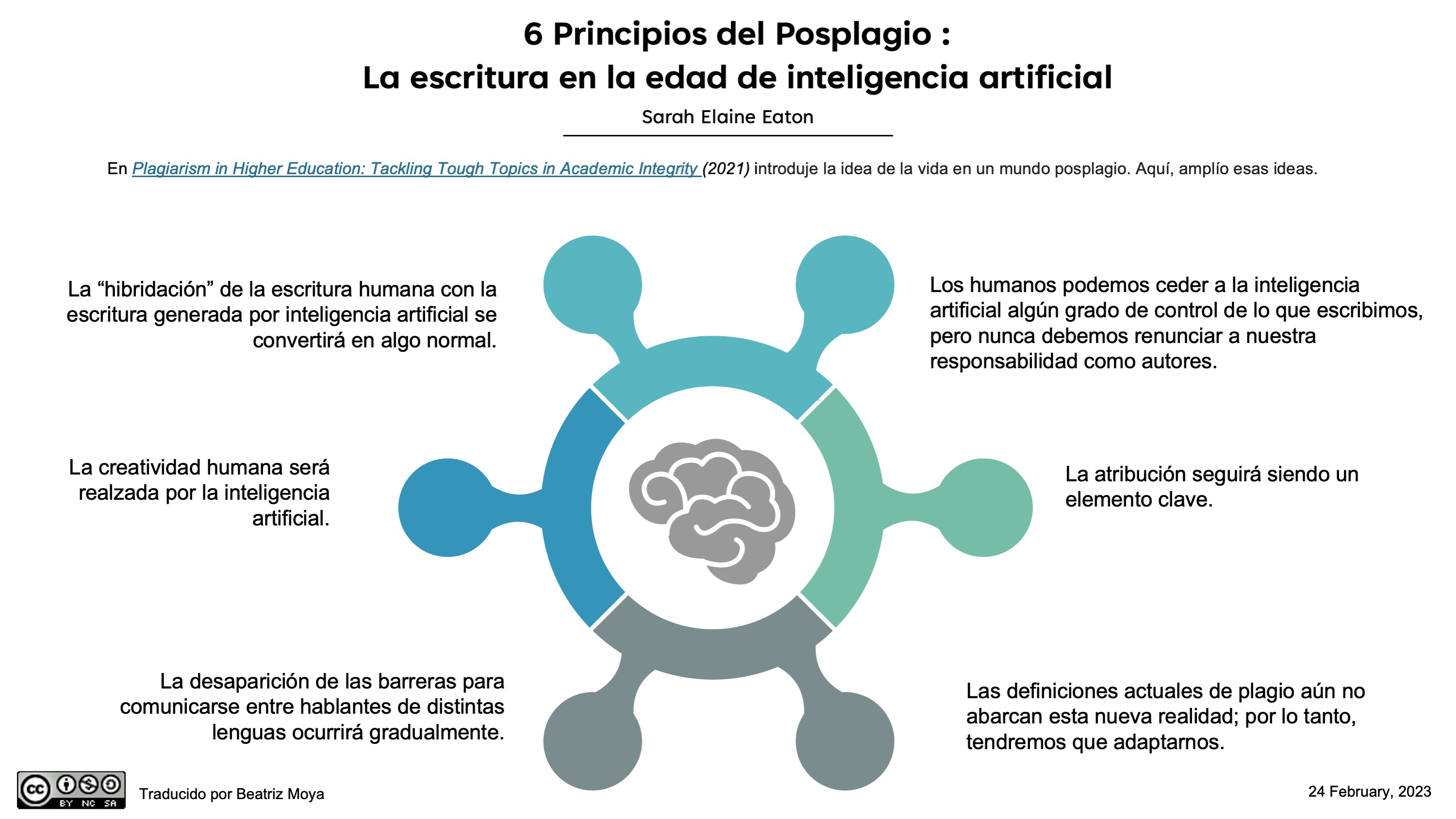
Since I first shared the Six Tenets of Postplagiarism, the infographic has been translated into French and Spanish. I am very grateful to the translators, who put in time and effort to go through the points in detail. Here are the translated versions:

Les 6 Principes du Postplagiat (French)

This translation was done by Dr. Elaine Beaulieu at the University of Ottawa, Canada.

Colleagues at the Université du Québec à Montréal (Canada), also wrote a web article in French. It is available here: https://collimateur.uqam.ca/collimateur/6-principes-de-lapres-plagiat-a-lere-de-lia/

6 Principios del Posplagio (Spanish)

The Spanish translation was done by Beatriz Moya, PhD candidate at the University of Calgary.

More Resources on PostPlagiarism

Check out my video on this topic on YouTube: https://youtu.be/NxFMMw1QZX0

Check out my article in University World News on this topic: “Artificial intelligence and academic integrity, post-plagiarism”

_________________________________

Share this:  6 Tenets of Postplagiarism: Writing in the Age of Artificial Intelligence https://drsaraheaton.wordpress.com/2023/02/25/6-tenets-of-postplagiarism-writing-in-the-age-of-artificial-intelligence/

This blog has had over 3 million views thanks to readers like you. If you enjoyed this post, please “like” it or share it on social media. Thanks!

Sarah Elaine Eaton, PhD, is a faculty member in the Werklund School of Education, and the Educational Leader in Residence, Academic Integrity, University of Calgary, Canada. Opinions are my own and do not represent those of the University of Calgary.