Future-proofing integrity in the age of artificial intelligence and neurotechnology: Prioritizing human rights, dignity, and equity

November 13, 2024

Once a year I write an editorial for the International Journal for Educational Integrity. I take a big idea, ground it in literature written by some of the best in the world and then call for ways to improve our field even more. In 2023 I wrote about Postplagiarism and in 2022, I focused on equity, diversity, inclusion, accessibility and decolonization as new priorities for academic integrity. Here is this year’s editorial:

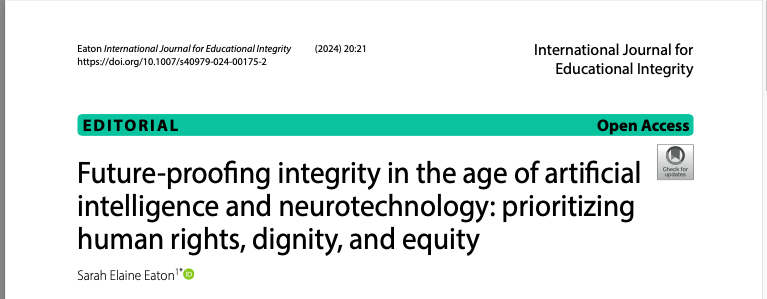
Future-proofing integrity in the age of artificial intelligence and neurotechnology: prioritizing human rights, dignity, and equity

A screenshot of an article title page. There is black text on a white background with a green banner at the top.
Here is a link to the original: https://edintegrity.biomedcentral.com/articles/10.1007/s40979-024-00175-2

Abstract

In this article I argue for the prioritisation of human rights when developing and implementing misconduct policies. Existing approaches may be perpetuate inequities, particularly for individuals from marginalised groups. A human-rights-by-design approach, which centres human rights in policy development, revision, and implementation, ensuring that every individual is treated with dignity and respect.

Recommendations for implementing a human-rights approach to misconduct investigations and case management are offered, covering areas such as procedural fairness, privacy, equity, and the right to education. Additional topics covered are the need to limit surveillance technologies, and the need to recognize that not all use of artificial intelligence tools automatically constitutes misconduct. I disentangle

the differences between equity and equality and explain how both are important when considering ethics and integrity. A central argument of this paper is that a human-rights-by-design approach to integrity does not diminish standards but rather strengthens educational systems by cultivating ethical awareness and respect for personhood. I conclude with a call to action with a seven-point plan for institutions to adopt a human-rights-based approach to ethics and integrity. In the age of artificial intelligence and neurotechnology, insisting on human rights and dignity when we investigate and address misconduct allegations is an ethical imperative that has never been more important.

Keywords Academic misconduct, Academic dishonesty, Plagiarism, Policy, Human rights, Restorative justice, Artificial intelligence, Neurotechnology, Higher education, Education

Commentary

As I reflect on the current state of academic and research integrity, I am struck by a glaring omission in our discussions: the connection between misconduct and human rights. We often treat these as separate entities, failing to recognize the profound impact that misconduct investigations and policies can have on the fundamental rights of individuals. This oversight is particularly concerning in the age of artificial intelligence (AI) and neurotechnology, where the potential for harm is magnified.

Take, for example, the case of a professor in Canada who physically assaulted international students accused of plagiarism. This horrifying example demonstrates how the pursuit of academic integrity can be twisted into a justification for degrading and inhumane treatment, violating the very principles of dignity and respect that should guide our actions. While this is an extreme case, it highlights the need for a fundamental shift in our approach.

In this editorial, I offer a call to action to move beyond simply adhering to legal requirements and embrace a ‘human-rights-by-design’ approach that embeds human rights principles into our policies and practices. This means ensuring procedural fairness throughout investigations, safeguarding the privacy of individuals, and recognizing the right to be presumed innocent until there is proof to the contrary. It also requires us to acknowledge the diverse backgrounds and circumstances of our students and staff, striving for equitable treatment that addresses systemic inequalities and provides the support needed for everyone to succeed.

In the face of rapidly evolving technologies like AI, we must be especially vigilant in upholding human rights. The temptation to rely on unproven AI detection tools or to rush to judgement based on suspicion rather than evidence is strong, but it is a path that leads us away from justice and fairness. We cannot allow fear or expediency to erode our commitment to human dignity.

By centring human rights in our approach to integrity, we can create educational and research environments that are not only ethically sound but also truly just and equitable. This is not about lowering standards; it is about building a culture of integrity that upholds the inherent worth of every individual.

________________________

Share this post: Future-proofing integrity in the age of artificial intelligence and neurotechnology: Prioritizing human rights, dignity, and equity – https://drsaraheaton.com/2024/11/13/future-proofing-integrity-in-the-age-of-artificial-intelligence-and-neurotechnology-prioritizing-human-rights-dignity-and-equity/
This blog has had over 3 million views thanks to readers like you. If you enjoyed this post, please “like” it or share it on social media. Thanks!

Sarah Elaine Eaton, PhD, is a Professor and Research Chair in the Werklund School of Education at the University of Calgary, Canada. Opinions are my own and do not represent those of my employer.


UNESCO Women for Ethical AI: outlook study on artificial intelligence and gender

October 30, 2024

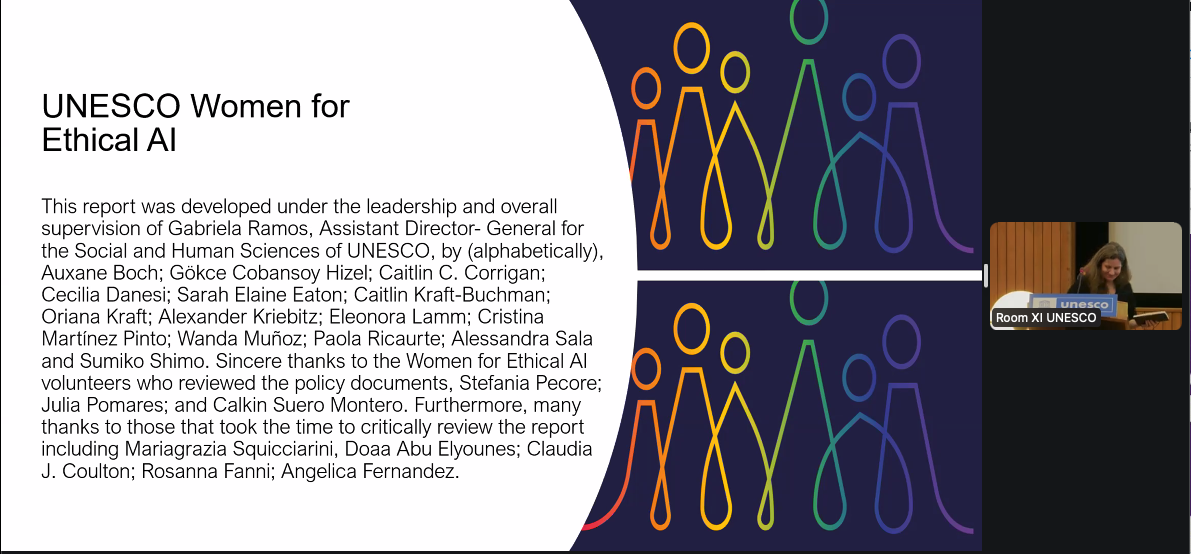
Over the past few months I have had the tremendous opportunity to work with an incredible group of women under the direction of Assistant Director-General (ADG) for Social and Human Sciences of UNESCO. Our collective produced this report that was launched today at a special conference in Paris:

UNESCO Women for Ethical AI: outlook study on artificial intelligence and gender

https://unesdoc.unesco.org/ark:/48223/pf0000391719

Here is our agenda from today’s conference:

I joined today’s conference online. Here are a few pics that I snapped during the presentations:

________________________

Share this post:
UNESCO Women for Ethical AI: outlook study on artificial intelligence and gender – https://drsaraheaton.com/2024/10/30/unesco-women-for-ethical-ai-outlook-study-on-artificial-intelligence-and-gender/

This blog has had over 3 million views thanks to readers like you. If you enjoyed this post, please “like” it or share it on social media. Thanks!

Sarah Elaine Eaton, PhD, is a Professor and Research Chair in the Werklund School of Education at the University of Calgary, Canada. Opinions are my own and do not represent those of my employer.


Event: The Intersection of Academic Integrity and Inclusion: A Fireside Chat

October 10, 2024

Next week is Academic Integrity Week at the Univeristy of Calgary. This year, I have the honour of moderating a fireside chat with one of my very own Werklund School of Education Doctor of Education (EdD) students, Colleen Fleming. 

Join us for a thought-provoking discussion during Academic Integrity Week 2024!

A poster with text in black, red, and orange. The University of Calgary logo appears at the top. On the right-hand side there is art featuring a woman wearing a headset.

Discover the crucial link between academic integrity and inclusion in higher education with our distinguished speaker, Colleen Fleming, EdD student, Werklund School of Education.

Moderated by Dr. Sarah Elaine Eaton, this conversation will explore:

  • Defining academic integrity in an inclusive context
  • Challenges in maintaining integrity across diverse student populations
  • Practical strategies for educators to promote both integrity and inclusion

Don’t miss this opportunity to gain insights from Colleen’s extensive experience as a K-12 practitioner and her cutting-edge doctoral research. Engage in a live Q&A session and contribute to this important conversation.

A bit about Colleen…

A photograph of a woman with chin-length blonde hair. She is wearing a white top. The background is blue.

Colleen Fleming (she/her/hers) is a K-12 practitioner at a designated special education school in Calgary. She has a keen interest in developing a culture of integrity among learners through the promotion of equity, diversity, and inclusion. As a Doctor of Education student at Werklund, her research involves proactively educating students about academic integrity in preparation for higher education.

Event details

Date: October 16, 2024

Time: 12:00 – 1:00 p.m.

Location: University of Calgary, Taylor Family Digital Library, Gallery Hall

https://events.ucalgary.ca/library/event/481166-academic-integrity-and-inclusion-with-colleen-fleming

This event is free and open to the public. Everyone is welcome!

________________________

Share this post: The Intersection of Academic Integrity and Inclusion: A Fireside Chat – https://drsaraheaton.com/2024/10/10/event-the-intersection-of-academic-integrity-and-inclusion-a-fireside-chat/

This blog has had over 3 million views thanks to readers like you. If you enjoyed this post, please “like” it or share it on social media. Thanks!

Sarah Elaine Eaton, PhD, is a Professor and Research Chair in the Werklund School of Education at the University of Calgary, Canada. Opinions are my own and do not represent those of my employer.


Radical Acceptance: A Framing for Advocacy and Equity, Diversity, Inclusion, Accessibility and Integrity Work

October 7, 2024

Although my role at the University of Calgary’s Office of Equity, Diversity, and Inclusion (OEDI) wrapped up some months ago, there’s an experience that I have been reflecting on that I wanted to share.

While I was working at the OEDI I ran into a colleague at an event. I’d known this person for many years and as we were chatting, they asked, “How does it feel to be a white woman working in an office of equity, diversity, and inclusion? I mean, don’t you feel like you’re taking up space for someone who is more deserving?”

The question was asked with genuine curiosity, and without any judgement or blame that I could ascertain. This person had been engaged in equity work themselves and was genuinely puzzled and curious about why I had taken up a director role in the office.

The question has lingered in my mind and heart for a long time and quite frankly, it’s taken me ages to process, which is why I am just getting around to writing about it now.  It is a complex and values-laded question that I have grappled with for what seems like an eon. Although I understand the sentiment behind it, the question itself it oversimplifies the nature of equity, diversity, inclusion, and accessibility (EDIA) work and makes some problematic assumptions.

First, it’s important to recognize that equity work isn’t solely the responsibility of people from marginalized groups. Creating truly inclusive environments requires engagement and effort from people of all backgrounds. I bring my own lived experiences that include both discrimination and privilege. As a woman, I have lived experience of gender-based discrimination. As a white person, I recognize my racial privilege. Being human means that we are infinitely complex and reducing a person down to either a victim of discrimination or a purveyor of privilege is not only reductionist, it can be harmful. In my case, I engage in ongoing reflection that allows me to relate to some challenges faced by marginalized groups, while maintaining awareness of my own privilege.

I am acutely aware of the immense privilege I hold. I continually educate myself, amplify diverse voices, and strive to use my privilege to advocate for systemic changes. I see my role not as speaking for underrepresented groups, but as working to dismantle oppressive structures that perpetuate harm. This includes challenging others to examine their biases and pushing for institutional reforms, and doing so in a way that does not antagonize them, which is quite an art.

The notion that I might be ‘taking up space’ assumes there’s a fixed number of EDIA positions that should be reserved for people of colour. Representation absolutely matters, and EDI work requires a variety of skills, experiences, and perspectives. What matters most, in my humble opinion (and sure to be challenged by some who reads this post, I’m sure…) is a deep commitment to justice, a willingness to continually learn and grow, and the ability to effect change within organizations. These qualities aren’t exclusive to any one demographic.

Moreover, the idea that someone else might be inherently ‘more deserving’ based solely on their identity is problematic. It reduces people to singular aspects of their identity and ignores the complexity of lived experiences. I am about to make another contentious claim here, but here goes… A person of colour is not automatically an expert in all facets of EDIA work simply by virtue of their race, just as being white doesn’t preclude someone from developing expertise in this field.

It is critical — essential —  to remember that many forms of marginalization are invisible. Disabilities, neurodivergence, chronic illnesses, socioeconomic background, and LGBTQ2S+* identities are just a few examples of characteristics that may not be immediately apparent. This underscores the importance of resisting the temptation to judge someone’s qualifications or experiences based solely on what we can see or what we think we know about them.

By making assumptions about who ‘deserves’ to be in EDI spaces based on visible characteristics, we risk excluding valuable perspectives, lived experience, and qualifications, while simultaneously reinforcing harmful stereotypes.

Inclusivity means creating environments where all individuals feel empowered to bring their full selves to the work, including aspects of their identity that may not be visible to others.

A key component of my EDI work is the practice of ‘radical acceptance’. This concept goes beyond mere tolerance or surface-level inclusion. Radical acceptance means embracing the full humanity of every individual, including all their complexities, contradictions, and lived experiences. It requires us to set aside our preconceptions and biases, and to approach each person with genuine openness and empathy. In the context of EDIA work, radical acceptance means creating spaces where people feel truly seen, heard, and valued for who they are, not just for how they fit into predefined categories or expectations. Being angry is easy; practising radical acceptance is exhausting, but ultimately more useful than anger.

Being an equity advocate means acknowledging that every person’s journey is unique and valid, even if it doesn’t align with our own experiences or understanding.

Even though I am no longer serving in a formal role related to EDI, I continue to focus on equity, diversity, inclusion, accessibility, and social justice in my work. This includes focusing on dignity, acceptance, and belonging. I strive to approach every interaction with openness and humility, recognizing that each person I encounter may have experiences and insights that I can learn from, regardless of their outward appearance. It also means making a conscious effort to resist the temptation that I might think that I know everything about a person.

There is wisdom to the old adage that “there is more to a person than meets the eye.” What I can say is that every human being is worthy of dignity. This mindset is crucial for creating genuinely inclusive spaces and avoiding the pitfalls of tokenism or superficial diversity.

People whose advocacy focuses on EDIA roles have a special responsibility to practice rigorous self-reflection, actively seek out diverse perspectives, and ensure we keep our privilege and biases in check. We must be humble enough to know when to step back and elevate other voices. I have watched people who believe their position is superior or their experience is more valid  lash out at others who are just as deserving of understanding, kindness, and respect. This kind of lateral violence is both jarring and heartbreaking to watch… and even worse when a person has been “cancelled” by a group of loud, virtue-signalling individuals. In some cases, the accusers  fail to recognize that in their efforts to be activists and uphold what they believe to be right and true, they may have forgotten that a foundation of equity work is human dignity for all, not just for some.

Those who proclaim to value social justice have a responsibility to be extra cautious before “cancelling” someone.

Practicing radical acceptance has profound implications for how we approach diversity and inclusion. Instead of focusing solely on visible markers of diversity or trying to fill quotas, we work to create environments where every individual feels empowered to bring their whole self to the table. This includes embracing diverse thought processes, communication styles, and ways of problem-solving that might challenge our own assumptions about what ‘professional’ or ‘effective’ looks like. 

I work hard to embody this principle of radical acceptance in my interactions. But this is not a linear practice or something that one learns and then does correctly every day. Some days I screw up. Practicing radical acceptance is a constant process of self-reflection, learning, and growth. It means being willing to have my own assumptions challenged and to continually expand my understanding of what diversity and inclusion truly mean. It also means extending grace and forgiveness in moments of conflict with others whose views and lived experiences may lead them to say things or act in ways that I do not understand. What I know for sure is that I will never know the entirety of another person… and they will never know my entirety.

Living and working with others, with an appreciation of who they are, as they are, is part of the daily practice of radical acceptance.

Equity work — as well as integrity work — isn’t about virtue signaling or moral grandstanding. It’s about dismantling oppressive systems and creating genuine, lasting change. That requires participation and commitment from people of all backgrounds, working in solidarity toward a more just and equitable world. I’m driven by a genuine passion for creating more equitable and inclusive environments. I often say that the word ‘integrity’ comes from a Latin word meaning ‘to make whole’. I have said it before and I will say it again (and again… and again…): There can be no integrity without equity.

Related posts:

Finding your Flair: Clothing Choice in School and Work

A Scholar’s Thoughts About Social Media and Blogging

________________________

Share this post: Radical Acceptance: A Framing for Advocacy and Equity, Diversity, Inclusion, Accessibility and Integrity Work – https://drsaraheaton.com/2024/10/07/radical-acceptance-a-framing-for-advocacy-and-equity-diversity-inclusion-accessibility-and-integrity-work/

This blog has had over 3 million views thanks to readers like you. If you enjoyed this post, please “like” it or share it on social media. Thanks!

Sarah Elaine Eaton, PhD, is a Professor and Research Chair in the Werklund School of Education at the University of Calgary, Canada. Opinions are my own and do not represent those of my employer.


Decolonizing and Indigenizing Academic Integrity 

September 30, 2024

September 30 marks the National Day for Truth and Reconciliation in Canada. The purpose of this day is to honour Survivors of residential schools and pay tribute to those who died or were killed in them.

In 2021, I posted about Indigenous ways of citing, referencing, and acknowledging in honour of this day. I won’t repeat the content of that post here, but instead I will share an update on work in the field of academic integrity that has focused on decolonization and Indigenization that has   happened over the past several years.

When I first reached out to Keeta Gladue in 2019 to lead a project on Indigenous Academic Integrity at the University of Calgary, there was little content available. Today, there are many more resources available in a variety of formats. In this post, I have collected as many as I can in one place for anyone who is interested in this topic. 

This list may not be exhaustive, which I would consider exciting and inspiring. When a field has more resources on a topic than can be captured in a blog post, then you know you have reached a critical mass of contributions that extends beyond what any one individual is aware of. If you know of additional resources, please drop me a line. I’d love to add to this list.

The resources below are by Indigenous and non-Indigenous people. 

Videos / Multimedia Resources

Gladue, K. (2020, November 13). Indigenous Paradigms in Practice: Relationships, Story and Academic Integrity [webinar] Academic Integrity: Urgent and Emerging Topics Webinar Series, Taylor Institute for Teaching and Learning, University of Calgary. https://youtu.be/I0ZJl3dLmKg

Teaching Resources

Gladue, K. (2020). Indigenous Academic Integrity (written). https://taylorinstitute.ucalgary.ca/sites/default/files/Content/Resources/Academic-Integrity/21-TAY-Indigenous-Academic-Integrity.pdf  

Maracle, I. B. J. (2020). Seven grandfathers in academic integrity. First Nations House for Indigenous Student Services, University of Toronto. https://studentlife.utoronto.ca/wp-content/uploads/Seven_Grandfathers_in_Academic_Integrity.pdf 

Book chapters

Note: Some of these may be behind a paywall. Contact your local library to ask about getting a copy at no cost.

Cowan, M., & Nurse, A. (2024). Teaching Academic Integrity as Good Historical Practice. In S. E. Eaton (Ed.), Second Handbook of Academic Integrity (pp. 389-408). Springer Nature Switzerland. https://doi.org/10.1007/978-3-031-54144-5_99  

Gladue, K., & Poitras Pratt, Y. (2024). The Integrity of Good Relations: Indigenous Approaches to Respect, Relationality, and Reciprocity in Higher Learning. In S. E. Eaton (Ed.), Second Handbook of Academic Integrity (pp. 1223-1244). Springer Nature Switzerland. https://doi.org/10.1007/978-3-031-54144-5_132 

Lindstrom, G. (2022). Accountability, relationality and Indigenous epistemology: Advancing an Indigenous perspective on academic integrity. In S. E. Eaton & J. Christensen Hughes (Eds.), Academic integrity in Canada: An enduring and essential challenge (pp. 125-139). Springer. https://doi.org/10.1007/978-3-030-83255-1 

Parnther, C. (2024). Decolonization, Equity, Diversity, and Inclusion in Academic Integrity: Introduction. In S. E. Eaton (Ed.), Second Handbook of Academic Integrity (pp. 1115-1127). Springer Nature Switzerland. https://doi.org/10.1007/978-3-031-54144-5_126

Poitras Pratt, Y., & Gladue, K. (2022). Re-defining academic integrity: Embracing Indigenous truths. In S. E. Eaton & J. Christensen Hughes (Eds.), Academic integrity in Canada: An enduring and essential challenge (pp. 103-123). Springer. https://doi.org/10.1007/978-3-030-83255-1  

Weasel Head, G. (2024). Toward Reflexive Practice: Deconstructing Academic Integrity, EDI, and Awareness Training from an Indigenous Perspective. In S. E. Eaton (Ed.), Second Handbook of Academic Integrity (pp. 1273-1286). Springer Nature Switzerland. https://doi.org/10.1007/978-3-031-54144-5_136

Scholarly articles

Note: Some of these may be behind a paywall. Contact your local library to ask about getting a copy at no cost.

Eaton, S. E. (2024). Decolonizing academic integrity: Knowledge caretaking as ethical practice. Assessment & Evaluation in Higher Education, 1-16. https://doi.org/10.1080/02602938.2024.2312918 

Eaton, S. E. (2022). New priorities for academic integrity: equity, diversity, inclusion, decolonization and Indigenization. International Journal for Educational Integrity, 1-12. https://doi.org/10.1007/s40979-022-00105-0 

Pete, S. (2016). 100 Ways: Indigenizing & Decolonizing Academic Programs. aboriginal policy studies, 6(1), 81-89. https://doi.org/10.5663/aps.v6i1.27455 

Stein, S. (2020). A colonial history of the higher education present: rethinking land-grant institutions through processes of accumulation and relations of conquest. Critical Studies in Education, 61(2), 212-228. https://doi.org/10.1080/17508487.2017.1409646 

Conference Presentations

Note: Not all of these conference presentations have links to the slide decks or papers from the conference. If you are interested in further details, you may have to do some work to track down the presenters and contact them directly about their work.

Eaton, S. E., Moya, B., Dahal, B., Judge-Stasiak, A., & Fleming, C. (2023, October 12). Equity, Diversity, Inclusion, Accessibility, Decolonization and Indigenization in Academic and Research Integrity: Policy, Procedure, and Praxis [Presentation] Canadian Association for the Prevention of Discrimination and Harassment in Higher Education (CAPDHHE) Conference, Calgary, Canada. https://hdl.handle.net/1880/118076 

Longstreet, C. S., Ives, C., & Martin, P. (2022, November 17). Decolonizing academic integrity. POD 2022, Seattle, WA, USA. 

Longstreet, C. S., Ives, C., & Martin, P. (2021, June 22-23). Conversations about decolonizing academic integrity Canadian Symposium on Academic Integrity [online], Thompson Rivers University, Kamloops, BC, Canada.

Theses/Dissertations

Cunningham Hall, D. C. (2022). Indigenous Perspectives on Academic Integrity in Post-Secondary Institutions in British Columbia. University of Glasgow. https://www.researchgate.net/publication/367163413_Indigenous_Perspectives_on_Academic_Integrity_in_Post-Secondary_Institutions_in_British_Columbia


Hagen, E. (2024). Practical Approaches: Decolonizing Academic Integrity. Master of Education thesis. Vancouver Island University. https://www.viurrspace.ca/server/api/core/bitstreams/17f7c17d-812e-4d3d-9968-3fcfd02c2cfd/content

Other Web Resources

Eaton, S. E. (2022, July 18). Academic integrity in Canada: deepening our commitment to reconciliation, decolonization, and indigenization. ETICO. https://etico.iiep.unesco.org/en/academic-integrity-canada-deepening-our-commitment-reconciliation-decolonization-and-indigenization

Gladue, K. (2021). Indigenous Academic Integrity (website). https://taylorinstitute.ucalgary.ca/resources/indigenous-academic-integrity 

Hagen, E. Decolonizing Academic Integrity. https://erinkhagen.wordpress.com/

Toronto Metropolitan University. (2021). Academic Integrity Office: Indigenous Perspectives. Retrieved March 1, 2021 from https://www.ryerson.ca/academicintegrity/indigenous-perspectives/

Closing comments

Academic integrity is a cornerstone of higher education, but it has historically been defined by Western (colonial) standards of originality, citation, and individual achievement. As institutions strive for greater inclusivity and cultural responsiveness, there is a growing recognition of the need to decolonize and Indigenize academic integrity practices. This process involves — but is not limited to — critically examining and reforming existing norms to better reflect diverse knowledge systems and ways of learning.

Decolonizing academic integrity means acknowledging and dismantling the colonial legacies embedded in our educational systems. These legacies often privilege Western ways of knowing and marginalize Indigenous, non-Western, and oral traditions. By decolonizing, we create space for multiple perspectives and epistemologies, fostering a more inclusive and equitable academic environment.

Indigenizing academic integrity goes hand in hand with decolonization. It involves incorporating Indigenous ways of knowing, learning, and sharing knowledge into our understanding and practice of academic integrity. This process recognizes that Indigenous knowledge systems have their own rigorous standards of integrity, which may differ from Western (including colonial) academic norms but are equally valid and valuable.

Key aspects of decolonizing and Indigenizing academic integrity include:

  1. Recognizing collective knowledge: Many Indigenous cultures emphasize collective knowledge creation and ownership, challenging the Western focus on individual authorship and originality.
  2. Valuing oral traditions: Acknowledging the validity of oral sources and storytelling as legitimate forms of knowledge transmission and citation.
  3. Embracing holistic learning: Incorporating experiential and land-based learning, recognizing that knowledge acquisition extends beyond textbooks and classrooms.
  4. Redefining plagiarism: Considering cultural differences in knowledge sharing and attribution, and developing more nuanced understandings of intellectual property.
  5. Diversifying assessment methods: Implementing culturally responsive evaluation techniques that honour diverse ways of demonstrating knowledge and understanding.

By decolonizing and Indigenizing academic integrity, institutions can:

  • Include Indigenous persons in institutional policy, procedure, and pedagogical decisions related to academic integrity.
  • Create a more inclusive learning environment that values diverse knowledge systems
  • Enhance cultural safety for Indigenous and non-Western students
  • Promote critical thinking about the nature of knowledge and scholarship
  • Foster cross-cultural understanding and respect
  • Prepare students for global citizenship in a diverse world by recognizing that decolonization is ongoing work and a commitment to this work is not limited to one day or one event.

The process of decolonizing and Indigenizing academic integrity is not without challenges. It requires a willingness to question long-held assumptions, engage in difficult conversations, and reimagine established practices. Institutions must collaborate closely with Indigenous communities and scholars to ensure that changes are meaningful and respectful, rather than tokenistic.

Ultimately, decolonizing and Indigenizing academic integrity is about creating a more just and equitable academic educational system. It acknowledges that integrity is not a universal concept but one that is culturally informed. By broadening our understanding of what constitutes ethical academic conduct, we can create learning environments that honour and uplift all forms of knowledge and ways of knowing.

This shift not only benefits Indigenous and non-Western students but enriches the academic experience for all. It prepares students to engage with diverse perspectives, fostering critical thinking and cultural competence essential in our increasingly interconnected world. As we move forward, the decolonization and Indigenization of academic integrity will play a crucial role in shaping a more inclusive, equitable, and dynamic higher education landscape.

Keywords: Academic integrity, decolonization, decolonisation, Indigenous, Indigenization, Indigenisation, student conduct, plagiarism, academic misconduct 

Last update: 11 February 2025

Related posts:

Indigenous Academic Integrity: A Post in Honour of the National Day for Truth and Reconciliation – https://drsaraheaton.wordpress.com/2021/09/30/indigenous-academic-integrity-a-post-in-honour-of-the-national-day-for-truth-and-reconciliation/ 

A Journey of Reflection: Visiting the Former Kamloops Indian Residential School https://drsaraheaton.wordpress.com/2023/11/12/a-journey-of-reflection-visiting-the-former-kamloops-indian-residential-school/

________________________

Decolonizing and Indigenizing Academic Integrity – https://drsaraheaton.com/2024/09/30/decolonizing-and-indigenizing-academic-integrity/

This blog has had over 3.7 million views thanks to readers like you. If you enjoyed this post, please “like” it or share it on social media. Thanks!

Sarah Elaine Eaton, PhD, is a faculty member in the Werklund School of Education at the University of Calgary, Canada. Opinions are my own and do not represent those of my employer.