Beyond Student Compliance: Building a Culture of Shared Academic Integrity

November 17, 2025

The recent court case in British Columbia, Canada, involving a student suing instructors for alleged plagiarism at University Canada West raises an uncomfortable but important question: Should academic integrity policies apply only to students?

In this case, the court dismissed the lawsuit, noting that the university’s academic integrity policy explicitly applied to students, but not faculty. Although the legal reasoning is sound, the ethical implications are profound. 

Integrity Is a Shared Responsibility

Academic integrity is not a student-only obligation. As Julia Christensen Hughes and I pointed out in our 2022 chapter on why academic integrity is about more than student cheating, faculty members are role models and gatekeepers of scholarly standards. When instructors are exempt from integrity policies, institutions risk creating a double standard that erodes trust and credibility.

Why does this matter?

  1. Role Modeling: Faculty are the standard-bearers of scholarly conduct. When instructors fail to uphold integrity, it undermines the credibility of the entire educational process. This is an idea repeated over and over again in the Second Handbook of Academic Integrity and one that emerged in the Comprehensive Academic Integrity Framework: academic integrity includes, and extends beyond student conduct.
  2. Trust and Fairness: Students trust that their learning environment is built on fairness. A double standard, where plagiarism policies apply only to students, erodes that trust. As I have written about elsewhere, trust has been a central theme of academic integrity for decades and is a foundation for education and it applies not only to students, but to faculty and administrators as well.
  3. Institutional Reputation: Universities thrive on public confidence in their academic rigour. Ignoring faculty misconduct risks reputational damage far beyond the classroom.

What should change?

Institutions need comprehensive integrity policies that apply to everyone—students, faculty, and administrators. These policies should include clear definitions, reporting mechanisms, and consequences for violations. Academic integrity is a shared responsibility, and everyone in the learning community is accountable.

Recommendations for Higher Education Institutions

  1. Expand and Unify Policy Scope: Ensure academic integrity policies explicitly apply to faculty, staff, and administrators, not just students. 
  2. Develop Reporting Mechanisms: Create confidential, transparent processes for reporting and investigating faculty misconduct.
  3. Mandatory Training: Require regular integrity training for faculty, emphasizing ethical scholarship and teaching practices, as well as research ethics.
  4. Institutional Culture: Promote integrity as a shared value through leadership messaging, recognition programs, and open dialogue. 
  5. Accountability Framework: Include consequences for faculty breaches in contracts and performance evaluations. 

Call to Action

Academic integrity is a foundation of higher education. If we expect students to be honest in their work, then faculty must be held to the same (if not higher) standards. Universities and colleges should act now to close the policy gap, embed integrity in institutional culture, and hold everyone accountable. If we want students to take integrity seriously, faculty must lead by example. Anything less is hypocrisy.

References

Eaton, S. E. (2024). Comprehensive Academic Integrity (CAI): An Ethical Framework for Educational Contexts. In S. E. Eaton (Ed.), Second Handbook of Academic Integrity (pp. 1–14). Springer Nature Switzerland. https://doi.org/10.1007/978-3-031-54144-5_194 

Eaton, S. E. (2025). Think Piece: Trust as a foundation for ethics and integrity in educational contexts. Critical Studies in Teaching and Learning (CriSTaL), 13(SI2), 4–7. https://doi.org/10.14426/cristal.v13iSI2.3057

Christensen Hughes, J., & Eaton, S. E. (2022). Academic misconduct in Canadian higher education: Beyond student cheating. In S. E. Eaton & J. Christensen Hughes (Eds.), Academic integrity in Canada: An enduring and essential challenge (pp. 81–102). Springer. https://doi.org/10.1007/978-3-030-83255-1

Labbé, S. (2025, November 13). B.C. student sues his teachers over plagiarism, judge strikes case. Business Intellgence for BC. https://www.biv.com/news/human-resources-education/bc-student-sues-his-teachers-over-plagiarism-judge-strikes-case-11485013

______________

Share this post: Beyond Student Compliance: Building a Culture of Shared Academic Integrity – https://drsaraheaton.com/2025/11/17/beyond-student-compliance-building-a-culture-of-shared-academic-integrity/

Sarah Elaine Eaton, PhD, is a Professor and Research Chair in the Werklund School of Education at the University of Calgary, Canada. Opinions are my own and do not represent those of my employer.


Embedding Social Justice, Equity, Inclusion, Diversity, and Accessibility in Academic Integrity

August 25, 2025

As a new academic year begins here in the northern hemisphere, I’m worried. I am worried that equity-deserving students, including racialized and linguistic-minority students, disabled and neurodivergent students, and others from equity-deserving groups will fall through the cracks again this year.

Conversations about academic integrity often centre around detection and discipline. 

How many students will be accused of — and investigated for — academic cheating this year when what they actually needed was learning support? Or language support? Or just a clearer understanding of what academic integrity is and how to uphold it?

It doesn’t have to be this way.

Academic integrity is also about creating a learning environment grounded in fairness and opportunity for every student. Social justice, equity, inclusion, diversity, and accessibility shape how students experience integrity in real ways:

  • Equity reminds us that students enter the classroom with different levels of preparation and support.
  • Inclusion ensures every student can participate in learning and assessment.
  • Accessibility removes barriers that make it harder for some students to meet expectations.
Infographic entitled 'Embedding Social Justice, Equity, Inclusion, Diversity, and Accessibility in Academic Integrity.' It features four bullet points: Equity acknowledges varied student preparation and support; Inclusion promotes participation in learning and assessment; Accessibility removes barriers to meeting expectations; and a Social Justice lens reveals patterns in integrity breaches. An illustration of a balanced scale appears below the text. The poster is credited to Sarah Elaine Eaton, PhD, August 2025.

A social justice lens helps us see patterns in who is reported or penalized for breaches of integrity and why.

  • Here are some actions educators can take in the first month of classes to support student success:
  • Review course materials to ensure instructions and policies about integrity are written in plain, accessible language.
  • Dedicate class time to talking with students about what integrity looks like in your course and why it matters.
  • Share examples of proper citation and collaboration that are relevant to your discipline.
  • Make time for questions about assessments so students understand what is expected and where to find help.
  • Connect students early to campus supports such as writing centres, student services, and accessibility services.

This is just a start.

My point is this: Do not assume that students should just know what academic integrity means. Take the time to explain your expectations and policies. In order for students to follow the rules, they need to know what the rules are.

Academic integrity is not only about avoiding plagiarism or cheating. It is also about fostering trust and fairness so that all students have a fair chance to learn and succeed. The choices we make in the first few weeks of the term set the tone for the entire year.

What steps are you taking at the start of this new school year to build a more inclusive and equitable approach to academic integrity?

________________________

Share this post: Embedding Social Justice, Equity, Inclusion, Diversity, and Accessibility in Academic Integrity – https://drsaraheaton.com/2025/08/25/embedding-social-justice-equity-inclusion-diversity-and-accessibility-in-academic-integrity/

Sarah Elaine Eaton, PhD, is a Professor and Research Chair in the Werklund School of Education at the University of Calgary, Canada. Opinions are my own and do not represent those of my employer.


The Impact of Workplace Incivility on Higher Education

August 23, 2025

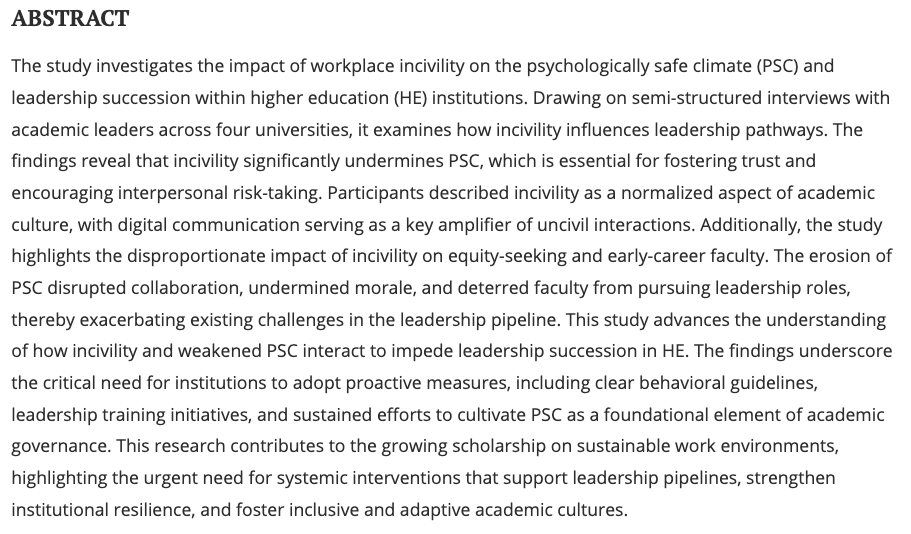
I am pleased to have collaborated with Dr. Leda Stawnychko and Ms. Rafi Mehnaz on this new article, “Exploring the impact of workplace incivility on psychological safety and leadership succession in higher education” in the International Journal for Leadership in Education.

I first met Leda Stawnychko when she was an EdD student at the University of Calgary. I had the pleasure of serving on her supervisory committee to support her doctor of education research project on Leadership Development Experiences of Department Chairs at a Canadian University.

When Leda invited me to join her later for a project on psychological safety and leadership succession in higher education, I accepted right away. This topic is important one and it rarely gets discussed in the literature on academic integrity, but as we know, professional and collegial ethics are part of a comprehensive approach to academic integrity.

As we point out in the abstract and in the main body of the article, there is a disproportionate impact of incivility on equity-seeking and early-career faculty. In other words, those who are already marginalized and experience barriers and discrimination are more likely to be on the receiving end of workplace incivility and hostility.

I’ve said it before and I’ll say it again: There can be no integrity without equity. We need to think more about the way that higher education as a system allows for the perpetuation of discrimination and harm, not only for students, but also for faculty and staff. If the workplace is not a psychologically safe environment, then employees cannot thrive.

I invite you to check out the article, which is open access and free to read and download.

________________________

Share this post: The Impact of Workplace Incivility on Higher Education – https://drsaraheaton.com/2025/08/23/the-impact-of-workplace-incivility-on-higher-education/

Sarah Elaine Eaton, PhD, is a Professor and Research Chair in the Werklund School of Education at the University of Calgary, Canada. Opinions are my own and do not represent those of my employer.


Dignity: A Foundation of Academic Integrity

April 8, 2025

In our pursuit of knowledge, we often focus on policies, consequences, and detection systems. Yet at the heart of academic integrity lies something fundamental: human dignity.

When we produce original work, we honor our intellectual journey and the dignity of those whose ideas we build upon. Attribution acknowledges that knowledge creation is a collaborative endeavor spanning generations.

Academic integrity shouldn’t be about avoiding punishment, but rather, about recognizing the worth in honest intellectual exchange. It’s understanding that shortcuts diminish our growth and the trust that sustains scholarly communities.

As educators and learners, we can frame integrity less as compliance and more as respect – for ourselves, peers, and institutions that facilitate collective wisdom. When we approach academic work with dignity as our compass, integrity follows.

–——–-

Share this post: Dignity: A Foundation of Academic Integrity – https://drsaraheaton.com/2025/04/08/dignity-a-foundation-of-academic-integrity/

This blog has had over 3.7 million views thanks to readers like you. If you enjoyed this post, please ‘Like’ it using the button below or share it on social media. Thanks!

Sarah Elaine Eaton, PhD, is a Professor and Research Chair in the Werklund School of Education at the University of Calgary, Canada. Opinions are my own and do not represent those of my employer. 


UNESCO Women for Ethical AI: outlook study on artificial intelligence and gender

October 30, 2024

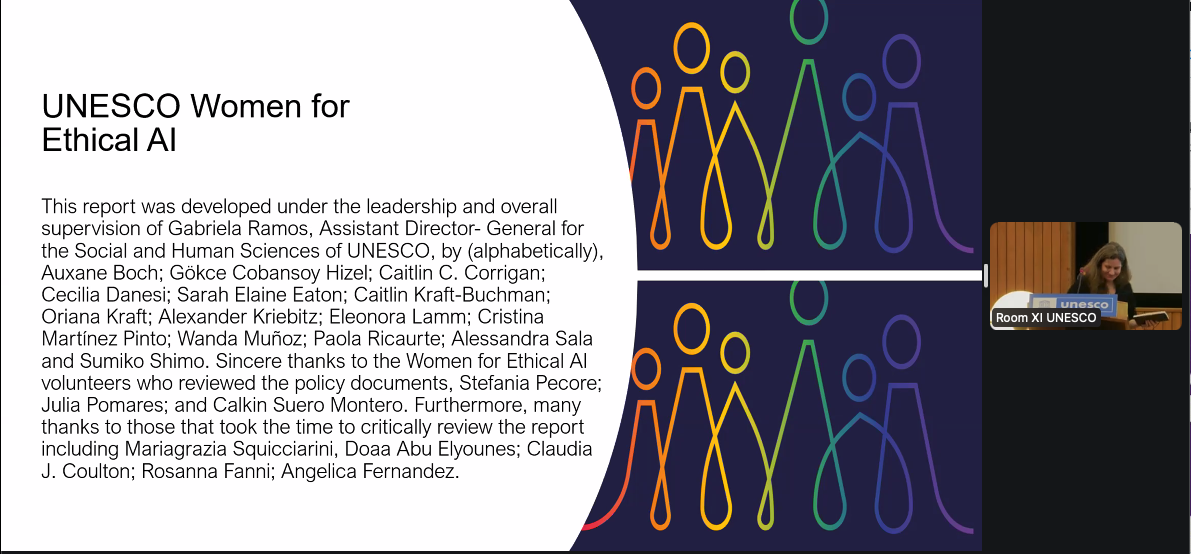
Over the past few months I have had the tremendous opportunity to work with an incredible group of women under the direction of Assistant Director-General (ADG) for Social and Human Sciences of UNESCO. Our collective produced this report that was launched today at a special conference in Paris:

UNESCO Women for Ethical AI: outlook study on artificial intelligence and gender

https://unesdoc.unesco.org/ark:/48223/pf0000391719

Here is our agenda from today’s conference:

I joined today’s conference online. Here are a few pics that I snapped during the presentations:

________________________

Share this post:
UNESCO Women for Ethical AI: outlook study on artificial intelligence and gender – https://drsaraheaton.com/2024/10/30/unesco-women-for-ethical-ai-outlook-study-on-artificial-intelligence-and-gender/

This blog has had over 3 million views thanks to readers like you. If you enjoyed this post, please “like” it or share it on social media. Thanks!

Sarah Elaine Eaton, PhD, is a Professor and Research Chair in the Werklund School of Education at the University of Calgary, Canada. Opinions are my own and do not represent those of my employer.