Fake Degrees, Fraudulent Credentials and the Ecosystem of Commercial Academic Fraud

April 10, 2025

Since 2020 I’ve been working with a number of collaborators on projects related to fake degrees, diploma mills, and credential fraud. One of the people I have had the privilege of working with is FBI Special Agent (ret.), Allen Ezell, who is one of the world’s leading experts on  fake degrees and accreditation fraud. 

I’ve spent countless hours on the phone with Allen and have exchanged dozens, if not hundreds, of e-mails with him, over the years. Now in his 80s, Allen is one of the world’s finest experts on the topic. He contributed a fascinating chapter called “Yesterday, today, and tomorrow: A tour of Axact, the ‘World’s Largest Diploma Mill’” to our book, Fake Degrees and Fraudulent Credentials in Higher Education

We also learned from other contributors to the book that the companies who sell fake credentials don’t stop there. They can also provide contact cheating services (often under the guise of ‘research services’), fake admission letters, fake transcripts, fraud in standardized testing (e.g., sending impersonators to write English language proficiency tests), and much more. 

In the introduction for the book, we connect the dots to show how admissions fraud, contract cheating (e.g., term paper mills), scientific and scholarly paper mills, and fake degrees and fraudulent credentials are all connected. We synthesize the key ideas in this infographic:

Diagram titled "The Ecosystem of Commercial Academic Fraud" by Eaton & Carmichael (2022), showing four overlapping colored circles, each representing a type of academic fraud, with "Fraud" in the center where all circles overlap. The categories are: Degree Mills (red): Fake and fraudulent diplomas, transcripts, reference letters, and other academic and professional documents. Contract Cheating (orange): Outsourced student academic work including term paper mills, assignment completion services, thesis writing services, and student proxy services. Admissions Fraud (green): Impersonation and fraud services for standardized admissions testing (e.g., SATs), language proficiency testing, and unethical educational agents. Paper Mills (blue): Manufactured scholarly and scientific publications, authorship for sale. Each category overlaps in the center to show they are part of a broader ecosystem of fraud. The image includes a citation and Creative Commons license at the bottom.

It is difficult to get a handle on the exact size and scope of the industry, but based on what we know, we estimated that the industry is worth at least $21 Billion USD, and we figure that is a low estimate.

Throughout the past half-decade, we’ve developed a number of resources related to these topics. I’ve posted about them previously, but I figured it might be helpful if I gathered some of them into a single blog post. They are all freely available as open access resources.

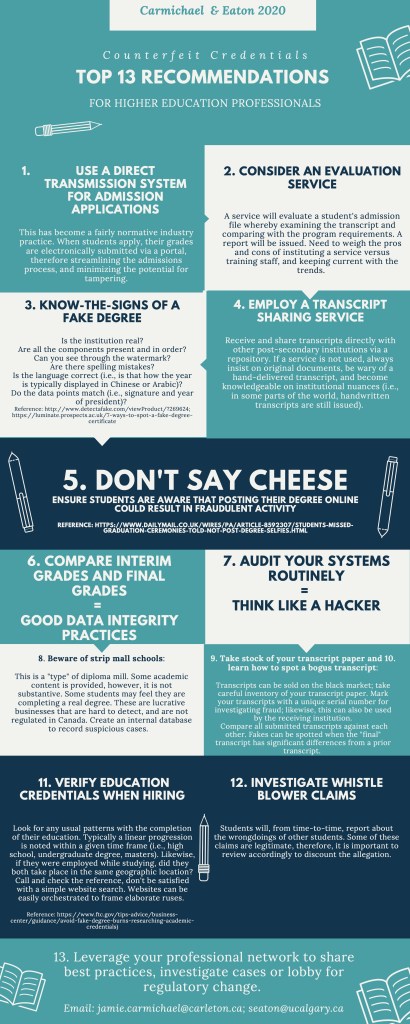
Counterfeit Credentials: 13 Recommendations for Higher Education Professionals

Infographic titled "Counterfeit Credentials: Top 13 Recommendations for Higher Education Professionals" by Carmichael & Eaton (2020). It offers guidance to help institutions detect and prevent the use of fake degrees and fraudulent documents in admissions and hiring. The recommendations are:
1.	Use a direct transmission system for admission applications – Electronic grade submissions reduce tampering.
2.	Consider an evaluation service – Evaluate transcripts against program requirements.
3.	Know the signs of a fake degree – Check for authenticity, spelling, watermarks, correct language, matching data points.
4.	Employ a transcript sharing service – Use secure repositories or verify hand-delivered transcripts.
5.	Don't say cheese – Warn students not to post degrees online due to risk of fraud.
6.	Compare interim and final grades – Ensures data integrity.
7.	Audit your systems routinely – Think like a hacker to uncover weaknesses.
8.	Beware of strip mall schools – Diploma mills that mimic real institutions; create internal databases for tracking.
9.	Take stock of your transcript paper – Use serial numbers and compare for inconsistencies.
10.	Learn how to spot a bogus transcript – Identify fakes by comparing submitted transcripts.
11.	Verify education credentials when hiring – Check for linear academic progression and verify references beyond website searches.
12.	Investigate whistleblower claims – Some student reports may be legitimate and need proper review.
13.	Leverage your professional network – Share practices, investigate cases, or lobby for change.
References and contact emails (jamie.carmichael@carleton.ca; seaton@ucalgary.ca) are included for further information.

This infographic is intended mainly for registrars, admissions staff, admissions committees and others whose work involves assessing the credentials of applicants for university and college programs. 

Scholarships Without Scruples

In this infographic, Jamie Carmichael and I share signs of scholarship scams, which is one from of educational fraud:

Infographic titled “Scholarships Without Scruples – 3 Signs of Scholarship Scams.” Credit Card Required: Don’t give out your credit card number. Legitimate scholarship applications never ask for this information. Discount in Disguise: You should not have to buy anything to receive a scholarship. Legit scholarships never require payment for goods or services. Tax Trickery: Legit scholarships are taxed differently than earned income. If proper tax documentation isn’t provided, it may not be a real scholarship. At the bottom: “Find out more” – Contact information for Sarah Elaine Eaton (University of Calgary, seaton@ucalgary.ca) and Jamie Carmichael (Carleton University, Jamie.Carmichael@Carleton.ca). Footer text: “Scholarship scams are real. Learn how to protect yourself!”

When it comes to education fraud, there are many angles to consider. There is certainly a need for more research, awareness, and advocacy on these topics, especially as GenAI can make these types of fraud easier.

Below are some related posts and further resources that I hope you find helpful.

Related posts

References and Resources

  • Carmichael, J. (2023, June 7). Understanding Fake Degrees and Credential Fraud in Higher Ed. The Evollution: A Modern Campus Illumination. https://evolllution.com/programming/credentials/understanding-fake-degrees-and-credential-fraud-in-higher-ed/
  • Carmichael, J. J. (2024). Reframing and Broadening Adversarial Stylometry for Academic Integrity. In S. E. Eaton (Ed.), Second Handbook of Academic Integrity (pp. 1467-1485). Springer Nature Switzerland. https://doi.org/10.1007/978-3-031-54144-5_148 
  • Carmichael, J., & Eaton, S. E. (2020). Counterfeit Credentials: Top 13 Recommendations for Higher Education Professionals (Infographic). University of Calgary. http://hdl.handle.net/1880/113042 
  • Clark, A. (2023). Examining the problem of fraudulent English test scores: What can Canadian higher education institutions learn? In S. E. Eaton, J. J. Carmichael, & H. Pethrick (Eds.), Fake Degrees and Fraudulent Credentials in Higher Education (pp. 187-207). Springer International Publishing. https://doi.org/10.1007/978-3-031-21796-8_9 
  • Çelik, Ö., & Razı, S. (2023). Avoiding favouritism in the recruitment practice of Turkish higher education institutions. In S. E. Eaton, J. J. Carmichael, & H. Pethrick (Eds.), Fake Degrees and Fraudulent Credentials in Higher Education (pp. 153-167). Springer International Publishing. https://doi.org/10.1007/978-3-031-21796-8_7 
  • DeCoster, B. (2023). There is no culture? A framework for addressing admissions fraud. In S. E. Eaton, J. J. Carmichael, & H. Pethrick (Eds.), Fake Degrees and Fraudulent Credentials in Higher Education (pp. 209-226). Springer International Publishing. https://doi.org/10.1007/978-3-031-21796-8_10 
  • Duklas, J. (2023). Bridging to tomorrow: A historical and technological review of credential exchange in higher education within Canada. In S. E. Eaton, J. J. Carmichael, & H. Pethrick (Eds.), Fake Degrees and Fraudulent Credentials in Higher Education (pp. 95-113). Springer International Publishing. https://doi.org/10.1007/978-3-031-21796-8_4
  • Eaton, S. E., & Carmichael, J. (2020). Scholarships without scruples (Infographic). University of Calgary: http://hdl.handle.net/1880/113044
  • Eaton, S. E., & Carmichael, J. (2022). The Ecosystem of Commercial Academic Fraud. University of Calgary. https://dx.doi.org/10.11575/PRISM/40330
  • Eaton, S. E., Carmichael, J., & Pethrick, H. (Eds.). (2023). Fake degrees and credential fraud in higher education. Springer. https://doi.org/10.1007/978-3-031-21796-8
  • Ezell, A. (2023). Yesterday, today, and tomorrow: A tour of Axact, the “World’s Largest Diploma Mill”. In S. E. Eaton, J. J. Carmichael, & H. Pethrick (Eds.), Fake Degrees and Fraudulent Credentials in Higher Education (pp. 49-94). Springer International Publishing. https://doi.org/10.1007/978-3-031-21796-8_3 
  • Hextrum, K. (2023). Fair play, fraud, or fixed? Athletic credentials in U.S. higher education. In S. E. Eaton, J. J. Carmichael, & H. Pethrick (Eds.), Fake Degrees and Fraudulent Credentials in Higher Education (pp. 115-132). Springer International Publishing. https://doi.org/10.1007/978-3-031-21796-8_5
  • Orim, S.-M., & Glendinning, I. (2023). Corruption in admissions, recruitment, qualifications and credentials: From research into quality assurance. In S. E. Eaton, J. J. Carmichael, & H. Pethrick (Eds.), Fake Degrees and Fraudulent Credentials in Higher Education (pp. 133-151). Springer International Publishing. https://doi.org/10.1007/978-3-031-21796-8_6
  • Sabbaghan, S., & Fazel, I. (2023). None of the above: Integrity concerns of standardized English proficiency tests. In S. E. Eaton, J. J. Carmichael, & H. Pethrick (Eds.), Fake Degrees and Fraudulent Credentials in Higher Education (pp. 169-185). Springer International Publishing. https://doi.org/10.1007/978-3-031-21796-8_8

–——–-

Share this post: Fake Degrees, Fraudulent Credentials and the Ecosystem of Commercial Academic Fraud – https://drsaraheaton.com/2025/04/10/fake-degrees-fraudulent-credentials-and-the-ecosystem-of-commercial-academic-fraud/

This blog has had over 3.7 million views thanks to readers like you. If you enjoyed this post, please ‘Like’ it using the button below or share it on social media. Thanks!

Sarah Elaine Eaton, PhD, is a Professor and Research Chair in the Werklund School of Education at the University of Calgary, Canada. Opinions are my own and do not represent those of my employer. 


A Reflection to Start 2025

January 1, 2025
An infographic with black text set on a background with blue at the top that transitions into green at the bottom.

Starting the year with a brief reflection inspired by the OECD Social and Emotional Skills for Better Lives report:

How can we, as educators, create systems and circumstances to help students thrive? How do we create opportunities for them? If there are doors that have been closed to them, how do we open those doors?

Or better yet, how do we break down the walls that hold up those doors in the first place?

These are some big questions I am contemplating for this year. How about you?

________________________

Share this post: A Reflection to Start 2025 https://drsaraheaton.com/2025/01/01/a-reflection-to-start-2025/

This blog has had over 3 million views thanks to readers like you. If you enjoyed this post, please “like” it or share it on social media. Thanks!

Sarah Elaine Eaton, PhD, is a Professor and Research Chair in the Werklund School of Education at the University of Calgary, Canada. Opinions are my own and do not represent those of my employer. 


How to Publish your Amazon Kindle e-book (It’s easier than you think!)

March 15, 2012

Are you an author or a writer? Do you have a book in you that is ready to be shared with the world?

I published my first book in 2002. Last year, everything changed. I published 4 of my own e-books as Amazon Kindle books.

In Feburary, I had the privilege of presenting the nuts and bolts of the “how to” at the National Speakers Association 2012 Winter Conference in Dallas, TX on February 4.

A few weeks later, I did the same presentation for the my home chapter of the Canadian Association of Professional Speakers. We taped the Calgary session and I have the highlights here for you. This video details the exact method for you, step-by-step.

My prediction is that teachers, students and writers of all types are soon going to be publishing and sharing their work on line in a variety of formats. Amazon e-books are just one way to do that. It is easier now to be a published writer than it has ever been in history. If you are a writer, this is your time!

___________________________

Share or Tweet this post: How to Publish your Amazon Kindle e-book (It’s easier than you think!) http://wp.me/pNAh3-1jm

Update – January 2018 – This blog has had over 1.8 million views thanks to readers like you. If you enjoyed this post, please “like” it or share it on social media. Thanks!

Sarah Elaine Eaton is a faculty member in the Werklund School of Education, University of Calgary, Canada.


“Big Universe” teaches children the love of reading and writing

June 22, 2010

When I saw this resource posted on a friends’ Facebook page, I had to share it with you. It’s a fun, creative, value-priced resource to help children learn to love reading and writing. Children create their own picture books through Big Universe, a fee-based service that also offers a free trial. There are family, classroom and school plans. The site makes it easy for children to create and publish their own books. Super resource for literacy programs, language arts programs, and home schoolers. Love it!

_____________________________

Share this post: “Big Universe” teaches children the love of reading and writing https://wp.me/pNAh3-9W

Update – January 2018 – This blog has had over 1.8 million views thanks to readers like you. If you enjoyed this post, please “like” it or share it on social media. Thanks!

Sarah Elaine Eaton is a faculty member in the Werklund School of Education, University of Calgary, Canada.


Leadership Book Recommendation: Good to Great

April 29, 2010

One of my goals for 2010 is to read one leadership book per month. I’ve been able to meet that goal and of the books I’ve read so far, the work of one author stands out. Jim Collins’ Good to Great: Why Some Companies Make the Leap and Others Don’t (2001) is an insightful read into why “good is the enemy of great” (p. 1). He shares insights such as:

  • “When you have disciplined people, you don’t need hierarchy. When you have disciplined thought, you don’t need bureaucracy.” (p. 13)
  • “There’s a huge difference between having the opportunity to have your say, and the opportunity to be heard.” (p. 74)
  • “The essence of profound insight is simplicity.” (p. 91)
  • “You can’t manufacture passion or motivate people to feel passionate. You can only discover what ignites your passion and the passions of those around you.” (p. 109)
  • “It is impossible to have a great life unless it is a meaningful life.”

After studying businesses, Collins did a short companion book called, Why Business Thinking is Not the Answer: Good to Great and the Social Sectors: A Monograph to Accompany Good to Great (2005). This is a thought-provoking little gem that helps us wrap our brains around the struggle that education and non-profit organizations face to be more like businesses. Collins makes a compelling argument that they shouldn’t try. He challenges us to think in new ways when he claims, that “most businesses are mediocre. Why would we want to import the practices of mediocrity into the social sectors?” (p. 1)

He talks about “organizational greatness”, as opposed to business as being something to aspire to. He urges us to consider that, “A great organization is one that delivers superior performance and makes a distinctive impact over a long period of time”. It’s easy to see how that could apply either to a business or a social sector organization.

Collins goes on to say that he suspects, “we will find more true leadership in the social sectors than the business sector” (p. 12). That’s quite a claim from a former faculty member of the Standford University Graduate School of Business.

Good to Great and the companion monograph, Good to Great and the Social Sectors are thought-provoking and insightful books on organizations and leadership. Well researched. Well written. Worth the read.