Embracing AI as a Teaching Tool: Practical Approaches for the Post-plagiarism Classroom

March 23, 2025

Artificial intelligence (AI) has moved from a futuristic concept to an everyday reality. Rather than viewing AI tools like ChatGPT as threats to academic integrity, forward-thinking educators are discovering their potential as powerful teaching instruments. Here’s how you can meaningfully incorporate AI into your classroom while promoting critical thinking and ethical technology use.

Making AI Visible in the Learning Process

One of the most effective approaches to teaching with AI is to bring it into the open. When we demystify these tools, students develop a more nuanced understanding of the tools’ capabilities and limitations.

Start by dedicating class time to explore AI tools together. You might begin with a demonstration of how ChatGPT or similar tools respond to different types of prompts. Ask students to compare the quality of responses when the tool is asked to:

  • Summarize factual information
  • Analyze a complex concept
  • Solve a problem in your discipline
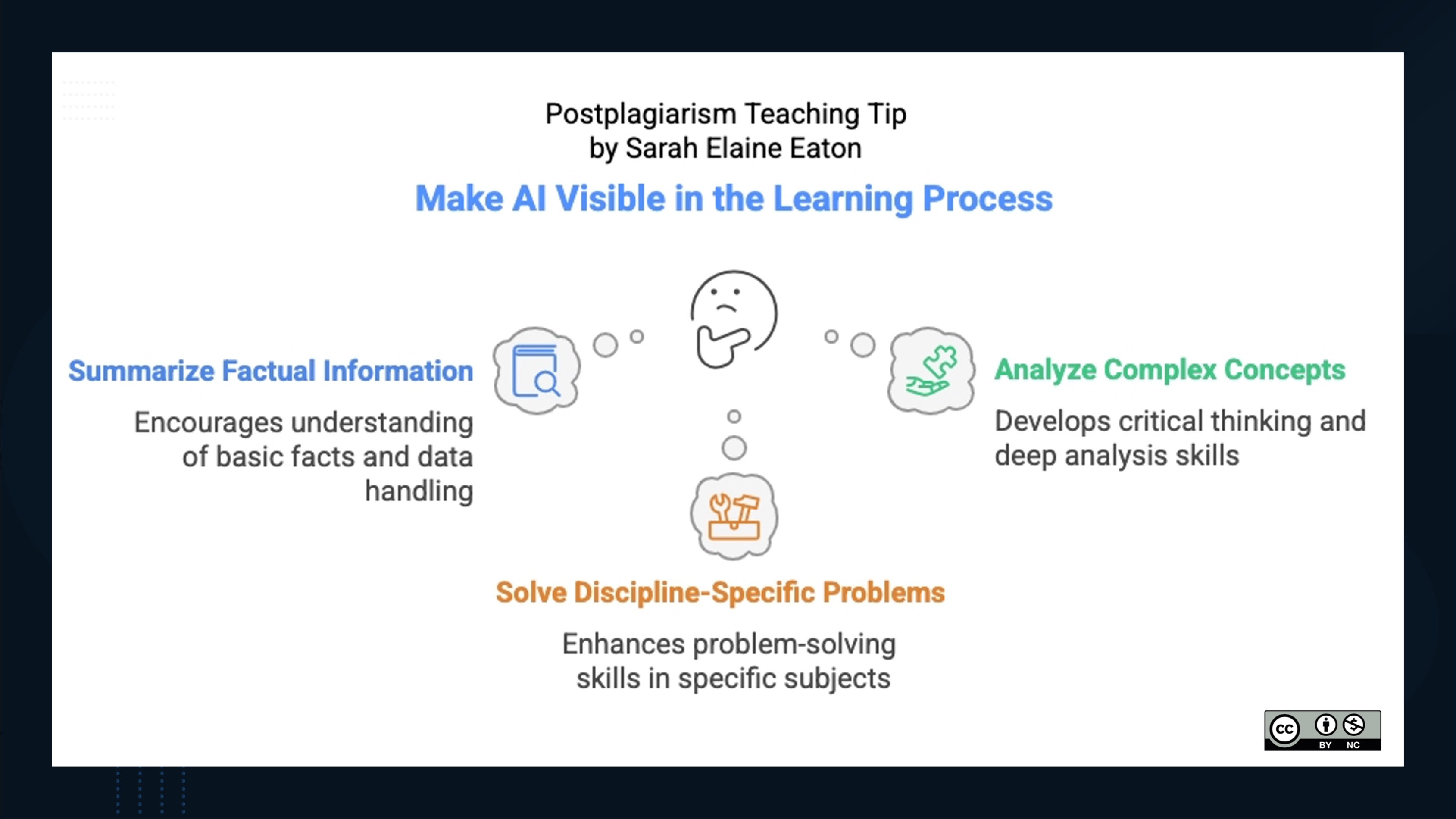
A teaching tip infographic titled "Postplagiarism Teaching Tip by Sarah Elaine Eaton: Make AI Visible in the Learning Process." The infographic features a central image of a thinking face emoji, with three connected bubbles highlighting different aspects of AI integration in learning:

Summarize Factual Information (blue): Encourages understanding of basic facts and data handling, represented by an icon of a document with a magnifying glass.

Analyze Complex Concepts (green): Develops critical thinking and deep analysis skills, represented by an icon of a puzzle piece.

Solve Discipline-Specific Problems (orange): Enhances problem-solving skills in specific subjects, represented by an icon of tools (wrench and screwdriver).
In the bottom right corner, there’s a Creative Commons license (CC BY-NC) icon.

Have students identify where the AI excels and where it falls short. Hands-on experience that is supervised by an educator helps students understand that while AI can be impressive and  capable, it has clear boundaries and weaknesses.

From AI Drafts to Critical Analysis

AI tools can quickly generate content that serves as a starting point for deeper learning. Here is a step-by-step approach for using AI-generated drafts as teaching material:

  1. Assignment Preparation: Choose a topic relevant to your course and generate a draft response using an AI tool such as ChatGPT.
  2. Collaborative Analysis: Share the AI-generated draft with students and facilitate a discussion about its strengths and weaknesses. Prompt students with questions such as:
    • What perspectives are missing from this response?
    • How could the structure be improved?
    • What claims require additional evidence?
    • How might we make this content more engaging or relevant?

The idea is to bring students into conversations about AI, to build their critical thinking and also have them puzzle through the strengths and weaknesses of current AI tools.

  • Revision Workshop: Have students work individually or in groups to revised an AI draft into a more nuanced, complete response. This process teaches students that the value lies not in generating initial content (which AI can do) but in refining, expanding, and critically evaluating information (which requires human judgment).
  • Reflection: Ask students to document what they learned through the revision process. What gaps did they identify in the AI’s understanding? How did their human perspective enhance the work? Building in meta-cognitive awareness is one of the skills that assessment experts such as Bearman and Luckin (2020) emphasize in their work.

This approach shifts the educational focus from content creation to content evaluation and refinement—skills that will remain valuable regardless of technological advancement.

Teaching Fact-Checking Through Deliberate Errors

AI systems often present information confidently, even when that information is incorrect or fabricated. This characteristic makes AI-generated content perfect for teaching fact-checking skills.

Try this classroom activity:

  1. Generate Content with Errors: Use an AI tool to create content in your subject area, either by requesting information you know contains errors or by asking about obscure topics where the AI might fabricate details.
  2. Fact-Finding Mission: Provide this content to students with the explicit instruction to identify potential errors and verify information. You might structure this as:
    • Individual verification of specific claims
    • Small group investigation with different sections assigned to each group
    • A whole-class collaborative fact-checking document
  3. Source Evaluation: Have students document not just whether information is correct, but how they determined its accuracy. This reinforces the importance of consulting authoritative sources and cross-referencing information.
  4. Meta-Discussion: Use this opportunity to discuss why AI systems make these kinds of errors. Topics might include:
  • How large language models are trained
  • The concept of ‘hallucination’ in AI
  • The difference between pattern recognition and understanding
  • Why AI might present incorrect information with high confidence

These activities teach students not just to be skeptical of AI outputs but to develop systematic approaches to information verification—an essential skill in our information-saturated world.

Case Studies in AI Ethics

Ethical considerations around AI use should be explicit rather than implicit in education. Develop case studies that prompt students to engage with real ethical dilemmas:

  1. Attribution Discussions: Present scenarios where students must decide how to properly attribute AI contributions to their work. For example, if an AI helps to brainstorm ideas or provides an outline that a student substantially revises, how could this be acknowledged?
  2. Equity Considerations: Explore cases highlighting AI’s accessibility implications. Who benefits from these tools? Who might be disadvantaged? How might different cultural perspectives be underrepresented in AI outputs?
  3. Professional Standards: Discuss how different fields are developing guidelines for AI use. Medical students might examine how AI diagnostic tools should be used alongside human expertise, while creative writing students could debate the role of AI in authorship.
  4. Decision-Making Frameworks: Help students develop personal guidelines for when and how to use AI tools. What types of tasks might benefit from AI assistance? Where is independent human work essential?

These discussions help students develop thoughtful approaches to technology use that will serve them well beyond the classroom.

Implementation Tips for Educators

As you incorporate these approaches into your teaching, consider these practical suggestions:

  • Start small with one AI-focused activity before expanding to broader integration
  • Be transparent with students about your own learning curve with these technologies
  • Update your syllabus to clearly outline expectations for appropriate AI use
  • Document successes and challenges to refine your approach over time
  • Share experiences with colleagues to build institutional knowledge

Moving Beyond the AI Panic

The concept of postplagiarism does not mean abandoning academic integrity—rather, it calls for reimagining how we teach integrity in a technologically integrated world. By bringing AI tools directly into our teaching practices, we help students develop the critical thinking, evaluation skills, and ethical awareness needed to use these technologies responsibly.

When we shift our focus from preventing AI use to teaching with and about AI, we prepare students not just for academic success, but for thoughtful engagement with technology throughout their lives and careers.

References

Bearman, M., & Luckin, R. (2020). Preparing university assessment for a world with AI: Tasks for human intelligence. In M. Bearman, P. Dawson, R. Ajjawi, J. Tai, & D. Boud (Eds.), Re-imagining University Assessment in a Digital World (pp. 49-63). Springer International Publishing. https://doi.org/10.1007/978-3-030-41956-1_5 

Eaton, S. E. (2023). Postplagiarism: Transdisciplinary ethics and integrity in the age of artificial intelligence and neurotechnology. International Journal for Educational Integrity, 19(1), 1-10. https://doi.org/10.1007/s40979-023-00144-1

Edwards, B. (2023, April 6). Why ChatGPT and Bing Chat are so good at making things up. Arts Technica. https://arstechnica.com/information-technology/2023/04/why-ai-chatbots-are-the-ultimate-bs-machines-and-how-people-hope-to-fix-them/ 

________________________

Share this post: Embracing AI as a Teaching Tool: Practical Approaches for the Postplagiarism Classroom – https://drsaraheaton.com/2025/03/23/embracing-ai-as-a-teaching-tool-practical-approaches-for-the-post-plagiarism-classroom/

This blog has had over 3.7 million views thanks to readers like you. If you enjoyed this post, please ‘Like’ it using the button below or share it on social media. Thanks!

Sarah Elaine Eaton, PhD, is a Professor and Research Chair in the Werklund School of Education at the University of Calgary, Canada. Opinions are my own and do not represent those of my employer.


Upcoming Talk: From Plagiarism to Postplagiarism: Navigating the GenAI Revolution in Higher Education

January 3, 2025
An promo announcement on a white background. There is a red stripe down the left-hand site. The University of Calgary logo appears on the top right. The following text is written in black, orange and red:
From Plagiarism to Postplagiarism: Navigating the GenAI Revolution in Higher Education
The first 2025 public presentation about #Postplagiarism
is now open for registration!

Free and open to the public.
Join us in person or via webinar.
January 29, 2025| 12:00 – 13:00 Mountain time

https://workrooms.ucalgary.ca/event/3854045

Join us for our first presentation of 2025:

From Plagiarism to Postplagiarism: Navigating the GenAI Revolution in Higher Education

Format: Hybrid (in person or live stream)

I am delighted to kick off a speaker series on GenAI hosted by my colleague, Dr. Soroush Sabbaghan, through the Centre for Artificial Intelligence Ethics, Literacy, and Integrity (CAIELI) at the University of Calgary.

Description

Generative AI (GenAI) is transforming teaching, learning, and assessment in higher education.

Learn to integrate GenAI effectively while maintaining academic integrity and enhancing student agency.

Dr. Sarah Eaton shares innovative strategies that promote critical thinking and original scholarship. Explore how GenAI reshapes academic practices and discover proactive approaches to leverage its potential.

This session equips educators, administrators, and policymakers to lead purposefully in a dynamic academic landscape.

Speaker bio

Sarah Elaine Eaton is a Professor and research chair at the Werklund School of Education at the University of Calgary (Canada). She is an award-winning educator, researcher, and leader. She leads transdisciplinary research teams focused on the ethical implications of advanced technology use in educational contexts. Dr. Eaton also holds a concurrent appointment as an Honorary Associate Professor, Deakin University, Australia.

More Details

Date: January 29, 2025

Time: 12:00 – 13:00 Mountain time

This talk is free and open to the public, but there are only 20 seats available to join us in person! We can also accommodate folks online.

Get more details and register here.

________________________

Share this post: Upcoming talk: From Plagiarism to Postplagiarism: Navigating the GenAI Revolution in Higher Education – https://drsaraheaton.com/2025/01/03/upcoming-talk-from-plagiarism-to-postplagiarism-navigating-the-genai-revolution-in-higher-education/

This blog has had over 3.7 million views thanks to readers like you. If you enjoyed this post, please “like” it or share it on social media. Thanks!

Sarah Elaine Eaton, PhD, is a Professor and Research Chair in the Werklund School of Education at the University of Calgary, Canada. Opinions are my own and do not represent those of my employer. 


Future-proofing integrity in the age of artificial intelligence and neurotechnology: Prioritizing human rights, dignity, and equity

November 13, 2024

Once a year I write an editorial for the International Journal for Educational Integrity. I take a big idea, ground it in literature written by some of the best in the world and then call for ways to improve our field even more. In 2023 I wrote about Postplagiarism and in 2022, I focused on equity, diversity, inclusion, accessibility and decolonization as new priorities for academic integrity. Here is this year’s editorial:

Future-proofing integrity in the age of artificial intelligence and neurotechnology: prioritizing human rights, dignity, and equity

A screenshot of an article title page. There is black text on a white background with a green banner at the top.
Here is a link to the original: https://edintegrity.biomedcentral.com/articles/10.1007/s40979-024-00175-2

Abstract

In this article I argue for the prioritisation of human rights when developing and implementing misconduct policies. Existing approaches may be perpetuate inequities, particularly for individuals from marginalised groups. A human-rights-by-design approach, which centres human rights in policy development, revision, and implementation, ensuring that every individual is treated with dignity and respect.

Recommendations for implementing a human-rights approach to misconduct investigations and case management are offered, covering areas such as procedural fairness, privacy, equity, and the right to education. Additional topics covered are the need to limit surveillance technologies, and the need to recognize that not all use of artificial intelligence tools automatically constitutes misconduct. I disentangle

the differences between equity and equality and explain how both are important when considering ethics and integrity. A central argument of this paper is that a human-rights-by-design approach to integrity does not diminish standards but rather strengthens educational systems by cultivating ethical awareness and respect for personhood. I conclude with a call to action with a seven-point plan for institutions to adopt a human-rights-based approach to ethics and integrity. In the age of artificial intelligence and neurotechnology, insisting on human rights and dignity when we investigate and address misconduct allegations is an ethical imperative that has never been more important.

Keywords Academic misconduct, Academic dishonesty, Plagiarism, Policy, Human rights, Restorative justice, Artificial intelligence, Neurotechnology, Higher education, Education

Commentary

As I reflect on the current state of academic and research integrity, I am struck by a glaring omission in our discussions: the connection between misconduct and human rights. We often treat these as separate entities, failing to recognize the profound impact that misconduct investigations and policies can have on the fundamental rights of individuals. This oversight is particularly concerning in the age of artificial intelligence (AI) and neurotechnology, where the potential for harm is magnified.

Take, for example, the case of a professor in Canada who physically assaulted international students accused of plagiarism. This horrifying example demonstrates how the pursuit of academic integrity can be twisted into a justification for degrading and inhumane treatment, violating the very principles of dignity and respect that should guide our actions. While this is an extreme case, it highlights the need for a fundamental shift in our approach.

In this editorial, I offer a call to action to move beyond simply adhering to legal requirements and embrace a ‘human-rights-by-design’ approach that embeds human rights principles into our policies and practices. This means ensuring procedural fairness throughout investigations, safeguarding the privacy of individuals, and recognizing the right to be presumed innocent until there is proof to the contrary. It also requires us to acknowledge the diverse backgrounds and circumstances of our students and staff, striving for equitable treatment that addresses systemic inequalities and provides the support needed for everyone to succeed.

In the face of rapidly evolving technologies like AI, we must be especially vigilant in upholding human rights. The temptation to rely on unproven AI detection tools or to rush to judgement based on suspicion rather than evidence is strong, but it is a path that leads us away from justice and fairness. We cannot allow fear or expediency to erode our commitment to human dignity.

By centring human rights in our approach to integrity, we can create educational and research environments that are not only ethically sound but also truly just and equitable. This is not about lowering standards; it is about building a culture of integrity that upholds the inherent worth of every individual.

________________________

Share this post: Future-proofing integrity in the age of artificial intelligence and neurotechnology: Prioritizing human rights, dignity, and equity – https://drsaraheaton.com/2024/11/13/future-proofing-integrity-in-the-age-of-artificial-intelligence-and-neurotechnology-prioritizing-human-rights-dignity-and-equity/
This blog has had over 3 million views thanks to readers like you. If you enjoyed this post, please “like” it or share it on social media. Thanks!

Sarah Elaine Eaton, PhD, is a Professor and Research Chair in the Werklund School of Education at the University of Calgary, Canada. Opinions are my own and do not represent those of my employer.


Event: The Intersection of Academic Integrity and Inclusion: A Fireside Chat

October 10, 2024

Next week is Academic Integrity Week at the Univeristy of Calgary. This year, I have the honour of moderating a fireside chat with one of my very own Werklund School of Education Doctor of Education (EdD) students, Colleen Fleming. 

Join us for a thought-provoking discussion during Academic Integrity Week 2024!

A poster with text in black, red, and orange. The University of Calgary logo appears at the top. On the right-hand side there is art featuring a woman wearing a headset.

Discover the crucial link between academic integrity and inclusion in higher education with our distinguished speaker, Colleen Fleming, EdD student, Werklund School of Education.

Moderated by Dr. Sarah Elaine Eaton, this conversation will explore:

  • Defining academic integrity in an inclusive context
  • Challenges in maintaining integrity across diverse student populations
  • Practical strategies for educators to promote both integrity and inclusion

Don’t miss this opportunity to gain insights from Colleen’s extensive experience as a K-12 practitioner and her cutting-edge doctoral research. Engage in a live Q&A session and contribute to this important conversation.

A bit about Colleen…

A photograph of a woman with chin-length blonde hair. She is wearing a white top. The background is blue.

Colleen Fleming (she/her/hers) is a K-12 practitioner at a designated special education school in Calgary. She has a keen interest in developing a culture of integrity among learners through the promotion of equity, diversity, and inclusion. As a Doctor of Education student at Werklund, her research involves proactively educating students about academic integrity in preparation for higher education.

Event details

Date: October 16, 2024

Time: 12:00 – 1:00 p.m.

Location: University of Calgary, Taylor Family Digital Library, Gallery Hall

https://events.ucalgary.ca/library/event/481166-academic-integrity-and-inclusion-with-colleen-fleming

This event is free and open to the public. Everyone is welcome!

________________________

Share this post: The Intersection of Academic Integrity and Inclusion: A Fireside Chat – https://drsaraheaton.com/2024/10/10/event-the-intersection-of-academic-integrity-and-inclusion-a-fireside-chat/

This blog has had over 3 million views thanks to readers like you. If you enjoyed this post, please “like” it or share it on social media. Thanks!

Sarah Elaine Eaton, PhD, is a Professor and Research Chair in the Werklund School of Education at the University of Calgary, Canada. Opinions are my own and do not represent those of my employer.


Exploring Postplagiarism with Google NotebookLM

September 23, 2024

This weekend I have been playing around with Google’s NotebookLM. This is a brand new, completely free service that can help users learn content in a variety of ways. It is powered by Gemini 1.5 Pro and it’s worth checking out. 

To test it out, I uploaded a copy of “Postplagiarism: Transdisciplinary ethics and integrity in the age of artificial intelligence and neurotechnology” in .pdf format.

Here is what NotebookLM came up with:

Audio Conversation

Perhaps the most impressive of the outputs is a podcast-style audio conversation that is completely AI-generated. You can listen to the Postplagiarism conversation here.

Postplagiarism: Navigating Ethics and Integrity in the Age of AI: Study Guide

Screenshot from Google’s NotebookLM, taken 22-SEP-2024

Summary

This article introduces the concept of “postplagiarism,” an era defined by the seamless integration of artificial intelligence (AI) and neurotechnology into everyday life, including education. Eaton explores the implications of this integration for academic integrity, arguing that traditional definitions of plagiarism may become obsolete as AI blurs the lines of authorship.

The author posits six key tenets of postplagiarism:

  1. Hybrid human-AI writing will become the norm: Co-created content will make distinguishing human and AI input increasingly difficult.
  2. Human creativity is enhanced: AI serves as a tool to augment human creativity, not replace it.
  3. Language barriers disappear: AI translation tools have the potential to facilitate cross-cultural communication.
  4. Humans can relinquish control, but not responsibility: While AI can assist in content creation, individuals remain accountable for accuracy and ethical use.
  5. Attribution remains important: Acknowledging sources and intellectual contributions remains crucial, with evolving considerations for Indigenous knowledge systems.
  6. Historical definitions of plagiarism no longer apply: Shifting technological landscapes necessitate new frameworks for ethical engagement with information and knowledge creation.

Eaton challenges Chomsky’s view of AI as “high-tech plagiarism,” arguing instead that it demands a reevaluation of existing definitions of plagiarism within the context of rapidly evolving technological capabilities. She advocates for pre-emptive research into the ethical implications of AI and neurotechnology, particularly commercially available brain-computer interfaces (BCIs), highlighting the need for transdisciplinary collaboration to address these complex issues.

The article concludes with a call to action, urging educators to prepare students for a future characterized by ubiquitous AI and neurotechnology, emphasizing ethical considerations and societal impact.

Quiz

Instructions: Answer the following questions in 2-3 sentences.

  1. What does Eaton mean by “postplagiarism”?
  2. Why does Eaton believe that AI will make traditional definitions of plagiarism obsolete?
  3. What is Eaton’s stance on Chomsky’s characterization of AI as “high-tech plagiarism”?
  4. Explain the concept of “hybrid human-AI writing” and its implications.
  5. According to Eaton, how does the emergence of AI impact human creativity?
  6. Why does Eaton believe that attribution remains important in the age of AI?
  7. What ethical concerns does Eaton raise regarding the use of neurotechnology in education?
  8. Why does Eaton believe that educators were caught off guard by both the COVID-19 pandemic and the emergence of AI like ChatGPT?
  9. What type of research does Eaton advocate for in relation to AI and neurotechnology in education?
  10. What is Eaton’s primary call to action for educators in light of the emerging postplagiarism era?

Quiz Answer Key

  1. “Postplagiarism” refers to an era where advanced technologies like AI and neurotechnology are fully integrated into everyday life, including education. This integration significantly impacts how we teach, learn, communicate, and engage with knowledge.
  2. Eaton argues that traditional definitions of plagiarism, often focused on verbatim copying, become inadequate in the face of AI. This is because AI tools enable the creation of sophisticated, original content, blurring the lines between human and machine authorship and challenging the notion of plagiarism as we know it.
  3. Eaton disagrees with Chomsky’s view, arguing that AI should not be simply dismissed as “high-tech plagiarism.” Instead, she calls for a nuanced understanding of AI’s capabilities and a re-evaluation of existing plagiarism definitions within the context of evolving technology.
  4. “Hybrid human-AI writing” refers to the collaborative process where humans and AI tools work together to create content. This collaboration makes it difficult to discern human input from AI-generated content, challenging traditional authorship and plagiarism detection methods.
  5. Eaton argues that AI enhances, rather than threatens, human creativity. She sees AI tools as resources that can augment human imagination and inspire new forms of creative expression, rather than replacing human ingenuity.
  6. Eaton stresses the continued importance of attribution in acknowledging intellectual debts and recognizing the contributions of others. In the age of AI, this includes responsibly crediting both human and AI sources, acknowledging the collaborative nature of knowledge creation.
  7. Eaton raises ethical concerns related to privacy, consent, and equitable access when it comes to neurotechnology in education. She particularly highlights concerns regarding commercially available brain-computer interfaces (BCIs) and their potential for misuse or exacerbating existing inequalities.
  8. Eaton suggests that educators were caught off guard by both the rapid shift to online learning during the COVID-19 pandemic and the sudden rise of AI tools like ChatGPT. She attributes this to a lack of preparedness for large-scale disruptions and the exponential pace of technological advancement.
  9. Eaton advocates for pre-emptive, transdisciplinary research on the ethical implications of AI and neurotechnology in education. This research would involve collaboration between academics, policymakers, and industry experts to address complex questions surrounding equitable access, privacy, and the impact on learning and teaching practices.
  10. Eaton calls on educators to proactively prepare students for a future deeply integrated with AI and neurotechnology. This preparation involves fostering critical thinking skills, ethical awareness regarding technology use, and adaptability in the face of evolving technological landscapes.

Essay Questions

  1. Analyse Eaton’s argument that traditional definitions of plagiarism are no longer applicable in the age of AI. How does AI challenge existing notions of authorship and originality?
  2. Discuss the ethical implications of commercially available neurotechnology in education. What are the potential benefits and risks associated with using such technologies in learning environments?
  3. How should educational institutions adapt their policies and practices to address the challenges and opportunities presented by postplagiarism?
  4. In what ways can AI be used to enhance, rather than replace, human creativity and critical thinking skills in educational settings? Provide specific examples to support your arguments.
  5. Discuss the potential impact of AI-driven translation tools on language learning and cross-cultural communication in education. How can we ensure equitable access to these tools and address concerns related to language diversity and cultural representation?

Glossary of Key Terms

  • Postplagiarism: An era characterized by the seamless integration of advanced technologies like AI and neurotechnology into everyday life, impacting how we learn, communicate, and create knowledge.
  • Artificial Intelligence (AI): The ability of a computer or a robot controlled by a computer to perform tasks that are usually done by humans because they require human intelligence and discernment.
  • Neurotechnology: Technology that interacts directly with the brain or nervous system, encompassing tools for monitoring, recording, or modulating neural activity.
  • Brain-Computer Interface (BCI): A device that establishes a direct communication pathway between the brain and an external device, often a computer, enabling the control of the device using brain signals.
  • Hybrid Human-AI Writing: Collaborative content creation involving both human input and AI-generated text, blurring the lines of authorship.
  • Large Language Model (LLM): A type of AI trained on a massive dataset of text and code to generate human-quality text, translate languages, write different kinds of creative content, and answer your questions in an informative way.
  • Decolonization: The process of undoing the harmful effects of colonialism, particularly in educational contexts, challenging Eurocentric perspectives and promoting Indigenous knowledge systems.
  • Knowledge Caretaker: An individual or community responsible for preserving, transmitting, and respectfully engaging with knowledge, particularly within Indigenous cultures.

This study guide provides a comprehensive overview of the article, aiding in your understanding of the key concepts and arguments presented. Remember to utilize the quiz and essay questions to test your knowledge and delve deeper into the complexities of postplagiarism.

Postplagiarism FAQ

1. What is postplagiarism?

Postplagiarism refers to an era where advanced technologies, such as artificial intelligence (AI) and neurotechnology like brain-computer interfaces (BCIs), are deeply integrated into our daily lives, including education. This integration will significantly impact how we teach, learn, and interact.

2. How will AI impact academic writing?

AI writing tools are becoming increasingly sophisticated, making it difficult to distinguish between human and AI-generated text. This rise of hybrid human-AI writing presents challenges to traditional notions of plagiarism. While AI can enhance creativity by assisting with writing tasks, it also raises concerns about authenticity and the need to uphold ethical writing practices.

3. Will AI make learning languages irrelevant?

While AI translation tools are becoming more powerful, they won’t render language learning obsolete. Although AI can facilitate communication across language barriers, it cannot replace the cultural understanding and nuanced communication that comes with learning a language.

4. Can I use AI to complete my assignments?

Even with AI assistance, students are ultimately responsible for their academic work. Using AI to complete assignments without proper attribution or understanding can be considered a form of academic misconduct. Educators have a responsibility to adapt assessment methods to ensure students demonstrate genuine learning.

5. How does postplagiarism affect attribution practices?

While traditional citation methods remain important, postplagiarism challenges us to rethink how we acknowledge and value knowledge sources, particularly Indigenous knowledge systems often overlooked in standard academic practices. Respectful attribution in the postplagiarism era requires moving beyond technical citations to engage deeply with the works and ideas of others.

6. Are current academic integrity policies equipped to handle AI?

Existing definitions and policies related to plagiarism may need to be reevaluated in the age of postplagiarism. The lines are becoming blurred, demanding a more nuanced understanding of academic integrity that goes beyond simply detecting copied text.

7. What about neurotechnology? How will it impact education?

The emergence of neurotechnology, particularly BCIs, brings both opportunities and challenges. While it has the potential to revolutionize learning and assist individuals with disabilities, it also raises ethical concerns regarding privacy, autonomy, and potential misuse for academic cheating.

8. What can educators do to prepare for the postplagiarism era?

Educators should actively engage in discussions surrounding AI and neurotechnology in education. This includes researching ethical implications, promoting responsible AI use, adapting teaching practices, and fostering critical thinking skills in students to navigate this evolving landscape. Collaboration between educators, policymakers, and researchers is crucial to address these challenges proactively.

Sarah’s Reflections on NotebookLM

Notebook LM is a game-changer for teaching and learning. Students can upload any material to the app and generate content in plain language in both text and audio format.

NotebookLM is a game-changer for teaching and learning. Students can upload any material to the app and generate content in plain language in both text and audio format. There are benefits and drawbacks to any technology and here are some that come to mind for NotebookLM:

Benefits

  • Personalized Learning: NotebookLM can tailor learning experiences to individual students’ needs, pace, and preferences. It can provide personalized explanations, examples, and practice test questions. I like this aspect of NotebookLM because it allows learners to personalize their own learning experience, rather than having a teacher do it for them.
  • Enhanced Engagement: By offering interactive and engaging content, NotebookLM can increase student interest and motivation by situating the locus of control for the learning with the student. I like this because the app can help to promote learner autonomy and agency. It can also facilitate collaborative learning through features like group discussions and shared notes.
  • Accessibility and UDL: The tool can make learning more accessible to students with disabilities, learning difficulties or really, just any learner. It does this by providing the content in a variety of formats such as text-based summaries or the audio pod-cast style conversation.
  • 24/7 Support: NotebookLM can be available to students at any time, providing a resource for independent learning and practice. No matter when a student prefers to do their learning,”just-in-time” tools like this meet learners where they are at, on their timeline, not the teacher’s timeline.

Drawbacks

  • Lack of Human Interaction: Although NotebookLM can provide valuable support, it cannot fully replace the human connection and guidance that educators offer. The affective aspects of teaching and learning and the social connections, remain important.
  • Dependency on Technology: Overreliance on NotebookLM could lead to technological issues and disruptions in learning.  For example, students who are overly dependent on technology may struggle to adapt to situations where the tool is not available or appropriate. Tools like this may — or may not — help students to develop metacognitve skills and evaluative judgement. (For more info on assessment in the age of generative AI, check out this article by Margaret Bearman and Rosemary Luckin.)
  • Perpetuation of Inequities: Students from disadvantaged backgrounds may have limited access to technology or to Internet connectivity, creating a digital divide and exacerbating educational inequalities. So, just as tools like this can enhance accessibility, they may simultaneously erode equity in different ways.
  • Data Privacy Concerns: The collection and use of student data raise privacy concerns and require careful consideration of data protection measures. There are also questions about copyright and what happens when students upload work to which others hold the copyright.
  • Potential for Misuse: NotebookLM could be misused by students to cheat or generate inaccurate content, requiring educators to implement appropriate safeguards. So, like any other technology, it can be used ethically, or unethically. Students may or may not know what is allowed or expected and so having conversations with students about expectations remains important.

Thank you to my friend and colleague, Dr. Soroush Sabbaghan, Associate Professor (Teaching) at the University of Calgary, for introducing me to NotebookLM a few days ago. I am keen to hear what learners and educators think of this tool.

References

Eaton, S. E. (2023). Postplagiarism: Transdisciplinary ethics and integrity in the age of artificial intelligence and neurotechnology. International Journal for Educational Integrity, 19(1), 1-10. https://doi.org/10.1007/s40979-023-00144-1 

Related posts:

_________________________________

Share this post: Exploring Postplagiarism Using Google’s Notebook LM – https://drsaraheaton.com/2024/09/23/exploring-postplagiarism-with-google-notebooklm/

This blog has had over 3 million views thanks to readers like you. If you enjoyed this post, please “like” it or share it on social media. Thanks!

Sarah Elaine Eaton, PhD, is a faculty member in the Werklund School of Education, and the Educational Leader in Residence, Academic Integrity, University of Calgary, Canada. Opinions are my own and do not represent those of the University of Calgary.