The Impact of Workplace Incivility on Higher Education

August 23, 2025

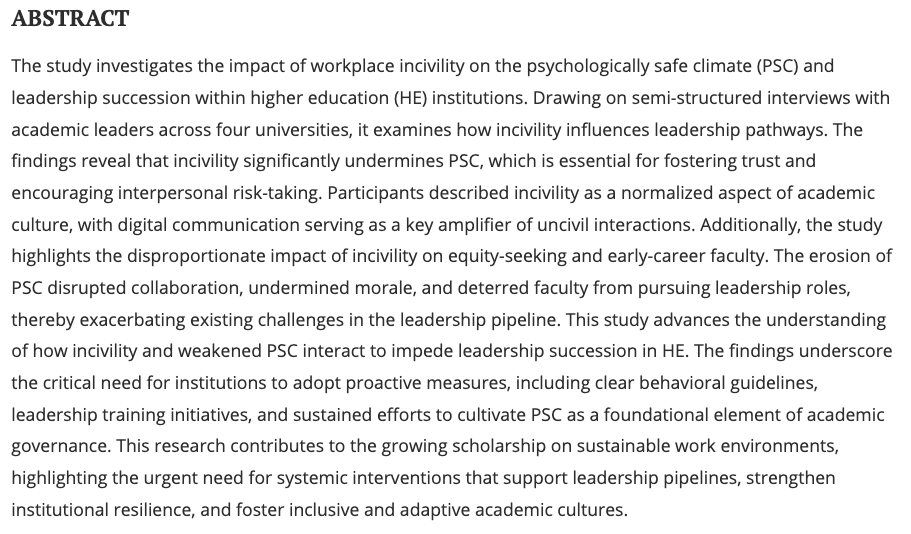
I am pleased to have collaborated with Dr. Leda Stawnychko and Ms. Rafi Mehnaz on this new article, “Exploring the impact of workplace incivility on psychological safety and leadership succession in higher education” in the International Journal for Leadership in Education.

I first met Leda Stawnychko when she was an EdD student at the University of Calgary. I had the pleasure of serving on her supervisory committee to support her doctor of education research project on Leadership Development Experiences of Department Chairs at a Canadian University.

When Leda invited me to join her later for a project on psychological safety and leadership succession in higher education, I accepted right away. This topic is important one and it rarely gets discussed in the literature on academic integrity, but as we know, professional and collegial ethics are part of a comprehensive approach to academic integrity.

As we point out in the abstract and in the main body of the article, there is a disproportionate impact of incivility on equity-seeking and early-career faculty. In other words, those who are already marginalized and experience barriers and discrimination are more likely to be on the receiving end of workplace incivility and hostility.

I’ve said it before and I’ll say it again: There can be no integrity without equity. We need to think more about the way that higher education as a system allows for the perpetuation of discrimination and harm, not only for students, but also for faculty and staff. If the workplace is not a psychologically safe environment, then employees cannot thrive.

I invite you to check out the article, which is open access and free to read and download.

________________________

Share this post: The Impact of Workplace Incivility on Higher Education – https://drsaraheaton.com/2025/08/23/the-impact-of-workplace-incivility-on-higher-education/

Sarah Elaine Eaton, PhD, is a Professor and Research Chair in the Werklund School of Education at the University of Calgary, Canada. Opinions are my own and do not represent those of my employer.

Teaching Fact-Checking Through Deliberate Errors: An Essential AI Literacy Skill

April 23, 2025

Abstract

This teaching resource explores an innovative pedagogical approach for developing AI literacy in a postplagiarism era. The document outlines a method of teaching fact-checking skills by having students critically evaluate AI-generated content containing deliberate errors. It provides practical guidance for educators on creating content with strategic inaccuracies, structuring verification activities, teaching source evaluation through a 5-step process, understanding AI error patterns, and implementing these exercises throughout courses. By engaging students in systematic verification processes, this approach helps develop metacognitive awareness, evaluative judgment, and appropriate skepticism when consuming AI-generated information. The resource emphasizes assessing students on their verification process rather than solely on error detection, preparing them to navigate an information landscape where distinguishing fact from fiction is increasingly challenging yet essential.

Here is a downloadable .pdf of this teaching activity:

Introduction

In a postplagiarism era, one of the most valuable skills we can teach students is how to critically evaluate AI-generated content. This can help them to cultivate meta-cognition and evaluative judgement, which have been identified as important skills for feedback and evaluation (e.g., Bearman and Luckin, 2020; Tai et al., 2018). Gen AI tools present information with confidence, regardless of accuracy. This characteristic creates an ideal opportunity to develop fact-checking competencies that serve students throughout their academic and professional lives.

Creating Content with Strategic Errors

Begin by generating content through an AI tool that contains factual inaccuracies. There are several approaches to ensure errors are present:

  • Ask the AI about obscure topics where it lacks sufficient training data
  • Request information about recent events beyond its knowledge cutoff
  • Pose questions about specialized fields with technical terminology
  • Combine legitimate questions with subtle misconceptions in your prompts

For example, ask a Large Language Model (LLM), such as ChatGPT (or any similar tool) to ‘Explain the impact of the Marshall-Weaver Theory on educational psychology’. There is no such theory, at least to the best of my knowledge. I have fabricated it for the purposes of illustration. The GenAI will likely fabricate details, citations, and research.

Structured Verification Activities

Provide students with the AI-generated content and clear verification objectives. Structure the fact-checking process as a systematic investigation.

First, have students highlight specific claims that require verification. This focuses their attention on identifying testable statements versus general information.

  • Next, assign verification responsibilities using different models:
  • Individual verification where each student investigates all claims
  • Jigsaw approach where students verify different sections then share findings
  • Team-based verification where groups compete to identify the most inaccuracies

Require students to document their verification methods for each claim. This documentation could include:

  • Sources consulted
  • Search terms used
  • Alternative perspectives considered
  • Confidence level in their verification conclusion

Requiring students to document how they verified each claim can help them develop meta-cognitive awareness about their own learning and experience how GenAI’s outputs should be treated with some skepticism and gives them specific strategies to verify content for themselves.

Teaching Source Evaluation: A 5-Step Process

The fact-checking process creates a natural opportunity to reinforce source evaluation skills.

As teachers, we can guide students to follow a 5-step plan to learn how to evaluate the reliability, truthfulness, and credibility of sources.

  • Step 1: Distinguish between primary and secondary sources. (A conversation about how terms such as ‘primary source’ and ‘secondary source’ can mean different things in different academic disciplines could also be useful here.)
  • Step 2: Recognize the difference between peer-reviewed research and opinion pieces. For opinion pieces, editorials, position papers, essays, it can be useful to talk about how these different genres are regarded in different academic subject areas. For example, in the humanities, an essay can be considered an elevated form of scholarship; however, in the social sciences, it may be considered less impressive than research that involves collecting empirical data from human research participants.
  • Step 3: Evaluate author credentials and institutional affiliations. Of course, we want to be careful about avoiding bias when doing this. Just because an author may have an affiliation with an ivy league university, for example, that does not automatically make them a credible source. Evaluating credentials can — and should — include conversations about avoiding and mitigating bias.
  • Step 4: Identify publication date and relevance. Understanding the historical, social, and political context in which a piece was written can be helpful.
  • Step 5: Consider potential biases in information sources. Besides bias about an author’s place of employment, consider what motivations they may have. This can include a personal or political agenda, or any other kind of motive. Understanding a writer’s biases can help us evaluate the credibility of what they write.

Connect these skills to your subject area by discussing authoritative sources specific to your field. What makes a source trustworthy in history differs from chemistry or literature.

Understanding Gen AI Error Patterns

One valuable aspect of this exercise goes beyond identifying individual errors to recognizing patterns in how AI systems fail. As educators, we can facilitate discussions about:

  • Pattern matching versus genuine understanding
  • How training data limitations affect AI outputs
  • The concept of AI ‘hallucination’ and why it occurs
  • Why AI presents speculative information as factual
  • How AI systems blend legitimate information with fabricated details

Connect these skills to your subject area by discussing authoritative sources specific to your field. What makes a source trustworthy in history differs from chemistry or literature.

Practical Implementation

Integrate these fact-checking exercises throughout your course rather than as a one-time activity. Start with simple verification tasks and progress to more complex scenarios. Connect fact-checking to course content by using AI-generated material related to current topics.

Assessment should focus on the verification process rather than simply identifying errors. Evaluate students on their systematic approach, source quality, and reasoning—not just error detection.

As AI-generated content becomes increasingly prevalent, fact-checking skills are an important academic literacy skill. By teaching students to approach information with appropriate skepticism and verification methods, we prepare them to navigate a postplagiarism landscape where distinguishing fact from fiction becomes both more difficult and more essential.

References

Eaton, S. E. (2023). Postplagiarism: Transdisciplinary ethics and integrity in the age of artificial intelligence and neurotechnology. International Journal for Educational Integrity, 19(1), 1-10. https://doi.org/10.1007/s40979-023-00144-1

Edwards, B. (2023, April 6). Why ChatGPT and Bing Chat are so good at making things up. Arts Technica. https://arstechnica.com/information-technology/2023/04/why-ai-chatbots-are-the-ultimate-bs-machines-and-how-people-hope-to-fix-them/

Tai, J., Ajjawi, R., Boud, D., Dawson, P., & Panadero, E. (2018). Developing evaluative judgement: enabling students to make decisions about the quality of work. Higher Education, 76(3), 467-481. https://doi.org/10.1007/s10734-017-0220-3

Disclaimer: This content is crossposted from: https://postplagiarism.com/2025/04/23/teaching-fact-checking-through-deliberate-errors-an-essential-ai-literacy-skill/

________________________

Share this post: Teaching Fact-Checking Through Deliberate Errors: An Essential AI Literacy Skill – https://drsaraheaton.com/2025/04/23/teaching-fact-checking-through-deliberate-errors-an-essential-ai-literacy-skill/

Sarah Elaine Eaton, PhD, is a Professor and Research Chair in the Werklund School of Education at the University of Calgary, Canada. Opinions are my own and do not represent those of my employer.


A Reflection to Start 2025

January 1, 2025
An infographic with black text set on a background with blue at the top that transitions into green at the bottom.

Starting the year with a brief reflection inspired by the OECD Social and Emotional Skills for Better Lives report:

How can we, as educators, create systems and circumstances to help students thrive? How do we create opportunities for them? If there are doors that have been closed to them, how do we open those doors?

Or better yet, how do we break down the walls that hold up those doors in the first place?

These are some big questions I am contemplating for this year. How about you?

________________________

Share this post: A Reflection to Start 2025 https://drsaraheaton.com/2025/01/01/a-reflection-to-start-2025/

This blog has had over 3 million views thanks to readers like you. If you enjoyed this post, please “like” it or share it on social media. Thanks!

Sarah Elaine Eaton, PhD, is a Professor and Research Chair in the Werklund School of Education at the University of Calgary, Canada. Opinions are my own and do not represent those of my employer. 


Just published! Ethics and Integrity in Teacher Education (Eaton & Khan, eds.)

January 5, 2023

We are pleased to share that our edited volume, Ethics and Integrity in Teacher Education, has just been published. 

Front cover of the edited volume, Ethics and Integrity in Teacher Education

Here is an overview of the book that Zeenath Reza Khan and I edited, with contributions from authors in Canada, Australia, the United Kingdom, UAE, Sweden and Mexico.

Book Description

This book addresses issues related to ethics and integrity in teacher training. Authors pay special attention to the role ethics plays in teaching practice and the importance of establishing expectations for students to learn with integrity from a young age. The book celebrates global perspectives on ethics and integrity for pre-service teachers, acknowledging that although some aspects of ethics are universal, the ways in which these are implemented can vary. Contributors present original research, case studies, and recommendations for practice and teaching.

The book draws on a range of theoretical and conceptual foundations including applied ethics, academic integrity, and moral education.

Table of Contents

Additional Details

Publisher: Springer

Book doi: https://doi.org/10.1007/978-3-031-16922-9

Hardcover ISBN: 978-3-031-16921-2 (Published 02 January, 2023)

Softcover ISBN: 978-3-031-16924-3

eBook ISBN: 978-3-031-16922-9Published: 01 January 2023

Number of Pages: XIII, 178

_________________________________

Share or Tweet this: Just published! Ethics and Integrity in Teacher Education (Eaton & Khan, eds.) – https://wp.me/pNAh3-2RW

This blog has had over 3 million views thanks to readers like you. If you enjoyed this post, please “like” it or share it on social media. Thanks! Sarah Elaine Eaton, PhD, is a faculty member in the Werklund School of Education, and the Educational Leader in Residence, Academic Integrity, University of Calgary, Canada. Opinions are my own and do not represent those of the University of Calgary.


New book Series: Ethics and Integrity in Educational Contexts

February 1, 2021

A97796_EIEC_Series_Banner_P2

I am pleased to announce a new book series, Ethics and Integrity in Educational Contexts by Springer.

About this series

The aim of this series is to provide an authoritative series of books on topics relating to ethics and integrity in educational contexts. Its scope includes ethics and integrity, defined in broad and inclusive terms, in educational contexts. It focuses on higher education, but also welcomes contributions that address ethics and integrity in primary and secondary education, non-formal educational contexts, professional education, etc. We welcome books that address traditional academic integrity topics such as plagiarism, exam cheating, and collusion.

In addition, we are particularly interested in topics that extend beyond questions of student conduct, such as

  • Quality assurance in education;
  • Research ethics and integrity;
  • Admissions fraud;
  • Fake and fraudulent credentials;
  • Publication ethics;
  • Educational technology ethics (e.g., surveillance tech, machine learning, and artificial intelligence, as they are used in education);
  • Biomedical ethics in educational contexts;
  • Ethics in varsity and school sports.

This series extends beyond traditional and narrow concepts of academic integrity to broader interpretations of applied ethics in education, including corruption and ethical questions relating to instruction, assessment, and educational leadership. It also seeks to promote social justice, diversity, equity, and inclusion.

The series provides a forum to address emerging, urgent, and even provocative topics related to ethics and integrity at all levels of education, from a variety of disciplinary and geographical perspectives.

Editorial Board

I am delighted to work with an international group scholars and experts as members of the Editorial Board:

Tomáš Foltýnek, Department of Informatics, Faculty of Business and Economics, Mendel University, Brno, Czechia

Irene Glendinning, Coventry University, Coventry, UK

Zeenath Reza Khan, University of Wollongong, Dubai, United Arab Emirates

Rebecca Moore Howard, Syracuse University, New York, USA

Mark Israel, Australasian Human Research Ethics Consultancy Services, Perth, Australia

Ceceilia Parnther, St. Johns’ University, New York, USA

Brenda M. Stoesz, The Center for Advancement of Teaching and Learning, University of Manitoba, Winnipeg, Manitoba, Canada

Forthcoming and New Books

The first book to launch the series will be Academic Integrity in Canada (Eaton & Christensen Hughes, eds., forthcoming). I will share more details about this first book when we are closer to publication, which should be in mid to late 2021.

Proposals for a number of other books to join the series are underway, with authors and editors from a variety of countries.

If you have an idea for a book to be included as part of this series, please contact me.

_____

Share or Tweet this: New book Series: Ethics and Integrity in Educational Contexts https://drsaraheaton.wordpress.com/2021/02/01/new-book-series-ethics-and-integrity-in-educational-contexts/

This blog has had over 2 million views thanks to readers like you. If you enjoyed this post, please “like” it or share it on social media. Thanks!

Sarah Elaine Eaton, PhD, is a faculty member in the Werklund School of Education, and the Educational Leader in Residence, Academic Integrity, University of Calgary, Canada.

Opinions are my own and do not represent those of the University of Calgary or anyone else.