Three tips for future-proofing academic and research integrity this year

January 2, 2025

In my 2024 annual editorial for the International Journal for Educational Integrity, was entitled, ’Future-proofing integrity in the age of artificial intelligence and neurotechnology: prioritizing human rights, dignity, and equity

Here are three things you can do to prioritize human rights and dignity when it comes to policies and procedures to address allegations of academic or research misconduct:

Use a human-rights-by-design approach to developing, revising, and implementing policies by conducting a comprehensive review of existing academic integrity policies. Update policies to explicitly incorporate human rights principles, ensuring they address fair process, privacy, equitable treatment, and respect for human dignity. It is essential to involve individuals from representative groups in this process.

Provide ongoing training, education, and support to faculty, staff, and students about human rights principles and how they apply to misconduct investigations and case management. Create orientation programs that explain expectations for ethical conduct while respecting diverse cultural perspectives. Offer workshops and resources, peer mentoring programs, and support services.

Focus on continuous improvement and quality assurance of ethics and integrity practices by gathering feedback from students, faculty, staff and relevant stakeholders. Regularly review misconduct case management processes and data to ensure equitable treatment across different demographics.

Implementing human rights principles into misconduct investigations and case management helps to create more effective and sustainable learning environments. This approach prioritizes people over punishment, dignity over draconianism, and compassion over callousness.

Read the full article here: https://edintegrity.biomedcentral.com/articles/10.1007/s40979-024-00175-2 

Related post:

Future-proofing integrity in the age of artificial intelligence and neurotechnology: Prioritizing human rights, dignity, and equity

________________________

Share this post: Three tips for future-proofing academic and research integrity this year – https://drsaraheaton.com/2025/01/02/three-tips-for-future-proofing-academic-and-research-integrity-this-year/

This blog has had over 3 million views thanks to readers like you. If you enjoyed this post, please “like” it or share it on social media. Thanks!

Sarah Elaine Eaton, PhD, is a Professor and Research Chair in the Werklund School of Education at the University of Calgary, Canada. Opinions are my own and do not represent those of my employer. 


Future-proofing integrity in the age of artificial intelligence and neurotechnology: Prioritizing human rights, dignity, and equity

November 13, 2024

Once a year I write an editorial for the International Journal for Educational Integrity. I take a big idea, ground it in literature written by some of the best in the world and then call for ways to improve our field even more. In 2023 I wrote about Postplagiarism and in 2022, I focused on equity, diversity, inclusion, accessibility and decolonization as new priorities for academic integrity. Here is this year’s editorial:

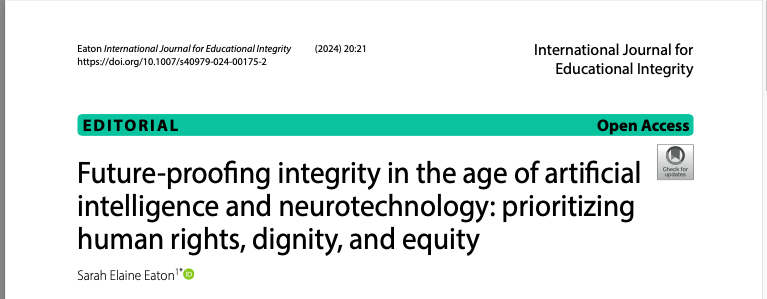
Future-proofing integrity in the age of artificial intelligence and neurotechnology: prioritizing human rights, dignity, and equity

A screenshot of an article title page. There is black text on a white background with a green banner at the top.
Here is a link to the original: https://edintegrity.biomedcentral.com/articles/10.1007/s40979-024-00175-2

Abstract

In this article I argue for the prioritisation of human rights when developing and implementing misconduct policies. Existing approaches may be perpetuate inequities, particularly for individuals from marginalised groups. A human-rights-by-design approach, which centres human rights in policy development, revision, and implementation, ensuring that every individual is treated with dignity and respect.

Recommendations for implementing a human-rights approach to misconduct investigations and case management are offered, covering areas such as procedural fairness, privacy, equity, and the right to education. Additional topics covered are the need to limit surveillance technologies, and the need to recognize that not all use of artificial intelligence tools automatically constitutes misconduct. I disentangle

the differences between equity and equality and explain how both are important when considering ethics and integrity. A central argument of this paper is that a human-rights-by-design approach to integrity does not diminish standards but rather strengthens educational systems by cultivating ethical awareness and respect for personhood. I conclude with a call to action with a seven-point plan for institutions to adopt a human-rights-based approach to ethics and integrity. In the age of artificial intelligence and neurotechnology, insisting on human rights and dignity when we investigate and address misconduct allegations is an ethical imperative that has never been more important.

Keywords Academic misconduct, Academic dishonesty, Plagiarism, Policy, Human rights, Restorative justice, Artificial intelligence, Neurotechnology, Higher education, Education

Commentary

As I reflect on the current state of academic and research integrity, I am struck by a glaring omission in our discussions: the connection between misconduct and human rights. We often treat these as separate entities, failing to recognize the profound impact that misconduct investigations and policies can have on the fundamental rights of individuals. This oversight is particularly concerning in the age of artificial intelligence (AI) and neurotechnology, where the potential for harm is magnified.

Take, for example, the case of a professor in Canada who physically assaulted international students accused of plagiarism. This horrifying example demonstrates how the pursuit of academic integrity can be twisted into a justification for degrading and inhumane treatment, violating the very principles of dignity and respect that should guide our actions. While this is an extreme case, it highlights the need for a fundamental shift in our approach.

In this editorial, I offer a call to action to move beyond simply adhering to legal requirements and embrace a ‘human-rights-by-design’ approach that embeds human rights principles into our policies and practices. This means ensuring procedural fairness throughout investigations, safeguarding the privacy of individuals, and recognizing the right to be presumed innocent until there is proof to the contrary. It also requires us to acknowledge the diverse backgrounds and circumstances of our students and staff, striving for equitable treatment that addresses systemic inequalities and provides the support needed for everyone to succeed.

In the face of rapidly evolving technologies like AI, we must be especially vigilant in upholding human rights. The temptation to rely on unproven AI detection tools or to rush to judgement based on suspicion rather than evidence is strong, but it is a path that leads us away from justice and fairness. We cannot allow fear or expediency to erode our commitment to human dignity.

By centring human rights in our approach to integrity, we can create educational and research environments that are not only ethically sound but also truly just and equitable. This is not about lowering standards; it is about building a culture of integrity that upholds the inherent worth of every individual.

________________________

Share this post: Future-proofing integrity in the age of artificial intelligence and neurotechnology: Prioritizing human rights, dignity, and equity – https://drsaraheaton.com/2024/11/13/future-proofing-integrity-in-the-age-of-artificial-intelligence-and-neurotechnology-prioritizing-human-rights-dignity-and-equity/
This blog has had over 3 million views thanks to readers like you. If you enjoyed this post, please “like” it or share it on social media. Thanks!

Sarah Elaine Eaton, PhD, is a Professor and Research Chair in the Werklund School of Education at the University of Calgary, Canada. Opinions are my own and do not represent those of my employer.


New Academic Integrity Research from Canada (October, 2021)

October 15, 2021

I think this might be a record for the number of academic integrity research outputs in Canada across different venues, all published in a single week: two articles, each published in a different journal, as well as two conference presentations. It’s one thing to have a series of research outputs from a single source, such as one issue of a journal or a set of conference proceedings, but what’s worth celebrating here is that these are from multiple, peer-reviewed sources.

Hu & Zhang (2021) and Liang et al. (2021) have papers in the proceedings from Teaching Culturally and Linguistically Diverse International Students in Open and/or Online Learning Environments: A Research Symposium hosted by the University of Windsor in June:

Hu, J., & Zhang, C. (2021). ESL student plagiarism prevention challenges and institutional interventions. Paper presented at the Teaching Culturally and Linguistically Diverse International Students in Open and/or Online Learning Environments: A Research Symposium (Online), University of Windsor, ON. https://scholar.uwindsor.ca/cgi/viewcontent.cgi?article=1048&context=itos21

Liang, A., Maddison, T., & England, S. (2021). Proactive not punitive: Strategies to prevent plagiarism and promote international student success. Paper presented at the Teaching Culturally and Linguistically Diverse International Students in Open and/or Online Learning Environments: A Research Symposium (Online), University of Windsor, ON. https://scholar.uwindsor.ca/cgi/viewcontent.cgi?article=1053&context=itos21

Josh Seeland and colleagues from Manitoba published this Classroom Note in the International Journal of Mathematical Education in Science and Technology (Taylor & Francis):

Seeland, J., Cliplef, L., Munn, C., & Dedrick, C. (2021). Mathematics and academic integrity: institutional support at a Canadian college. International Journal of Mathematical Education in Science and Technology, 1-8. https://doi.org/10.1080/0020739X.2021.1981472

And last but not least, the latest article from the Contract Cheating in Canada: National Policy Analysis project that I’m leading has been published in the Canadian Journal for Educational Administration and Policy. This paper reports on our policy analysis of Ontario Universities.

Miron, J. B., McKenzie, A., Eaton, S. E., Stoesz, B. M., Thacker, E., Devereaux, L., . . . Rowbotham, K. (2021). Academic integrity policy analysis of publicly-funded universities in Ontario, Canada: A focus on contract cheating. Canadian Journal of Educational Administration and Policy, 197, 62-75. https://journalhosting.ucalgary.ca/index.php/cjeap/article/view/72082

In 2018 when I co-published with Rachael Edino a literature review about existing research from Canada on academic integrity, we reported that we’d found 56 sources published over 25 years. I am so proud to see how far we have come as a Canadian community to build our research and practice expertise and mobilize that knowledge via high quality peer-reviewed journals and conferences.

In case you’re wondering if academic integrity is a field of research, it absolutely is, with high quality scholarly outputs coming out every month, from scholars across the world. Of course, I highlight outputs from my compatriots because I am happy for them and proud of their work, and we are part of a global community of scholars, educators, and professionals across the world doing this work. (Hey, colleagues in Australia and the UK, are you reading this? We are catching up to you!)

Check out these recent publications and see what we’ve been doing in Canada. It’s pretty awesome.

______________________

Share or Tweet this: New Academic Integrity Research from Canada (October 2021) https://drsaraheaton.wordpress.com/2021/10/15/new-academic-integrity-research-from-canada-october-2021/

This blog has had over 2 million views thanks to readers like you. If you enjoyed this post, please “like” it or share it on social media. Thanks!

Sarah Elaine Eaton, PhD, is a faculty member in the Werklund School of Education, and the Educational Leader in Residence, Academic Integrity, University of Calgary, Canada.

Opinions are my own and do not represent those of the University of Calgary or anyone else.


New article: Understanding the academic integrity policies of publicly funded universities in western Canada

December 23, 2020

Educational PolicyThe latest article in our project, Contract Cheating in Canada: National Policy Analysis has just been published!

Stoesz, B., & Eaton, S. E. (2020). Understanding the academic integrity policies of publicly funded universities in western Canada. Educational Policy. https://doi.org/10.1177/0895904820983032

Abstract

We examined 45 academic integrity policy documents from 24 publicly-funded universities in Canada’s four western provinces using a qualitative research design. We extracted data related to 5 core elements of exemplary academic integrity policy (i.e., access, detail, responsibility, approach, support). Most documents pointed to punitive approaches for academic misconduct and were based on the notion that academic misconduct results from a lack of morals. One university used the term “contract cheating,” although nearly all categorized the outsourcing of academic work as plagiarism. Details about educational resources and supports to increase student and staff understanding of academic integrity and prevention of academic misconduct were sparse. This study signals the continuing punitive nature of academic integrity policies in western Canadian universities, the reluctance to address contract cheating directly, and the need to revise policies with deeper consideration of educative approaches to academic integrity that support students and academic staff.

Keywords: academic integrity, Canada, contract cheating, educational supports, higher education, policy

This is an open access article and is free to read and download.

For more information about this article, or the national project, please contact me directly.

_____

Share or Tweet this: New article: Understanding the academic integrity policies of publicly funded universities in western Canada – https://drsaraheaton.wordpress.com/2020/12/23/new-article-understanding-the-academic-integrity-policies-of-publicly-funded-universities-in-western-canada/

This blog has had over 2 million views thanks to readers like you. If you enjoyed this post, please “like” it or share it on social media. Thanks!

Sarah Elaine Eaton, PhD, is a faculty member in the Werklund School of Education, and the Educational Leader in Residence, Academic Integrity, University of Calgary, Canada. Opinions are my own and do not represent those of the University of Calgary.


“Math Wrath”: Are parents pushing for a return to tradition?

January 13, 2014

Recently, Canada’s national newspaper, the Globe and Mail, published, “Math wrath: Parents and teachers demanding a return to basic skills.” The article talks about a movement by some Canadian educators and parents to put greater emphasis on developing concrete math skills such as addition, subtraction, multiplication and division and less focus on discovery and creative strategies.

I find myself fascinated by this debate. I have long wondered about “creative strategies” in education. At the very beginning of my teaching career I took the Gregorc learning styles test. I came out perfectly balanced between all four quadrants: concrete, abstract, random and sequential. Apparently, that’s not particularly common. What it means though is that I can see and appreciate a variety of different learning styles.

Over the past 20 years or so (about the length of my teaching career), I have noted a distinct shift away from concrete sequential learning. Order, logic, learning to follow directions and getting facts seem to have diminished in value, while experimentation, risk taking, using intuition, problem-solving, learning to work in teams and focusing on this issues at hand all seem to fit with the creative learning strategies that have become popular in recent decades.

There has been a notable shift away from valuing sequential learning, structure, learning to follow precise directions and memorizing. In decades past, educational structures and systems may have favoured the concrete sequential learner. Today’s educational systems favour a more random or exploratory approach.

The debate has become almost vicious in some educational circles. Those who favor teaching methods that are concrete and sequential have been poo-poo’ed or dismissed by colleagues who insist vehemently on the random nouveau. I have known colleagues who have been quietly yet unapologetically exited from their teaching jobs because they continue to insist that their students follow directions, do activities in a particular order or memorize.

I worry a bit about the defiant horror expressed by some educational experts and parents at the idea of memorizing. While I agree that rote learning may not employ the highest levels of our cognition, memorization has its place. Learning to say, “Please” and “Thank you” are largely memorized behaviours. Learning to stop at a red light and drive on a green light is also a memorized response. Memorizing how to do CPR could save someone’s life.

Don’t get me wrong. It’s not that I believe that we need to go back to the days of corporal punishment for an incorrect answer based on memorization. What has always puzzled me though, is how quickly methodological fashions change in education. When a new way of learning or teaching is introduced, old ways seem to be immediately, unequivocally and vehemently dismissed. Really good teachers whose background are more traditional than fashionable are thrown out along with their teaching methods.

Do we need to take a step back and look at models that integrate and value a variety of approaches? Would it be wise to hesitate… just a little bit… before we denounce traditional methods as being heinous and abhorrent, with only newer and more fashionable ones as being worthy?

I wonder if the obsessive focus on creativity, exploration and problem-solving might be doing some harm that we can not yet predict? Perhaps a small dose of memorization, learning to follow specific directions and learning systematically might be helpful?

Personally, I give both children and adults more credit than some educators or policy makers who insist on a singular approach to learning, regardless of whether it is systematic memorization or exploratory problem-solving. Being the utterly complex and capable creatures humans are, surely we can cope with both memorization and developing creativity simultaneously?

It’s the drastic swings of the policy pendulum that should worry us. The unflinching insistence that exploratory methods are the only legitimate or credible ways of learning should make us nervous. Polarized and uncompromising opinions on the singular “best” way to learn should be considered suspect.

There is almost always more than one “right” way to learn.

_____________________________________________________

If you enjoyed this post, please “like” it or share it on social media. Thanks!

Share or Tweet this: “Math Wrath”: Are parents pushing for a return to tradition? http://wp.me/pNAh3-1GY

Update – January 2018 – This blog has had over 1.8 million views thanks to readers like you. If you enjoyed this post, please “like” it or share it on social media. Thanks!

Sarah Elaine Eaton is a faculty member in the Werklund School of Education, University of Calgary, Canada.