Chapter 10 explores the theoretical, policy, and practical aspects of navigating pedagogical ethics in learning environments augmented by generative artificial intelligence (GenAI). The chapter considers the role of higher education and the need to reconceptualize academic cheating in a post-plagiarism era. It discusses the role of learner agency, accountability, and responsibility within the context of learning and academic integrity. The chapter offers informed guidance for educators to incorporate GenAI in meaningful ways into teaching, learning, and assessment.
Our chapter is open access and free to read online and to download. We are really excited to continue the conversations happening about postplagiairsm and how we can can navigate teaching, learning, and assessment ethically in the age of generative AI.
Sarah Elaine Eaton, PhD, is a Professor and Research Chair in the Werklund School of Education at the University of Calgary, Canada. Opinions are my own and do not represent those of my employer.
In a recent talk I did at the University of Toronto Mississauga, I was chatting with a couple of folks afterwards and they asked if one specific slide was available as an infographic. It wasn’t and I promised to follow up. (This blog post is for you Amanda and Victoria!)
Artificial intelligence tools can generate human-like text and knowledge creation has become increasingly collaborative, questions arise about traditional academic practices. Although many conventions are being reimagined, citing, referencing, and attribution remain important. Attribution — acknowledging those who have shaped our thinking—transcends the mechanical act of citing sources according to prescribed formats. It represents an ethical commitment to intellectual honesty and respect (Eaton, 2023).
Attribution is a cornerstone of the postplagiarism framework. In the postplagiarism era, where the boundaries between human and AI-generated content blur and traditional definitions of authorship are challenged, the practice of acknowledging our intellectual influences becomes more vital, not less (Kumar, 2025). Attribution serves multiple purposes: it honors those who contributed to knowledge development, establishes credibility for the writer, and allows readers to explore foundational ideas more deeply.
Many educators and students mistakenly equate attribution with the technical minutiae of citation styles. I am talking here about the precise placement of commas, periods, and parentheses. While these conventions serve practical purposes in academic writing, they represent only the surface of what attribution entails (Gladue & Poitras Pratt, 2024). At its core, attribution demands that we answer questions such as: How do I know what I know? Who were my teachers? Whose ideas have influenced my thinking?
In this post (a re-blog from the postplagiarism site) I explore attribution as an enduring ethical principle within the postplagiarism framework. We’ll distinguish between citation as mechanical practice and attribution as intellectual honesty, examine how attribution practices might evolve with technology, and consider how we might teach attribution as a value rather than merely a skill (Eaton, 2024). Throughout, we’ll keep returning to a central idea: even as definitions of plagiarism transform, the need to recognize and pay respect to those from whom we have learned remains constant.
Attribution vs. Citation: Understanding the Differences
Understanding the distinction between attribution and referencing is crucial in our discussion of academic integrity in a postplagiarism era. The terms ‘referencing’ and ‘attribution’ are often used interchangeably, but they represent fundamentally different approaches to giving credit where it is due. In the table below, I present an overview of some of the differences.
Table 1
Attribution versus Referencing
Citing and Referencing
First, let’s talk about citing and referencing. Citing is often referred to in-text citation. In APA format, for example, we cite sources in the main body of the text as we write. Then, we produce a list of references, usually with the heading “References” at the end of the paper. (I have modelled this practice throughout). If we follow APA, the sources cited in the body of the text should exactly match the sources in the reference list at the end, and vice versa. So, citing and referencing go hand-in-hand. For the purposes of this post, I’ll use the term ‘referencing’ collectively to refer to both citing and referencing, given that the two are intertwined.
A foundational question about referencing is: How can I learn and demonstrate the technical norms of a prescribed style manual?
Let me give you an example of what I mean. I did my undergraduate and master’s degrees in literature. We used the Modern Language Association (MLA) style guide. When I moved over to Education to undertake my PhD, I had to learn a completely different style, the one prescribed by the American Psychological Association (APA), as that is the style used across much of the social sciences. I often describe having to shift from learning MLA style to APA style as intellectual trauma. I had spent years meticulously learning to be rule-compliant to MLA style. I knew the details of MLA style inside and out. Having to learn APA style meant unlearning everything I’d spent years learning about MLA style. My PhD supervisor marked up drafts of my work with a red pen, noting APA errors everywhere.
I bought the APA style guide (we were using the 5th edition back then) and set out to memorize every detail to ensure that I knew the rules. Citing and referencing are taught and evaluated using style guides, checklists, and technical rubrics to evaluate how well someone has followed the rules. Citing and referencing are essentially about rule compliance.
Attribution
Attribution goes beyond the technical aspects of rule compliance. When we give attribution, we dig deeper into questions about our intellectual lineage. We ask: How do I know what I know? Who did I learn from? Who influenced the those from whom I have learned?
Attribution requires meta-cognitive awareness and evaluative judgement. If you are unfamiliar with these concepts, I recommend the work of Bearman and Luckin (2020), Fischer et al. (2024), and Tai et al. (2018). Collectively, they explain evaluative judgement and meta-cognitive awareness better than I ever could.
(If you’re paying attention, you’ll see that I just combined citing with attribution there… I provided the sources as per the citing rules of APA, and I also talked about how I learned about deeper concepts from some terrific folks who have done deep work on the topic. See, you can combine citing and referencing with attribution. It’s not all or nothing.)
We teach attribution through a shared collective understanding, by establishing communal expectations and through (often informal) relational coaching.
In everyday conversations, we often reference where we learned ideas. We say, “As my grandmother always said…” or “I read in an article that…” These informal attribution practices demonstrate how instinctively we connect ideas to their sources. Citing and referencing formalizes socialized practices that have extended across various cultures for centuries.
When we give attribution, we show gratitude for the conversations, texts, and teachings that have formed our understanding. This perspective shifts attribution from a defensive practice (avoiding plagiarism accusations) to an affirmative one (acknowledging the intellectual debt we owe to others who have generously shared their knowledge with us).
Acknowledging Others’ Work in the Age of GenAI
Generative AI tools have disrupted our traditional understandings of authorship and attribution. These technologies create new questions about intellectual ownership and acknowledgment practices that our citing and referencing systems weren’t designed to address. GenAI models produce outputs based on massive training datasets containing human-created works. When a student uses ChatGPT to draft an essay, the resulting text represents a complex blend of sources that even the AI developers cannot fully trace. This opacity challenges our ability to attribute ideas to their original creators (Kumar, 2025).
The collaborative nature of AI-assisted writing further blurs authorship boundaries. Who deserves credit when a human prompts, edits, and refines AI-generated text? The distinction between tool and co-creator is difficult to establish. This is another tenet in the postplagiarism framework.
In work led by my colleague, Dr. Soroush Sabbagan, we found graduate students wanted agency in how they integrate AI tools while maintaining academic integrity (Sabbaghan and Eaton (2025). The graduate students who participated in our study, “Participants also emphasized the importance of combining their own expertise and judgment with the AI’s suggestions to create truly original research.” (Sabbaghan & Eaton, 2025, p. 18).
The postplagiarism framework offers helpful guidance by distinguishing between control and responsibility. Although students may share control with AI tools, they retain full responsibility for the integrity of their work, including proper attribution of all sources, both human and machine. Ultimately, the goal isn’t to prevent AI use but to cultivate ethical practices for learning, working, and living.
As Corbin et al (2025) have noted, AI presents wicked problems when it comes to assessment. I would extend their idea further by saying that AI presents wicked problems for plagiarism in general. There are no absolute definitions of plagiarism, but if we think about citing, referencing, and giving attribution as ways of preventing or mitigating plagiarism, then AI has certainly complicated everything. These are problems that we do not have all the answers to, but disentangling the difference between rule-based referencing and attribution as a social practice of paying our respects to those from whom we have learned, might be one step forward as we enter into a postplagiarism age.
The ideas I’ve shared here are not intended to be exhaustive, but rather to help folks make sense of some key differences between referencing and giving attribution and to recognize that citing and referencing are deeply connected to rule compliance and technical rules, whereas giving attribution can at times be imprecise, but may in fact be more deeply-rooted in a desire to give respect where it is due.
As I have tried to model above, it does not have to be all or nothing. Referencing can exist in the absence of any desire to respect others for the work they have created and attribution can be given orally or in any variety of ways that may not comply with a technical style guide. When we are working with students, it can be helpful to unpack the differences and talk about why both are need in academic environments.
There is more to say on this topic, but I’ll wrap up here for now. Thanks again to Amanda and Victoria, who nudged me to write down and share ideas that I have been talking about for a few years now.
References
Bearman, M., & Luckin, R. (2020). Preparing university assessment for a world with AI: Tasks for human intelligence. In M. Bearman, P. Dawson, R. Ajjawi, J. Tai, & D. Boud (Eds.), Re-imagining University Assessment in a Digital World (pp. 49–63). Springer International Publishing. https://doi.org/10.1007/978-3-030-41956-1_5
Corbin, T., Bearman, M., Boud, D., & Dawson, P. (2025). The wicked problem of AI and assessment. Assessment & Evaluation in Higher Education, 1–17. https://doi.org/10.1080/02602938.2025.2553340
Eaton, S. E. (2023). Postplagiarism: Transdisciplinary ethics and integrity in the age of artificial intelligence and neurotechnology. International Journal for Educational Integrity, 19(1), 1–10. https://doi.org/10.1007/s40979-023-00144-1
Eaton, S. E. (2024). Decolonizing academic integrity: Knowledge caretaking as ethical practice. Assessment & Evaluation in Higher Education, 49(7), 962-977. https://doi.org/10.1080/02602938.2024.2312918
Fischer, J., Bearman, M., Boud, D., & Tai, J. (2024). How does assessment drive learning? A focus on students’ development of evaluative judgement. Assessment & Evaluation in Higher Education, 49(2), 233–245. https://doi.org/10.1080/02602938.2023.2206986
Kumar, R. (2025). Understanding PSE students’ reactions to the postplagiarism concept: a quantitative analysis. International Journal for Educational Integrity, 21(1), 9. https://doi.org/10.1007/s40979-025-00182-x
Sabbaghan, S., & Eaton, S. E. (2025). Navigating the ethical frontier: Graduate students’ experiences with generative AI-mediated scholarship. International Journal of Artificial Intelligence in Education. https://doi.org/10.1007/s40593-024-00454-6
Tai, J., Ajjawi, R., Boud, D., Dawson, P., & Panadero, E. (2018). Developing evaluative judgement: enabling students to make decisions about the quality of work. Higher Education, 76(3), 467–481. https://doi.org/10.1007/s10734-017-0220-3
Note: This is a re-blog. See the original post here:
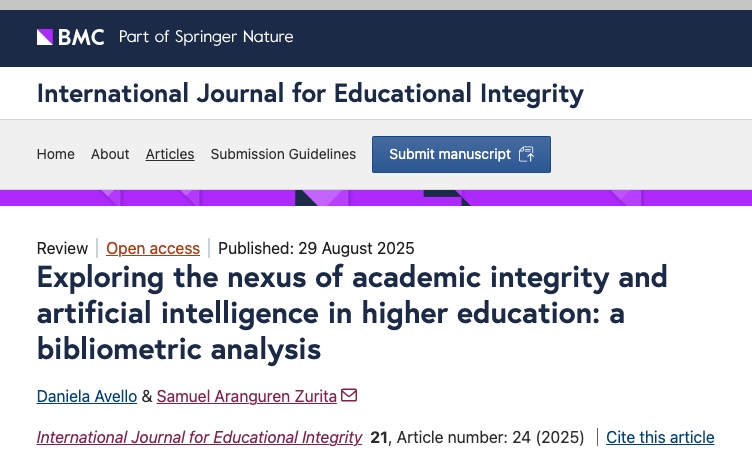
One of the great joys of being a journal editor is getting to share good news when a new article is published. I am going to make more of an effort to do this on my blog because the International Journal for Educational Integrity is a high quality (Q1) journal with lots to offer when it comes to academic integrity. We accept only about 10% of manuscripts submitted to the journal, so having an article published is a great achievment!
Artificial intelligence has created new opportunities in higher education, enhancing teaching and learning methods for both students and educators. However, it has also posed challenges to academic integrity.
Objective
To describe the evolution of scientific production on academic integrity and artificial intelligence in higher education.
Methodology
A bibliometric analysis was carried out using VOSviewer software and the Bibliometrix package in R. A total of 467 documents published between 2017 and 2025, retrieved from the Web of Science database, were analyzed.
Results
The analysis reveals a rapid expansion of the field, with an annual growth rate of 71.97%, concentrated in journals specializing in education, academic ethics, and technology. The field has evolved from a focus on the use of artificial intelligence in dishonest practices to the study of its integration in higher education. Four main lines of research were identified: the impact and adoption of artificial intelligence, implications for students, academic dishonesty, and associated psychological factors.
Conclusions
The field is at an early stage of development but is expanding rapidly, albeit with fragmented evolution, limited collaboration between research teams, and high editorial dispersion. The analysis shows a predominance of descriptive approaches, leaving room for the development of theoretical frameworks.
Originality or value
This study provides an overview and updated of the evolution of research on artificial intelligence and academic integrity, identifying trends, collaborations, and conceptual gaps. It highlights the need to promote theoretical reflection to guide future practice and research on the ethical use of artificial intelligence in higher education.
Sarah Elaine Eaton, PhD, is a Professor and Research Chair in the Werklund School of Education at the University of Calgary, Canada. Opinions are my own and do not represent those of my employer.
I started my Bachelor of Arts (Honours) degree 37 years ago this September. (Gosh, that’s a long time ago!) Looking back, I was sooo excited to be a university student… and also terrified. I was the first person in my immediate family to attend university. Now, as a professor, I am committed to helping to create pathways to success for students from equity-deserving groups, those who may be from marginalized or underrepresented groups. Part of this includes academic integrity for these students, who may genuinely have no idea when they start their first year of college what is expected of them.
First-generation college students (also called “first in family” students) are those whose parents did not complete a four-year college degree. These students face unique challenges that some folks in higher education may not fully appreciate. As faculty members, we have both an opportunity and responsibility to create more inclusive and supportive learning environments for these students.
Understanding the Barriers
First-generation students often navigate college without the cultural capital and informal knowledge that their peers may take for granted. They may be unfamiliar with academic norms, unsure about when and how to seek help, or struggling to balance college demands with family obligations and work responsibilities. These students may also experience heightened anxiety about whether they belong in academic spaces.
The principles I have advocated for in academic integrity work apply directly here. Existing systems in higher education can create barriers for students who don’t arrive with certain forms of privilege. As I have argued elsewhere, there can be no integrity without equity (Eaton, 2022). When we fail to address systemic barriers, we perpetuate conditions that disadvantage particular student groups.
Practical Strategies for Faculty
These strategies may work for many different student, not just first gen ones, but I would argue that we can be especially attentive to first generation students by taking the following into account:
Make the Implicit Explicit
Academic culture is filled with unspoken rules and expectations. What seems obvious to those of us who have spent years in higher education may be completely foreign to first-generation students. As I have learned from my work on equity and academic integrity, “if the system is invisible to you, that is because it was created for you” (Eaton, 2022, p. 6).
Provide detailed rubrics and examples of successful work: Create comprehensive rubrics that clearly articulate expectations for each level of performance. Include examples of student work that demonstrate different quality levels, with annotations explaining what makes each example effective or ineffective. Consider providing both excellent examples and common mistakes to help students understand the full range of expectations.
Explain the purpose behind assignments, not just the requirements: Help students understand the learning objectives and real-world applications of their coursework. For instance, explain how a research paper develops critical thinking skills, information literacy, and written communication abilities that transfer to professional contexts. This contextual understanding helps students engage more meaningfully with their learning.
Use plain language in syllabi and course materials: Avoid unnecessary jargon and academic terminology that may be unfamiliar to first-generation students. When discipline-specific terms are essential, define them clearly. Review your syllabus annually to identify language that might be confusing or intimidating to newcomers to higher education.
Clarify expectations for participation, email communication, and office hour visits: Explicitly teach students how to write professional emails, including appropriate subject lines, greetings, and tone. Explain what constitutes meaningful class participation beyond simply speaking up. Describe what happens during office hours and provide specific examples of productive topics for discussion.
Build Genuine Relationships
Connection matters. First-generation students benefit tremendously from feeling that faculty care about them as individuals. This mirrors what we know from academic integrity research: students are less likely to engage in misconduct when they believe their instructors care about them (Eaton, 2022).
Learn students’ names and use them regularly: Make a conscious effort to learn and use student names from the first week of class. Consider using name tents, seating charts, or other strategies to help with this process. Using names creates a sense of belonging and demonstrates that you see students as individuals rather than anonymous faces in a crowd.
Share your own educational journey when appropriate: If you were a first-generation student yourself, consider sharing relevant aspects of your experience. Even if you weren’t, you can share challenges you faced and how you overcame them. This vulnerability helps normalize struggle and shows students that difficulty doesn’t indicate inadequacy.
Create opportunities for peer interaction and collaboration: Design activities that help students connect with one another, such as think-pair-share exercises, small group discussions, or collaborative projects. These connections can provide crucial academic and social support throughout their college experience.
Be approachable and normalize help-seeking behavior: Explicitly tell students that asking questions is a sign of engagement, not weakness. Share examples of productive questions from past students. Make yourself available through multiple channels and respond to student inquiries promptly and warmly.
Schedule regular check-ins, particularly with students who seem to be struggling: Proactively reach out to students who have missed classes, submitted late work, or seem disengaged. A simple email expressing concern and offering support can make a significant difference. Consider mid-semester individual conferences with all students to discuss their progress and address any concerns.
Address Financial and Time Pressures
Many first-generation students work multiple jobs or have family caregiving responsibilities. Our course design should acknowledge these realities without compromising academic rigor. In some research that I did with a graduate student on mental wellbeing and academic integrity, we found that students experiencing stress may be more vulnerable to academic misconduct (Eaton & Turner, 2020), making supportive course design even more crucial.
Avoid requiring expensive textbooks when alternatives exist: Explore open educational resources (OERs), library reserves, or older editions of textbooks. If expensive materials are necessary, provide information about rental options, used book sources, or financial aid resources that might help students afford them.
Consider the timing of assignment due dates and major exams: Avoid scheduling major assignments during times when students are likely to face additional stressors, such as midterms week or right before holidays when many students increase their work hours. Provide advance notice of all major assignments and deadlines.
Offer multiple pathways to demonstrate learning: Design assessments that allow students to showcase their knowledge in different ways. This might include options for oral presentations instead of written papers, creative projects alongside traditional exams, or multiple smaller assignments rather than a few high-stakes evaluations.
Build flexibility into attendance policies when appropriate: While maintaining reasonable expectations, consider policies that account for the realities of students who may face transportation issues, work conflicts, or family emergencies. Provide clear guidelines about how to communicate absences and make up missed work.
Connect students with campus resources for emergency financial assistance: Learn about your institution’s emergency funding programs and don’t hesitate to refer students who are struggling financially. Many students are unaware these resources exist or feel uncomfortable accessing them without encouragement from faculty.
Provide Proactive Academic Support
Don’t wait for students to ask for help. The cultural norm of self-advocacy may not be familiar to first-generation students, and they may interpret struggling as evidence that they don’t belong. As research on academic integrity and mental health during COVID-19 has shown, students may experience significant anxiety about academic expectations and performance (Eaton & Turner, 2020).
Introduce campus support services early and repeatedly: Don’t just mention writing support and student success workshops once in your syllabus. Regularly remind students about these resources and explain specifically how they can help with course assignments. Consider inviting representatives from student services to visit your class.
Provide feedback throughout the semester, not just at the end: Offer low-stakes opportunities for students to receive feedback on their work before major assignments are due. This might include draft submissions, peer review sessions, or brief conferences about work in progress.
Connect students with tutoring, writing centers, and peer support programs: Make specific referrals rather than general suggestions. For example, “Based on your draft, I think working with the writing center on thesis development would be helpful. Here’s how to make an appointment, and I recommend mentioning that you’re working on argument structure.”
Offer study strategies and time management guidance: Many first-generation students have never been taught effective study techniques. Provide concrete strategies for reading academic texts, taking notes, preparing for exams, and managing large projects over time.
Explain how to read and interpret feedback on assignments: Students may not understand how to use your comments to improve their work. Consider providing examples of how to revise based on feedback or scheduling brief meetings to discuss your comments on major assignments.
Challenge Deficit Thinking
Resist viewing first-generation students through a deficit lens. Instead, recognize the strengths, resilience, and diverse perspectives they bring to your classroom. This aligns with advocacy for decolonizing academic practices and embracing multiple ways of knowing (Eaton, 2022).
Value different forms of knowledge and experience: Acknowledge that students bring valuable perspectives from their work, family, and community experiences. Create opportunities for students to connect course content to their lived experiences and cultural backgrounds.
Incorporate diverse voices and perspectives in your curriculum: Include authors, researchers, and case studies that reflect diverse backgrounds and experiences. This helps all students see themselves reflected in the curriculum while exposing everyone to broader perspectives.
Create assignments that allow students to draw on their backgrounds: Design projects that invite students to explore topics relevant to their communities or to apply course concepts to contexts they know well. This validates their experiences while helping them see the relevance of academic content.
Resist conflating struggle with inability: Normalize the learning process and help students understand that confusion and difficulty are natural parts of intellectual growth. Share examples of how struggle leads to deeper understanding.
Advocate for institutional changes that support student success: Use your voice in departmental and institutional committees to push for policies and practices that better serve first-generation students. This might include advocating for more flexible scheduling, expanded financial aid, or improved support services.
Practice Cultural Humility
Acknowledge that our own educational experiences may differ significantly from those of our students. Be willing to learn about their perspectives and challenges.
Ask students about their needs rather than making assumptions: Use anonymous surveys or informal check-ins to understand what your students are experiencing. Their insights can help you adjust your teaching to better meet their needs.
Be open to feedback about your teaching practices: Create opportunities for students to provide honest feedback about what’s working and what isn’t. Consider mid-semester evaluations or regular pulse checks to gauge student understanding and engagement.
Recognize the limits of your own knowledge and experience: Be honest about what you don’t know about first-generation student experiences and commit to learning more. Attend professional development sessions, read relevant research, and seek out colleagues who have expertise in this area.
Collaborate with student affairs professionals who specialize in first-generation student support: Build relationships with staff in student success centers, counseling services, and first-generation student programs. They can provide valuable insights and serve as resources for your students.
Beyond Individual Action
Individual faculty efforts are essential, but systemic change is equally important. As I have argued in my work on equity in academic integrity, we must advocate for institutional transformation and systemic change (Eaton, 2022).
Within your department and institution, push for professional development focused on supporting first-generation students, policies that address food insecurity and housing instability, expanded financial aid and emergency funding programs, mentoring programs connecting students with faculty, staff, and successful peers, and recognition systems that value inclusive teaching practices.
The Mental Health Connection
There are connections between academic stress and mental health concerns (Eaton & Turner, 2020). For first-generation students, this stress may be compounded by family pressures, financial worries, and feelings of not belonging. Our rapid review of literature during COVID-19 found that students experienced “amplification of students’ anxiety and stress during the pandemic, especially for matters relating to academic integrity” (Eaton & Turner, 2020, p. 37).
Faculty should be attentive to signs of student distress and prepared to connect students with appropriate campus resources. Creating supportive classroom environments can help mitigate some of these stressors. When students feel valued and supported, they are more likely to seek help when needed rather than struggling in isolation.
A Personal Commitment
Supporting first-generation students requires ongoing commitment to equity and inclusion. It means examining our own practices and assumptions, being willing to change course when needed, and advocating for students both inside and outside our classrooms.
The work of creating equitable educational environments is never finished. As I have written elsewhere, “A commitment to allyship is a life’s work, demonstrated throughout our daily ethical practice as educators, leaders, researchers, and human beings” (Eaton, 2022, p. 6). When we commit to supporting first-generation students, we strengthen our entire academic community and move closer to the ideals of fairness and inclusion that should guide higher education.
As educators, we have the power to significantly impact student success. The question is how we use that power to dismantle existing barriers or to create pathways for all students to thrive.
References
Eaton, S. E. (2022). New priorities for academic integrity: equity, diversity, inclusion, decolonization and Indigenization. International Journal for Educational Integrity, 18(10), 1-12. https://doi.org/10.1007/s40979-022-00105-0
Eaton, S. E., & Turner, K. L. (2020). Exploring academic integrity and mental health during COVID-19: Rapid review. Journal of Contemporary Education Theory & Research, 4(1), 35-41. http://doi.org/10.5281/zenodo.4256825
Sarah Elaine Eaton, PhD, is a Professor and Research Chair in the Werklund School of Education at the University of Calgary, Canada. Opinions are my own and do not represent those of my employer.
As a new academic year begins here in the northern hemisphere, I’m worried. I am worried that equity-deserving students, including racialized and linguistic-minority students, disabled and neurodivergent students, and others from equity-deserving groups will fall through the cracks again this year.
Conversations about academic integrity often centre around detection and discipline.
How many students will be accused of — and investigated for — academic cheating this year when what they actually needed was learning support? Or language support? Or just a clearer understanding of what academic integrity is and how to uphold it?
It doesn’t have to be this way.
Academic integrity is also about creating a learning environment grounded in fairness and opportunity for every student. Social justice, equity, inclusion, diversity, and accessibility shape how students experience integrity in real ways:
Equity reminds us that students enter the classroom with different levels of preparation and support.
Inclusion ensures every student can participate in learning and assessment.
Accessibility removes barriers that make it harder for some students to meet expectations.
A social justice lens helps us see patterns in who is reported or penalized for breaches of integrity and why.
Here are some actions educators can take in the first month of classes to support student success:
Review course materials to ensure instructions and policies about integrity are written in plain, accessible language.
Dedicate class time to talking with students about what integrity looks like in your course and why it matters.
Share examples of proper citation and collaboration that are relevant to your discipline.
Make time for questions about assessments so students understand what is expected and where to find help.
Connect students early to campus supports such as writing centres, student services, and accessibility services.
This is just a start.
My point is this: Do not assume that students should just know what academic integrity means. Take the time to explain your expectations and policies. In order for students to follow the rules, they need to know what the rules are.
Academic integrity is not only about avoiding plagiarism or cheating. It is also about fostering trust and fairness so that all students have a fair chance to learn and succeed. The choices we make in the first few weeks of the term set the tone for the entire year.
What steps are you taking at the start of this new school year to build a more inclusive and equitable approach to academic integrity?
Sarah Elaine Eaton, PhD, is a Professor and Research Chair in the Werklund School of Education at the University of Calgary, Canada. Opinions are my own and do not represent those of my employer.


 Posted by Sarah Elaine Eaton, Ph.D.


 Learning, Teaching and Leadership
You must be logged in to post a comment.