Academic Integrity on Trial: Mark Carney’s Case and the Politics of Plagiarism

March 29, 2025

Gosh, we humans love a good scandal, don’t we? The recent allegations against Liberal leader Mark Carney regarding plagiarism in his 1995 Oxford doctoral thesis raise important questions about how we define, detect, and respond to plagiarism in academic and public life.

Drawing from both the specifics of Carney’s case and broader discussions about academic integrity, several important themes emerge:

The Pattern of Plagiarism Witch Hunts

In my January 2024 blog post, “Plagiarism Witch Hunts Cause Harm,” about the case of former Harvard University President, Dr. Claudine Gay, I pointed out that we appear to be in an era where plagiarism is increasingly weaponized against public figures. Following the resignation of Dr. Gay amid plagiarism allegations, we have seen a troubling pattern of using academic integrity as a political weapon rather than an educational concern. 

This weaponization is particularly concerning when we consider the broader landscape of academic integrity issues. 

In my 2020 investigation “Is the Hon. Demetrios Nicolaides, Alberta Minister of Advanced Education involved with contract cheating?”, I showed how careful we must be in assessing evidence before making accusations. That investigation highlighted the need for rigorous verification when claiming someone has violated academic integrity, especially when political motivations might be involved. For the record, the analysis that I conducted for that blog post took me several days to complete.

The National Post’s investigation of Carney’s thesis identified several instances of alleged plagiarism, including unattributed quotes and paraphrasing from authors such as Michael Porter and Jeremy Stein. This follows a pattern seen in previous high-profile cases where decades-old academic work is scrutinized through modern lenses of academic integrity.

The Complexities of Defining Plagiarism

One critical aspect highlighted across these cases is the lack of universal agreement on what constitutes plagiarism. There is no singular or universally accepted definition of plagiarism. Oxford University defines it as “presenting work or ideas from another source as your own.” However, interpretations of definitions, as well as the definitions themselves can vary from one university to the next, as I have pointed out elsewhere.

In Carney’s case, his doctoral supervisor defended his work, stating she saw “no evidence of plagiarism in the thesis,” whereas academics consulted by the National Post disagreed. One professor, Dr. Geoffrey Sigalet, a political science professor at the University of British Columbia Okanagan (UBCO) stated that the unattributed quotes are “what we call plagiarism.” According to the National Post article, Dr. Sigalet is a member of the UBCO’s institutional president’s advisory committee on student discipline, “which handles cases of plagiarism for the university”. This disagreement underscores the subjectivity in evaluating academic integrity.

If you are curious about the UBCO Rules for President’s Advisory Committee on Student Discipline, they are publicly available here. Of note is that in allegations of academic misconduct, section 9.c of the regulations state that the committee must “provide the student with a copy of the Statement of Case and any documentary evidence and list of any witnesses”, and it is expected that the individual alleged to have engaged in misconduct has a right to know the case being brought against them before the matter is decided. This is a basic principle of procedural fairness in academic misconduct investigations and case management.

Upon reading the National Post article, one question that I had was: was Mr. Carney informed of the allegations before they were investigated?

Post-Facto Investigations and Their Consequences

The timing of these allegations is noteworthy. Investigating work completed nearly 30 years ago raises questions about motives and impact. As I have pointed out previously when I commented on the Dr. Claudine Gay case, “a retroactive investigation into a person’s academic work while they were a student is often an exercise in discrediting someone in their current professional role.”

For Carney, these allegations emerge as he serves as Liberal Leader and campaigns in a federal election—timing that raises questions about political motivations rather than genuine concerns about academic integrity.

The Role of Academic Supervision

An often-overlooked aspect of these cases is the responsibility of academic supervisors. I asked this question with respect to the Dr. Claudine Gay case, and it bears repeating: Where are all the graduate supervisors? In Carney’s case, his supervisor, Dr. Margaret Meyer, Oxford University has defended his work, noting it was “evaluated and approved by a faculty committee.” 

This comment is not insignificant because highlights the collective responsibility of the academic community in ensuring academic integrity. As in other high-profile cases of student PhD theses being scrutinized for plagiarism post-graduation, a big question — and I mean, a really big question —is, how could the academic supervisors, faculty committee members, and academic examiners, allow a student to pass their PhD thesis if it was rife with plagiarism? We may never be able to answer this question in this case, or in the cases of countless other allegations of academic misconduct that arise after a student has graduated.

If we take a wraparound approach to student success, then everyone in the educational ecosystem plays a role in supporting to students to write and research ethically. This is, quite literally, our job as professors.

So, Did Mark Carney Plagiarize or Not?

The answer is, I don’t know. When I conduct an analysis of text for possible plagiarism, it is a meticulously in-depth and detailed process. I start with the allegedly plagiarized text and I go through it line-by-line comparing it to the original sources from which text has been allegedly lifted without attribution. That can show whether or not there is a potential ‘text match’. There are examples of possible text matches in the National Post article, but they are selective. I cannot make a call on whether or not there was plagiarism based on excerpts. I would want to see the full texts (original and allegedly plagiarized), not bits and pieces.

If we can identify a possible text match, then we need to look for additional evidence. Was this sloppy scholarship or poor academic literacy? For example, were the original sources perhaps listed in the bibliography, but the direct quotations were not attributed in the main body of the text? In the context of the entire thesis, would it appear as though the student was deliberately trying to deceive their supervisor or academic advisory committee. (Intent to deceive is difficult, if not impossible to prove in many cases.) 

Were there drafts of the work that were reviewed by the supervisor or committee that commented on the content, as well as as technical aspects of citing and referencing? If not, how was the student supported to ensure that their research was done properly?

When I conduct an analysis of text for plagiarism, it can take me days or weeks, depending on the length of the text and the complexity of the case. When an individual’s reputation is on the line, I take even greater care, knowing that my findings might have an impact on their career or their future. There can be a great deal at stake in high-profile cases of plagiarism. A thorough investigation takes time and expertise and quite frankly, any plagiarism expert worth their reputation would insist on taking the time they need before drawing conclusions in such matters.

So, dear readers, if you are looking for me to weigh in with a definitive stance on this case, you are going to be disappointed. I simply have too many questions to draw a reasonable conclusion on the matter. 

Human Rights and Due Process

What I can say is this: due process, procedural fairness, and human rights matter. When we allege, investigate, and manage cases of plagiarism or misconduct, the accused, regardless of whether they are a student, a professor, a politician, or anyone else, deserves at the very least to have their human rights upheld. 

Even though Article 11 of the United Nations Universal Declaration of Human Rights states everyone is “entitled to a fair and public hearing by an independent and impartial tribunal” in case after case of public allegations of plagiarism, we can observe that there is due process is often bypassed, with accused individuals presumed to be guilty and forced to prove their own innocence.

The topic of how basic human rights and dignity are dismissed in academic cheating cases is something I have written about in some detail. No matter who you are, if you are accused of misconduct, you have the right to be treated with basic human dignity while the matter is under investigation and being decided. Whether you are a member of the United Conservative Party of Alberta alleged to have engaged in contract cheating, a Black woman who is president of Harvard University accused of plagiarism, or the liberal prime minister of Canada, human beings are entitled to dignity and due process.

Moving Forward: Balance in Academic Integrity

The Carney case, like those before it, shows a need for a balanced approach to academic integrity that:

  1. Distinguishes between technical citation errors (i.e., sloppiness) and an outright intention to deceive (even if intent is difficult to prove).
  2. Considers the standards and practices of the time when work was produced.
  3. Respects due process and presumes innocence until proven guilty.
  4. Acknowledges the shared responsibility of academic communities, and in particular, the responsibilities of graduate supervisors and academic advisors.
  5. Recognizes when allegations may be politically motivated.
  6. Prioritizes educational responses over punitive approaches (i.e., providing students with an opportunity to learn how to cite and reference properly).

Rather than using plagiarism as a weapon to discredit public figures, we could focus on strengthening current academic integrity practices and supporting students and researchers to write and research well, which includes proper attribution. Academic integrity is a foundation for ethical decision-making in everyday life and in one’s career.

As we evaluate these allegations against Mark Carney, we should consider not just the specific instances cited but also the context, timing, and potential consequences of how we frame and respond to questions of academic and professional integrity in public life. 

Final note

For what it is worth, if this case had been against Pierre Poilievre instead of Mark Carney, my position would be exactly the same, because integrity matters no matter which side of the political bench you sit on.

________________________

Share this post: Academic Integrity on Trial: Mark Carney’s Case and the Politics of Plagiarism – https://drsaraheaton.com/2025/03/29/academic-integrity-on-trial-mark-carneys-case-and-the-politics-of-plagiarism/

This blog has had over 3.7 million views thanks to readers like you. If you enjoyed this post, please ‘Like’ it using the button below or share it on social media. Thanks!

Sarah Elaine Eaton, PhD, is a Professor and Research Chair in the Werklund School of Education at the University of Calgary, Canada. Opinions are my own and do not represent those of my employer. 


Embracing AI as a Teaching Tool: Practical Approaches for the Post-plagiarism Classroom

March 23, 2025

Artificial intelligence (AI) has moved from a futuristic concept to an everyday reality. Rather than viewing AI tools like ChatGPT as threats to academic integrity, forward-thinking educators are discovering their potential as powerful teaching instruments. Here’s how you can meaningfully incorporate AI into your classroom while promoting critical thinking and ethical technology use.

Making AI Visible in the Learning Process

One of the most effective approaches to teaching with AI is to bring it into the open. When we demystify these tools, students develop a more nuanced understanding of the tools’ capabilities and limitations.

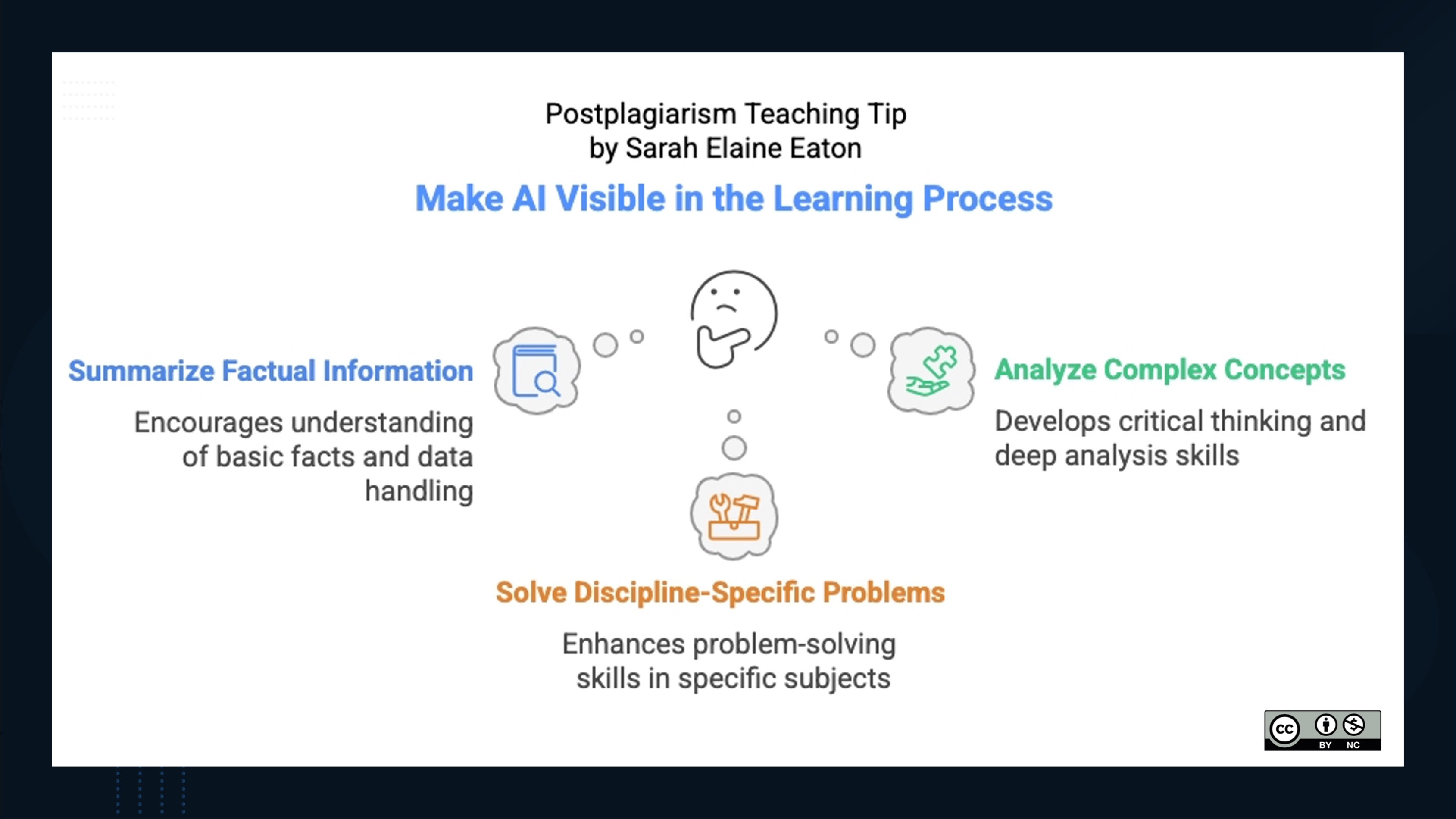
Start by dedicating class time to explore AI tools together. You might begin with a demonstration of how ChatGPT or similar tools respond to different types of prompts. Ask students to compare the quality of responses when the tool is asked to:

  • Summarize factual information
  • Analyze a complex concept
  • Solve a problem in your discipline
A teaching tip infographic titled "Postplagiarism Teaching Tip by Sarah Elaine Eaton: Make AI Visible in the Learning Process." The infographic features a central image of a thinking face emoji, with three connected bubbles highlighting different aspects of AI integration in learning:

Summarize Factual Information (blue): Encourages understanding of basic facts and data handling, represented by an icon of a document with a magnifying glass.

Analyze Complex Concepts (green): Develops critical thinking and deep analysis skills, represented by an icon of a puzzle piece.

Solve Discipline-Specific Problems (orange): Enhances problem-solving skills in specific subjects, represented by an icon of tools (wrench and screwdriver).
In the bottom right corner, there’s a Creative Commons license (CC BY-NC) icon.

Have students identify where the AI excels and where it falls short. Hands-on experience that is supervised by an educator helps students understand that while AI can be impressive and  capable, it has clear boundaries and weaknesses.

From AI Drafts to Critical Analysis

AI tools can quickly generate content that serves as a starting point for deeper learning. Here is a step-by-step approach for using AI-generated drafts as teaching material:

  1. Assignment Preparation: Choose a topic relevant to your course and generate a draft response using an AI tool such as ChatGPT.
  2. Collaborative Analysis: Share the AI-generated draft with students and facilitate a discussion about its strengths and weaknesses. Prompt students with questions such as:
    • What perspectives are missing from this response?
    • How could the structure be improved?
    • What claims require additional evidence?
    • How might we make this content more engaging or relevant?

The idea is to bring students into conversations about AI, to build their critical thinking and also have them puzzle through the strengths and weaknesses of current AI tools.

  • Revision Workshop: Have students work individually or in groups to revised an AI draft into a more nuanced, complete response. This process teaches students that the value lies not in generating initial content (which AI can do) but in refining, expanding, and critically evaluating information (which requires human judgment).
  • Reflection: Ask students to document what they learned through the revision process. What gaps did they identify in the AI’s understanding? How did their human perspective enhance the work? Building in meta-cognitive awareness is one of the skills that assessment experts such as Bearman and Luckin (2020) emphasize in their work.

This approach shifts the educational focus from content creation to content evaluation and refinement—skills that will remain valuable regardless of technological advancement.

Teaching Fact-Checking Through Deliberate Errors

AI systems often present information confidently, even when that information is incorrect or fabricated. This characteristic makes AI-generated content perfect for teaching fact-checking skills.

Try this classroom activity:

  1. Generate Content with Errors: Use an AI tool to create content in your subject area, either by requesting information you know contains errors or by asking about obscure topics where the AI might fabricate details.
  2. Fact-Finding Mission: Provide this content to students with the explicit instruction to identify potential errors and verify information. You might structure this as:
    • Individual verification of specific claims
    • Small group investigation with different sections assigned to each group
    • A whole-class collaborative fact-checking document
  3. Source Evaluation: Have students document not just whether information is correct, but how they determined its accuracy. This reinforces the importance of consulting authoritative sources and cross-referencing information.
  4. Meta-Discussion: Use this opportunity to discuss why AI systems make these kinds of errors. Topics might include:
  • How large language models are trained
  • The concept of ‘hallucination’ in AI
  • The difference between pattern recognition and understanding
  • Why AI might present incorrect information with high confidence

These activities teach students not just to be skeptical of AI outputs but to develop systematic approaches to information verification—an essential skill in our information-saturated world.

Case Studies in AI Ethics

Ethical considerations around AI use should be explicit rather than implicit in education. Develop case studies that prompt students to engage with real ethical dilemmas:

  1. Attribution Discussions: Present scenarios where students must decide how to properly attribute AI contributions to their work. For example, if an AI helps to brainstorm ideas or provides an outline that a student substantially revises, how could this be acknowledged?
  2. Equity Considerations: Explore cases highlighting AI’s accessibility implications. Who benefits from these tools? Who might be disadvantaged? How might different cultural perspectives be underrepresented in AI outputs?
  3. Professional Standards: Discuss how different fields are developing guidelines for AI use. Medical students might examine how AI diagnostic tools should be used alongside human expertise, while creative writing students could debate the role of AI in authorship.
  4. Decision-Making Frameworks: Help students develop personal guidelines for when and how to use AI tools. What types of tasks might benefit from AI assistance? Where is independent human work essential?

These discussions help students develop thoughtful approaches to technology use that will serve them well beyond the classroom.

Implementation Tips for Educators

As you incorporate these approaches into your teaching, consider these practical suggestions:

  • Start small with one AI-focused activity before expanding to broader integration
  • Be transparent with students about your own learning curve with these technologies
  • Update your syllabus to clearly outline expectations for appropriate AI use
  • Document successes and challenges to refine your approach over time
  • Share experiences with colleagues to build institutional knowledge

Moving Beyond the AI Panic

The concept of postplagiarism does not mean abandoning academic integrity—rather, it calls for reimagining how we teach integrity in a technologically integrated world. By bringing AI tools directly into our teaching practices, we help students develop the critical thinking, evaluation skills, and ethical awareness needed to use these technologies responsibly.

When we shift our focus from preventing AI use to teaching with and about AI, we prepare students not just for academic success, but for thoughtful engagement with technology throughout their lives and careers.

References

Bearman, M., & Luckin, R. (2020). Preparing university assessment for a world with AI: Tasks for human intelligence. In M. Bearman, P. Dawson, R. Ajjawi, J. Tai, & D. Boud (Eds.), Re-imagining University Assessment in a Digital World (pp. 49-63). Springer International Publishing. https://doi.org/10.1007/978-3-030-41956-1_5 

Eaton, S. E. (2023). Postplagiarism: Transdisciplinary ethics and integrity in the age of artificial intelligence and neurotechnology. International Journal for Educational Integrity, 19(1), 1-10. https://doi.org/10.1007/s40979-023-00144-1

Edwards, B. (2023, April 6). Why ChatGPT and Bing Chat are so good at making things up. Arts Technica. https://arstechnica.com/information-technology/2023/04/why-ai-chatbots-are-the-ultimate-bs-machines-and-how-people-hope-to-fix-them/ 

________________________

Share this post: Embracing AI as a Teaching Tool: Practical Approaches for the Postplagiarism Classroom – https://drsaraheaton.com/2025/03/23/embracing-ai-as-a-teaching-tool-practical-approaches-for-the-post-plagiarism-classroom/

This blog has had over 3.7 million views thanks to readers like you. If you enjoyed this post, please ‘Like’ it using the button below or share it on social media. Thanks!

Sarah Elaine Eaton, PhD, is a Professor and Research Chair in the Werklund School of Education at the University of Calgary, Canada. Opinions are my own and do not represent those of my employer.


IELTS Exam Fraud: Is large-scale cheating really a shock to anyone?

January 7, 2025
A screenshot from an online news story. There is a photo of students taking an exam. There is black text on a white background.

The headline reads, “IELTS exam fraud scandal ‘shocks’ Indonesia“, as reported by Vietnam.vn. The article goes on to offer details about large-scale cheating on English-language proficiency testing, saying that, “Faced with the increasing incidence of fraud, many prestigious universities around the world have adjusted their admission policies, especially regarding IELTS requirements.”

Contract cheating and exam proxies (i.e., impersonators) are at the heart of the scandal, with customers each paying about 47,000,000 Vietnamese Dong (which seems to convert to about $1851 USD or $2650 CAD, according to one online currency exchange website).

The article reports that these cheating incidents have caused schools in Singapore, Australia, and the US to raise the minimum test score for entrance to certain programs. (I am puzzled as to why schools think that raising the minimum score for admissions will prevent cheating on standardized texts used as an entrance requirement? My guess is that it might just drive up the price of fraud…)

Two chapters from our edited book, Fake Degrees and Fraudulent Credentials in Higher Education (Eaton, Carmichael, and Pethrick, 2023) are worth mentioning, as the authors of both chapters raised the alarm about the issue of large-scale global cheating on English language proficiency exams.

Soroush Sabbaghan (University of Calgary) and Ismaeil Fazel (University of British Columbia) in their chapter, ‘None of the above: Integrity concerns of standardized English proficiency tests’, “shed light on the complexities and the apparent disconnect between equity, integrity, fairness, and justice in standardized language proficiency tests and the integrity issues that can arise as a result.”

Angela Clark (York University), in her chapter, “Examining the Problem of Fraudulent English Test Scores: What Can Canadian Higher Education Institutions Learn?”, argues that “relying on a single language proficiency test score to determine an individual’s readiness is problematic, and also problematic is the lack of related academic research and data to help guide admissions decision-making”. She looks at media reports from the UK, US, and Canada, noting that, “Media reports and a lack of data serve to promote distrust of the language testing process and the test scores that institutions receive.”

Cheating on English language proficiency exams is nothing new and nor is it isolated to any one country.

Both of these chapters are thoroughly researched and well written. If you’re interested in the topic of fraud in English language exams, I recommend checking them out. In the meantime, large-scale cheating on standardized tests and the related problem of admissions fraud should shock exactly no one.

References

Clark, A. (2023). Examining the problem of fraudulent English test scores: What can Canadian higher education institutions learn? In S. E. Eaton, J. J. Carmichael, & H. Pethrick (Eds.), Fake Degrees and Fraudulent Credentials in Higher Education (pp. 187-207). Springer International Publishing. https://doi.org/10.1007/978-3-031-21796-8_9 

IELTS exam fraud scandal “shocks” Indonesia. (2024, December 28). Vietnam.vn. https://www.vietnam.vn/en/be-boi-thi-ho-ielts-rung-dong-indonesia/

Sabbaghan, S., & Fazel, I. (2023). None of the above: Integrity concerns of standardized English proficiency tests. In S. E. Eaton, J. J. Carmichael, & H. Pethrick (Eds.), Fake Degrees and Fraudulent Credentials in Higher Education (pp. 169-185). Springer International Publishing. https://doi.org/10.1007/978-3-031-21796-8_8 

Related posts:

________________________

Share this post: IELTS Exam Fraud: Is large-scale cheating really a shock to anyone? https://drsaraheaton.com/2025/01/07/ielts-exam-fraud-is-large-scale-cheating-really-a-shock-to-anyone/

This blog has had over 3.7 million views thanks to readers like you. If you enjoyed this post, please ‘Like’ it using the button below or share it on social media. Thanks!

Sarah Elaine Eaton, PhD, is a Professor and Research Chair in the Werklund School of Education at the University of Calgary, Canada. Opinions are my own and do not represent those of my employer. 


Upcoming Talk: From Plagiarism to Postplagiarism: Navigating the GenAI Revolution in Higher Education

January 3, 2025
An promo announcement on a white background. There is a red stripe down the left-hand site. The University of Calgary logo appears on the top right. The following text is written in black, orange and red:
From Plagiarism to Postplagiarism: Navigating the GenAI Revolution in Higher Education
The first 2025 public presentation about #Postplagiarism
is now open for registration!

Free and open to the public.
Join us in person or via webinar.
January 29, 2025| 12:00 – 13:00 Mountain time

https://workrooms.ucalgary.ca/event/3854045

Join us for our first presentation of 2025:

From Plagiarism to Postplagiarism: Navigating the GenAI Revolution in Higher Education

Format: Hybrid (in person or live stream)

I am delighted to kick off a speaker series on GenAI hosted by my colleague, Dr. Soroush Sabbaghan, through the Centre for Artificial Intelligence Ethics, Literacy, and Integrity (CAIELI) at the University of Calgary.

Description

Generative AI (GenAI) is transforming teaching, learning, and assessment in higher education.

Learn to integrate GenAI effectively while maintaining academic integrity and enhancing student agency.

Dr. Sarah Eaton shares innovative strategies that promote critical thinking and original scholarship. Explore how GenAI reshapes academic practices and discover proactive approaches to leverage its potential.

This session equips educators, administrators, and policymakers to lead purposefully in a dynamic academic landscape.

Speaker bio

Sarah Elaine Eaton is a Professor and research chair at the Werklund School of Education at the University of Calgary (Canada). She is an award-winning educator, researcher, and leader. She leads transdisciplinary research teams focused on the ethical implications of advanced technology use in educational contexts. Dr. Eaton also holds a concurrent appointment as an Honorary Associate Professor, Deakin University, Australia.

More Details

Date: January 29, 2025

Time: 12:00 – 13:00 Mountain time

This talk is free and open to the public, but there are only 20 seats available to join us in person! We can also accommodate folks online.

Get more details and register here.

________________________

Share this post: Upcoming talk: From Plagiarism to Postplagiarism: Navigating the GenAI Revolution in Higher Education – https://drsaraheaton.com/2025/01/03/upcoming-talk-from-plagiarism-to-postplagiarism-navigating-the-genai-revolution-in-higher-education/

This blog has had over 3.7 million views thanks to readers like you. If you enjoyed this post, please “like” it or share it on social media. Thanks!

Sarah Elaine Eaton, PhD, is a Professor and Research Chair in the Werklund School of Education at the University of Calgary, Canada. Opinions are my own and do not represent those of my employer. 


Three tips for future-proofing academic and research integrity this year

January 2, 2025

In my 2024 annual editorial for the International Journal for Educational Integrity, was entitled, ’Future-proofing integrity in the age of artificial intelligence and neurotechnology: prioritizing human rights, dignity, and equity

Here are three things you can do to prioritize human rights and dignity when it comes to policies and procedures to address allegations of academic or research misconduct:

Use a human-rights-by-design approach to developing, revising, and implementing policies by conducting a comprehensive review of existing academic integrity policies. Update policies to explicitly incorporate human rights principles, ensuring they address fair process, privacy, equitable treatment, and respect for human dignity. It is essential to involve individuals from representative groups in this process.

Provide ongoing training, education, and support to faculty, staff, and students about human rights principles and how they apply to misconduct investigations and case management. Create orientation programs that explain expectations for ethical conduct while respecting diverse cultural perspectives. Offer workshops and resources, peer mentoring programs, and support services.

Focus on continuous improvement and quality assurance of ethics and integrity practices by gathering feedback from students, faculty, staff and relevant stakeholders. Regularly review misconduct case management processes and data to ensure equitable treatment across different demographics.

Implementing human rights principles into misconduct investigations and case management helps to create more effective and sustainable learning environments. This approach prioritizes people over punishment, dignity over draconianism, and compassion over callousness.

Read the full article here: https://edintegrity.biomedcentral.com/articles/10.1007/s40979-024-00175-2 

Related post:

Future-proofing integrity in the age of artificial intelligence and neurotechnology: Prioritizing human rights, dignity, and equity

________________________

Share this post: Three tips for future-proofing academic and research integrity this year – https://drsaraheaton.com/2025/01/02/three-tips-for-future-proofing-academic-and-research-integrity-this-year/

This blog has had over 3 million views thanks to readers like you. If you enjoyed this post, please “like” it or share it on social media. Thanks!

Sarah Elaine Eaton, PhD, is a Professor and Research Chair in the Werklund School of Education at the University of Calgary, Canada. Opinions are my own and do not represent those of my employer.