“What should we be assessing exactly?” This was a question one of our research participants asked when we interviewed them as part of our project on artificial intelligence and academic integrity, sponsored by a University of Calgary Teaching Grant.
In an article published in The Conversation, we provide highlights of the results from our interviews with 28 educators across Canada, as well as our analysis of 15 years of research that looked at how AI affects education. (Spoiler alert: AI is a double-edged sword for educators and there are no easy answers.)
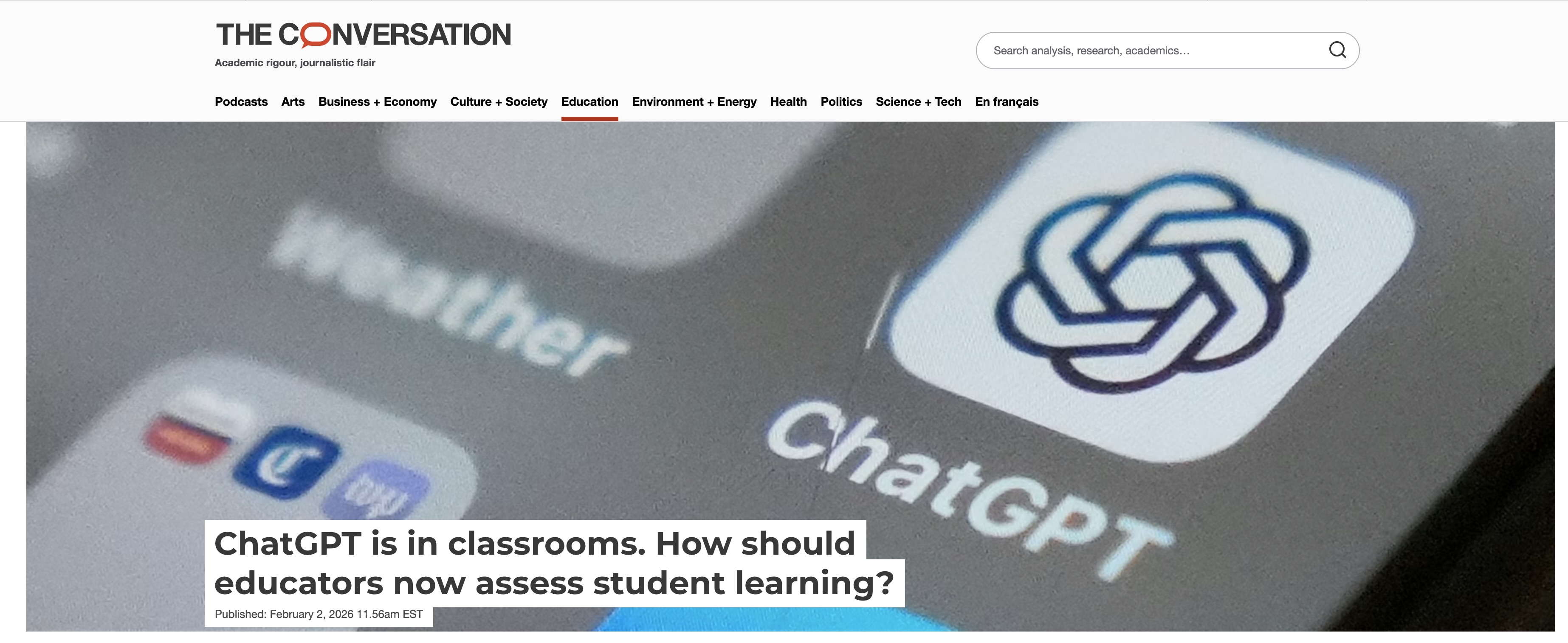
Screenshot from The Conversation.
We emphasize that, “in a post-plagiarism context, we consider that humans and AI co-writing and co-creating does not automatically equate to plagiarism.” Check out the full article in The Conversation.
You can check out the scholarly paper that we published in Assessment and Evaluation in Higher Education that goes into more detail about the methods and findings of our interviews.
I’d like to give a shoutout to all the project team members who worked with us on various aspects of this research: Robert (Bob) Brennan (Schulich School of Engineering, University of Calgary), Jason Weins (Faculty of Arts, University of Calgary), Brenda McDermott (Student Accessibility Services, University of Calgary), Rahul Kumar (Faculty of Education, Brock University), Beatriz Moya (Instituto de Éticas Aplicadas, Pontificia Universidad Católica de Chile) and the student research assistants who helped along the way (who have now all successfully graduated and moved on to the next phase of their careers): Jonathan Lesage, Helen Pethrick, and Mawuli Tay.
Sarah Elaine Eaton, PhD, is a Professor and Research Chair in the Werklund School of Education at the University of Calgary, Canada. Opinions are my own and do not represent those of my employer.
The first time I heard about decriminalizing the language and processes we use to address cases of plagiarism and other forms of academic misconduct; I was riveted. It was at an academic integrity conference in Richmond, Virginia and the lead presenter was Dr. James Earl Orr, who presented together with students on how a developmental and supportive approach to academic misconduct case management can help lead students towards academic success while still holding them responsible for their behaviour. James Earl Orr, writing together with Karita Orr, published an excellent article on using restorative practices to resolve academic integrity violations.
When I was writing the University of Calgary’s academic integrity Handbook for Academic Staff and Teaching Assistants, I took the opportunity to apply what I had learned from listening to Dr. Orr at conferences and reading his work by including a section on how to decriminalize the language we use to talk about academic misconduct.
Academic integrity violations are rarely criminal in nature and yet, much of the language we use when addressing plagiarism and academic cheating is legalistic, setting the stage for criminalizing student behaviour. One step towards taking a more learner-centred approach to misconduct is to decriminalize the language we use to talk about breaches of academic integrity.
Front cover of the Student Academic Integrity Faculty Handbook, published by the Taylor Institute for Teaching and Learning at the University of Calgary
“We know that words matter and the language we use is important. A full list of terms related to academic misconduct is available in our policy. It should be noted that the terms “academic integrity” and “academic misconduct” are not interchangeable.
Academic integrity is about acting ethically in teaching, learning and research contexts. We do not report, investigate or manage cases of academic integrity. We report, investigate and manage cases of academic misconduct.
Academic misconduct is what happens when individuals do not act with integrity. This is currently the language used in our policy and procedures. When speaking and writing about academic misconduct, we can use the terms “breaches of integrity or “violations of integrity” as synonyms for academic misconduct.
At the University of Calgary we take a proactive approach to academic integrity, including in the language we use and in keeping the focus on teaching, learning and fairness to students. In our conversations with students and others, it can be helpful to use the language of integrity that focuses on education and support” (Eaton, 2022, p. 13).
See the table below, which is also an expert from our handbook (with a few minor updates):
The language of academic integrity
Preferred language
Language to avoid
Explanation
Hold responsible
Guilt Guilty
The words “guilt” and “guilty” do not appear anywhere in our polices or procedures. We do not find students guilty of academic misconduct, but instead we hold them responsible for their behaviours.
Sanctions Consequence Outcome
Punish Punishment
When disciplinary actions are taken in response to academic misconduct, we do not use the terms “punish” or “punishment” in our institutional documents. We opt instead for “sanctions”, “discipline,” “consequences” or “outcome” which can include educational responses depending on the misconduct.
Hearing
Trial
The University of Calgary does not conduct trials related to academic misconduct. In other countries, various forms of academic misconduct can be considered an offense under the criminal code and students may be required to attend a criminal trial. That is not the case at the University of Calgary or anywhere in Canada. In the case of an appeal, a hearing might occur. In rare cases, an appeal case might escalate to an externally reviewed case in court, but these proceedings are not administered by the university itself.
When I talk about taking a postplagiarism approach to academic integrity I am talking about disrupting historically adversarial and antagonistic approaches to misconduct that pit students against their teachers. It is time to move past crime-and-punishment approaches to student misconduct where students are the villains and teachers are the heroes. When we talk about postplagiarism we talk about social justice and student success as being intertwined, and we focus on students as stewards of the future, who will be best equipped for an increasingly complex world when they understand the importance of ethical decision-making, both in theory and in practice.
Postplagiarism does not mean anything goes, and nor does it mean that we turn a blind eye to misconduct. Postplagiarism is about finding socially just ways to address misconduct include relationally, restoration, and the preservation of dignity and human rights. When we decriminalize language related to student misconduct, we are taking a step towards dignity and student success.
Our University of Calgary’s academic integrity Handbook for Academic Staff and Teaching Assistants is an open access handbook with a Creative Commons license. This means you can share and adapt the material, providing the original work is properly attributed.
If this is helpful to you, please share this with others.
Eaton, S. E. (2023). Postplagiarism: Transdisciplinary ethics and integrity in the age of artificial intelligence and neurotechnology. International Journal for Educational Integrity, 19(1), 1–10. https://doi.org/10.1007/s40979-023-00144-1
Eaton, S. E. (2025). Global Trends in Education: Artificial Intelligence, Postplagiarism, and Future-focused Learning for 2025 and Beyond – 2024–2025 Werklund Distinguished Research Lecture. International Journal for Educational Integrity, 21(1), 12. https://doi.org/10.1007/s40979-025-00187-6
Orr, J. E., & Hall, J. (2018). Student-led case adjudication: Promoting student learning through peer-to-peer engagement. 25th Annual International Center for Academic Integrity (ICAI) Conference, Richmond, VA.
Orr, J. E., & Orr, K. (2023). Restoring honor and integrity through integrating restorative practices in academic integrity with student leaders. Journal of Academic Ethics, 21, 55–70. https://doi.org/10.1007/s10805-021-09437-x
Orr, J. E., & Orren, S. (2018, March 4). The Development & Implementation of a Campus Academic Integrity Education Program. 25th Annual International Center for Academic Integrity (ICAI) Conference, Richmond, VA.
Sarah Elaine Eaton, PhD, is a Professor and Research Chair in the Werklund School of Education at the University of Calgary, Canada. Opinions are my own and do not represent those of my employer.
This week I did an invited presentation for the European Network for Academic Integrity (ENAI) Integrity for All Working Group.
As part of my presentation, I shared this bibliography of resources that I’ve worked on over the past several years on academic integrity as it relates to equity, diversity, inclusion, accessibility, and decolonization. These topics have become increasingly important to me over the past half decade and it is more important now than it ever has been to elevate the importance of these topics, along with human rights and social justice, when addressing matters of student conduct.
This bibliography contains a list of academic integrity articles, presentations, and resources that focus on these topics.
I’ve done my best to prepare this list according to APA 7 conventions, but please forgive any errors.
I aim to make as much of my content open access. If there is anything on this list that you cannot access, please contact me directly and I’ll see what I can do.
Sarah Elaine Eaton, PhD, is a Professor and Research Chair in the Werklund School of Education at the University of Calgary, Canada. Opinions are my own and do not represent those of my employer.
As a new academic year begins here in the northern hemisphere, I’m worried. I am worried that equity-deserving students, including racialized and linguistic-minority students, disabled and neurodivergent students, and others from equity-deserving groups will fall through the cracks again this year.
Conversations about academic integrity often centre around detection and discipline.
How many students will be accused of — and investigated for — academic cheating this year when what they actually needed was learning support? Or language support? Or just a clearer understanding of what academic integrity is and how to uphold it?
It doesn’t have to be this way.
Academic integrity is also about creating a learning environment grounded in fairness and opportunity for every student. Social justice, equity, inclusion, diversity, and accessibility shape how students experience integrity in real ways:
Equity reminds us that students enter the classroom with different levels of preparation and support.
Inclusion ensures every student can participate in learning and assessment.
Accessibility removes barriers that make it harder for some students to meet expectations.
A social justice lens helps us see patterns in who is reported or penalized for breaches of integrity and why.
Here are some actions educators can take in the first month of classes to support student success:
Review course materials to ensure instructions and policies about integrity are written in plain, accessible language.
Dedicate class time to talking with students about what integrity looks like in your course and why it matters.
Share examples of proper citation and collaboration that are relevant to your discipline.
Make time for questions about assessments so students understand what is expected and where to find help.
Connect students early to campus supports such as writing centres, student services, and accessibility services.
This is just a start.
My point is this: Do not assume that students should just know what academic integrity means. Take the time to explain your expectations and policies. In order for students to follow the rules, they need to know what the rules are.
Academic integrity is not only about avoiding plagiarism or cheating. It is also about fostering trust and fairness so that all students have a fair chance to learn and succeed. The choices we make in the first few weeks of the term set the tone for the entire year.
What steps are you taking at the start of this new school year to build a more inclusive and equitable approach to academic integrity?
Sarah Elaine Eaton, PhD, is a Professor and Research Chair in the Werklund School of Education at the University of Calgary, Canada. Opinions are my own and do not represent those of my employer.
Academic misconduct cases can leave professors feeling frustrated, especially when outcomes don’t align with their expectations. These emotions are understandable and how faculty respond to disappointing rulings can impact their professional standing; relationships with colleagues and students; and future effectiveness in addressing misconduct.
Here are five common mistakes professors make when they disagree with academic misconduct decisions—and better approaches to consider.
1. Venting to Students About the Decision
The Mistake: Discussing the case details or expressing frustration about the ruling with other students, either in class or informal settings.
Why It Backfires: This behavior undermines institutional authority, creates an uncomfortable environment for students, and may violate confidentiality requirements. Students lose confidence in the system and may question whether they’ll receive fair treatment.
Better Approach: Process your concerns through appropriate channels. If you need to discuss the case, speak with department chairs, ombudspersons, or trusted colleagues who understand confidentiality requirements.
2. Making Public Complaints on Social Media or Forums
The Mistake: Posting about the case on social media, academic forums, or other public platforms, even when avoiding specific names.
Why It Backfires: Public complaints damage professional relationships and institutional reputation. Even anonymous posts can often be traced back to their authors. This approach also models poor conflict resolution for students and colleagues.
Better Approach: Use internal grievance procedures or professional development opportunities to address systemic concerns. Focus energy on improving processes rather than criticizing past decisions.
3. Refusing to Participate in Future Misconduct Proceedings
The Mistake: Declining to serve on academic integrity committees or refusing to report suspected misconduct because of disagreement with previous outcomes.
Why It Backfires: Withdrawal from the process eliminates your voice from future decisions and reduces the system’s effectiveness. This stance also shifts additional burden to colleagues who continue participating.
Better Approach: Stay engaged while working to improve the system. Use your experience to advocate for clearer guidelines, better training, or procedural improvements that address your concerns.
4. Treating the Student Differently in Future Interactions
The Mistake: Allowing disappointment about the ruling to affect how you interact with the student in subsequent courses, recommendations, or professional settings.
Why It Backfires: This behavior constitutes unprofessional conduct and potential retaliation. It undermines the educational mission and creates legal risks for both you and the institution.
Better Approach: Maintain professional boundaries and treat all students equitably. If you find it difficult to interact objectively with the student, consider recusing yourself from situations where bias might affect your judgment.
5. Bypassing Established Processes
The Mistake: Going directly to senior administrators, board members, or external parties without following institutional procedures for investigations, appeals, or grievances.
Why It Backfires: Skipping proper channels damages relationships with immediate supervisors and colleagues. It also reduces the likelihood that your concerns will receive serious consideration, as decision-makers prefer to see that established processes were followed.
Better Approach: Work through designated channels first. Document your concerns clearly and present them through official appeal mechanisms. If these prove insufficient, seek guidance from faculty governance bodies or professional organizations.
Moving Forward Constructively
Disagreement with academic misconduct decisions stems from genuine concern for educational standards and fairness. Channel this concern into productive action by focusing on prevention, process improvement, and professional development rather than relitigating past cases.
Consider these constructive alternatives: participate in policy review committees, mentor colleagues on documentation practices, advocate for faculty training on academic integrity, or contribute to scholarship on effective misconduct prevention.
The goal is not to eliminate disagreement with misconduct decisions—different perspectives strengthen academic integrity systems. The goal is to express disagreement in ways that improve outcomes for everyone involved while maintaining the professional standards that serve our educational mission.
Sarah Elaine Eaton, PhD, is a Professor and Research Chair in the Werklund School of Education at the University of Calgary, Canada. Opinions are my own and do not represent those of my employer.


 Posted by Sarah Elaine Eaton, Ph.D.



 Learning, Teaching and Leadership
You must be logged in to post a comment.